

Importe total (1 artículo artículos):
Destino del pedido:

9788176257817 - Emerging Dimensions of Global Trade: Discussons on Trade Related Policies de Bisht, Nandan Sngh; Jalal, R.S. (5 resultados)
Ir a los resultados principales
Filtros de búsqueda
Tipo de artículo
- Todos los tipos de productos
- Libros (5)
- Revistas y publicaciones (No hay ningún otro resultado que coincida con este filtro.)
- Cómics (No hay ningún otro resultado que coincida con este filtro.)
- Partituras (No hay ningún otro resultado que coincida con este filtro.)
- Arte, grabados y pósters (No hay ningún otro resultado que coincida con este filtro.)
- Fotografías (No hay ningún otro resultado que coincida con este filtro.)
- Mapas (No hay ningún otro resultado que coincida con este filtro.)
- Manuscritos y coleccionismo de papel (No hay ningún otro resultado que coincida con este filtro.)
Condición Más información
- Nuevo (3)
- Como nuevo, Excelente o Muy bueno (1)
- Bueno o Aceptable (No hay ningún otro resultado que coincida con este filtro.)
- Regular o Pobre (No hay ningún otro resultado que coincida con este filtro.)
- Tal como se indica (1)
Encuadernación
- Todas
- Tapa dura (5)
- Tapa blanda (No hay ningún otro resultado que coincida con este filtro.)
Más atributos
- Primera edición (No hay ningún otro resultado que coincida con este filtro.)
- Firmado (No hay ningún otro resultado que coincida con este filtro.)
- Sobrecubierta (2)
- Con imágenes (No hay ningún otro resultado que coincida con este filtro.)
- No impresión bajo demanda (5)
Idioma (2)
Precio
- Cualquier precio
- Menos de EUR 20
- EUR 20 a EUR 45
- Más de EUR 45 (No hay ningún otro resultado que coincida con este filtro.)
Gastos de envío gratis
- Envío gratis a Estados Unidos de America (No hay ningún otro resultado que coincida con este filtro.)
Ubicación del vendedor
Valoración de los vendedores
-
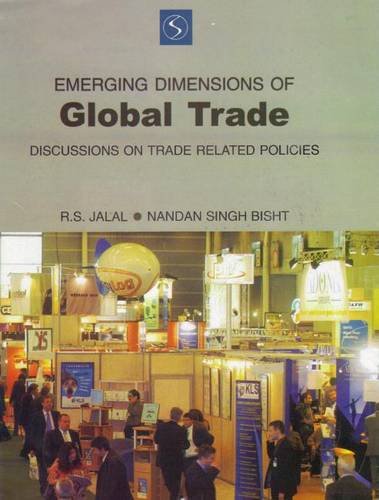
Emerging Dimensions of Global Trade
Librería: Majestic Books, Hounslow, Reino Unido
Calificación del vendedor: 4 de 5 estrellas

EUR 20,69
Envío por EUR 7,53
Se envía de Reino Unido a Estados Unidos de AmericaCantidad disponible: 4 disponibles
Añadir al carritoCondición: New. pp. 284 + 16.
-
Emerging Dimensions of Global Trade
Librería: Books Puddle, New York, NY, Estados Unidos de America
Calificación del vendedor: 4 de 5 estrellas
EUR 25,40
Envío por EUR 3,50
Se envía dentro de Estados Unidos de AmericaCantidad disponible: 4 disponibles
Añadir al carritoCondición: New. pp. 284 + 16 Index.
-
Emerging Dimensions of Global Trade
Librería: Biblios, Frankfurt am main, HESSE, Alemania
Calificación del vendedor: 4 de 5 estrellas
EUR 19,87
Envío por EUR 9,95
Se envía de Alemania a Estados Unidos de AmericaCantidad disponible: 4 disponibles
Añadir al carritoCondición: New. pp. 284 + 16.
-
Emerging Dimensions of Global Trade : Discussions on Trade Related Policies
Librería: Vedams eBooks (P) Ltd, New Delhi, India
Calificación del vendedor: 4 de 5 estrellas
EUR 40,71
Envío por EUR 17,50
Se envía de India a Estados Unidos de AmericaCantidad disponible: 1 disponibles
Añadir al carritoHardbound. Condición: As New. New. Contents Contributors. Preface. I. Global Trade Policy liberalisation and WTO 1. Multilateralism globalisation and business bargaining in WTO Deliberations some implications for developing countries/R.S. Jalal. 2. Distortions and asymmetries in global trading order implications for developing areas/M.R. Aggarwal. 3. Liberalisation of Indian economy reflections on the external sectors/R. Shashi Kumar. 4. Dialectics of economic reform implications of a regime change/S.V. Bokil. 5. Multilateralism under the Aegis of WTO Some issues and their implications for India and other developing countries/Neelam Choudhary and Rajender Gupta. 6. World Trade Organisation and its implications for developing countries/Prashant Pandey and Neetu Kaushik. 7. Impact of WTO on Indian economy/Sanjay Kumar and Nandan Singh Bisht. II. Agricultural constraints and domestic rural manufacturing 8. Role of small scale and agro based industries in India a discussion in the context of Liberalisation Policy/B. Satyanaranan. 9. Indian agriculture Trade and WTO/M.K. Ghadoliya. 10. Changes in the cropping pattern of Andhra Pradesh and its impact on food security/E. Krishna Rao. 11. Prospects of agro processed food exports under globalisation/V.P. Tripathi Sudhakar Dwivedi and Arun Bhadauria. 12. Globalisation of Indian agriculture and challenges/P. Arunachalam. 13. Need for technological innovations in agricultural sector for keeping pace with globalisation a case of North East Indian Agriculture/A.B. Rajkonwar. 14. Potentialities for export of horticulture product Indian scenario/Satish Srivastav. 15. Implications of World Trade Organisation on dairy sector of India/Kusum Maini and R.K. Lekhi. III. Challenges implications and adjustments under emerging trade order 16. Challenges posed by globalization for domestic economies of developing world/R.S. Jalal and Nandan S. Bisht. 17. GATS and Higher education some critical reflections/V.B. Kakade. 18. Challenge of protecting labour against technological unemployment/Seema Singh. 19. Impact of globalisation on Indian diaspora some implications for socio economic management/D.S. Bisht and Madhu Sah. 20. Liberalisation and FDI in India/P. Arunachalam. 21. Trade balance of India some reflections on trends vis a vis globalisation/Sanjay Tiwari and Bhartendu Singh. 22. Globalisation and disinvestment in India/Prashant Pandey. 23. Impact of privatisation on public sector enterprises and employment in India/R.S. Dhananjayan and R. Shanthi. Index. New Economic Policy (NEP) or the economic reforms package was injected in the Indian economy in 1991. A controversy is tabled for discussion even today as to whether the NEP is enthusiastically acceptable to Indian farmer the rural petty manufacturers and the class of craftsmen. As a founder member of GATT now WTO India formally accepted it and took it for granted that Indian farmers and rural industry men would be by and large gainers. Finally the Uruguay Agreement was enforced on 1 January 1995. Before Uruguay Round the Indian economy then was in a critical shape and radical changes had taken place at global level. India could not keep aloof from this new wave. Over the last decade our economy has witnessed a fairly drastic change in its growth and trade related policies. Today liberalization privatisation and globalization are the basic features of trade related policies which has compelled the government to completely overhaul policies relating to industry exim fiscal and monetary regimes in the country. Removal of the trade and non trade barriers for enhancing the size of international trade is basic objective of the WTO agenda. A decade down the line it is therefore pertinent to ask has India gained as result of liberalization policy. If not why has India not gained and what can be done to remove the constraints. This book presents a critical appraisal of aforesaid questions. It examines the multifarious problems and constraints to trade related policies. Agreements on market.
-
Creativity and its Cultivation
Publicado por Sarup, 2011
ISBN 10: 8176257818 ISBN 13: 9788176257817
Librería: Vedams eBooks (P) Ltd, New Delhi, India
Calificación del vendedor: 4 de 5 estrellas
EUR 44,10
Envío por EUR 17,50
Se envía de India a Estados Unidos de AmericaCantidad disponible: 1 disponibles
Añadir al carritoContents Preface 1 Scientific creativityHenry Eyring 2 The creativeness of lifeEdmund W Sinnott 3 An architects views on creativityAlden B Dow 4 The creative attitudeErich Fromm 5 The nature of creativityRollo May 6 Toward a theory of creativityCarl R Rogers 7 Creativity in self actualizing peopleAbraham H Maslow 8 Vicissitudes of creativityHenry A Murray 9 Creativity as personality developmentHarold H Anderson 10 Traits of creativityJP Guilford 11 Creativity and problem solvingErnest R Hilgard 12 Creativity in educationGeorge D Stoddard 13 The social setting of creativityHarold D Lasswell 14 Creativity in cross cultural perspectiveMargaret Mead 15 Creativity in perspectiveHarold H Anderson References It is rather difficult to plan to develop an individual as a writer artist novelist and a musician or a scientist It is said that creativity is dependent on heredity and that creative persons are born and not cultivatedBut the fact remains that early identification of talent and to help it grow is in the hands of the educator It is on these aspects that this book considers in detail jacket 336 pp.
