

Importe total (1 artículo artículos):
Destino del pedido:

9786204978307 - Agriculture & Rural Development in Indian Scenario de Channi, Harpreet Kaur (8 resultados)
Ir a los resultados principales
Filtros de búsqueda
Tipo de artículo
- Todos los tipos de productos
- Libros (8)
- Revistas y publicaciones (No hay ningún otro resultado que coincida con este filtro.)
- Cómics (No hay ningún otro resultado que coincida con este filtro.)
- Partituras (No hay ningún otro resultado que coincida con este filtro.)
- Arte, grabados y pósters (No hay ningún otro resultado que coincida con este filtro.)
- Fotografías (No hay ningún otro resultado que coincida con este filtro.)
- Mapas (No hay ningún otro resultado que coincida con este filtro.)
- Manuscritos y coleccionismo de papel (No hay ningún otro resultado que coincida con este filtro.)
Condición Más información
- Nuevo (8)
- Como nuevo, Excelente o Muy bueno (No hay ningún otro resultado que coincida con este filtro.)
- Bueno o Aceptable (No hay ningún otro resultado que coincida con este filtro.)
- Regular o Pobre (No hay ningún otro resultado que coincida con este filtro.)
- Tal como se indica (No hay ningún otro resultado que coincida con este filtro.)
Encuadernación
- Todas
- Tapa dura (No hay ningún otro resultado que coincida con este filtro.)
- Tapa blanda (8)
Más atributos
- Primera edición (No hay ningún otro resultado que coincida con este filtro.)
- Firmado (No hay ningún otro resultado que coincida con este filtro.)
- Sobrecubierta (No hay ningún otro resultado que coincida con este filtro.)
- Con imágenes (5)
- No impresión bajo demanda (3)
Idioma (1)
Precio
- Cualquier precio
- Menos de EUR 20 (No hay ningún otro resultado que coincida con este filtro.)
- EUR 20 a EUR 40
- Más de EUR 40
Gastos de envío gratis
- Envío gratis a Estados Unidos de America (No hay ningún otro resultado que coincida con este filtro.)
Ubicación del vendedor
Valoración de los vendedores
-

Agriculture & Rural Development in Indian Scenario
Idioma: Inglés
Publicado por LAP LAMBERT Academic Publishing, 2022
ISBN 10: 6204978306 ISBN 13: 9786204978307
Librería: Books Puddle, New York, NY, Estados Unidos de America
Calificación del vendedor: 4 de 5 estrellas

EUR 56,72
Envío por EUR 3,38
Se envía dentro de Estados Unidos de AmericaCantidad disponible: 4 disponibles
Añadir al carritoCondición: New.
-

Agriculture & Rural Development in Indian Scenario
Idioma: Inglés
Publicado por LAP LAMBERT Academic Publishing Jun 2022, 2022
ISBN 10: 6204978306 ISBN 13: 9786204978307
Librería: buchversandmimpf2000, Emtmannsberg, BAYE, Alemania
Calificación del vendedor: 5 de 5 estrellas

EUR 43,90
Envío por EUR 60,00
Se envía de Alemania a Estados Unidos de AmericaCantidad disponible: 2 disponibles
Añadir al carritoTaschenbuch. Condición: Neu. Neuware -India has the second largest population in the world and is characterized by a broad diversity in climate, topography, flora, fauna, land use, and socioeconomic conditions. To help ensure food security in the future, agricultural systems will have to respond to global change drivers such as population growth, changing dietary habits, and climate change. However, alterations of how food is produced in the future may conflict with other UN Sustainable Development Goals (SDGs), such as the protection of land resources and climate change mitigation. It is crucial for decision-makers to understand potential trade-offs between these goals to find a balance of human needs and environmental impacts. In this paper, we analyze pathways of agricultural productivity, land use, and land-cover changes in India until 2030 and their impacts on terrestrial biodiversity and carbon storage. The results show that in order to meet future food production demands, agricultural lands are likely to expand, and existing farmlands need to be intensified. However, both processes will result in biodiversity losses.Books on Demand GmbH, Überseering 33, 22297 Hamburg 56 pp. Englisch.
-

Agriculture & Rural Development in Indian Scenario
Idioma: Inglés
Publicado por LAP LAMBERT Academic Publishing, 2022
ISBN 10: 6204978306 ISBN 13: 9786204978307
Librería: preigu, Osnabrück, Alemania
Calificación del vendedor: 5 de 5 estrellas
EUR 39,35
Envío por EUR 70,00
Se envía de Alemania a Estados Unidos de AmericaCantidad disponible: 5 disponibles
Añadir al carritoTaschenbuch. Condición: Neu. Agriculture & Rural Development in Indian Scenario | Harpreet Kaur Channi | Taschenbuch | Englisch | 2022 | LAP LAMBERT Academic Publishing | EAN 9786204978307 | Verantwortliche Person für die EU: preigu GmbH & Co. KG, Lengericher Landstr. 19, 49078 Osnabrück, mail[at]preigu[dot]de | Anbieter: preigu.
-
Agriculture & Rural Development in Indian Scenario
Idioma: Inglés
Publicado por LAP LAMBERT Academic Publishing, 2022
ISBN 10: 6204978306 ISBN 13: 9786204978307
Librería: Majestic Books, Hounslow, Reino Unido
Calificación del vendedor: 4 de 5 estrellas
EUR 54,65
Envío por EUR 7,43
Se envía de Reino Unido a Estados Unidos de AmericaCantidad disponible: 4 disponibles
Añadir al carritoCondición: New. Print on Demand.
-
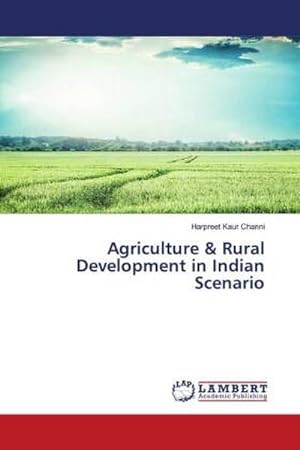
Agriculture & Rural Development in Indian Scenario
Idioma: Inglés
Publicado por LAP LAMBERT Academic Publishing Jun 2022, 2022
ISBN 10: 6204978306 ISBN 13: 9786204978307
Librería: BuchWeltWeit Ludwig Meier e.K., Bergisch Gladbach, Alemania
Calificación del vendedor: 5 de 5 estrellas
EUR 43,90
Envío por EUR 23,00
Se envía de Alemania a Estados Unidos de AmericaCantidad disponible: 2 disponibles
Añadir al carritoTaschenbuch. Condición: Neu. This item is printed on demand - it takes 3-4 days longer - Neuware -India has the second largest population in the world and is characterized by a broad diversity in climate, topography, flora, fauna, land use, and socioeconomic conditions. To help ensure food security in the future, agricultural systems will have to respond to global change drivers such as population growth, changing dietary habits, and climate change. However, alterations of how food is produced in the future may conflict with other UN Sustainable Development Goals (SDGs), such as the protection of land resources and climate change mitigation. It is crucial for decision-makers to understand potential trade-offs between these goals to find a balance of human needs and environmental impacts. In this paper, we analyze pathways of agricultural productivity, land use, and land-cover changes in India until 2030 and their impacts on terrestrial biodiversity and carbon storage. The results show that in order to meet future food production demands, agricultural lands are likely to expand, and existing farmlands need to be intensified. However, both processes will result in biodiversity losses. 56 pp. Englisch.
-
Agriculture & Rural Development in Indian Scenario
Idioma: Inglés
Publicado por LAP LAMBERT Academic Publishing, 2022
ISBN 10: 6204978306 ISBN 13: 9786204978307
Librería: Biblios, Frankfurt am main, HESSE, Alemania
Calificación del vendedor: 4 de 5 estrellas
EUR 56,73
Envío por EUR 9,95
Se envía de Alemania a Estados Unidos de AmericaCantidad disponible: 4 disponibles
Añadir al carritoCondición: New. PRINT ON DEMAND.
-

Agriculture & Rural Development in Indian Scenario
Idioma: Inglés
Publicado por LAP Lambert Academic Publishing, 2022
ISBN 10: 6204978306 ISBN 13: 9786204978307
Librería: moluna, Greven, Alemania
Calificación del vendedor: 4 de 5 estrellas
EUR 37,23
Envío por EUR 48,99
Se envía de Alemania a Estados Unidos de AmericaCantidad disponible: Más de 20 disponibles
Añadir al carritoKartoniert / Broschiert. Condición: New. Dieser Artikel ist ein Print on Demand Artikel und wird nach Ihrer Bestellung fuer Sie gedruckt. India has the second largest population in the world and is characterized by a broad diversity in climate, topography, flora, fauna, land use, and socioeconomic conditions. To help ensure food security in the future, agricultural systems will have to respon.
-

Agriculture & Rural Development in Indian Scenario
Idioma: Inglés
Publicado por LAP LAMBERT Academic Publishing, 2022
ISBN 10: 6204978306 ISBN 13: 9786204978307
Librería: AHA-BUCH GmbH, Einbeck, Alemania
Calificación del vendedor: 5 de 5 estrellas
EUR 44,59
Envío por EUR 60,51
Se envía de Alemania a Estados Unidos de AmericaCantidad disponible: 1 disponibles
Añadir al carritoTaschenbuch. Condición: Neu. nach der Bestellung gedruckt Neuware - Printed after ordering - India has the second largest population in the world and is characterized by a broad diversity in climate, topography, flora, fauna, land use, and socioeconomic conditions. To help ensure food security in the future, agricultural systems will have to respond to global change drivers such as population growth, changing dietary habits, and climate change. However, alterations of how food is produced in the future may conflict with other UN Sustainable Development Goals (SDGs), such as the protection of land resources and climate change mitigation. It is crucial for decision-makers to understand potential trade-offs between these goals to find a balance of human needs and environmental impacts. In this paper, we analyze pathways of agricultural productivity, land use, and land-cover changes in India until 2030 and their impacts on terrestrial biodiversity and carbon storage. The results show that in order to meet future food production demands, agricultural lands are likely to expand, and existing farmlands need to be intensified. However, both processes will result in biodiversity losses.

