

Importe total (1 artículo artículos):
Destino del pedido:

9786202004503 - ASEAN Free Trade Area (AFTA): A Success or Failure?: Utilization of Preferential Tariffs and Intra-Regional Trade Effects de Faiz Shaul Hamid, Mohammed (7 resultados)
Ir a los resultados principales
Filtros de búsqueda
Tipo de artículo
- Todos los tipos de productos
- Libros (7)
- Revistas y publicaciones (No hay ningún otro resultado que coincida con este filtro.)
- Cómics (No hay ningún otro resultado que coincida con este filtro.)
- Partituras (No hay ningún otro resultado que coincida con este filtro.)
- Arte, grabados y pósters (No hay ningún otro resultado que coincida con este filtro.)
- Fotografías (No hay ningún otro resultado que coincida con este filtro.)
- Mapas (No hay ningún otro resultado que coincida con este filtro.)
- Manuscritos y coleccionismo de papel (No hay ningún otro resultado que coincida con este filtro.)
Condición Más información
- Nuevo (7)
- Como nuevo, Excelente o Muy bueno (No hay ningún otro resultado que coincida con este filtro.)
- Bueno o Aceptable (No hay ningún otro resultado que coincida con este filtro.)
- Regular o Pobre (No hay ningún otro resultado que coincida con este filtro.)
- Tal como se indica (No hay ningún otro resultado que coincida con este filtro.)
Encuadernación
- Todas
- Tapa dura (No hay ningún otro resultado que coincida con este filtro.)
- Tapa blanda (7)
Más atributos
- Primera edición (No hay ningún otro resultado que coincida con este filtro.)
- Firmado (No hay ningún otro resultado que coincida con este filtro.)
- Sobrecubierta (No hay ningún otro resultado que coincida con este filtro.)
- Con imágenes (5)
- No impresión bajo demanda (2)
Idioma (1)
Precio
- Cualquier precio
- Menos de EUR 20 (No hay ningún otro resultado que coincida con este filtro.)
- EUR 20 a EUR 45 (No hay ningún otro resultado que coincida con este filtro.)
- Más de EUR 45
Gastos de envío gratis
- Envío gratis a Estados Unidos de America (No hay ningún otro resultado que coincida con este filtro.)
Ubicación del vendedor
Valoración de los vendedores
-

ASEAN Free Trade Area (AFTA): A Success or Failure?: Utilization of Preferential Tariffs and Intra-Regional Trade Effects
Idioma: Inglés
Publicado por LAP LAMBERT Academic Publishing, 2017
ISBN 10: 6202004509 ISBN 13: 9786202004503
Librería: Revaluation Books, Exeter, Reino Unido
Calificación del vendedor: 5 de 5 estrellas

EUR 157,02
Envío por EUR 14,67
Se envía de Reino Unido a Estados Unidos de AmericaCantidad disponible: 1 disponibles
Añadir al carritoPaperback. Condición: Brand New. 376 pages. 8.66x5.91x0.85 inches. In Stock.
-
ASEAN Free Trade Area (AFTA): A Success or Failure: Utilization of Preferential Tariffs and Intra-Regional Trade Effects
Idioma: Inglés
Publicado por LAP LAMBERT Academic Publishing, 2017
ISBN 10: 6202004509 ISBN 13: 9786202004503
Librería: Mispah books, Redhill, SURRE, Reino Unido
Calificación del vendedor: 4 de 5 estrellas

EUR 235,74
Envío por EUR 29,34
Se envía de Reino Unido a Estados Unidos de AmericaCantidad disponible: 1 disponibles
Añadir al carritopaperback. Condición: New. NEW. SHIPS FROM MULTIPLE LOCATIONS. book.
-
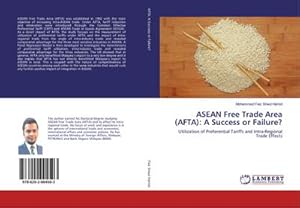
ASEAN Free Trade Area (AFTA): A Success or Failure?
Idioma: Inglés
Publicado por LAP LAMBERT Academic Publishing Jul 2017, 2017
ISBN 10: 6202004509 ISBN 13: 9786202004503
Librería: BuchWeltWeit Ludwig Meier e.K., Bergisch Gladbach, Alemania
Calificación del vendedor: 5 de 5 estrellas
EUR 84,90
Envío por EUR 23,00
Se envía de Alemania a Estados Unidos de AmericaCantidad disponible: 2 disponibles
Añadir al carritoTaschenbuch. Condición: Neu. This item is printed on demand - it takes 3-4 days longer - Neuware -ASEAN Free Trade Area (AFTA) was established in 1992 with the main objective of increasing intra-ASEAN trade. Under AFTA, tariff reduction and elimination were introduced through the Common Effective Preferential Tariff (CEPT) and ASEAN Trade in Goods Agreement (ATIGA). As a direct impact of AFTA, the study focuses on the measurement of utilization of preferential tariffs under AFTA and the impact of intra-regional trade from the angle of intra-industry trade and revealed comparative advantage for the three most sensitive industries in ASEAN. A Panel Regression Model is then developed to investigate the determinants of preferential tariff utilization, intra-industry trade and revealed comparative advantage for the three industries. The UR showed that in general, AFTA only benefitted Malaysia's export to a very low degree and it also implies that AFTA has not directly benefitted Malaysia's export to ASEAN in total. This is coupled with the nature of competitiveness of ASEAN countries among each other in the same industries that would curb any further positive impact of integration in ASEAN. 376 pp. Englisch.
-

ASEAN Free Trade Area (AFTA): A Success or Failure?
Idioma: Inglés
Publicado por LAP LAMBERT Academic Publishing, 2017
ISBN 10: 6202004509 ISBN 13: 9786202004503
Librería: moluna, Greven, Alemania
Calificación del vendedor: 5 de 5 estrellas
EUR 67,82
Envío por EUR 48,99
Se envía de Alemania a Estados Unidos de AmericaCantidad disponible: Más de 20 disponibles
Añadir al carritoCondición: New. Dieser Artikel ist ein Print on Demand Artikel und wird nach Ihrer Bestellung fuer Sie gedruckt. Autor/Autorin: Faiz Shaul Hamid MohammedThe author earned his Doctoral Degree studying ASEAN Free Trade Area (AFTA) and its effect to intra-regional trade. His focus of work and experience is in the spheres of international trade and economics, int.
-

ASEAN Free Trade Area (AFTA): A Success or Failure? | Utilization of Preferential Tariffs and Intra-Regional Trade Effects
Idioma: Inglés
Publicado por LAP LAMBERT Academic Publishing, 2017
ISBN 10: 6202004509 ISBN 13: 9786202004503
Librería: preigu, Osnabrück, Alemania
Calificación del vendedor: 5 de 5 estrellas
EUR 71,05
Envío por EUR 70,00
Se envía de Alemania a Estados Unidos de AmericaCantidad disponible: 5 disponibles
Añadir al carritoTaschenbuch. Condición: Neu. ASEAN Free Trade Area (AFTA): A Success or Failure? | Utilization of Preferential Tariffs and Intra-Regional Trade Effects | Mohammed Faiz Shaul Hamid | Taschenbuch | 376 S. | Englisch | 2017 | LAP LAMBERT Academic Publishing | EAN 9786202004503 | Verantwortliche Person für die EU: preigu GmbH & Co. KG, Lengericher Landstr. 19, 49078 Osnabrück, mail[at]preigu[dot]de | Anbieter: preigu Print on Demand.
-

ASEAN Free Trade Area (AFTA): A Success or Failure?
Idioma: Inglés
Publicado por LAP LAMBERT Academic Publishing Jul 2017, 2017
ISBN 10: 6202004509 ISBN 13: 9786202004503
Librería: buchversandmimpf2000, Emtmannsberg, BAYE, Alemania
Calificación del vendedor: 5 de 5 estrellas
EUR 84,90
Envío por EUR 60,00
Se envía de Alemania a Estados Unidos de AmericaCantidad disponible: 1 disponibles
Añadir al carritoTaschenbuch. Condición: Neu. This item is printed on demand - Print on Demand Titel. Neuware -ASEAN Free Trade Area (AFTA) was established in 1992 with the main objective of increasing intra-ASEAN trade. Under AFTA, tariff reduction and elimination were introduced through the Common Effective Preferential Tariff (CEPT) and ASEAN Trade in Goods Agreement (ATIGA). As a direct impact of AFTA, the study focuses on the measurement of utilization of preferential tariffs under AFTA and the impact of intra-regional trade from the angle of intra-industry trade and revealed comparative advantage for the three most sensitive industries in ASEAN. A Panel Regression Model is then developed to investigate the determinants of preferential tariff utilization, intra-industry trade and revealed comparative advantage for the three industries. The UR showed that in general, AFTA only benefitted Malaysia's export to a very low degree and it also implies that AFTA has not directly benefitted Malaysia's export to ASEAN in total. This is coupled with the nature of competitiveness of ASEAN countries among each other in the same industries that would curb any further positive impact of integration in ASEAN.VDM Verlag, Dudweiler Landstraße 99, 66123 Saarbrücken 376 pp. Englisch.
-

ASEAN Free Trade Area (AFTA): A Success or Failure? : Utilization of Preferential Tariffs and Intra-Regional Trade Effects
Idioma: Inglés
Publicado por LAP LAMBERT Academic Publishing, 2017
ISBN 10: 6202004509 ISBN 13: 9786202004503
Librería: AHA-BUCH GmbH, Einbeck, Alemania
Calificación del vendedor: 5 de 5 estrellas
EUR 85,92
Envío por EUR 62,89
Se envía de Alemania a Estados Unidos de AmericaCantidad disponible: 1 disponibles
Añadir al carritoTaschenbuch. Condición: Neu. nach der Bestellung gedruckt Neuware - Printed after ordering - ASEAN Free Trade Area (AFTA) was established in 1992 with the main objective of increasing intra-ASEAN trade. Under AFTA, tariff reduction and elimination were introduced through the Common Effective Preferential Tariff (CEPT) and ASEAN Trade in Goods Agreement (ATIGA). As a direct impact of AFTA, the study focuses on the measurement of utilization of preferential tariffs under AFTA and the impact of intra-regional trade from the angle of intra-industry trade and revealed comparative advantage for the three most sensitive industries in ASEAN. A Panel Regression Model is then developed to investigate the determinants of preferential tariff utilization, intra-industry trade and revealed comparative advantage for the three industries. The UR showed that in general, AFTA only benefitted Malaysia's export to a very low degree and it also implies that AFTA has not directly benefitted Malaysia's export to ASEAN in total. This is coupled with the nature of competitiveness of ASEAN countries among each other in the same industries that would curb any further positive impact of integration in ASEAN.

