

Importe total (1 artículo artículos):
Destino del pedido:

9783659932823 - Occlusion in implants de Gupta, Richa; Goswami, Roma; Singh, S.P. (7 resultados)
Ir a los resultados principales
Filtros de búsqueda
Tipo de artículo
- Todos los tipos de productos
- Libros (7)
- Revistas y publicaciones (No hay ningún otro resultado que coincida con este filtro.)
- Cómics (No hay ningún otro resultado que coincida con este filtro.)
- Partituras (No hay ningún otro resultado que coincida con este filtro.)
- Arte, grabados y pósters (No hay ningún otro resultado que coincida con este filtro.)
- Fotografías (No hay ningún otro resultado que coincida con este filtro.)
- Mapas (No hay ningún otro resultado que coincida con este filtro.)
- Manuscritos y coleccionismo de papel (No hay ningún otro resultado que coincida con este filtro.)
Condición Más información
- Nuevo (7)
- Como nuevo, Excelente o Muy bueno (No hay ningún otro resultado que coincida con este filtro.)
- Bueno o Aceptable (No hay ningún otro resultado que coincida con este filtro.)
- Regular o Pobre (No hay ningún otro resultado que coincida con este filtro.)
- Tal como se indica (No hay ningún otro resultado que coincida con este filtro.)
Encuadernación
- Todas
- Tapa dura (No hay ningún otro resultado que coincida con este filtro.)
- Tapa blanda (7)
Más atributos
- Primera edición (No hay ningún otro resultado que coincida con este filtro.)
- Firmado (No hay ningún otro resultado que coincida con este filtro.)
- Sobrecubierta (No hay ningún otro resultado que coincida con este filtro.)
- Con imágenes (5)
- No impresión bajo demanda (3)
Idioma (1)
Precio
- Cualquier precio
- Menos de EUR 20 (No hay ningún otro resultado que coincida con este filtro.)
- EUR 20 a EUR 45 (No hay ningún otro resultado que coincida con este filtro.)
- Más de EUR 45
Gastos de envío gratis
- Envío gratis a Estados Unidos de America (No hay ningún otro resultado que coincida con este filtro.)
Ubicación del vendedor
Valoración de los vendedores
-

Occlusion in implants
Idioma: Inglés
Publicado por LAP LAMBERT Academic Publishing, 2016
ISBN 10: 3659932825 ISBN 13: 9783659932823
Librería: Revaluation Books, Exeter, Reino Unido
Calificación del vendedor: 5 de 5 estrellas

EUR 107,80
Envío por EUR 11,80
Se envía de Reino Unido a Estados Unidos de AmericaCantidad disponible: 1 disponibles
Añadir al carritoPaperback. Condición: Brand New. 160 pages. 8.66x5.91x0.37 inches. In Stock.
-

Occlusion in implants
Idioma: Inglés
Publicado por LAP LAMBERT Academic Publishing, 2016
ISBN 10: 3659932825 ISBN 13: 9783659932823
Librería: preigu, Osnabrück, Alemania
Calificación del vendedor: 5 de 5 estrellas
EUR 55,65
Envío por EUR 70,00
Se envía de Alemania a Estados Unidos de AmericaCantidad disponible: 5 disponibles
Añadir al carritoTaschenbuch. Condición: Neu. Occlusion in implants | Richa Gupta (u. a.) | Taschenbuch | 160 S. | Englisch | 2016 | LAP LAMBERT Academic Publishing | EAN 9783659932823 | Verantwortliche Person für die EU: preigu GmbH & Co. KG, Lengericher Landstr. 19, 49078 Osnabrück, mail[at]preigu[dot]de | Anbieter: preigu.
-
Occlusion in implants
Idioma: Inglés
Publicado por LAP LAMBERT Academic Publishing, 2016
ISBN 10: 3659932825 ISBN 13: 9783659932823
Librería: Mispah books, Redhill, SURRE, Reino Unido
Calificación del vendedor: 4 de 5 estrellas

EUR 186,03
Envío por EUR 29,51
Se envía de Reino Unido a Estados Unidos de AmericaCantidad disponible: 1 disponibles
Añadir al carritopaperback. Condición: New. NEW. SHIPS FROM MULTIPLE LOCATIONS. book.
-

Occlusion in implants
Idioma: Inglés
Publicado por LAP LAMBERT Academic Publishing Nov 2016, 2016
ISBN 10: 3659932825 ISBN 13: 9783659932823
Librería: BuchWeltWeit Ludwig Meier e.K., Bergisch Gladbach, Alemania
Calificación del vendedor: 5 de 5 estrellas
EUR 64,90
Envío por EUR 23,00
Se envía de Alemania a Estados Unidos de AmericaCantidad disponible: 2 disponibles
Añadir al carritoTaschenbuch. Condición: Neu. This item is printed on demand - it takes 3-4 days longer - Neuware -The type of occlusion recommended for the osseointegrated prosthesis is related to the different physiologic conditions which lie between the osseointegrated implant and the natural teeth. It should beemphasized that osseointegrated implant does not have periodontal tolerance like the natural teeth, nor does it have specific defense mechanism against occlusal forces.Occlusion being the key factor to the overall success rate. The local occlusal considerations in implant dentistry include the transosteal forces, bone biomechanics, basic mechanics, differences in natural teeth and implants, muscles of mastication and occlusal force, and bone resorption. The incorporation of all these factors leads to an optimum occlusal scheme. Occlusal overload is often regarded as one of the main causes for peri-implant bone loss and implant/implant prosthesis failure. Clinical complications such as prosthesis fracture, screw loosening or fracture, implant fracture, continuing marginal bone loss, and implant loss may be attributed to implant overload, which can be prevented by application of biomechanical principles such as the passive fitting of prostheses, reducing the cantilever length etc. 160 pp. Englisch.
-
Occlusion in implants
Idioma: Inglés
Publicado por LAP LAMBERT Academic Publishing, 2016
ISBN 10: 3659932825 ISBN 13: 9783659932823
Librería: moluna, Greven, Alemania
Calificación del vendedor: 5 de 5 estrellas
EUR 52,90
Envío por EUR 48,99
Se envía de Alemania a Estados Unidos de AmericaCantidad disponible: Más de 20 disponibles
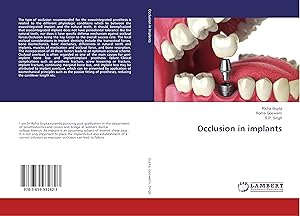
Añadir al carritoKartoniert / Broschiert. Condición: New. Dieser Artikel ist ein Print on Demand Artikel und wird nach Ihrer Bestellung fuer Sie gedruckt. Autor/Autorin: Gupta RichaI am Dr.Richa Gupta curently pursuing post graduation in the department of prosthodontics and crown and bridge at subharti dental college,Meerut. As implant is an upcoming subject of interest these days . It is not on.
-

Occlusion in implants
Idioma: Inglés
Publicado por LAP LAMBERT Academic Publishing Nov 2016, 2016
ISBN 10: 3659932825 ISBN 13: 9783659932823
Librería: buchversandmimpf2000, Emtmannsberg, BAYE, Alemania
Calificación del vendedor: 5 de 5 estrellas
EUR 64,90
Envío por EUR 60,00
Se envía de Alemania a Estados Unidos de AmericaCantidad disponible: 1 disponibles
Añadir al carritoTaschenbuch. Condición: Neu. This item is printed on demand - Print on Demand Titel. Neuware -The type of occlusion recommended for the osseointegrated prosthesis is related to the different physiologic conditions which lie between the osseointegrated implant and the natural teeth. It should beemphasized that osseointegrated implant does not have periodontal tolerance like the natural teeth, nor does it have specific defense mechanism against occlusal forces.Occlusion being the key factor to the overall success rate. The local occlusal considerations in implant dentistry include the transosteal forces, bone biomechanics, basic mechanics, differences in natural teeth and implants, muscles of mastication and occlusal force, and bone resorption. The incorporation of all these factors leads to an optimum occlusal scheme. Occlusal overload is often regarded as one of the main causes for peri-implant bone loss and implant/implant prosthesis failure. Clinical complications such as prosthesis fracture, screw loosening or fracture, implant fracture, continuing marginal bone loss, and implant loss may be attributed to implant overload, which can be prevented by application of biomechanical principles such as the passive fitting of prostheses, reducing the cantilever length etc.VDM Verlag, Dudweiler Landstraße 99, 66123 Saarbrücken 160 pp. Englisch.
-

Occlusion in implants
Idioma: Inglés
Publicado por LAP LAMBERT Academic Publishing, 2016
ISBN 10: 3659932825 ISBN 13: 9783659932823
Librería: AHA-BUCH GmbH, Einbeck, Alemania
Calificación del vendedor: 5 de 5 estrellas
EUR 64,90
Envío por EUR 61,28
Se envía de Alemania a Estados Unidos de AmericaCantidad disponible: 1 disponibles
Añadir al carritoTaschenbuch. Condición: Neu. nach der Bestellung gedruckt Neuware - Printed after ordering - The type of occlusion recommended for the osseointegrated prosthesis is related to the different physiologic conditions which lie between the osseointegrated implant and the natural teeth. It should beemphasized that osseointegrated implant does not have periodontal tolerance like the natural teeth, nor does it have specific defense mechanism against occlusal forces.Occlusion being the key factor to the overall success rate. The local occlusal considerations in implant dentistry include the transosteal forces, bone biomechanics, basic mechanics, differences in natural teeth and implants, muscles of mastication and occlusal force, and bone resorption. The incorporation of all these factors leads to an optimum occlusal scheme. Occlusal overload is often regarded as one of the main causes for peri-implant bone loss and implant/implant prosthesis failure. Clinical complications such as prosthesis fracture, screw loosening or fracture, implant fracture, continuing marginal bone loss, and implant loss may be attributed to implant overload, which can be prevented by application of biomechanical principles such as the passive fitting of prostheses, reducing the cantilever length etc.

