

Importe total (1 artículo artículos):
Destino del pedido:

9783642813832 - Computer Processing of Electron Microscope Images: 13 (Topics in Current Physics) (13 resultados)
Ir a los resultados principales
Filtros de búsqueda
Tipo de artículo
- Todos los tipos de productos
- Libros (13)
- Revistas y publicaciones (No hay ningún otro resultado que coincida con este filtro.)
- Cómics (No hay ningún otro resultado que coincida con este filtro.)
- Partituras (No hay ningún otro resultado que coincida con este filtro.)
- Arte, grabados y pósters (No hay ningún otro resultado que coincida con este filtro.)
- Fotografías (No hay ningún otro resultado que coincida con este filtro.)
- Mapas (No hay ningún otro resultado que coincida con este filtro.)
- Manuscritos y coleccionismo de papel (No hay ningún otro resultado que coincida con este filtro.)
Condición Más información
- Nuevo (11)
- Como nuevo, Excelente o Muy bueno (2)
- Bueno o Aceptable (No hay ningún otro resultado que coincida con este filtro.)
- Regular o Pobre (No hay ningún otro resultado que coincida con este filtro.)
- Tal como se indica (No hay ningún otro resultado que coincida con este filtro.)
Encuadernación
- Todas
- Tapa dura (No hay ningún otro resultado que coincida con este filtro.)
- Tapa blanda (13)
Más atributos
- Primera edición (No hay ningún otro resultado que coincida con este filtro.)
- Firmado (No hay ningún otro resultado que coincida con este filtro.)
- Sobrecubierta (No hay ningún otro resultado que coincida con este filtro.)
- Con imágenes (8)
- No impresión bajo demanda (11)
Idioma (1)
Precio
- Cualquier precio
- Menos de EUR 20 (No hay ningún otro resultado que coincida con este filtro.)
- EUR 20 a EUR 40 (No hay ningún otro resultado que coincida con este filtro.)
- Más de EUR 40
Gastos de envío gratis
Ubicación del vendedor
Valoración de los vendedores
-

Computer Processing of Electron Microscope Images
Librería: GreatBookPrices, Columbia, MD, Estados Unidos de America
Calificación del vendedor: 5 de 5 estrellas

EUR 52,75
Envío por EUR 2,22
Se envía dentro de Estados Unidos de AmericaCantidad disponible: 15 disponibles
Añadir al carritoCondición: New.
-
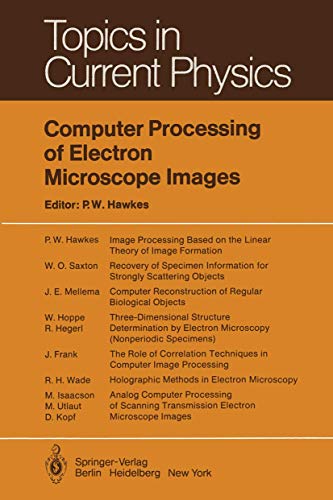
Computer Processing of Electron Microscope Images (Topics in Current Physics)
Librería: Lucky's Textbooks, Dallas, TX, Estados Unidos de America
Calificación del vendedor: 5 de 5 estrellas
EUR 51,59
Envío por EUR 3,36
Se envía dentro de Estados Unidos de AmericaCantidad disponible: Más de 20 disponibles
Añadir al carritoCondición: New.
-

Computer Processing of Electron Microscope Images
Librería: GreatBookPrices, Columbia, MD, Estados Unidos de America
Calificación del vendedor: 5 de 5 estrellas
EUR 61,38
Envío por EUR 2,22
Se envía dentro de Estados Unidos de AmericaCantidad disponible: Más de 20 disponibles
Añadir al carritoCondición: As New. Unread book in perfect condition.
-
Computer Processing of Electron Microscope Images (Topics in Current Physics)
Librería: California Books, Miami, FL, Estados Unidos de America
Calificación del vendedor: 5 de 5 estrellas
EUR 64,11
Gastos de envío gratis
Se envía dentro de Estados Unidos de AmericaCantidad disponible: Más de 20 disponibles
Añadir al carritoCondición: New.
-
Computer Processing of Electron Microscope Images (Topics in Current Physics)
Librería: Ria Christie Collections, Uxbridge, Reino Unido
Calificación del vendedor: 5 de 5 estrellas
EUR 58,23
Envío por EUR 13,74
Se envía de Reino Unido a Estados Unidos de AmericaCantidad disponible: Más de 20 disponibles
Añadir al carritoCondición: New. In.
-
Computer Processing of Electron Microscope Images
Librería: Chiron Media, Wallingford, Reino Unido
Calificación del vendedor: 4 de 5 estrellas

EUR 56,46
Envío por EUR 17,76
Se envía de Reino Unido a Estados Unidos de AmericaCantidad disponible: 10 disponibles
Añadir al carritoPF. Condición: New.
-

Computer Processing of Electron Microscope Images
Librería: GreatBookPricesUK, Woodford Green, Reino Unido
Calificación del vendedor: 5 de 5 estrellas
EUR 59,39
Envío por EUR 17,20
Se envía de Reino Unido a Estados Unidos de AmericaCantidad disponible: Más de 20 disponibles
Añadir al carritoCondición: New.
-

Computer Processing of Electron Microscope Images
Librería: GreatBookPricesUK, Woodford Green, Reino Unido
Calificación del vendedor: 5 de 5 estrellas
EUR 66,00
Envío por EUR 17,20
Se envía de Reino Unido a Estados Unidos de AmericaCantidad disponible: Más de 20 disponibles
Añadir al carritoCondición: As New. Unread book in perfect condition.
-
Computer Processing of Electron Microscope Images
Librería: Revaluation Books, Exeter, Reino Unido
Calificación del vendedor: 5 de 5 estrellas
EUR 77,52
Envío por EUR 14,33
Se envía de Reino Unido a Estados Unidos de AmericaCantidad disponible: 2 disponibles
Añadir al carritoPaperback. Condición: Brand New. reprint edition. 310 pages. 9.60x6.70x0.80 inches. In Stock.
-
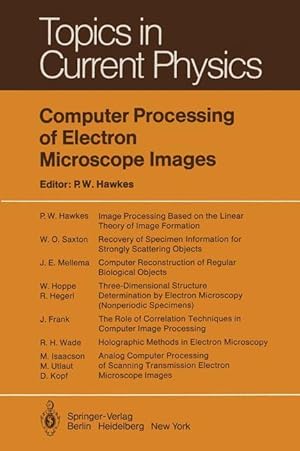
Computer Processing of Electron Microscope Images
Idioma: Inglés
Publicado por Springer Berlin Heidelberg, 2011
ISBN 10: 3642813836 ISBN 13: 9783642813832
Librería: moluna, Greven, Alemania
Calificación del vendedor: 4 de 5 estrellas
EUR 48,37
Envío por EUR 48,99
Se envía de Alemania a Estados Unidos de AmericaCantidad disponible: Más de 20 disponibles
Añadir al carritoCondición: New.
-
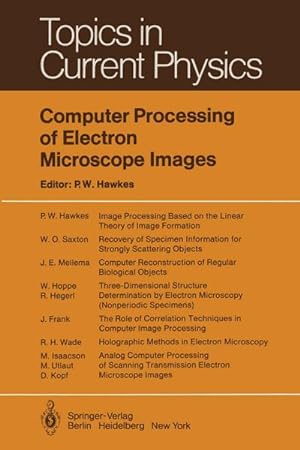
Computer Processing of Electron Microscope Images
Idioma: Inglés
Publicado por Springer Berlin Heidelberg, 2011
ISBN 10: 3642813836 ISBN 13: 9783642813832
Librería: AHA-BUCH GmbH, Einbeck, Alemania
Calificación del vendedor: 5 de 5 estrellas
EUR 53,49
Envío por EUR 62,74
Se envía de Alemania a Estados Unidos de AmericaCantidad disponible: 1 disponibles
Añadir al carritoTaschenbuch. Condición: Neu. Druck auf Anfrage Neuware - Printed after ordering - Towards the end of the 1960s, a number of quite different circumstances combined to launch a period of intense activity in the digital processing of electron micro graphs. First, many years of work on correcting the resolution-limiting aberrations of electron microscope objectives had shown that these optical impediments to very high resolution could indeed be overcome, but only at the cost of immense exper imental difficulty; thanks largely to the theoretical work of K. -J. Hanszen and his colleagues and to the experimental work of F. Thon, the notions of transfer func tions were beginning to supplant or complement the concepts of geometrical optics in electron optical thinking; and finally, large fast computers, capable of manipu lating big image matrices in a reasonable time, were widely accessible. Thus the idea that recorded electron microscope images could be improved in some way or rendered more informative by subsequent computer processing gradually gained ground. At first, most effort was concentrated on three-dimensional reconstruction, particu larly of specimens with natural symmetry that could be exploited, and on linear operations on weakly scattering specimens (Chap. l). In 1973, however, R. W. Gerchberg and W. O. Saxton described an iterative algorithm that in principle yielded the phase and amplitude of the electron wave emerging from a strongly scattering speci men.
-
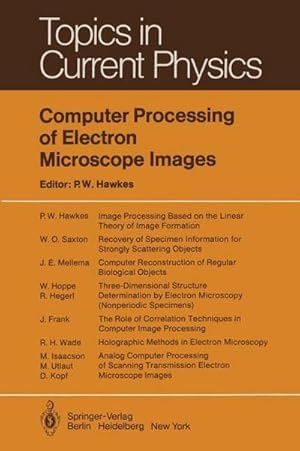
Computer Processing of Electron Microscope Images
Idioma: Inglés
Publicado por Springer Berlin Heidelberg, Springer Berlin Heidelberg Dez 2011, 2011
ISBN 10: 3642813836 ISBN 13: 9783642813832
Librería: buchversandmimpf2000, Emtmannsberg, BAYE, Alemania
Calificación del vendedor: 5 de 5 estrellas
EUR 53,49
Envío por EUR 60,00
Se envía de Alemania a Estados Unidos de AmericaCantidad disponible: 1 disponibles
Añadir al carritoTaschenbuch. Condición: Neu. This item is printed on demand - Print on Demand Titel. Neuware -Towards the end of the 1960s, a number of quite different circumstances combined to launch a period of intense activity in the digital processing of electron micro graphs. First, many years of work on correcting the resolution-limiting aberrations of electron microscope objectives had shown that these optical impediments to very high resolution could indeed be overcome, but only at the cost of immense exper imental difficulty; thanks largely to the theoretical work of K. -J. Hanszen and his colleagues and to the experimental work of F. Thon, the notions of transfer func tions were beginning to supplant or complement the concepts of geometrical optics in electron optical thinking; and finally, large fast computers, capable of manipu lating big image matrices in a reasonable time, were widely accessible. Thus the idea that recorded electron microscope images could be improved in some way or rendered more informative by subsequent computer processing gradually gained ground. At first, most effort was concentrated on three-dimensional reconstruction, particu larly of specimens with natural symmetry that could be exploited, and on linear operations on weakly scattering specimens (Chap. l). In 1973, however, R. W. Gerchberg and W. O. Saxton described an iterative algorithm that in principle yielded the phase and amplitude of the electron wave emerging from a strongly scattering speci men.Springer Verlag GmbH, Tiergartenstr. 17, 69121 Heidelberg 316 pp. Englisch.
-
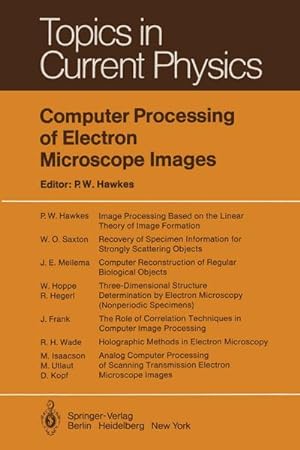
Computer Processing of Electron Microscope Images
Idioma: Inglés
Publicado por Springer Berlin Heidelberg Dez 2011, 2011
ISBN 10: 3642813836 ISBN 13: 9783642813832
Librería: BuchWeltWeit Ludwig Meier e.K., Bergisch Gladbach, Alemania
Calificación del vendedor: 5 de 5 estrellas
EUR 106,99
Envío por EUR 23,00
Se envía de Alemania a Estados Unidos de AmericaCantidad disponible: 2 disponibles
Añadir al carritoTaschenbuch. Condición: Neu. This item is printed on demand - it takes 3-4 days longer - Neuware -Towards the end of the 1960s, a number of quite different circumstances combined to launch a period of intense activity in the digital processing of electron micro graphs. First, many years of work on correcting the resolution-limiting aberrations of electron microscope objectives had shown that these optical impediments to very high resolution could indeed be overcome, but only at the cost of immense exper imental difficulty; thanks largely to the theoretical work of K. -J. Hanszen and his colleagues and to the experimental work of F. Thon, the notions of transfer func tions were beginning to supplant or complement the concepts of geometrical optics in electron optical thinking; and finally, large fast computers, capable of manipu lating big image matrices in a reasonable time, were widely accessible. Thus the idea that recorded electron microscope images could be improved in some way or rendered more informative by subsequent computer processing gradually gained ground. At first, most effort was concentrated on three-dimensional reconstruction, particu larly of specimens with natural symmetry that could be exploited, and on linear operations on weakly scattering specimens (Chap. l). In 1973, however, R. W. Gerchberg and W. O. Saxton described an iterative algorithm that in principle yielded the phase and amplitude of the electron wave emerging from a strongly scattering speci men. 316 pp. Englisch.

