

Importe total (1 artículo artículos):
Destino del pedido:

9783642685248 - Species at Risk Research in Australia: Proceedings of a Symposium on the Biology of Rare and Endangered Species in Australia, sponsored by the ... and held in Canbe... (10 resultados)
Ir a los resultados principales
Filtros de búsqueda
Tipo de artículo
- Todos los tipos de productos
- Libros (10)
- Revistas y publicaciones (No hay ningún otro resultado que coincida con este filtro.)
- Cómics (No hay ningún otro resultado que coincida con este filtro.)
- Partituras (No hay ningún otro resultado que coincida con este filtro.)
- Arte, grabados y pósters (No hay ningún otro resultado que coincida con este filtro.)
- Fotografías (No hay ningún otro resultado que coincida con este filtro.)
- Mapas (No hay ningún otro resultado que coincida con este filtro.)
- Manuscritos y coleccionismo de papel (No hay ningún otro resultado que coincida con este filtro.)
Condición Más información
- Nuevo (8)
- Como nuevo, Excelente o Muy bueno (2)
- Bueno o Aceptable (No hay ningún otro resultado que coincida con este filtro.)
- Regular o Pobre (No hay ningún otro resultado que coincida con este filtro.)
- Tal como se indica (No hay ningún otro resultado que coincida con este filtro.)
Encuadernación
- Todas
- Tapa dura (No hay ningún otro resultado que coincida con este filtro.)
- Tapa blanda (10)
Más atributos
- Primera edición (No hay ningún otro resultado que coincida con este filtro.)
- Firmado (No hay ningún otro resultado que coincida con este filtro.)
- Sobrecubierta (No hay ningún otro resultado que coincida con este filtro.)
- Con imágenes (4)
- No impresión bajo demanda (6)
Idioma (1)
Precio
- Cualquier precio
- Menos de EUR 20 (No hay ningún otro resultado que coincida con este filtro.)
- EUR 20 a EUR 45 (No hay ningún otro resultado que coincida con este filtro.)
- Más de EUR 45
Gastos de envío gratis
- Envío gratis a Estados Unidos de America (No hay ningún otro resultado que coincida con este filtro.)
Ubicación del vendedor
Valoración de los vendedores
-

Species at Risk Research in Australia: Proceedings of a Symposium on the Biology of Rare and Endangered Species in Australia, sponsored by the ... and held in Canberra, 25 and 26 November 1981
Librería: Ria Christie Collections, Uxbridge, Reino Unido
Calificación del vendedor: 5 de 5 estrellas

EUR 117,07
Envío por EUR 14,05
Se envía de Reino Unido a Estados Unidos de AmericaCantidad disponible: Más de 20 disponibles
Añadir al carritoCondición: New. In.
-
Species at Risk Research in Australia : Proceedings of a Symposium on the Biology of Rare and Endangered Species in Australia, sponsored by the Australian Academy of Science and held in Canberra, 25 and 26 November 1981
Librería: GreatBookPrices, Columbia, MD, Estados Unidos de America
Calificación del vendedor: 5 de 5 estrellas
EUR 132,68
Envío por EUR 2,31
Se envía dentro de Estados Unidos de AmericaCantidad disponible: 15 disponibles
Añadir al carritoCondición: New.
-
Species at Risk Research in Australia: Proceedings of a Symposium on the Biology of Rare and Endangered Species in Australia, sponsored by the Australian Academy of Science and held in Canb
Librería: Revaluation Books, Exeter, Reino Unido
Calificación del vendedor: 5 de 5 estrellas
EUR 154,43
Envío por EUR 11,73
Se envía de Reino Unido a Estados Unidos de AmericaCantidad disponible: 2 disponibles
Añadir al carritoPaperback. Condición: Brand New. 228 pages. 9.60x6.70x0.70 inches. In Stock.
-
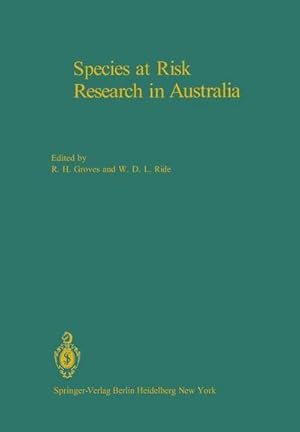
Species at Risk Research in Australia : Proceedings of a Symposium on the Biology of Rare and Endangered Species in Australia, sponsored by the Australian Academy of Science and held in Canberra, 25 and 26 November 1981
Idioma: Inglés
Publicado por Springer Berlin Heidelberg, 2011
ISBN 10: 3642685242 ISBN 13: 9783642685248
Librería: AHA-BUCH GmbH, Einbeck, Alemania
Calificación del vendedor: 5 de 5 estrellas
EUR 106,99
Envío por EUR 62,01
Se envía de Alemania a Estados Unidos de AmericaCantidad disponible: 1 disponibles
Añadir al carritoTaschenbuch. Condición: Neu. Druck auf Anfrage Neuware - Printed after ordering - Evolutionary progress has long been associated with the extinction of species. So why should we be concerned now, even when the number of species at risk is substantial, such as one tenth of the Australian flora The reasons for concern are many stranded. Compassion is one strand. Remember the instructions to Noah: 'And you shall bring living creatures of every kind into the ark and keep them alive with you'. Guilt may be another strand, that our hunting, clearing, collecting, pollution, introduction of competitors and other human activities may have endangered species such as the Orange-bellied Parrot. Nostalgia for what was and concern for what might be also play a part; species at risk include some which are of immediate use, such as the whales, and many of potential use, whether drug plants in the forests of the Amazon or a wild relative of the soybean in Victoria. Aesthetic considerations are also involved, particularly where colourful birds or unusual flowers are threatened. We cherish diversity, as culturally desirable, and are delighted when supposedly extinct species such as the notornis and coelacanth - and maybe yet the thylacine - are rediscovered. The Loch Ness monster has already been blessed with a Latin binomial in anticipation! Diversity is also of ecological as well as of cultural value, contributing to the stability of ecosystems, as in the case of insects and birds which fertilize the flowers and disperse the seeds of plants.
-
Species at Risk Research in Australia: Proceedings of a Symposium on the Biology of Rare and Endangered Species in Australia, sponsored by the . and held in Canberra, 25 and 26 November 1981
Librería: Mispah books, Redhill, SURRE, Reino Unido
Calificación del vendedor: 4 de 5 estrellas

EUR 188,51
Envío por EUR 29,33
Se envía de Reino Unido a Estados Unidos de AmericaCantidad disponible: 1 disponibles
Añadir al carritoPaperback. Condición: Like New. LIKE NEW. SHIPS FROM MULTIPLE LOCATIONS. book.
-
Species at Risk Research in Australia : Proceedings of a Symposium on the Biology of Rare and Endangered Species in Australia, sponsored by the Australian Academy of Science and held in Canberra, 25 and 26 November 1981
Librería: GreatBookPrices, Columbia, MD, Estados Unidos de America
Calificación del vendedor: 5 de 5 estrellas
EUR 221,66
Envío por EUR 2,31
Se envía dentro de Estados Unidos de AmericaCantidad disponible: 15 disponibles
Añadir al carritoCondición: As New. Unread book in perfect condition.
-
Species at Risk Research in Australia (eng)
Librería: Brook Bookstore On Demand, Napoli, NA, Italia
Calificación del vendedor: 5 de 5 estrellas
EUR 86,24
Envío por EUR 5,50
Se envía de Italia a Estados Unidos de AmericaCantidad disponible: Más de 20 disponibles
Añadir al carritoCondición: new. Questo è un articolo print on demand.
-
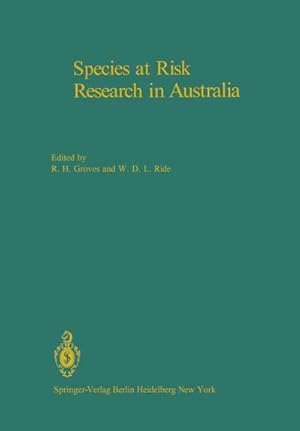
Species at Risk Research in Australia
Idioma: Inglés
Publicado por Springer Berlin Heidelberg, Springer Berlin Heidelberg Dez 2011, 2011
ISBN 10: 3642685242 ISBN 13: 9783642685248
Librería: BuchWeltWeit Ludwig Meier e.K., Bergisch Gladbach, Alemania
Calificación del vendedor: 5 de 5 estrellas
EUR 106,99
Envío por EUR 23,00
Se envía de Alemania a Estados Unidos de AmericaCantidad disponible: 2 disponibles
Añadir al carritoTaschenbuch. Condición: Neu. This item is printed on demand - it takes 3-4 days longer - Neuware -Evolutionary progress has long been associated with the extinction of species. So why should we be concerned now, even when the number of species at risk is substantial, such as one tenth of the Australian flora The reasons for concern are many stranded. Compassion is one strand. Remember the instructions to Noah: 'And you shall bring living creatures of every kind into the ark and keep them alive with you'. Guilt may be another strand, that our hunting, clearing, collecting, pollution, introduction of competitors and other human activities may have endangered species such as the Orange-bellied Parrot. Nostalgia for what was and concern for what might be also play a part; species at risk include some which are of immediate use, such as the whales, and many of potential use, whether drug plants in the forests of the Amazon or a wild relative of the soybean in Victoria. Aesthetic considerations are also involved, particularly where colourful birds or unusual flowers are threatened. We cherish diversity, as culturally desirable, and are delighted when supposedly extinct species such as the notornis and coelacanth - and maybe yet the thylacine - are rediscovered. The Loch Ness monster has already been blessed with a Latin binomial in anticipation! Diversity is also of ecological as well as of cultural value, contributing to the stability of ecosystems, as in the case of insects and birds which fertilize the flowers and disperse the seeds of plants. 228 pp. Englisch.
-
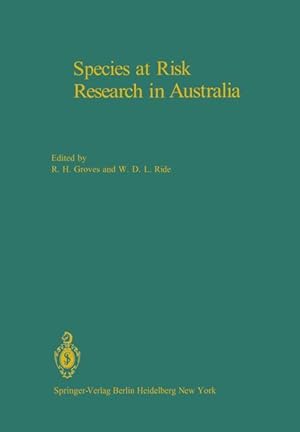
Species at Risk Research in Australia
Idioma: Inglés
Publicado por Springer Berlin Heidelberg, 2011
ISBN 10: 3642685242 ISBN 13: 9783642685248
Librería: moluna, Greven, Alemania
Calificación del vendedor: 5 de 5 estrellas
EUR 92,27
Envío por EUR 48,99
Se envía de Alemania a Estados Unidos de AmericaCantidad disponible: Más de 20 disponibles
Añadir al carritoCondición: New. Dieser Artikel ist ein Print on Demand Artikel und wird nach Ihrer Bestellung fuer Sie gedruckt. Evolutionary progress has long been associated with the extinction of species. So why should we be concerned now, even when the number of species at risk is substantial, such as one tenth of the Australian flora? The reasons for concern are many stranded. C.
-

Species at Risk Research in Australia
Idioma: Inglés
Publicado por Springer Berlin Heidelberg, Springer Dez 2011, 2011
ISBN 10: 3642685242 ISBN 13: 9783642685248
Librería: buchversandmimpf2000, Emtmannsberg, BAYE, Alemania
Calificación del vendedor: 5 de 5 estrellas
EUR 106,99
Envío por EUR 60,00
Se envía de Alemania a Estados Unidos de AmericaCantidad disponible: 1 disponibles
Añadir al carritoTaschenbuch. Condición: Neu. This item is printed on demand - Print on Demand Titel. Neuware -Evolutionary progress has long been associated with the extinction of species. So why should we be concerned now, even when the number of species at risk is substantial, such as one tenth of the Australian flora The reasons for concern are many stranded. Compassion is one strand. Remember the instructions to Noah: 'And you shall bring living creatures of every kind into the ark and keep them alive with you'. Guilt may be another strand, that our hunting, clearing, collecting, pollution, introduction of competitors and other human activities may have endangered species such as the Orange-bellied Parrot. Nostalgia for what was and concern for what might be also play a part; species at risk include some which are of immediate use, such as the whales, and many of potential use, whether drug plants in the forests of the Amazon or a wild relative of the soybean in Victoria. Aesthetic considerations are also involved, particularly where colourful birds or unusual flowers are threatened. We cherish diversity, as culturally desirable, and are delighted when supposedly extinct species such as the notornis and coelacanth - and maybe yet the thylacine - are rediscovered. The Loch Ness monster has already been blessed with a Latin binomial in anticipation! Diversity is also of ecological as well as of cultural value, contributing to the stability of ecosystems, as in the case of insects and birds which fertilize the flowers and disperse the seeds of plants.Springer-Verlag GmbH, Tiergartenstr. 17, 69121 Heidelberg 228 pp. Englisch.

