
Importe total (1 artículo artículos):
Destino del pedido:

9783642434532 - Call Admission Control in Mobile Cellular Networks: 437 (Studies in Computational Intelligence) de Ghosh, Sanchita; Konar, Amit (15 resultados)
Ir a los resultados principales
Filtros de búsqueda
Tipo de artículo
- Todos los tipos de productos
- Libros (15)
- Revistas y publicaciones (No hay ningún otro resultado que coincida con este filtro.)
- Cómics (No hay ningún otro resultado que coincida con este filtro.)
- Partituras (No hay ningún otro resultado que coincida con este filtro.)
- Arte, grabados y pósters (No hay ningún otro resultado que coincida con este filtro.)
- Fotografías (No hay ningún otro resultado que coincida con este filtro.)
- Mapas (No hay ningún otro resultado que coincida con este filtro.)
- Manuscritos y coleccionismo de papel (No hay ningún otro resultado que coincida con este filtro.)
Condición Más información
- Nuevo (13)
- Como nuevo, Excelente o Muy bueno (2)
- Bueno o Aceptable (No hay ningún otro resultado que coincida con este filtro.)
- Regular o Pobre (No hay ningún otro resultado que coincida con este filtro.)
- Tal como se indica (No hay ningún otro resultado que coincida con este filtro.)
Encuadernación
- Todas
- Tapa dura (No hay ningún otro resultado que coincida con este filtro.)
- Tapa blanda (15)
Más atributos
- Primera edición (No hay ningún otro resultado que coincida con este filtro.)
- Firmado (No hay ningún otro resultado que coincida con este filtro.)
- Sobrecubierta (No hay ningún otro resultado que coincida con este filtro.)
- Con imágenes (6)
- No impresión bajo demanda (10)
Idioma (1)
Precio
- Cualquier precio
- Menos de EUR 20 (No hay ningún otro resultado que coincida con este filtro.)
- EUR 20 a EUR 40 (No hay ningún otro resultado que coincida con este filtro.)
- Más de EUR 40
Gastos de envío gratis
Ubicación del vendedor
Valoración de los vendedores
-

Call Admission Control in Mobile Cellular Networks
Librería: GreatBookPrices, Columbia, MD, Estados Unidos de America
Calificación del vendedor: 5 de 5 estrellas

EUR 100,94
Envío por EUR 2,20
Se envía dentro de Estados Unidos de AmericaCantidad disponible: 15 disponibles
Añadir al carritoCondición: New.
-

Call Admission Control in Mobile Cellular Networks (Paperback)
Idioma: Inglés
Publicado por Springer-Verlag Berlin and Heidelberg GmbH & Co. KG, Berlin, 2014
ISBN 10: 3642434533 ISBN 13: 9783642434532
Librería: Grand Eagle Retail, Bensenville, IL, Estados Unidos de America
Calificación del vendedor: 5 de 5 estrellas
EUR 103,22
Gastos de envío gratis
Se envía dentro de Estados Unidos de AmericaCantidad disponible: 1 disponibles
Añadir al carritoPaperback. Condición: new. Paperback. Call Admission Control (CAC) and Dynamic Channel Assignments (DCA) are important decision-making problems in mobile cellular communication systems. Current research in mobile communication considers them as two independent problems, although the former greatly depends on the resulting free channels obtained as the outcome of the latter. This book provides a solution to the CAC problem, considering DCA as an integral part of decision-making for call admission. Further, current technical resources ignore movement issues of mobile stations and fluctuation in network load (incoming calls) in the control strategy used for call admission. In addition, the present techniques on call admission offers solution globally for the entire network, instead of considering the cells independently. CAC here has been formulated by two alternative approaches. The first approach aimed at handling the uncertainty in the CAC problem by employing fuzzy comparators. The second approach is concerned with formulation of CAC as an optimization problem to minimize call drop, satisfying a set of constraints on feasibility and availability of channels, hotness of cells, and velocity and angular displacement of mobile stations. Evolutionary techniques, including Genetic Algorithm and Biogeography Based Optimization, have been employed to solve the optimization problems. The proposed approaches outperform traditional methods with respect to grade and quality of services. Call Admission Control (CAC) and Dynamic Channel Assignments (DCA) are important decision-making problems in mobile cellular communication systems. Shipping may be from multiple locations in the US or from the UK, depending on stock availability.
-
Call Admission Control in Mobile Cellular Networks (Studies in Computational Intelligence, 437)
Librería: Lucky's Textbooks, Dallas, TX, Estados Unidos de America
Calificación del vendedor: 5 de 5 estrellas
EUR 99,81
Envío por EUR 3,33
Se envía dentro de Estados Unidos de AmericaCantidad disponible: Más de 20 disponibles
Añadir al carritoCondición: New.
-
Call Admission Control in Mobile Cellular Networks (Studies in Computational Intelligence, 437)
Librería: Ria Christie Collections, Uxbridge, Reino Unido
Calificación del vendedor: 5 de 5 estrellas
EUR 112,11
Envío por EUR 13,83
Se envía de Reino Unido a Estados Unidos de AmericaCantidad disponible: Más de 20 disponibles
Añadir al carritoCondición: New. In.
-
Call Admission Control in Mobile Cellular Networks (Studies in Computational Intelligence, 437)
Librería: California Books, Miami, FL, Estados Unidos de America
Calificación del vendedor: 5 de 5 estrellas
EUR 123,84
Gastos de envío gratis
Se envía dentro de Estados Unidos de AmericaCantidad disponible: Más de 20 disponibles
Añadir al carritoCondición: New.
-
Call Admission Control in Mobile Cellular Networks (Studies.
Librería: Books Puddle, New York, NY, Estados Unidos de America
Calificación del vendedor: 4 de 5 estrellas

EUR 138,70
Envío por EUR 3,33
Se envía dentro de Estados Unidos de AmericaCantidad disponible: 4 disponibles
Añadir al carritoCondición: New.
-

Call Admission Control in Mobile Cellular Networks
Idioma: Inglés
Publicado por Springer Berlin Heidelberg, 2014
ISBN 10: 3642434533 ISBN 13: 9783642434532
Librería: AHA-BUCH GmbH, Einbeck, Alemania
Calificación del vendedor: 5 de 5 estrellas
EUR 106,99
Envío por EUR 61,91
Se envía de Alemania a Estados Unidos de AmericaCantidad disponible: 1 disponibles
Añadir al carritoTaschenbuch. Condición: Neu. Druck auf Anfrage Neuware - Printed after ordering - Call Admission Control (CAC) and Dynamic Channel Assignments (DCA) are important decision-making problems in mobile cellular communication systems. Current research in mobile communication considers them as two independent problems, although the former greatly depends on the resulting free channels obtained as the outcome of the latter. This book provides a solution to the CAC problem, considering DCA as an integral part of decision-making for call admission. Further, current technical resources ignore movement issues of mobile stations and fluctuation in network load (incoming calls) in the control strategy used for call admission. In addition, the present techniques on call admission offers solution globally for the entire network, instead of considering the cells independently. CAC here has been formulated by two alternative approaches. The first approach aimed at handling the uncertainty in the CAC problem by employing fuzzy comparators. The second approach is concerned with formulation of CAC as an optimization problem to minimize call drop, satisfying a set of constraints on feasibility and availability of channels, hotness of cells, and velocity and angular displacement of mobile stations. Evolutionary techniques, including Genetic Algorithm and Biogeography Based Optimization, have been employed to solve the optimization problems. The proposed approaches outperform traditional methods with respect to grade and quality of services.
-
Call Admission Control in Mobile Cellular Networks (Studies in Computational Intelligence, 437)
Librería: Mispah books, Redhill, SURRE, Reino Unido
Calificación del vendedor: 4 de 5 estrellas
EUR 167,62
Envío por EUR 28,85
Se envía de Reino Unido a Estados Unidos de AmericaCantidad disponible: 1 disponibles
Añadir al carritoPaperback. Condición: Like New. Like New. book.
-

Call Admission Control in Mobile Cellular Networks
Librería: GreatBookPrices, Columbia, MD, Estados Unidos de America
Calificación del vendedor: 5 de 5 estrellas
EUR 197,75
Envío por EUR 2,20
Se envía dentro de Estados Unidos de AmericaCantidad disponible: 15 disponibles
Añadir al carritoCondición: As New. Unread book in perfect condition.
-
Call Admission Control in Mobile Cellular Networks (Paperback)
Idioma: Inglés
Publicado por Springer-Verlag Berlin and Heidelberg GmbH & Co. KG, Berlin, 2014
ISBN 10: 3642434533 ISBN 13: 9783642434532
Librería: AussieBookSeller, Truganina, VIC, Australia
Calificación del vendedor: 5 de 5 estrellas
EUR 197,60
Envío por EUR 30,89
Se envía de Australia a Estados Unidos de AmericaCantidad disponible: 1 disponibles
Añadir al carritoPaperback. Condición: new. Paperback. Call Admission Control (CAC) and Dynamic Channel Assignments (DCA) are important decision-making problems in mobile cellular communication systems. Current research in mobile communication considers them as two independent problems, although the former greatly depends on the resulting free channels obtained as the outcome of the latter. This book provides a solution to the CAC problem, considering DCA as an integral part of decision-making for call admission. Further, current technical resources ignore movement issues of mobile stations and fluctuation in network load (incoming calls) in the control strategy used for call admission. In addition, the present techniques on call admission offers solution globally for the entire network, instead of considering the cells independently. CAC here has been formulated by two alternative approaches. The first approach aimed at handling the uncertainty in the CAC problem by employing fuzzy comparators. The second approach is concerned with formulation of CAC as an optimization problem to minimize call drop, satisfying a set of constraints on feasibility and availability of channels, hotness of cells, and velocity and angular displacement of mobile stations. Evolutionary techniques, including Genetic Algorithm and Biogeography Based Optimization, have been employed to solve the optimization problems. The proposed approaches outperform traditional methods with respect to grade and quality of services. Call Admission Control (CAC) and Dynamic Channel Assignments (DCA) are important decision-making problems in mobile cellular communication systems. Shipping may be from our Sydney, NSW warehouse or from our UK or US warehouse, depending on stock availability.
-
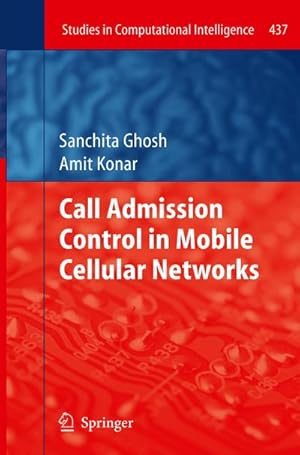
Call Admission Control in Mobile Cellular Networks
Idioma: Inglés
Publicado por Springer Berlin Heidelberg Sep 2014, 2014
ISBN 10: 3642434533 ISBN 13: 9783642434532
Librería: BuchWeltWeit Ludwig Meier e.K., Bergisch Gladbach, Alemania
Calificación del vendedor: 5 de 5 estrellas
EUR 106,99
Envío por EUR 23,00
Se envía de Alemania a Estados Unidos de AmericaCantidad disponible: 2 disponibles
Añadir al carritoTaschenbuch. Condición: Neu. This item is printed on demand - it takes 3-4 days longer - Neuware -Call Admission Control (CAC) and Dynamic Channel Assignments (DCA) are important decision-making problems in mobile cellular communication systems. Current research in mobile communication considers them as two independent problems, although the former greatly depends on the resulting free channels obtained as the outcome of the latter. This book provides a solution to the CAC problem, considering DCA as an integral part of decision-making for call admission. Further, current technical resources ignore movement issues of mobile stations and fluctuation in network load (incoming calls) in the control strategy used for call admission. In addition, the present techniques on call admission offers solution globally for the entire network, instead of considering the cells independently. CAC here has been formulated by two alternative approaches. The first approach aimed at handling the uncertainty in the CAC problem by employing fuzzy comparators. The second approach is concerned with formulation of CAC as an optimization problem to minimize call drop, satisfying a set of constraints on feasibility and availability of channels, hotness of cells, and velocity and angular displacement of mobile stations. Evolutionary techniques, including Genetic Algorithm and Biogeography Based Optimization, have been employed to solve the optimization problems. The proposed approaches outperform traditional methods with respect to grade and quality of services. 248 pp. Englisch.
-

Call Admission Control in Mobile Cellular Networks
Idioma: Inglés
Publicado por Springer Berlin Heidelberg, 2014
ISBN 10: 3642434533 ISBN 13: 9783642434532
Librería: moluna, Greven, Alemania
Calificación del vendedor: 4 de 5 estrellas
EUR 92,27
Envío por EUR 48,99
Se envía de Alemania a Estados Unidos de AmericaCantidad disponible: Más de 20 disponibles
Añadir al carritoCondición: New. Dieser Artikel ist ein Print on Demand Artikel und wird nach Ihrer Bestellung fuer Sie gedruckt. A practical approach to Call Admission Control in mobile/cellular networks Presents a Computational Intelligence Approach to Call Admission Control in a Mobile Cellular Network Written by leading experts in the fieldCall Admission Con.
-
Call Admission Control in Mobile Cellular Networks (Studies.
Librería: Majestic Books, Hounslow, Reino Unido
Calificación del vendedor: 4 de 5 estrellas
EUR 143,71
Envío por EUR 7,50
Se envía de Reino Unido a Estados Unidos de AmericaCantidad disponible: 4 disponibles
Añadir al carritoCondición: New. Print on Demand.
-
Call Admission Control in Mobile Cellular Networks (Studies.
Librería: Biblios, Frankfurt am main, HESSE, Alemania
Calificación del vendedor: 4 de 5 estrellas
EUR 150,30
Envío por EUR 9,95
Se envía de Alemania a Estados Unidos de AmericaCantidad disponible: 4 disponibles
Añadir al carritoCondición: New. PRINT ON DEMAND.
-

Call Admission Control in Mobile Cellular Networks
Idioma: Inglés
Publicado por Springer Berlin Heidelberg, Springer Berlin Heidelberg Sep 2014, 2014
ISBN 10: 3642434533 ISBN 13: 9783642434532
Librería: buchversandmimpf2000, Emtmannsberg, BAYE, Alemania
Calificación del vendedor: 5 de 5 estrellas
EUR 106,99
Envío por EUR 60,00
Se envía de Alemania a Estados Unidos de AmericaCantidad disponible: 1 disponibles
Añadir al carritoTaschenbuch. Condición: Neu. This item is printed on demand - Print on Demand Titel. Neuware -Call Admission Control (CAC) and Dynamic Channel Assignments (DCA) are important decision-making problems in mobile cellular communication systems. Current research in mobile communication considers them as two independent problems, although the former greatly depends on the resulting free channels obtained as the outcome of the latter. This book provides a solution to the CAC problem, considering DCA as an integral part of decision-making for call admission. Further, current technical resources ignore movement issues of mobile stations and fluctuation in network load (incoming calls) in the control strategy used for call admission. In addition, the present techniques on call admission offers solution globally for the entire network, instead of considering the cells independently. CAC here has been formulated by two alternative approaches. The first approach aimed at handling the uncertainty in the CAC problem by employing fuzzy comparators. The second approach is concerned with formulation of CAC as an optimization problem to minimize call drop, satisfying a set of constraints on feasibility and availability of channels, hotness of cells, and velocity and angular displacement of mobile stations. Evolutionary techniques, including Genetic Algorithm and Biogeography Based Optimization, have been employed to solve the optimization problems. The proposed approaches outperform traditional methods with respect to grade and quality of services.Springer Verlag GmbH, Tiergartenstr. 17, 69121 Heidelberg 248 pp. Englisch.

