

Importe total (1 artículo artículos):
Destino del pedido:

9783540250487 - Spatial Cognition IV, Reasoning, Action, Interaction: International Spatial Cognition 2004, Frauenchiemsee, Germany, October 11-13, 2004, Revised ... (Lecture Notes... (7 resultados)
Ir a los resultados principales
Filtros de búsqueda
Tipo de artículo
- Todos los tipos de productos
- Libros (7)
- Revistas y publicaciones (No hay ningún otro resultado que coincida con este filtro.)
- Cómics (No hay ningún otro resultado que coincida con este filtro.)
- Partituras (No hay ningún otro resultado que coincida con este filtro.)
- Arte, grabados y pósters (No hay ningún otro resultado que coincida con este filtro.)
- Fotografías (No hay ningún otro resultado que coincida con este filtro.)
- Mapas (No hay ningún otro resultado que coincida con este filtro.)
- Manuscritos y coleccionismo de papel (No hay ningún otro resultado que coincida con este filtro.)
Condición Más información
- Nuevo (6)
- Como nuevo, Excelente o Muy bueno (No hay ningún otro resultado que coincida con este filtro.)
- Bueno o Aceptable (1)
- Regular o Pobre (No hay ningún otro resultado que coincida con este filtro.)
- Tal como se indica (No hay ningún otro resultado que coincida con este filtro.)
Encuadernación
Más atributos
- Primera edición (No hay ningún otro resultado que coincida con este filtro.)
- Firmado (No hay ningún otro resultado que coincida con este filtro.)
- Sobrecubierta (No hay ningún otro resultado que coincida con este filtro.)
- Con imágenes (5)
- No impresión bajo demanda (5)
Idioma (1)
Precio
- Cualquier precio
- Menos de EUR 20 (No hay ningún otro resultado que coincida con este filtro.)
- EUR 20 a EUR 45
- Más de EUR 45
Gastos de envío gratis
- Envío gratis a Estados Unidos de America (No hay ningún otro resultado que coincida con este filtro.)
Ubicación del vendedor
Valoración de los vendedores
-

Spatial Cognition IV : Reasoning, Action, Interaction : International Conference on Spatial Cognition, Frauenchiemsee, Germany, October 11-13, 2004, Revised Selected Papers
Idioma: Inglés
Publicado por Springer- Verlag, New York City, 2005
ISBN 10: 3540250484 ISBN 13: 9783540250487
Librería: Doss-Haus Books, Redondo Beach, CA, Estados Unidos de America
Calificación del vendedor: 5 de 5 estrellas

EUR 23,46
Envío por EUR 4,77
Se envía dentro de Estados Unidos de AmericaCantidad disponible: 1 disponibles
Añadir al carritoHardcover. Condición: Very Good. No Jacket. Hardcover 2005 library bound edition. Ex-library book with stamps and labels attached. Binding firm. Pages unmarked and clean. Laminated covers and text in very good to near fine condition. Series: Lecture Notes in Artificial Intelligence ;3343 .[xiii, 517 p. : ill. ; 24 cm].
-
Spatial Cognition IV, Reasoning, Action, Interaction: International Spatial Cognition 2004, Frauenchiemsee, Germany, October 11-13, 2004, Revised ... (Lecture Notes in Computer Science, 3343)
Librería: Ria Christie Collections, Uxbridge, Reino Unido
Calificación del vendedor: 5 de 5 estrellas
EUR 112,14
Envío por EUR 13,83
Se envía de Reino Unido a Estados Unidos de AmericaCantidad disponible: Más de 20 disponibles
Añadir al carritoCondición: New. In.
-
Spatial Cognition IV, Reasoning, Action, Interaction | International Spatial Cognition 2004, Frauenchiemsee, Germany, October 11-13, 2004, Revised Selected Papers
Librería: preigu, Osnabrück, Alemania
Calificación del vendedor: 5 de 5 estrellas
EUR 95,70
Envío por EUR 70,00
Se envía de Alemania a Estados Unidos de AmericaCantidad disponible: 5 disponibles
Añadir al carritoTaschenbuch. Condición: Neu. Spatial Cognition IV, Reasoning, Action, Interaction | International Spatial Cognition 2004, Frauenchiemsee, Germany, October 11-13, 2004, Revised Selected Papers | Christian Freksa (u. a.) | Taschenbuch | Einband - flex.(Paperback) | Englisch | 2005 | Springer | EAN 9783540250487 | Verantwortliche Person für die EU: Springer-Verlag KG, Sachsenplatz 4-6, 1201 WIEN, ÖSTERREICH, productsafety[at]springernature[dot]com | Anbieter: preigu.
-

Spatial Cognition IV, Reasoning, Action, Interaction
Idioma: Inglés
Publicado por Springer Berlin Heidelberg, Springer Berlin Heidelberg Mär 2005, 2005
ISBN 10: 3540250484 ISBN 13: 9783540250487
Librería: buchversandmimpf2000, Emtmannsberg, BAYE, Alemania
Calificación del vendedor: 5 de 5 estrellas
EUR 106,99
Envío por EUR 60,00
Se envía de Alemania a Estados Unidos de AmericaCantidad disponible: 2 disponibles
Añadir al carritoTaschenbuch. Condición: Neu. Neuware -This is the fourth volume in a series of books dedicated to basic research in spatial cognition. Spatial cognition is a field that investigates the connection between the physical spatial world and the mental world. Philosophers and researchers have p- posed various views concerning the relation between the physical and the mental worlds: Plato considered pure concepts of thought as separate from their physical manifestations while Aristotle considered the physical and the mental realms as two aspects of the same substance. Descartes, a dualist, discussed the interaction between body and soul through an interface organ and thus introduced a functional view that presented a challenge for the natural sciences and the humanities. In modern psych- ogy, the relation between the physical and the cognitive space has been investigated using thorough experiments, and in artificial intelligence we have seen views as diverse as ¿problems can be solved on a representation of the world¿ and ¿a representation of the world is not necessary. ¿ Today¿s spatial cognition work establishes a correspondence between the mental and the physical worlds by studying and exploiting their interaction; it investigates how mental space and spatial ¿reality¿ join together in understanding the world and in interacting with it. The physical and representational aspects are equally important in this work. Almost all topics of cognitive science manifest themselves in spatial cognition. 540 pp. Englisch.
-

Spatial Cognition IV, Reasoning, Action, Interaction : International Spatial Cognition 2004, Frauenchiemsee, Germany, October 11-13, 2004, Revised Selected Papers
Idioma: Inglés
Publicado por Springer Berlin Heidelberg, 2005
ISBN 10: 3540250484 ISBN 13: 9783540250487
Librería: AHA-BUCH GmbH, Einbeck, Alemania
Calificación del vendedor: 5 de 5 estrellas
EUR 106,99
Envío por EUR 64,05
Se envía de Alemania a Estados Unidos de AmericaCantidad disponible: 1 disponibles
Añadir al carritoTaschenbuch. Condición: Neu. Druck auf Anfrage Neuware - Printed after ordering - This is the fourth volume in a series of books dedicated to basic research in spatial cognition. Spatial cognition is a field that investigates the connection between the physical spatial world and the mental world. Philosophers and researchers have p- posed various views concerning the relation between the physical and the mental worlds: Plato considered pure concepts of thought as separate from their physical manifestations while Aristotle considered the physical and the mental realms as two aspects of the same substance. Descartes, a dualist, discussed the interaction between body and soul through an interface organ and thus introduced a functional view that presented a challenge for the natural sciences and the humanities. In modern psych- ogy, the relation between the physical and the cognitive space has been investigated using thorough experiments, and in artificial intelligence we have seen views as diverse as 'problems can be solved on a representation of the world' and 'a representation of the world is not necessary. ' Today's spatial cognition work establishes a correspondence between the mental and the physical worlds by studying and exploiting their interaction; it investigates how mental space and spatial 'reality' join together in understanding the world and in interacting with it. The physical and representational aspects are equally important in this work. Almost all topics of cognitive science manifest themselves in spatial cognition.
-

Spatial Cognition IV, Reasoning, Action, Interaction
Idioma: Inglés
Publicado por Springer Berlin Heidelberg Mrz 2005, 2005
ISBN 10: 3540250484 ISBN 13: 9783540250487
Librería: BuchWeltWeit Ludwig Meier e.K., Bergisch Gladbach, Alemania
Calificación del vendedor: 5 de 5 estrellas
EUR 106,99
Envío por EUR 23,00
Se envía de Alemania a Estados Unidos de AmericaCantidad disponible: 2 disponibles
Añadir al carritoTaschenbuch. Condición: Neu. This item is printed on demand - it takes 3-4 days longer - Neuware -This is the fourth volume in a series of books dedicated to basic research in spatial cognition. Spatial cognition is a field that investigates the connection between the physical spatial world and the mental world. Philosophers and researchers have p- posed various views concerning the relation between the physical and the mental worlds: Plato considered pure concepts of thought as separate from their physical manifestations while Aristotle considered the physical and the mental realms as two aspects of the same substance. Descartes, a dualist, discussed the interaction between body and soul through an interface organ and thus introduced a functional view that presented a challenge for the natural sciences and the humanities. In modern psych- ogy, the relation between the physical and the cognitive space has been investigated using thorough experiments, and in artificial intelligence we have seen views as diverse as 'problems can be solved on a representation of the world' and 'a representation of the world is not necessary. ' Today's spatial cognition work establishes a correspondence between the mental and the physical worlds by studying and exploiting their interaction; it investigates how mental space and spatial 'reality' join together in understanding the world and in interacting with it. The physical and representational aspects are equally important in this work. Almost all topics of cognitive science manifest themselves in spatial cognition. 540 pp. Englisch.
-
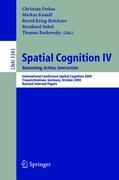
Spatial Cognition IV, Reasoning, Action, Interaction
Idioma: Inglés
Publicado por Springer Berlin Heidelberg, 2005
ISBN 10: 3540250484 ISBN 13: 9783540250487
Librería: moluna, Greven, Alemania
Calificación del vendedor: 4 de 5 estrellas

EUR 92,27
Envío por EUR 48,99
Se envía de Alemania a Estados Unidos de AmericaCantidad disponible: Más de 20 disponibles
Añadir al carritoCondición: New. Dieser Artikel ist ein Print on Demand Artikel und wird nach Ihrer Bestellung fuer Sie gedruckt. This is the fourth volume in a series of books dedicated to basic research in spatial cognition. Spatial cognition is a field that investigates the connection between the physical spatial world and the mental world. Philosophers and researchers have p- pose.


