

Importe total (1 artículo artículos):
Destino del pedido:

9783110226041 - Handbook of Interpersonal Communication: 2 (Handbooks of Applied Linguistics [HAL], 2) (17 resultados)
Ir a los resultados principales
Filtros de búsqueda
Tipo de artículo
- Todos los tipos de productos
- Libros (17)
- Revistas y publicaciones (No hay ningún otro resultado que coincida con este filtro.)
- Cómics (No hay ningún otro resultado que coincida con este filtro.)
- Partituras (No hay ningún otro resultado que coincida con este filtro.)
- Arte, grabados y pósters (No hay ningún otro resultado que coincida con este filtro.)
- Fotografías (No hay ningún otro resultado que coincida con este filtro.)
- Mapas (No hay ningún otro resultado que coincida con este filtro.)
- Manuscritos y coleccionismo de papel (No hay ningún otro resultado que coincida con este filtro.)
Condición Más información
- Nuevo (15)
- Como nuevo, Excelente o Muy bueno (2)
- Bueno o Aceptable (No hay ningún otro resultado que coincida con este filtro.)
- Regular o Pobre (No hay ningún otro resultado que coincida con este filtro.)
- Tal como se indica (No hay ningún otro resultado que coincida con este filtro.)
Encuadernación
- Todas
- Tapa dura (No hay ningún otro resultado que coincida con este filtro.)
- Tapa blanda (17)
Más atributos
- Primera edición (No hay ningún otro resultado que coincida con este filtro.)
- Firmado (No hay ningún otro resultado que coincida con este filtro.)
- Sobrecubierta (No hay ningún otro resultado que coincida con este filtro.)
- Con imágenes (12)
- No impresión bajo demanda (12)
Idioma (1)
Precio
- Cualquier precio
- Menos de EUR 20 (No hay ningún otro resultado que coincida con este filtro.)
- EUR 20 a EUR 40 (No hay ningún otro resultado que coincida con este filtro.)
- Más de EUR 40
Gastos de envío gratis
Ubicación del vendedor
Valoración de los vendedores
-

Handbook of Interpersonal Communication
Libro 7 de 18: Handbooks of Applied Linguistics [HAL]Librería: GreatBookPrices, Columbia, MD, Estados Unidos de America
Calificación del vendedor: 5 de 5 estrellas

EUR 51,29
Envío por EUR 2,24
Se envía dentro de Estados Unidos de AmericaCantidad disponible: Más de 20 disponibles
Añadir al carritoCondición: New.
-

Handbook of Interpersonal Communication (Paperback or Softback)
Libro 7 de 18: Handbooks of Applied Linguistics [HAL]Idioma: Inglés
Publicado por de Gruyter Mouton 6/28/2010, 2010
ISBN 10: 3110226049 ISBN 13: 9783110226041
Librería: BargainBookStores, Grand Rapids, MI, Estados Unidos de America
Calificación del vendedor: 5 de 5 estrellas
EUR 53,61
Gastos de envío gratis
Se envía dentro de Estados Unidos de AmericaCantidad disponible: 5 disponibles
Añadir al carritoPaperback or Softback. Condición: New. Handbook of Interpersonal Communication. Book.
-

Handbook of Interpersonal Communication
Libro 7 de 18: Handbooks of Applied Linguistics [HAL]Librería: GreatBookPrices, Columbia, MD, Estados Unidos de America
Calificación del vendedor: 5 de 5 estrellas
EUR 55,30
Envío por EUR 2,24
Se envía dentro de Estados Unidos de AmericaCantidad disponible: Más de 20 disponibles
Añadir al carritoCondición: As New. Unread book in perfect condition.
-
![Imagen de archivo de Handbook of Interpersonal Communication (Handbooks of Applied Linguistics [HAL], 2) a la venta por California Books](https://pictures.abebooks.com/isbn/9783110226041-es-300.jpg)
Handbook of Interpersonal Communication (Handbooks of Applied Linguistics [HAL], 2)
Libro 7 de 18: Handbooks of Applied Linguistics [HAL]Librería: California Books, Miami, FL, Estados Unidos de America
Calificación del vendedor: 5 de 5 estrellas
EUR 60,29
Gastos de envío gratis
Se envía dentro de Estados Unidos de AmericaCantidad disponible: Más de 20 disponibles
Añadir al carritoCondición: New.
-

Handbook of Interpersonal Communication
Libro 7 de 18: Handbooks of Applied Linguistics [HAL]Librería: Rarewaves USA, OSWEGO, IL, Estados Unidos de America
Calificación del vendedor: 5 de 5 estrellas
EUR 60,73
Gastos de envío gratis
Se envía dentro de Estados Unidos de AmericaCantidad disponible: Más de 20 disponibles
Añadir al carritoPaperback. Condición: New. Interpersonal communication (IC) is a continuous game between the interacting interactants. It is a give and take - a continuous, dynamic flow that is linguistically realized as discourse as an on-going sequence of interactants' moves. Interpersonal communication is produced and interpreted by acting linguistically, and this makes it a fascinating research area. The handbook, Interpersonal Communication , examines how interactants manage to exchange facts, ideas, views, opinions, beliefs, emotion, etc. by using the linguistic systems and the resources they offer. In interpersonal communication, the fine-tuning of individuals' use of the linguistic resources is continuously probed. The language used in interpersonal communication enhances social relations between interactants and keeps the interaction on the normal track. When interaction gets off the track, linguistic miscommunication may also destroy social relationships. This volume is essentially concerned with this fine-tuning in discourse, and how it is achieved among various interactant groups. The volume departs from the following fundamental questions: How do interpersonal relations manifest themselves in language? What is the role of language in developing and maintaining relationships in interpersonal communication?What types of problems occur in interpersonal communication and what kind of strategies and means are used to solve them?How does linguistically realized interpersonal communication interact with other semiotic modes? Interpersonal communication is seen and researched from the perspective of what is being said or written, and how it is realized in various generic forms. The current research also gives attention to other semiotic modes which interact with the linguistic modes. It is not just the social roles of interactants in groups, the possible media available, the non-verbal behaviors, the varying contextual frames for communication, but primarily the actual linguistic manifestations that we need to focus upon when we want to have a full picture of what is going on in human interpersonal communication. It is this linguistic perspective that the volume aims to present to all researchers interested in IC. The volume offers an overview of the theories, methods, tools, and resources of linguistically-oriented approaches, e.g. from the fields of linguistics, social psychology, sociology, and semiotics, for the purpose of integration and further development of the interests in IC., Topics e.g.: Orientation to interaction as primarily linguistically realized processesExpertise on theorizing and analyzing cultural and situational contexts where linguistic processes are realizedExpertise on handling language corporaExpertise on theorizing and analyzing interaction types as genresOrientation to an integrated view of linguistic and non-linguistic participant activities and of how interactants generate meanings and interact with spaceExpertise on researching the management of the lin.
-
Handbook of Interpersonal Communication (Handbooks of Applied Linguistics [HAL], 2)
Libro 7 de 18: Handbooks of Applied Linguistics [HAL]Librería: Ria Christie Collections, Uxbridge, Reino Unido
Calificación del vendedor: 5 de 5 estrellas
EUR 61,25
Envío por EUR 13,70
Se envía de Reino Unido a Estados Unidos de AmericaCantidad disponible: Más de 20 disponibles
Añadir al carritoCondición: New. In.
-
Handbook of Interpersonal Communication (Handbooks of Applied Linguistics [HAL])
Libro 7 de 18: Handbooks of Applied Linguistics [HAL]Idioma: Inglés
Publicado por Mouton de Gruyter 2010-06-28, 2010
ISBN 10: 3110226049 ISBN 13: 9783110226041
Librería: Chiron Media, Wallingford, Reino Unido
Calificación del vendedor: 5 de 5 estrellas
EUR 59,96
Envío por EUR 17,72
Se envía de Reino Unido a Estados Unidos de AmericaCantidad disponible: 10 disponibles
Añadir al carritoPaperback. Condición: New.
-

Handbook of Interpersonal Communication
Libro 7 de 18: Handbooks of Applied Linguistics [HAL]Librería: GreatBookPricesUK, Woodford Green, Reino Unido
Calificación del vendedor: 5 de 5 estrellas
EUR 61,24
Envío por EUR 17,15
Se envía de Reino Unido a Estados Unidos de AmericaCantidad disponible: Más de 20 disponibles
Añadir al carritoCondición: New.
-

Handbook of Interpersonal Communication
Libro 7 de 18: Handbooks of Applied Linguistics [HAL]Librería: GreatBookPricesUK, Woodford Green, Reino Unido
Calificación del vendedor: 5 de 5 estrellas
EUR 63,69
Envío por EUR 17,15
Se envía de Reino Unido a Estados Unidos de AmericaCantidad disponible: Más de 20 disponibles
Añadir al carritoCondición: As New. Unread book in perfect condition.
-

Handbook of Interpersonal Communication
Libro 7 de 18: Handbooks of Applied Linguistics [HAL]Librería: Rarewaves USA United, OSWEGO, IL, Estados Unidos de America
Calificación del vendedor: 5 de 5 estrellas
EUR 62,68
Envío por EUR 42,42
Se envía dentro de Estados Unidos de AmericaCantidad disponible: Más de 20 disponibles
Añadir al carritoPaperback. Condición: New. Interpersonal communication (IC) is a continuous game between the interacting interactants. It is a give and take - a continuous, dynamic flow that is linguistically realized as discourse as an on-going sequence of interactants' moves. Interpersonal communication is produced and interpreted by acting linguistically, and this makes it a fascinating research area. The handbook, Interpersonal Communication , examines how interactants manage to exchange facts, ideas, views, opinions, beliefs, emotion, etc. by using the linguistic systems and the resources they offer. In interpersonal communication, the fine-tuning of individuals' use of the linguistic resources is continuously probed. The language used in interpersonal communication enhances social relations between interactants and keeps the interaction on the normal track. When interaction gets off the track, linguistic miscommunication may also destroy social relationships. This volume is essentially concerned with this fine-tuning in discourse, and how it is achieved among various interactant groups. The volume departs from the following fundamental questions: How do interpersonal relations manifest themselves in language? What is the role of language in developing and maintaining relationships in interpersonal communication?What types of problems occur in interpersonal communication and what kind of strategies and means are used to solve them?How does linguistically realized interpersonal communication interact with other semiotic modes? Interpersonal communication is seen and researched from the perspective of what is being said or written, and how it is realized in various generic forms. The current research also gives attention to other semiotic modes which interact with the linguistic modes. It is not just the social roles of interactants in groups, the possible media available, the non-verbal behaviors, the varying contextual frames for communication, but primarily the actual linguistic manifestations that we need to focus upon when we want to have a full picture of what is going on in human interpersonal communication. It is this linguistic perspective that the volume aims to present to all researchers interested in IC. The volume offers an overview of the theories, methods, tools, and resources of linguistically-oriented approaches, e.g. from the fields of linguistics, social psychology, sociology, and semiotics, for the purpose of integration and further development of the interests in IC., Topics e.g.: Orientation to interaction as primarily linguistically realized processesExpertise on theorizing and analyzing cultural and situational contexts where linguistic processes are realizedExpertise on handling language corporaExpertise on theorizing and analyzing interaction types as genresOrientation to an integrated view of linguistic and non-linguistic participant activities and of how interactants generate meanings and interact with spaceExpertise on researching the management of the lin.
-

Handbook of Interpersonal Communication
Libro 7 de 18: Handbooks of Applied Linguistics [HAL]Idioma: Inglés
Publicado por De Gruyter Mouton, De Gruyter Mouton Jun 2010, 2010
ISBN 10: 3110226049 ISBN 13: 9783110226041
Librería: buchversandmimpf2000, Emtmannsberg, BAYE, Alemania
Calificación del vendedor: 5 de 5 estrellas
EUR 59,95
Envío por EUR 60,00
Se envía de Alemania a Estados Unidos de AmericaCantidad disponible: 2 disponibles
Añadir al carritoTaschenbuch. Condición: Neu. Neuware -Interpersonal communication (IC) is a continuous game between the interacting interactants. It is a give and take - a continuous, dynamic flow that is linguistically realized as discourse as an on-going sequence of interactants' moves. Interpersonal communication is produced and interpreted by acting linguistically, and this makes it a fascinating research area. The handbook, Interpersonal Communication , examines how interactants manage to exchange facts, ideas, views, opinions, beliefs, emotion, etc. by using the linguistic systems and the resources they offer. In interpersonal communication, the fine-tuning of individuals' use of the linguistic resources is continuously probed. The language used in interpersonal communication enhances social relations between interactants and keeps the interaction on the normal track. When interaction gets off the track, linguistic miscommunication may also destroy social relationships. This volume is essentially concerned with this fine-tuning in discourse, and how it is achieved among various interactant groups.The volume departs from the following fundamental questions: How do interpersonal relations manifest themselves in language What is the role of language in developing and maintaining relationships in interpersonal communication What types of problems occur in interpersonal communication and what kind of strategies and means are used to solve them How does linguistically realized interpersonal communication interact with other semiotic modes Interpersonal communication is seen and researched from the perspective of what is being said or written, and how it is realized in various generic forms. The current research also gives attention to other semiotic modes which interact with the linguistic modes. It is not just the social roles of interactants in groups, the possible media available, the non-verbal behaviors, the varying contextual frames for communication, but primarily the actual linguistic manifestations that we need to focus upon when we want to have a full picture of what is going on in human interpersonal communication.It is this linguistic perspective that the volume aims to present to all researchers interested in IC. The volume offers an overview of the theories, methods, tools, and resources of linguistically-oriented approaches, e.g. from the fields of linguistics, social psychology, sociology, and semiotics, for the purpose of integration and further development of the interests in IC.Topics e.g.: Orientation to interaction as primarily linguistically realized processesExpertise on theorizing and analyzing cultural and situational contexts where linguistic processes are realizedExpertise on handling language corporaExpertise on theorizing and analyzing interaction types as genresOrientation to an integrated view of linguistic and non-linguistic participant activities and of how interactants generate meanings and interact with spaceExpertise on researching the management of the linguistic flow in interaction and its successfulness.Walter de Gruyter GmbH, Genthiner Strasse 13, 10785 Berlin 660 pp. Englisch.
-

Handbook of Interpersonal Communication
Libro 7 de 18: Handbooks of Applied Linguistics [HAL]Librería: AHA-BUCH GmbH, Einbeck, Alemania
Calificación del vendedor: 5 de 5 estrellas
EUR 59,95
Envío por EUR 64,82
Se envía de Alemania a Estados Unidos de AmericaCantidad disponible: 1 disponibles
Añadir al carritoTaschenbuch. Condición: Neu. Druck auf Anfrage Neuware - Printed after ordering - Interpersonal communication (IC) is a continuous game between the interacting interactants. It is a give and take - a continuous, dynamic flow that is linguistically realized as discourse as an on-going sequence of interactants' moves. Interpersonal communication is produced and interpreted by acting linguistically, and this makes it a fascinating research area. The handbook, Interpersonal Communication , examines how interactants manage to exchange facts, ideas, views, opinions, beliefs, emotion, etc. by using the linguistic systems and the resources they offer. In interpersonal communication, the fine-tuning of individuals' use of the linguistic resources is continuously probed. The language used in interpersonal communication enhances social relations between interactants and keeps the interaction on the normal track. When interaction gets off the track, linguistic miscommunication may also destroy social relationships. This volume is essentially concerned with this fine-tuning in discourse, and how it is achieved among various interactant groups. The volume departs from the following fundamental questions: How do interpersonal relations manifest themselves in language What is the role of language in developing and maintaining relationships in interpersonal communication What types of problems occur in interpersonal communication and what kind of strategies and means are used to solve them How does linguistically realized interpersonal communication interact with other semiotic modes Interpersonal communication is seen and researched from the perspective of what is being said or written, and how it is realized in various generic forms. The current research also gives attention to other semiotic modes which interact with the linguistic modes. It is not just the social roles of interactants in groups, the possible media available, the non-verbal behaviors, the varying contextual frames for communication, but primarily the actual linguistic manifestations that we need to focus upon when we want to have a full picture of what is going on in human interpersonal communication. It is this linguistic perspective that the volume aims to present to all researchers interested in IC. The volume offers an overview of the theories, methods, tools, and resources of linguistically-oriented approaches, e.g. from the fields of linguistics, social psychology, sociology, and semiotics, for the purpose of integration and further development of the interests in IC., Topics e.g.: Orientation to interaction as primarily linguistically realized processes Expertise on theorizing and analyzing cultural and situational contexts where linguistic processes are realized Expertise on handling language corpora Expertise on theorizing and analyzing interaction types as genres Orientation to an integrated view of linguistic and non-linguistic participant activities and of how interactants generate meanings and interact with space Expertise on researching the management of the linguistic flow in interaction and its successfulness.
-
Handbook of Interpersonal Communication
Libro 7 de 18: Handbooks of Applied Linguistics [HAL]Librería: PBShop.store UK, Fairford, GLOS, Reino Unido
Calificación del vendedor: 4 de 5 estrellas

EUR 63,03
Envío por EUR 6,71
Se envía de Reino Unido a Estados Unidos de AmericaCantidad disponible: Más de 20 disponibles
Añadir al carritoPAP. Condición: New. New Book. Delivered from our UK warehouse in 4 to 14 business days. THIS BOOK IS PRINTED ON DEMAND. Established seller since 2000.
-
Handbook of Interpersonal Communication
Libro 7 de 18: Handbooks of Applied Linguistics [HAL]Librería: PBShop.store US, Wood Dale, IL, Estados Unidos de America
Calificación del vendedor: 5 de 5 estrellas
EUR 69,91
Gastos de envío gratis
Se envía dentro de Estados Unidos de AmericaCantidad disponible: Más de 20 disponibles
Añadir al carritoPAP. Condición: New. New Book. Shipped from UK. THIS BOOK IS PRINTED ON DEMAND. Established seller since 2000.
-
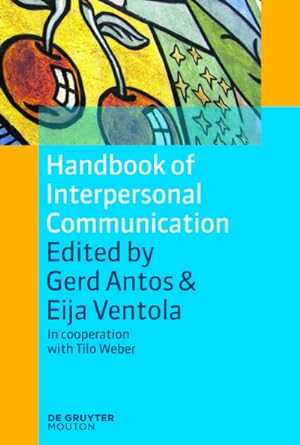
Handbook of Interpersonal Communication
Libro 7 de 18: Handbooks of Applied Linguistics [HAL]Idioma: Inglés
Publicado por De Gruyter Mouton Jun 2010, 2010
ISBN 10: 3110226049 ISBN 13: 9783110226041
Librería: BuchWeltWeit Ludwig Meier e.K., Bergisch Gladbach, Alemania
Calificación del vendedor: 5 de 5 estrellas
EUR 59,95
Envío por EUR 23,00
Se envía de Alemania a Estados Unidos de AmericaCantidad disponible: 2 disponibles
Añadir al carritoTaschenbuch. Condición: Neu. This item is printed on demand - it takes 3-4 days longer - Neuware -Interpersonal communication (IC) is a continuous game between the interacting interactants. It is a give and take - a continuous, dynamic flow that is linguistically realized as discourse as an on-going sequence of interactants' moves. Interpersonal communication is produced and interpreted by acting linguistically, and this makes it a fascinating research area. The handbook, Interpersonal Communication , examines how interactants manage to exchange facts, ideas, views, opinions, beliefs, emotion, etc. by using the linguistic systems and the resources they offer. In interpersonal communication, the fine-tuning of individuals' use of the linguistic resources is continuously probed. The language used in interpersonal communication enhances social relations between interactants and keeps the interaction on the normal track. When interaction gets off the track, linguistic miscommunication may also destroy social relationships. This volume is essentially concerned with this fine-tuning in discourse, and how it is achieved among various interactant groups. The volume departs from the following fundamental questions: How do interpersonal relations manifest themselves in language What is the role of language in developing and maintaining relationships in interpersonal communication What types of problems occur in interpersonal communication and what kind of strategies and means are used to solve them How does linguistically realized interpersonal communication interact with other semiotic modes Interpersonal communication is seen and researched from the perspective of what is being said or written, and how it is realized in various generic forms. The current research also gives attention to other semiotic modes which interact with the linguistic modes. It is not just the social roles of interactants in groups, the possible media available, the non-verbal behaviors, the varying contextual frames for communication, but primarily the actual linguistic manifestations that we need to focus upon when we want to have a full picture of what is going on in human interpersonal communication. It is this linguistic perspective that the volume aims to present to all researchers interested in IC. The volume offers an overview of the theories, methods, tools, and resources of linguistically-oriented approaches, e.g. from the fields of linguistics, social psychology, sociology, and semiotics, for the purpose of integration and further development of the interests in IC., Topics e.g.: Orientation to interaction as primarily linguistically realized processes Expertise on theorizing and analyzing cultural and situational contexts where linguistic processes are realized Expertise on handling language corpora Expertise on theorizing and analyzing interaction types as genres Orientation to an integrated view of linguistic and non-linguistic participant activities and of how interactants generate meanings and interact with space Expertise on researching the management of the linguistic flow in interaction and its successfulness. 660 pp. Englisch.
-

Handbook of Interpersonal Communication
Libro 7 de 18: Handbooks of Applied Linguistics [HAL]Librería: moluna, Greven, Alemania
Calificación del vendedor: 4 de 5 estrellas
EUR 52,41
Envío por EUR 48,99
Se envía de Alemania a Estados Unidos de AmericaCantidad disponible: Más de 20 disponibles
Añadir al carritoKartoniert / Broschiert. Condición: New. Dieser Artikel ist ein Print on Demand Artikel und wird nach Ihrer Bestellung fuer Sie gedruckt. Gerd Antos, Martin Luther Universitaet Halle-Wittenberg, Germany Eija Ventola, University of Helsinki, Finland.
-

Handbook of Interpersonal Communication
Libro 7 de 18: Handbooks of Applied Linguistics [HAL]Librería: preigu, Osnabrück, Alemania
Calificación del vendedor: 5 de 5 estrellas
EUR 54,40
Envío por EUR 70,00
Se envía de Alemania a Estados Unidos de AmericaCantidad disponible: 5 disponibles
Añadir al carritoTaschenbuch. Condición: Neu. Handbook of Interpersonal Communication | Gerd Antos (u. a.) | Taschenbuch | XX | Englisch | 2010 | De Gruyter Mouton | EAN 9783110226041 | Verantwortliche Person für die EU: Walter de Gruyter GmbH, De Gruyter GmbH, Genthiner Str. 13, 10785 Berlin, productsafety[at]degruyterbrill[dot]com | Anbieter: preigu Print on Demand.

