

Importe total (1 artículo artículos):
Destino del pedido:

9783034898355 - Progress in Inverse Spectral Geometry (Trends in Mathematics) de Andersson, Stig I.; Lapidus, Michel L. (8 resultados)
Ir a los resultados principales
Filtros de búsqueda
Tipo de artículo
- Todos los tipos de productos
- Libros (8)
- Revistas y publicaciones (No hay ningún otro resultado que coincida con este filtro.)
- Cómics (No hay ningún otro resultado que coincida con este filtro.)
- Partituras (No hay ningún otro resultado que coincida con este filtro.)
- Arte, grabados y pósters (No hay ningún otro resultado que coincida con este filtro.)
- Fotografías (No hay ningún otro resultado que coincida con este filtro.)
- Mapas (No hay ningún otro resultado que coincida con este filtro.)
- Manuscritos y coleccionismo de papel (No hay ningún otro resultado que coincida con este filtro.)
Condición Más información
- Nuevo (7)
- Como nuevo, Excelente o Muy bueno (1)
- Bueno o Aceptable (No hay ningún otro resultado que coincida con este filtro.)
- Regular o Pobre (No hay ningún otro resultado que coincida con este filtro.)
- Tal como se indica (No hay ningún otro resultado que coincida con este filtro.)
Encuadernación
- Todas
- Tapa dura (No hay ningún otro resultado que coincida con este filtro.)
- Tapa blanda (8)
Más atributos
- Primera edición (No hay ningún otro resultado que coincida con este filtro.)
- Firmado (No hay ningún otro resultado que coincida con este filtro.)
- Sobrecubierta (No hay ningún otro resultado que coincida con este filtro.)
- Con imágenes (5)
- No impresión bajo demanda (5)
Idioma (1)
Precio
- Cualquier precio
- Menos de EUR 20 (No hay ningún otro resultado que coincida con este filtro.)
- EUR 20 a EUR 45 (No hay ningún otro resultado que coincida con este filtro.)
- Más de EUR 45
Gastos de envío gratis
- Envío gratis a Estados Unidos de America (No hay ningún otro resultado que coincida con este filtro.)
Ubicación del vendedor
Valoración de los vendedores
-
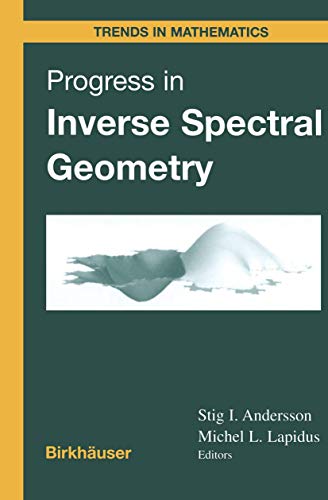
Progress in Inverse Spectral Geometry (Trends in Mathematics)
Librería: Ria Christie Collections, Uxbridge, Reino Unido
Calificación del vendedor: 5 de 5 estrellas

EUR 59,11
Envío por EUR 13,86
Se envía de Reino Unido a Estados Unidos de AmericaCantidad disponible: Más de 20 disponibles
Añadir al carritoCondición: New. In.
-
Progress in Inverse Spectral Geometry
Librería: moluna, Greven, Alemania
Calificación del vendedor: 4 de 5 estrellas

EUR 48,37
Envío por EUR 48,99
Se envía de Alemania a Estados Unidos de AmericaCantidad disponible: Más de 20 disponibles
Añadir al carritoCondición: New.
-

Progress in Inverse Spectral Geometry
Librería: AHA-BUCH GmbH, Einbeck, Alemania
Calificación del vendedor: 5 de 5 estrellas
EUR 53,49
Envío por EUR 61,65
Se envía de Alemania a Estados Unidos de AmericaCantidad disponible: 1 disponibles
Añadir al carritoTaschenbuch. Condición: Neu. Druck auf Anfrage Neuware - Printed after ordering - most polynomial growth on every half-space Re (z) ::::: c. Moreover, Op(t) depends holomorphically on t for Re t O. General references for much of the material on the derivation of spectral functions, asymptotic expansions and analytic properties of spectral functions are [A-P-S] and [Sh], especially Chapter 2. To study the spectral functions and their relation to the geometry and topology of X, one could, for example, take the natural associated parabolic problem as a starting point. That is, consider the 'heat equation': (%t + p) u(x, t) = 0 { u(x,O) = Uo(x), tP which is solved by means of the (heat) semi group V(t) = e- ; namely, u( , t) = V(t)uoU Assuming that V(t) is of trace class (which is guaranteed, for instance, if P has a positive principal symbol), it has a Schwartz kernel K E COO(X x X x Rt,E ®E), locally given by 00 K(x,y; t) = L-IAk(~k ® 'Pk)(X,y), k=O for a complete set of orthonormal eigensections 'Pk E COO(E). Taking the trace, we then obtain: 00 tA Op(t) = trace(V(t)) = 2::- k. k=O Now, using, e. g. , the Dunford calculus formula (where C is a suitable curve around a(P)) as a starting point and the standard for malism of pseudodifferential operators, one easily derives asymptotic expansions for the spectral functions, in this case for Op.
-
Progress in Inverse Spectral Geometry
Librería: preigu, Osnabrück, Alemania
Calificación del vendedor: 5 de 5 estrellas
EUR 50,25
Envío por EUR 70,00
Se envía de Alemania a Estados Unidos de AmericaCantidad disponible: 5 disponibles
Añadir al carritoTaschenbuch. Condición: Neu. Progress in Inverse Spectral Geometry | Stig I. Andersson (u. a.) | Taschenbuch | v | Englisch | 2012 | Birkhäuser | EAN 9783034898355 | Verantwortliche Person für die EU: Springer Basel AG in Springer Science + Business Media, Heidelberger Platz 3, 14197 Berlin, juergen[dot]hartmann[at]springer[dot]com | Anbieter: preigu.
-
Progress in Inverse Spectral Geometry (Trends in Mathematics)
Librería: Mispah books, Redhill, SURRE, Reino Unido
Calificación del vendedor: 4 de 5 estrellas
EUR 106,02
Envío por EUR 28,91
Se envía de Reino Unido a Estados Unidos de AmericaCantidad disponible: 1 disponibles
Añadir al carritoPaperback. Condición: Like New. Like New. book.
-
Andersson:Progress in Inverse Spectral (eng)
Librería: Brook Bookstore On Demand, Napoli, NA, Italia
Calificación del vendedor: 4 de 5 estrellas
EUR 46,22
Envío por EUR 5,50
Se envía de Italia a Estados Unidos de AmericaCantidad disponible: Más de 20 disponibles
Añadir al carritoCondición: new. Questo è un articolo print on demand.
-

Progress in Inverse Spectral Geometry
Idioma: Inglés
Publicado por Birkhäuser Basel Okt 2012, 2012
ISBN 10: 3034898355 ISBN 13: 9783034898355
Librería: BuchWeltWeit Ludwig Meier e.K., Bergisch Gladbach, Alemania
Calificación del vendedor: 5 de 5 estrellas
EUR 53,49
Envío por EUR 23,00
Se envía de Alemania a Estados Unidos de AmericaCantidad disponible: 2 disponibles
Añadir al carritoTaschenbuch. Condición: Neu. This item is printed on demand - it takes 3-4 days longer - Neuware -most polynomial growth on every half-space Re (z) ::::: c. Moreover, Op(t) depends holomorphically on t for Re t O. General references for much of the material on the derivation of spectral functions, asymptotic expansions and analytic properties of spectral functions are [A-P-S] and [Sh], especially Chapter 2. To study the spectral functions and their relation to the geometry and topology of X, one could, for example, take the natural associated parabolic problem as a starting point. That is, consider the 'heat equation': (%t + p) u(x, t) = 0 { u(x,O) = Uo(x), tP which is solved by means of the (heat) semi group V(t) = e- ; namely, u( , t) = V(t)uoU Assuming that V(t) is of trace class (which is guaranteed, for instance, if P has a positive principal symbol), it has a Schwartz kernel K E COO(X x X x Rt,E ®E), locally given by 00 K(x,y; t) = L-IAk(~k ® 'Pk)(X,y), k=O for a complete set of orthonormal eigensections 'Pk E COO(E). Taking the trace, we then obtain: 00 tA Op(t) = trace(V(t)) = 2::- k. k=O Now, using, e. g. , the Dunford calculus formula (where C is a suitable curve around a(P)) as a starting point and the standard for malism of pseudodifferential operators, one easily derives asymptotic expansions for the spectral functions, in this case for Op. 212 pp. Englisch.
-

Progress in Inverse Spectral Geometry
Idioma: Inglés
Publicado por Birkhäuser Basel, Birkhäuser Basel Okt 2012, 2012
ISBN 10: 3034898355 ISBN 13: 9783034898355
Librería: buchversandmimpf2000, Emtmannsberg, BAYE, Alemania
Calificación del vendedor: 5 de 5 estrellas
EUR 53,49
Envío por EUR 60,00
Se envía de Alemania a Estados Unidos de AmericaCantidad disponible: 1 disponibles
Añadir al carritoTaschenbuch. Condición: Neu. This item is printed on demand - Print on Demand Titel. Neuware -most polynomial growth on every half-space Re (z) ::::: c. Moreover, Op(t) depends holomorphically on t for Re t > O. General references for much of the material on the derivation of spectral functions, asymptotic expansions and analytic properties of spectral functions are [A-P-S] and [Sh], especially Chapter 2. To study the spectral functions and their relation to the geometry and topology of X, one could, for example, take the natural associated parabolic problem as a starting point. That is, consider the 'heat equation': (%t + p) u(x, t) = 0 { u(x,O) = Uo(x), tP which is solved by means of the (heat) semi group V(t) = e- ; namely, u( , t) = V(t)uoU Assuming that V(t) is of trace class (which is guaranteed, for instance, if P has a positive principal symbol), it has a Schwartz kernel K E COO(X x X x Rt,E\* ®E), locally given by 00 K(x,y; t) = L>-IAk(~k ® 'Pk)(X,y), k=O for a complete set of orthonormal eigensections 'Pk E COO(E). Taking the trace, we then obtain: 00 tA Op(t) = trace(V(t)) = 2::>- k. k=O Now, using, e. g. , the Dunford calculus formula (where C is a suitable curve around a(P)) as a starting point and the standard for malism of pseudodifferential operators, one easily derives asymptotic expansions for the spectral functions, in this case for Op.Springer Basel AG in Springer Science + Business Media, Heidelberger Platz 3, 14197 Berlin 212 pp. Englisch.


