
Importe total (1 artículo artículos):
Destino del pedido:

9783031014222 - Java Software Development with Event B: A Practical Guide (Synthesis Lectures on Software Engineering) de Collazos, Néstor Cataño (14 resultados)
Ir a los resultados principales
Filtros de búsqueda
Tipo de artículo
- Todos los tipos de productos
- Libros (14)
- Revistas y publicaciones (No hay ningún otro resultado que coincida con este filtro.)
- Cómics (No hay ningún otro resultado que coincida con este filtro.)
- Partituras (No hay ningún otro resultado que coincida con este filtro.)
- Arte, grabados y pósters (No hay ningún otro resultado que coincida con este filtro.)
- Fotografías (No hay ningún otro resultado que coincida con este filtro.)
- Mapas (No hay ningún otro resultado que coincida con este filtro.)
- Manuscritos y coleccionismo de papel (No hay ningún otro resultado que coincida con este filtro.)
Condición Más información
- Nuevo (12)
- Como nuevo, Excelente o Muy bueno (2)
- Bueno o Aceptable (No hay ningún otro resultado que coincida con este filtro.)
- Regular o Pobre (No hay ningún otro resultado que coincida con este filtro.)
- Tal como se indica (No hay ningún otro resultado que coincida con este filtro.)
Encuadernación
- Todas
- Tapa dura (No hay ningún otro resultado que coincida con este filtro.)
- Tapa blanda (14)
Más atributos
- Primera edición (No hay ningún otro resultado que coincida con este filtro.)
- Firmado (No hay ningún otro resultado que coincida con este filtro.)
- Sobrecubierta (No hay ningún otro resultado que coincida con este filtro.)
- Con imágenes (8)
- No impresión bajo demanda (10)
Idioma (1)
Precio
- Cualquier precio
- Menos de EUR 20 (No hay ningún otro resultado que coincida con este filtro.)
- EUR 20 a EUR 40
- Más de EUR 40
Gastos de envío gratis
- Envío gratis a Estados Unidos de America (No hay ningún otro resultado que coincida con este filtro.)
Ubicación del vendedor
Valoración de los vendedores
-

Java Software Development With Event B : A Practical Guide
Libro 4 de 4: Synthesis Lectures on Software EngineeringLibrería: GreatBookPrices, Columbia, MD, Estados Unidos de America
Calificación del vendedor: 5 de 5 estrellas

EUR 30,18
Envío por EUR 2,23
Se envía dentro de Estados Unidos de AmericaCantidad disponible: Más de 20 disponibles
Añadir al carritoCondición: New.
-

Java Software Development with Event B: A Practical Guide (Synthesis Lectures on Software Engineering)
Libro 4 de 4: Synthesis Lectures on Software EngineeringLibrería: Lucky's Textbooks, Dallas, TX, Estados Unidos de America
Calificación del vendedor: 5 de 5 estrellas
EUR 29,02
Envío por EUR 3,38
Se envía dentro de Estados Unidos de AmericaCantidad disponible: Más de 20 disponibles
Añadir al carritoCondición: New.
-

Java Software Development With Event B : A Practical Guide
Libro 4 de 4: Synthesis Lectures on Software EngineeringLibrería: GreatBookPrices, Columbia, MD, Estados Unidos de America
Calificación del vendedor: 5 de 5 estrellas
EUR 31,38
Envío por EUR 2,23
Se envía dentro de Estados Unidos de AmericaCantidad disponible: Más de 20 disponibles
Añadir al carritoCondición: As New. Unread book in perfect condition.
-
Java Software Development with Event B: A Practical Guide (Synthesis Lectures on Software Engineering)
Libro 4 de 4: Synthesis Lectures on Software EngineeringLibrería: Books Puddle, New York, NY, Estados Unidos de America
Calificación del vendedor: 4 de 5 estrellas

EUR 42,21
Envío por EUR 3,38
Se envía dentro de Estados Unidos de AmericaCantidad disponible: 4 disponibles
Añadir al carritoCondición: New. 1st edition NO-PA16APR2015-KAP.
-
Java Software Development with Event B : A Practical Guide
Libro 4 de 4: Synthesis Lectures on Software EngineeringLibrería: Chiron Media, Wallingford, Reino Unido
Calificación del vendedor: 5 de 5 estrellas
EUR 31,40
Envío por EUR 17,84
Se envía de Reino Unido a Estados Unidos de AmericaCantidad disponible: 10 disponibles
Añadir al carritoPF. Condición: New.
-
Java Software Development with Event B: A Practical Guide (Synthesis Lectures on Software Engineering)
Libro 4 de 4: Synthesis Lectures on Software EngineeringLibrería: Ria Christie Collections, Uxbridge, Reino Unido
Calificación del vendedor: 5 de 5 estrellas
EUR 34,75
Envío por EUR 13,79
Se envía de Reino Unido a Estados Unidos de AmericaCantidad disponible: Más de 20 disponibles
Añadir al carritoCondición: New. In English.
-

Java Software Development With Event B : A Practical Guide
Libro 4 de 4: Synthesis Lectures on Software EngineeringLibrería: GreatBookPricesUK, Woodford Green, Reino Unido
Calificación del vendedor: 5 de 5 estrellas
EUR 34,35
Envío por EUR 17,27
Se envía de Reino Unido a Estados Unidos de AmericaCantidad disponible: Más de 20 disponibles
Añadir al carritoCondición: New.
-

Java Software Development With Event B : A Practical Guide
Libro 4 de 4: Synthesis Lectures on Software EngineeringLibrería: GreatBookPricesUK, Woodford Green, Reino Unido
Calificación del vendedor: 5 de 5 estrellas
EUR 36,90
Envío por EUR 17,27
Se envía de Reino Unido a Estados Unidos de AmericaCantidad disponible: Más de 20 disponibles
Añadir al carritoCondición: As New. Unread book in perfect condition.
-

Java Software Development with Event B
Libro 4 de 4: Synthesis Lectures on Software EngineeringIdioma: Inglés
Publicado por Springer International Publishing, 2020
ISBN 10: 3031014227 ISBN 13: 9783031014222
Librería: moluna, Greven, Alemania
Calificación del vendedor: 4 de 5 estrellas
EUR 28,42
Envío por EUR 48,99
Se envía de Alemania a Estados Unidos de AmericaCantidad disponible: Más de 20 disponibles
Añadir al carritoCondición: New.
-

Java Software Development with Event B : A Practical Guide
Libro 4 de 4: Synthesis Lectures on Software EngineeringIdioma: Inglés
Publicado por Springer International Publishing, 2020
ISBN 10: 3031014227 ISBN 13: 9783031014222
Librería: AHA-BUCH GmbH, Einbeck, Alemania
Calificación del vendedor: 5 de 5 estrellas
EUR 29,95
Envío por EUR 61,03
Se envía de Alemania a Estados Unidos de AmericaCantidad disponible: 1 disponibles
Añadir al carritoTaschenbuch. Condición: Neu. Druck auf Anfrage Neuware - Printed after ordering - The cost of fixing software design flaws after the completion of a software product is so high that it is vital to come up with ways to detect software design flaws in the early stages of software development, for instance, during the software requirements, the analysis activity, or during software design, before coding starts. It is not uncommon that software requirements are ambiguous or contradict each other. Ambiguity is exacerbated by the fact that software requirements are typically written in a natural language, which is not tied to any formal semantics. A palliative to the ambiguity of software requirements is to restrict their syntax to boilerplates, textual templates with placeholders. However, as informal requirements do not enjoy any particular semantics, no essential properties about them (or about the system they attempt to describe) can be proven easily. Formal methods are an alternative to address this problem. They offer a range of mathematical techniques and mathematical tools to validate software requirements in the early stages of software development.This book is a living proof of the use of formal methods to develop software. The particular formalisms that we use are EVENT B and refinement calculus. In short: (i) software requirements as written as User Stories; (ii) they are ported to formal specifications; (iii) they are refined as desired; (iv) they are implemented in the form of a prototype; and finally (v) they are tested for inconsistencies. If some unit-test fails, then informal as well as formal specifications of the software system are revisited and evolved.This book presents a case study of software development of a chat system with EVENT B and a case study of formal proof of properties of a social network.
-
Java Software Development with Event B: A Practical Guide (Synthesis Lectures on Software Engineering)
Libro 4 de 4: Synthesis Lectures on Software EngineeringLibrería: Majestic Books, Hounslow, Reino Unido
Calificación del vendedor: 4 de 5 estrellas
EUR 39,84
Envío por EUR 7,48
Se envía de Reino Unido a Estados Unidos de AmericaCantidad disponible: 4 disponibles
Añadir al carritoCondición: New. Print on Demand.
-
Java Software Development with Event B: A Practical Guide (Synthesis Lectures on Software Engineering)
Libro 4 de 4: Synthesis Lectures on Software EngineeringLibrería: Biblios, Frankfurt am main, HESSE, Alemania
Calificación del vendedor: 4 de 5 estrellas
EUR 41,58
Envío por EUR 9,95
Se envía de Alemania a Estados Unidos de AmericaCantidad disponible: 4 disponibles
Añadir al carritoCondición: New. PRINT ON DEMAND.
-
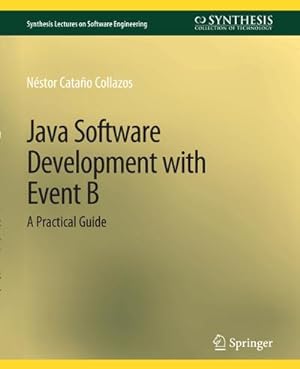
Java Software Development with Event B
Libro 4 de 4: Synthesis Lectures on Software EngineeringIdioma: Inglés
Publicado por Springer International Publishing Jan 2020, 2020
ISBN 10: 3031014227 ISBN 13: 9783031014222
Librería: BuchWeltWeit Ludwig Meier e.K., Bergisch Gladbach, Alemania
Calificación del vendedor: 5 de 5 estrellas
EUR 29,95
Envío por EUR 23,00
Se envía de Alemania a Estados Unidos de AmericaCantidad disponible: 2 disponibles
Añadir al carritoTaschenbuch. Condición: Neu. This item is printed on demand - it takes 3-4 days longer - Neuware -The cost of fixing software design flaws after the completion of a software product is so high that it is vital to come up with ways to detect software design flaws in the early stages of software development, for instance, during the software requirements, the analysis activity, or during software design, before coding starts. It is not uncommon that software requirements are ambiguous or contradict each other. Ambiguity is exacerbated by the fact that software requirements are typically written in a natural language, which is not tied to any formal semantics. A palliative to the ambiguity of software requirements is to restrict their syntax to boilerplates, textual templates with placeholders. However, as informal requirements do not enjoy any particular semantics, no essential properties about them (or about the system they attempt to describe) can be proven easily. Formal methods are an alternative to address this problem. They offer a range of mathematical techniques and mathematical tools to validate software requirements in the early stages of software development.This book is a living proof of the use of formal methods to develop software. The particular formalisms that we use are EVENT B and refinement calculus. In short: (i) software requirements as written as User Stories; (ii) they are ported to formal specifications; (iii) they are refined as desired; (iv) they are implemented in the form of a prototype; and finally (v) they are tested for inconsistencies. If some unit-test fails, then informal as well as formal specifications of the software system are revisited and evolved.This book presents a case study of software development of a chat system with EVENT B and a case study of formal proof of properties of a social network. 100 pp. Englisch.
-

Java Software Development with Event B
Libro 4 de 4: Synthesis Lectures on Software EngineeringIdioma: Inglés
Publicado por Springer International Publishing, Springer Jan 2020, 2020
ISBN 10: 3031014227 ISBN 13: 9783031014222
Librería: buchversandmimpf2000, Emtmannsberg, BAYE, Alemania
Calificación del vendedor: 5 de 5 estrellas
EUR 29,95
Envío por EUR 60,00
Se envía de Alemania a Estados Unidos de AmericaCantidad disponible: 1 disponibles
Añadir al carritoTaschenbuch. Condición: Neu. This item is printed on demand - Print on Demand Titel. Neuware -The cost of fixing software design flaws after the completion of a software product is so high that it is vital to come up with ways to detect software design flaws in the early stages of software development, for instance, during the software requirements, the analysis activity, or during software design, before coding starts. It is not uncommon that software requirements are ambiguous or contradict each other. Ambiguity is exacerbated by the fact that software requirements are typically written in a natural language, which is not tied to any formal semantics. A palliative to the ambiguity of software requirements is to restrict their syntax to boilerplates, textual templates with placeholders. However, as informal requirements do not enjoy any particular semantics, no essential properties about them (or about the system they attempt to describe) can be proven easily. Formal methods are an alternative to address this problem. They offer a range of mathematical techniques and mathematical tools to validate software requirements in the early stages of software development.This book is a living proof of the use of formal methods to develop software. The particular formalisms that we use are EVENT B and refinement calculus. In short: (i) software requirements as written as User Stories; (ii) they are ported to formal specifications; (iii) they are refined as desired; (iv) they are implemented in the form of a prototype; and finally (v) they are tested for inconsistencies. If some unit-test fails, then informal as well as formal specifications of the software system are revisited and evolved.This book presents a case study of software development of a chat system with EVENT B and a case study of formal proof of properties of a social network.Springer-Verlag GmbH, Tiergartenstr. 17, 69121 Heidelberg 100 pp. Englisch.

