

Importe total (1 artículo artículos):
Destino del pedido:

9783031013010 - Monte Carlo Methods: A Hands-On Computational Introduction Utilizing Excel (Synthesis Lectures on Mathematics & Statistics) de Chowdhury, Sujaul (11 resultados)
Ir a los resultados principales
Filtros de búsqueda
Tipo de artículo
- Todos los tipos de productos
- Libros (11)
- Revistas y publicaciones (No hay ningún otro resultado que coincida con este filtro.)
- Cómics (No hay ningún otro resultado que coincida con este filtro.)
- Partituras (No hay ningún otro resultado que coincida con este filtro.)
- Arte, grabados y pósters (No hay ningún otro resultado que coincida con este filtro.)
- Fotografías (No hay ningún otro resultado que coincida con este filtro.)
- Mapas (No hay ningún otro resultado que coincida con este filtro.)
- Manuscritos y coleccionismo de papel (No hay ningún otro resultado que coincida con este filtro.)
Condición Más información
- Nuevo (11)
- Como nuevo, Excelente o Muy bueno (No hay ningún otro resultado que coincida con este filtro.)
- Bueno o Aceptable (No hay ningún otro resultado que coincida con este filtro.)
- Regular o Pobre (No hay ningún otro resultado que coincida con este filtro.)
- Tal como se indica (No hay ningún otro resultado que coincida con este filtro.)
Encuadernación
- Todas
- Tapa dura (No hay ningún otro resultado que coincida con este filtro.)
- Tapa blanda (11)
Más atributos
- Primera edición (No hay ningún otro resultado que coincida con este filtro.)
- Firmado (No hay ningún otro resultado que coincida con este filtro.)
- Sobrecubierta (No hay ningún otro resultado que coincida con este filtro.)
- Con imágenes (3)
- No impresión bajo demanda (6)
Idioma (1)
Precio
- Cualquier precio
- Menos de EUR 20 (No hay ningún otro resultado que coincida con este filtro.)
- EUR 20 a EUR 45
- Más de EUR 45
Gastos de envío gratis
- Envío gratis a Estados Unidos de America (No hay ningún otro resultado que coincida con este filtro.)
Ubicación del vendedor
Valoración de los vendedores
-

Monte Carlo Methods : A Hands-On Computational Introduction Utilizing Excel
Libro 71 de 72: Synthesis Lectures on Mathematics & StatisticsLibrería: Chiron Media, Wallingford, Reino Unido
Calificación del vendedor: 5 de 5 estrellas

EUR 31,76
Envío por EUR 17,95
Se envía de Reino Unido a Estados Unidos de AmericaCantidad disponible: 10 disponibles
Añadir al carritoPF. Condición: New.
-
Monte Carlo Methods: A Hands-On Computational Introduction Utilizing Excel (Synthesis Lectures on Mathematics & Statistics)
Libro 71 de 72: Synthesis Lectures on Mathematics & StatisticsLibrería: Ria Christie Collections, Uxbridge, Reino Unido
Calificación del vendedor: 5 de 5 estrellas
EUR 36,19
Envío por EUR 13,88
Se envía de Reino Unido a Estados Unidos de AmericaCantidad disponible: Más de 20 disponibles
Añadir al carritoCondición: New. In English.
-
Monte Carlo Methods: A Hands-On Computational Introduction Utilizing Excel (Synthesis Lectures on Mathematics & Statistics)
Libro 71 de 72: Synthesis Lectures on Mathematics & StatisticsLibrería: Books Puddle, New York, NY, Estados Unidos de America
Calificación del vendedor: 4 de 5 estrellas

EUR 77,51
Envío por EUR 3,50
Se envía dentro de Estados Unidos de AmericaCantidad disponible: 4 disponibles
Añadir al carritoCondición: New. 1st edition NO-PA16APR2015-KAP.
-
Monte Carlo Methods : A Hands-on Computa
Libro 71 de 72: Synthesis Lectures on Mathematics & StatisticsLibrería: Kennys Bookshop and Art Galleries Ltd., Galway, GY, Irlanda
Calificación del vendedor: 5 de 5 estrellas
EUR 73,18
Envío por EUR 10,50
Se envía de Irlanda a Estados Unidos de AmericaCantidad disponible: 15 disponibles
Añadir al carritoCondición: New.
-
Monte Carlo Methods : A Hands-on Computa
Libro 71 de 72: Synthesis Lectures on Mathematics & StatisticsLibrería: Kennys Bookstore, Olney, MD, Estados Unidos de America
Calificación del vendedor: 5 de 5 estrellas
EUR 92,31
Envío por EUR 9,22
Se envía dentro de Estados Unidos de AmericaCantidad disponible: 15 disponibles
Añadir al carritoCondición: New.
-
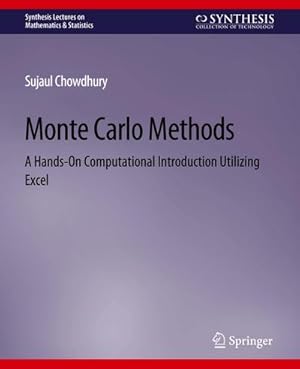
Monte Carlo Methods : A Hands-On Computational Introduction Utilizing Excel
Libro 71 de 72: Synthesis Lectures on Mathematics & StatisticsIdioma: Inglés
Publicado por Springer International Publishing, 2021
ISBN 10: 3031013018 ISBN 13: 9783031013010
Librería: AHA-BUCH GmbH, Einbeck, Alemania
Calificación del vendedor: 5 de 5 estrellas
EUR 56,70
Envío por EUR 61,35
Se envía de Alemania a Estados Unidos de AmericaCantidad disponible: 1 disponibles
Añadir al carritoTaschenbuch. Condición: Neu. Druck auf Anfrage Neuware - Printed after ordering - This book is intended for undergraduate students of Mathematics, Statistics, and Physics who know nothing about Monte Carlo Methods but wish to know how they work. All treatments have been done as much manually as is practicable. The treatments are deliberately manual to let the readers get the real feel of how Monte Carlo Methods work. Definite integrals of a total of five functions ( ), namely Sin( ), Cos( ), e , loge( ), and 1/(1+ 2), have been evaluated using constant, linear, Gaussian, and exponential probability density functions ( ). It is shown that results agree with known exact values better if ( ) is proportional to ( ). Deviation from the proportionality results in worse agreement. This book is on Monte Carlo Methods which are numerical methods for Computational Physics. These are parts of a syllabus for undergraduate students of Mathematics and Physics for the course titled 'Computational Physics.' Need for the book: Besides the three referenced books, this is the only book that teaches how basic Monte Carlo methods work. This book is much more explicit and easier to follow than the three referenced books. The two chapters on the Variational Quantum Monte Carlo method are additional contributions of the book. Pedagogical features: After a thorough acquaintance with background knowledge in Chapter 1, five thoroughly worked out examples on how to carry out Monte Carlo integration is included in Chapter 2. Moreover, the book contains two chapters on the Variational Quantum Monte Carlo method applied to a simple harmonic oscillator and a hydrogen atom. The book is a good read; it is intended to make readers adept at using the method. The book is intended to aid in hands-on learning of the Monte Carlo methods.
-
Monte Carlo Methods (eng)
Libro 71 de 72: Synthesis Lectures on Mathematics & StatisticsLibrería: Brook Bookstore On Demand, Napoli, NA, Italia
Calificación del vendedor: 5 de 5 estrellas
EUR 48,62
Envío por EUR 5,50
Se envía de Italia a Estados Unidos de AmericaCantidad disponible: Más de 20 disponibles
Añadir al carritoCondición: new. Questo è un articolo print on demand.
-
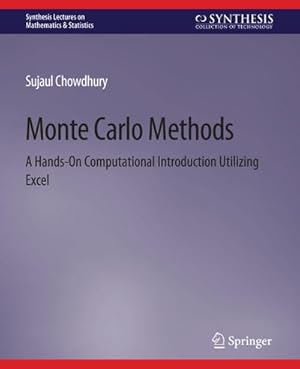
Monte Carlo Methods
Libro 71 de 72: Synthesis Lectures on Mathematics & StatisticsIdioma: Inglés
Publicado por Springer International Publishing Feb 2021, 2021
ISBN 10: 3031013018 ISBN 13: 9783031013010
Librería: BuchWeltWeit Ludwig Meier e.K., Bergisch Gladbach, Alemania
Calificación del vendedor: 5 de 5 estrellas
EUR 56,70
Envío por EUR 23,00
Se envía de Alemania a Estados Unidos de AmericaCantidad disponible: 2 disponibles
Añadir al carritoTaschenbuch. Condición: Neu. This item is printed on demand - it takes 3-4 days longer - Neuware -This book is intended for undergraduate students of Mathematics, Statistics, and Physics who know nothing about Monte Carlo Methods but wish to know how they work. All treatments have been done as much manually as is practicable. The treatments are deliberately manual to let the readers get the real feel of how Monte Carlo Methods work. Definite integrals of a total of five functions ( ), namely Sin( ), Cos( ), e , loge( ), and 1/(1+ 2), have been evaluated using constant, linear, Gaussian, and exponential probability density functions ( ). It is shown that results agree with known exact values better if ( ) is proportional to ( ). Deviation from the proportionality results in worse agreement. This book is on Monte Carlo Methods which are numerical methods for Computational Physics. These are parts of a syllabus for undergraduate students of Mathematics and Physics for the course titled 'Computational Physics.' Need for the book: Besides the three referenced books, this is the only book that teaches how basic Monte Carlo methods work. This book is much more explicit and easier to follow than the three referenced books. The two chapters on the Variational Quantum Monte Carlo method are additional contributions of the book. Pedagogical features: After a thorough acquaintance with background knowledge in Chapter 1, five thoroughly worked out examples on how to carry out Monte Carlo integration is included in Chapter 2. Moreover, the book contains two chapters on the Variational Quantum Monte Carlo method applied to a simple harmonic oscillator and a hydrogen atom. The book is a good read; it is intended to make readers adept at using the method. The book is intended to aid in hands-on learning of the Monte Carlo methods. 136 pp. Englisch.
-
Monte Carlo Methods: A Hands-On Computational Introduction Utilizing Excel (Synthesis Lectures on Mathematics & Statistics)
Libro 71 de 72: Synthesis Lectures on Mathematics & StatisticsLibrería: Majestic Books, Hounslow, Reino Unido
Calificación del vendedor: 4 de 5 estrellas
EUR 78,25
Envío por EUR 7,53
Se envía de Reino Unido a Estados Unidos de AmericaCantidad disponible: 4 disponibles
Añadir al carritoCondición: New. Print on Demand.
-
Monte Carlo Methods: A Hands-On Computational Introduction Utilizing Excel (Synthesis Lectures on Mathematics & Statistics)
Libro 71 de 72: Synthesis Lectures on Mathematics & StatisticsLibrería: Biblios, Frankfurt am main, HESSE, Alemania
Calificación del vendedor: 4 de 5 estrellas
EUR 77,95
Envío por EUR 9,95
Se envía de Alemania a Estados Unidos de AmericaCantidad disponible: 4 disponibles
Añadir al carritoCondición: New. PRINT ON DEMAND.
-

Monte Carlo Methods
Libro 71 de 72: Synthesis Lectures on Mathematics & StatisticsIdioma: Inglés
Publicado por Springer, Palgrave Macmillan Feb 2021, 2021
ISBN 10: 3031013018 ISBN 13: 9783031013010
Librería: buchversandmimpf2000, Emtmannsberg, BAYE, Alemania
Calificación del vendedor: 5 de 5 estrellas
EUR 56,70
Envío por EUR 60,00
Se envía de Alemania a Estados Unidos de AmericaCantidad disponible: 1 disponibles
Añadir al carritoTaschenbuch. Condición: Neu. This item is printed on demand - Print on Demand Titel. Neuware -This book is intended for undergraduate students of Mathematics, Statistics, and Physics who know nothing about Monte Carlo Methods but wish to know how they work. All treatments have been done as much manually as is practicable. The treatments are deliberately manual to let the readers get the real feel of how Monte Carlo Methods work. Definite integrals of a total of five functions ¿¿¿¿(¿¿¿¿), namely Sin(¿¿¿¿), Cos(¿¿¿¿), e¿¿¿¿, loge(¿¿¿¿), and 1/(1+¿¿¿¿2), have been evaluated using constant, linear, Gaussian, and exponential probability density functions ¿¿¿¿(¿¿¿¿). It is shown that results agree with known exact values better if ¿¿¿¿(¿¿¿¿) is proportional to ¿¿¿¿(¿¿¿¿). Deviation from the proportionality results in worse agreement. This book is on Monte Carlo Methods which are numerical methods for Computational Physics. These are parts of a syllabus for undergraduate students of Mathematics and Physics for the course titled 'Computational Physics.' Need for the book: Besides the three referenced books, this is the only book that teaches how basic Monte Carlo methods work. This book is much more explicit and easier to follow than the three referenced books. The two chapters on the Variational Quantum Monte Carlo method are additional contributions of the book. Pedagogical features: After a thorough acquaintance with background knowledge in Chapter 1, five thoroughly worked out examples on how to carry out Monte Carlo integration is included in Chapter 2. Moreover, the book contains two chapters on the Variational Quantum Monte Carlo method applied to a simple harmonic oscillator and a hydrogen atom. The book is a good read; it is intended to make readers adept at using the method. The book is intended to aid in hands-on learning of the Monte Carlo methods.Springer-Verlag KG, Sachsenplatz 4-6, 1201 Wien 136 pp. Englisch.

