

Importe total (1 artículo artículos):
Destino del pedido:

9781538140338 - The Future of Military Engines (CSIS Reports) de Hunter, Andrew P.; Coll, Gabriel; Akca, Asya; Moore, Schuyler (28 resultados)
Ir a los resultados principales
Filtros de búsqueda
Tipo de artículo
- Todos los tipos de productos
- Libros (28)
- Revistas y publicaciones (No hay ningún otro resultado que coincida con este filtro.)
- Cómics (No hay ningún otro resultado que coincida con este filtro.)
- Partituras (No hay ningún otro resultado que coincida con este filtro.)
- Arte, grabados y pósters (No hay ningún otro resultado que coincida con este filtro.)
- Fotografías (No hay ningún otro resultado que coincida con este filtro.)
- Mapas (No hay ningún otro resultado que coincida con este filtro.)
- Manuscritos y coleccionismo de papel (No hay ningún otro resultado que coincida con este filtro.)
Condición Más información
- Nuevo (26)
- Como nuevo, Excelente o Muy bueno (2)
- Bueno o Aceptable (No hay ningún otro resultado que coincida con este filtro.)
- Regular o Pobre (No hay ningún otro resultado que coincida con este filtro.)
- Tal como se indica (No hay ningún otro resultado que coincida con este filtro.)
Encuadernación
- Todas
- Tapa dura (No hay ningún otro resultado que coincida con este filtro.)
- Tapa blanda (28)
Más atributos
- Primera edición (No hay ningún otro resultado que coincida con este filtro.)
- Firmado (No hay ningún otro resultado que coincida con este filtro.)
- Sobrecubierta (No hay ningún otro resultado que coincida con este filtro.)
- Con imágenes (14)
- No impresión bajo demanda (27)
Idioma (1)
Precio
- Cualquier precio
- Menos de EUR 20 (No hay ningún otro resultado que coincida con este filtro.)
- EUR 20 a EUR 45
- Más de EUR 45
Gastos de envío gratis
Ubicación del vendedor
Valoración de los vendedores
-
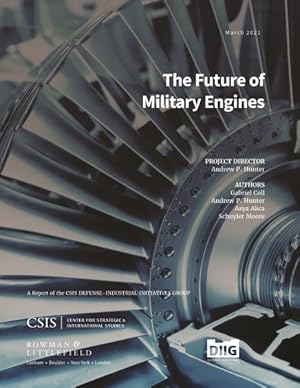
Future of Military Engines
Idioma: Inglés
Publicado por Center for Strategic & International Studies, 2021
ISBN 10: 1538140330 ISBN 13: 9781538140338
Librería: GreatBookPrices, Columbia, MD, Estados Unidos de America
Calificación del vendedor: 5 de 5 estrellas

EUR 43,11
Envío por EUR 2,27
Se envía dentro de Estados Unidos de AmericaCantidad disponible: 7 disponibles
Añadir al carritoCondición: As New. Unread book in perfect condition.
-
The Future of Military Engines (Paperback)
Idioma: Inglés
Publicado por Bloomsbury Publishing Plc, Lanham, MD, 2021
ISBN 10: 1538140330 ISBN 13: 9781538140338
Librería: Grand Eagle Retail, Bensenville, IL, Estados Unidos de America
Calificación del vendedor: 5 de 5 estrellas
EUR 47,37
Gastos de envío gratis
Se envía dentro de Estados Unidos de AmericaCantidad disponible: 1 disponibles
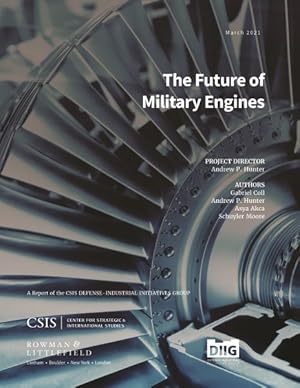
Añadir al carritoPaperback. Condición: new. Paperback. CSIS's The Future of Military Engines looks at the state of the U.S. military engine industrial base and the choices confronting policymakers at the Department of Defense (DoD). The military engine industrial base is closely tied to the industrial base for commercial engines. U.S. engine providers use many of the same facilities and largely the same supply chain for military and commercial engines. The ability to leverage commercial supply chains is critical because supply chain quality underlies the performance advantage of U.S. military engines, both for individual aircraft and military aircraft fleets. International competitors such as Russia and China are seeking to overtake the U.S. in engines. However, the current U.S. advantage is sustainable if it is treated as a national priority. Many military aircraft, especially fighters, require engines with important differences from commercial aircraft. They fly different flight profiles and perform different jobs. These differences mean that while DoD can leverage the commercial engine industrial base, it must also make investments to sustain the industrial bases unique military components. In the next few years, DoD investment in military engines is projected to decrease significantly, particularly for R&D. This presents a challenge as military-unique engineering skills are highly perishable. Four major policy choices confront DoD as it formulates its investment approach to military engines going forward: 1) Priority, 2) Resources, 3) Business Model, and 4) Competition. The DoD is at an inflection point for engine investment, and the time for choosing on these four key policy questions will come in the next few years. This CSIS report describes how DoDs investment in military aircraft engines will decrease significantly, presenting a challenge for the industrial base. The report also argues that DoD must make four major policy choices in its investment approach to military engines: priority, resources, business model, and competition. Shipping may be from multiple locations in the US or from the UK, depending on stock availability.
-
Future of Military Engines
Idioma: Inglés
Publicado por Center for Strategic & International Studies, 2021
ISBN 10: 1538140330 ISBN 13: 9781538140338
Librería: GreatBookPrices, Columbia, MD, Estados Unidos de America
Calificación del vendedor: 5 de 5 estrellas
EUR 45,03
Envío por EUR 2,27
Se envía dentro de Estados Unidos de AmericaCantidad disponible: 7 disponibles
Añadir al carritoCondición: New.
-

The Future of Military Engines
Idioma: Inglés
Publicado por Bloomsbury Publishing Plc, US, 2021
ISBN 10: 1538140330 ISBN 13: 9781538140338
Librería: Rarewaves.com USA, London, LONDO, Reino Unido
Calificación del vendedor: 5 de 5 estrellas
EUR 47,79
Gastos de envío gratis
Se envía de Reino Unido a Estados Unidos de AmericaCantidad disponible: 2 disponibles
Añadir al carritoPaperback. Condición: New. CSIS's The Future of Military Engines looks at the state of the U.S. military engine industrial base and the choices confronting policymakers at the Department of Defense (DoD). The military engine industrial base is closely tied to the industrial base for commercial engines. U.S. engine providers use many of the same facilities and largely the same supply chain for military and commercial engines. The ability to leverage commercial supply chains is critical because supply chain quality underlies the performance advantage of U.S. military engines, both for individual aircraft and military aircraft fleets. International competitors such as Russia and China are seeking to overtake the U.S. in engines. However, the current U.S. advantage is sustainable if it is treated as a national priority. Many military aircraft, especially fighters, require engines with important differences from commercial aircraft. They fly different flight profiles and perform different jobs. These differences mean that while DoD can leverage the commercial engine industrial base, it must also make investments to sustain the industrial base's unique military components. In the next few years, DoD investment in military engines is projected to decrease significantly, particularly for RandD. This presents a challenge as military-unique engineering skills are highly perishable. Four major policy choices confront DoD as it formulates its investment approach to military engines going forward: 1) Priority, 2) Resources, 3) Business Model, and 4) Competition. The DoD is at an inflection point for engine investment, and the time for choosing on these four key policy questions will come in the next few years.
-

The Future of Military Engines
Idioma: Inglés
Publicado por Bloomsbury Publishing Plc, 2021
ISBN 10: 1538140330 ISBN 13: 9781538140338
Librería: PBShop.store UK, Fairford, GLOS, Reino Unido
Calificación del vendedor: 4 de 5 estrellas

EUR 46,83
Envío por EUR 3,79
Se envía de Reino Unido a Estados Unidos de AmericaCantidad disponible: 3 disponibles
Añadir al carritoPAP. Condición: New. New Book. Shipped from UK. Established seller since 2000.
-

The Future of Military Engines
Idioma: Inglés
Publicado por Bloomsbury Publishing Plc, US, 2021
ISBN 10: 1538140330 ISBN 13: 9781538140338
Librería: Rarewaves USA, OSWEGO, IL, Estados Unidos de America
Calificación del vendedor: 5 de 5 estrellas
EUR 51,29
Gastos de envío gratis
Se envía dentro de Estados Unidos de AmericaCantidad disponible: 2 disponibles
Añadir al carritoPaperback. Condición: New. CSIS's The Future of Military Engines looks at the state of the U.S. military engine industrial base and the choices confronting policymakers at the Department of Defense (DoD). The military engine industrial base is closely tied to the industrial base for commercial engines. U.S. engine providers use many of the same facilities and largely the same supply chain for military and commercial engines. The ability to leverage commercial supply chains is critical because supply chain quality underlies the performance advantage of U.S. military engines, both for individual aircraft and military aircraft fleets. International competitors such as Russia and China are seeking to overtake the U.S. in engines. However, the current U.S. advantage is sustainable if it is treated as a national priority. Many military aircraft, especially fighters, require engines with important differences from commercial aircraft. They fly different flight profiles and perform different jobs. These differences mean that while DoD can leverage the commercial engine industrial base, it must also make investments to sustain the industrial base's unique military components. In the next few years, DoD investment in military engines is projected to decrease significantly, particularly for RandD. This presents a challenge as military-unique engineering skills are highly perishable. Four major policy choices confront DoD as it formulates its investment approach to military engines going forward: 1) Priority, 2) Resources, 3) Business Model, and 4) Competition. The DoD is at an inflection point for engine investment, and the time for choosing on these four key policy questions will come in the next few years.
-
The Future of Military Engines
Idioma: Inglés
Publicado por Center for Strategic & International Studies, 2021
ISBN 10: 1538140330 ISBN 13: 9781538140338
Librería: Majestic Books, Hounslow, Reino Unido
Calificación del vendedor: 4 de 5 estrellas
EUR 46,13
Envío por EUR 7,48
Se envía de Reino Unido a Estados Unidos de AmericaCantidad disponible: 3 disponibles
Añadir al carritoCondición: New.
-
FUTURE OF MILITARY ENGINES
Idioma: Inglés
Publicado por Center for Strategic & International Studies, 2021
ISBN 10: 1538140330 ISBN 13: 9781538140338
Librería: Speedyhen LLC, Hialeah, FL, Estados Unidos de America
Calificación del vendedor: 5 de 5 estrellas
EUR 54,42
Gastos de envío gratis
Se envía dentro de Estados Unidos de AmericaCantidad disponible: 6 disponibles
Añadir al carritoCondición: NEW.
-
The Future of Military Engines
Idioma: Inglés
Publicado por Center for Strategic & International Studies, 2021
ISBN 10: 1538140330 ISBN 13: 9781538140338
Librería: Brook Bookstore On Demand, Napoli, NA, Italia
Calificación del vendedor: 4 de 5 estrellas
EUR 46,50
Envío por EUR 5,50
Se envía de Italia a Estados Unidos de AmericaCantidad disponible: 3 disponibles
Añadir al carritoCondición: new.
-
The Future of Military Engines
Idioma: Inglés
Publicado por Center for Strategic & International Studies, 2021
ISBN 10: 1538140330 ISBN 13: 9781538140338
Librería: Books Puddle, New York, NY, Estados Unidos de America
Calificación del vendedor: 4 de 5 estrellas
EUR 52,29
Envío por EUR 3,44
Se envía dentro de Estados Unidos de AmericaCantidad disponible: 3 disponibles
Añadir al carritoCondición: New.
-
The Future of Military Engines
Idioma: Inglés
Publicado por Center for Strategic & International Studies, 2021
ISBN 10: 1538140330 ISBN 13: 9781538140338
Librería: Ria Christie Collections, Uxbridge, Reino Unido
Calificación del vendedor: 5 de 5 estrellas
EUR 44,47
Envío por EUR 13,79
Se envía de Reino Unido a Estados Unidos de AmericaCantidad disponible: 3 disponibles
Añadir al carritoCondición: New. In.
-
The Future of Military Engines
Idioma: Inglés
Publicado por Center for Strategic & International Studies 2021-10-01, 2021
ISBN 10: 1538140330 ISBN 13: 9781538140338
Librería: Chiron Media, Wallingford, Reino Unido
Calificación del vendedor: 5 de 5 estrellas
EUR 40,03
Envío por EUR 17,82
Se envía de Reino Unido a Estados Unidos de AmericaCantidad disponible: 3 disponibles
Añadir al carritoPaperback. Condición: New.
-
Future of Military Engines
Idioma: Inglés
Publicado por Center for Strategic & International Studies, 2021
ISBN 10: 1538140330 ISBN 13: 9781538140338
Librería: GreatBookPricesUK, Woodford Green, Reino Unido
Calificación del vendedor: 5 de 5 estrellas
EUR 42,42
Envío por EUR 17,26
Se envía de Reino Unido a Estados Unidos de AmericaCantidad disponible: 7 disponibles
Añadir al carritoCondición: New.
-
The Future of Military Engines
Idioma: Inglés
Publicado por Center for Strategic & International Studies, 2021
ISBN 10: 1538140330 ISBN 13: 9781538140338
Librería: Revaluation Books, Exeter, Reino Unido
Calificación del vendedor: 5 de 5 estrellas
EUR 49,19
Envío por EUR 11,51
Se envía de Reino Unido a Estados Unidos de AmericaCantidad disponible: 2 disponibles
Añadir al carritoPaperback. Condición: Brand New. 75 pages. 10.75x8.25x0.50 inches. In Stock.
-
The Future of Military Engines
Librería: Kennys Bookshop and Art Galleries Ltd., Galway, GY, Irlanda
Calificación del vendedor: 5 de 5 estrellas
EUR 49,58
Envío por EUR 10,50
Se envía de Irlanda a Estados Unidos de AmericaCantidad disponible: 3 disponibles
Añadir al carritoCondición: New. 2021. Paperback. . . . . .
-
Future of Military Engines
Idioma: Inglés
Publicado por Center for Strategic & International Studies, 2021
ISBN 10: 1538140330 ISBN 13: 9781538140338
Librería: GreatBookPricesUK, Woodford Green, Reino Unido
Calificación del vendedor: 5 de 5 estrellas
EUR 46,28
Envío por EUR 17,26
Se envía de Reino Unido a Estados Unidos de AmericaCantidad disponible: 7 disponibles
Añadir al carritoCondición: As New. Unread book in perfect condition.
-
The Future of Military Engines
Idioma: Inglés
Publicado por Center for Strategic & International Studies, 2021
ISBN 10: 1538140330 ISBN 13: 9781538140338
Librería: Biblios, Frankfurt am main, HESSE, Alemania
Calificación del vendedor: 4 de 5 estrellas
EUR 53,17
Envío por EUR 9,95
Se envía de Alemania a Estados Unidos de AmericaCantidad disponible: 3 disponibles
Añadir al carritoCondición: New.
-
The Future of Military Engines
Librería: THE SAINT BOOKSTORE, Southport, Reino Unido
Calificación del vendedor: 5 de 5 estrellas
EUR 49,64
Envío por EUR 15,24
Se envía de Reino Unido a Estados Unidos de AmericaCantidad disponible: 3 disponibles
Añadir al carritoPaperback / softback. Condición: New. New copy - Usually dispatched within 3 working days.
-
The Future of Military Engines
Librería: Kennys Bookstore, Olney, MD, Estados Unidos de America
Calificación del vendedor: 4 de 5 estrellas
EUR 61,93
Envío por EUR 9,05
Se envía dentro de Estados Unidos de AmericaCantidad disponible: 3 disponibles
Añadir al carritoCondición: New. 2021. Paperback. . . . . . Books ship from the US and Ireland.
-
The Future of Military Engines (Paperback)
Idioma: Inglés
Publicado por Bloomsbury Publishing Plc, Lanham, MD, 2021
ISBN 10: 1538140330 ISBN 13: 9781538140338
Librería: AussieBookSeller, Truganina, VIC, Australia
Calificación del vendedor: 5 de 5 estrellas
EUR 54,46
Envío por EUR 31,88
Se envía de Australia a Estados Unidos de AmericaCantidad disponible: 1 disponibles
Añadir al carritoPaperback. Condición: new. Paperback. CSIS's The Future of Military Engines looks at the state of the U.S. military engine industrial base and the choices confronting policymakers at the Department of Defense (DoD). The military engine industrial base is closely tied to the industrial base for commercial engines. U.S. engine providers use many of the same facilities and largely the same supply chain for military and commercial engines. The ability to leverage commercial supply chains is critical because supply chain quality underlies the performance advantage of U.S. military engines, both for individual aircraft and military aircraft fleets. International competitors such as Russia and China are seeking to overtake the U.S. in engines. However, the current U.S. advantage is sustainable if it is treated as a national priority. Many military aircraft, especially fighters, require engines with important differences from commercial aircraft. They fly different flight profiles and perform different jobs. These differences mean that while DoD can leverage the commercial engine industrial base, it must also make investments to sustain the industrial bases unique military components. In the next few years, DoD investment in military engines is projected to decrease significantly, particularly for R&D. This presents a challenge as military-unique engineering skills are highly perishable. Four major policy choices confront DoD as it formulates its investment approach to military engines going forward: 1) Priority, 2) Resources, 3) Business Model, and 4) Competition. The DoD is at an inflection point for engine investment, and the time for choosing on these four key policy questions will come in the next few years. This CSIS report describes how DoDs investment in military aircraft engines will decrease significantly, presenting a challenge for the industrial base. The report also argues that DoD must make four major policy choices in its investment approach to military engines: priority, resources, business model, and competition. Shipping may be from our Sydney, NSW warehouse or from our UK or US warehouse, depending on stock availability.
-
FUTURE OF MILITARY ENGINES
Idioma: Inglés
Publicado por Center for Strategic & International Studies, 2021
ISBN 10: 1538140330 ISBN 13: 9781538140338
Librería: Speedyhen, Hertfordshire, Reino Unido
Calificación del vendedor: 5 de 5 estrellas
EUR 42,37
Envío por EUR 47,18
Se envía de Reino Unido a Estados Unidos de AmericaCantidad disponible: 3 disponibles
Añadir al carritoCondición: NEW.
-
The Future of Military Engines (Paperback)
Idioma: Inglés
Publicado por Bloomsbury Publishing Plc, Lanham, MD, 2021
ISBN 10: 1538140330 ISBN 13: 9781538140338
Librería: CitiRetail, Stevenage, Reino Unido
Calificación del vendedor: 5 de 5 estrellas
EUR 47,40
Envío por EUR 42,58
Se envía de Reino Unido a Estados Unidos de AmericaCantidad disponible: 1 disponibles
Añadir al carritoPaperback. Condición: new. Paperback. CSIS's The Future of Military Engines looks at the state of the U.S. military engine industrial base and the choices confronting policymakers at the Department of Defense (DoD). The military engine industrial base is closely tied to the industrial base for commercial engines. U.S. engine providers use many of the same facilities and largely the same supply chain for military and commercial engines. The ability to leverage commercial supply chains is critical because supply chain quality underlies the performance advantage of U.S. military engines, both for individual aircraft and military aircraft fleets. International competitors such as Russia and China are seeking to overtake the U.S. in engines. However, the current U.S. advantage is sustainable if it is treated as a national priority. Many military aircraft, especially fighters, require engines with important differences from commercial aircraft. They fly different flight profiles and perform different jobs. These differences mean that while DoD can leverage the commercial engine industrial base, it must also make investments to sustain the industrial bases unique military components. In the next few years, DoD investment in military engines is projected to decrease significantly, particularly for R&D. This presents a challenge as military-unique engineering skills are highly perishable. Four major policy choices confront DoD as it formulates its investment approach to military engines going forward: 1) Priority, 2) Resources, 3) Business Model, and 4) Competition. The DoD is at an inflection point for engine investment, and the time for choosing on these four key policy questions will come in the next few years. This CSIS report describes how DoDs investment in military aircraft engines will decrease significantly, presenting a challenge for the industrial base. The report also argues that DoD must make four major policy choices in its investment approach to military engines: priority, resources, business model, and competition. Shipping may be from our UK warehouse or from our Australian or US warehouses, depending on stock availability.
-

The Future of Military Engines
Idioma: Inglés
Publicado por Bloomsbury Publishing Plc, US, 2021
ISBN 10: 1538140330 ISBN 13: 9781538140338
Librería: Rarewaves USA United, OSWEGO, IL, Estados Unidos de America
Calificación del vendedor: 5 de 5 estrellas
EUR 53,25
Envío por EUR 43,08
Se envía dentro de Estados Unidos de AmericaCantidad disponible: 2 disponibles
Añadir al carritoPaperback. Condición: New. CSIS's The Future of Military Engines looks at the state of the U.S. military engine industrial base and the choices confronting policymakers at the Department of Defense (DoD). The military engine industrial base is closely tied to the industrial base for commercial engines. U.S. engine providers use many of the same facilities and largely the same supply chain for military and commercial engines. The ability to leverage commercial supply chains is critical because supply chain quality underlies the performance advantage of U.S. military engines, both for individual aircraft and military aircraft fleets. International competitors such as Russia and China are seeking to overtake the U.S. in engines. However, the current U.S. advantage is sustainable if it is treated as a national priority. Many military aircraft, especially fighters, require engines with important differences from commercial aircraft. They fly different flight profiles and perform different jobs. These differences mean that while DoD can leverage the commercial engine industrial base, it must also make investments to sustain the industrial base's unique military components. In the next few years, DoD investment in military engines is projected to decrease significantly, particularly for RandD. This presents a challenge as military-unique engineering skills are highly perishable. Four major policy choices confront DoD as it formulates its investment approach to military engines going forward: 1) Priority, 2) Resources, 3) Business Model, and 4) Competition. The DoD is at an inflection point for engine investment, and the time for choosing on these four key policy questions will come in the next few years.
-
The Future of Military Engines
Librería: moluna, Greven, Alemania
Calificación del vendedor: 4 de 5 estrellas
EUR 48,26
Envío por EUR 48,99
Se envía de Alemania a Estados Unidos de AmericaCantidad disponible: 3 disponibles
Añadir al carritoCondición: New. This CSIS report describes how DoD s investment in military aircraft engines will decrease significantly, presenting a challenge for the industrial base. The report also argues that DoD must make four major policy choices in its investment approach to milit.
-
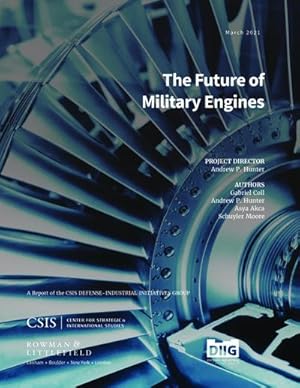
The Future of Military Engines
Idioma: Inglés
Publicado por Rowman & Littlefield Okt 2021, 2021
ISBN 10: 1538140330 ISBN 13: 9781538140338
Librería: AHA-BUCH GmbH, Einbeck, Alemania
Calificación del vendedor: 5 de 5 estrellas
EUR 49,34
Envío por EUR 61,36
Se envía de Alemania a Estados Unidos de AmericaCantidad disponible: 5 disponibles
Añadir al carritoTaschenbuch. Condición: Neu. Neuware - This CSIS report describes how DoD's investment in military aircraft engines will decrease significantly, presenting a challenge for the industrial base. The report also argues that DoD must make four major policy choices in its investment approach to military engines: priority, resources, business model, and competition.
-

The Future of Military Engines
Idioma: Inglés
Publicado por Bloomsbury Publishing Plc, US, 2021
ISBN 10: 1538140330 ISBN 13: 9781538140338
Librería: Rarewaves.com UK, London, Reino Unido
Calificación del vendedor: 5 de 5 estrellas
EUR 44,12
Envío por EUR 74,80
Se envía de Reino Unido a Estados Unidos de AmericaCantidad disponible: 2 disponibles
Añadir al carritoPaperback. Condición: New. CSIS's The Future of Military Engines looks at the state of the U.S. military engine industrial base and the choices confronting policymakers at the Department of Defense (DoD). The military engine industrial base is closely tied to the industrial base for commercial engines. U.S. engine providers use many of the same facilities and largely the same supply chain for military and commercial engines. The ability to leverage commercial supply chains is critical because supply chain quality underlies the performance advantage of U.S. military engines, both for individual aircraft and military aircraft fleets. International competitors such as Russia and China are seeking to overtake the U.S. in engines. However, the current U.S. advantage is sustainable if it is treated as a national priority. Many military aircraft, especially fighters, require engines with important differences from commercial aircraft. They fly different flight profiles and perform different jobs. These differences mean that while DoD can leverage the commercial engine industrial base, it must also make investments to sustain the industrial base's unique military components. In the next few years, DoD investment in military engines is projected to decrease significantly, particularly for RandD. This presents a challenge as military-unique engineering skills are highly perishable. Four major policy choices confront DoD as it formulates its investment approach to military engines going forward: 1) Priority, 2) Resources, 3) Business Model, and 4) Competition. The DoD is at an inflection point for engine investment, and the time for choosing on these four key policy questions will come in the next few years.
-

The Future of Military Engines
Idioma: Inglés
Publicado por Bloomsbury Publishing Plc, 2021
ISBN 10: 1538140330 ISBN 13: 9781538140338
Librería: preigu, Osnabrück, Alemania
Calificación del vendedor: 5 de 5 estrellas
EUR 54,40
Envío por EUR 70,00
Se envía de Alemania a Estados Unidos de AmericaCantidad disponible: 1 disponibles
Añadir al carritoTaschenbuch. Condición: Neu. The Future of Military Engines | Andrew P. Hunter (u. a.) | Taschenbuch | Kartoniert / Broschiert | Englisch | 2021 | Bloomsbury Publishing Plc | EAN 9781538140338 | Verantwortliche Person für die EU: Libri GmbH, Europaallee 1, 36244 Bad Hersfeld, gpsr[at]libri[dot]de | Anbieter: preigu.
-
The Future of Military Engines
Librería: THE SAINT BOOKSTORE, Southport, Reino Unido
Calificación del vendedor: 5 de 5 estrellas
EUR 48,36
Envío por EUR 15,24
Se envía de Reino Unido a Estados Unidos de AmericaCantidad disponible: 6 disponibles
Añadir al carritoPaperback / softback. Condición: New. This item is printed on demand. New copy - Usually dispatched within 5-9 working days 249.

