

Importe total (1 artículo artículos):
Destino del pedido:

9781461389842 - Advances in Soil Science: Dryland Agriculture: Strategies for Sustainability Volume 13 (10 resultados)
Ir a los resultados principales
Filtros de búsqueda
Tipo de artículo
- Todos los tipos de productos
- Libros (10)
- Revistas y publicaciones (No hay ningún otro resultado que coincida con este filtro.)
- Cómics (No hay ningún otro resultado que coincida con este filtro.)
- Partituras (No hay ningún otro resultado que coincida con este filtro.)
- Arte, grabados y pósters (No hay ningún otro resultado que coincida con este filtro.)
- Fotografías (No hay ningún otro resultado que coincida con este filtro.)
- Mapas (No hay ningún otro resultado que coincida con este filtro.)
- Manuscritos y coleccionismo de papel (No hay ningún otro resultado que coincida con este filtro.)
Condición Más información
- Nuevo (9)
- Como nuevo, Excelente o Muy bueno (1)
- Bueno o Aceptable (No hay ningún otro resultado que coincida con este filtro.)
- Regular o Pobre (No hay ningún otro resultado que coincida con este filtro.)
- Tal como se indica (No hay ningún otro resultado que coincida con este filtro.)
Encuadernación
- Todas
- Tapa dura (No hay ningún otro resultado que coincida con este filtro.)
- Tapa blanda (10)
Más atributos
- Primera edición (No hay ningún otro resultado que coincida con este filtro.)
- Firmado (No hay ningún otro resultado que coincida con este filtro.)
- Sobrecubierta (No hay ningún otro resultado que coincida con este filtro.)
- Con imágenes (5)
- No impresión bajo demanda (5)
Idioma (1)
Precio
- Cualquier precio
- Menos de EUR 20 (No hay ningún otro resultado que coincida con este filtro.)
- EUR 20 a EUR 45 (No hay ningún otro resultado que coincida con este filtro.)
- Más de EUR 45
Gastos de envío gratis
- Envío gratis a Estados Unidos de America (No hay ningún otro resultado que coincida con este filtro.)
Ubicación del vendedor
Valoración de los vendedores
-
Advances in Soil Science | Dryland Agriculture: Strategies for Sustainability Volume 13
Librería: preigu, Osnabrück, Alemania
Calificación del vendedor: 5 de 5 estrellas

EUR 104,80
Envío por EUR 70,00
Se envía de Alemania a Estados Unidos de AmericaCantidad disponible: 5 disponibles
Añadir al carritoTaschenbuch. Condición: Neu. Advances in Soil Science | Dryland Agriculture: Strategies for Sustainability Volume 13 | R. R. Allen | Taschenbuch | xiv | Englisch | 2011 | Springer | EAN 9781461389842 | Verantwortliche Person für die EU: Springer Verlag GmbH, Tiergartenstr. 17, 69121 Heidelberg, juergen[dot]hartmann[at]springer[dot]com | Anbieter: preigu.
-

Advances in Soil Science: Dryland Agriculture: Strategies for Sustainability
Librería: Revaluation Books, Exeter, Reino Unido
Calificación del vendedor: 5 de 5 estrellas
EUR 168,07
Envío por EUR 14,37
Se envía de Reino Unido a Estados Unidos de AmericaCantidad disponible: 2 disponibles
Añadir al carritoPaperback. Condición: Brand New. 387 pages. 6.00x5.80x0.30 inches. In Stock.
-
Advances in Soil Science: Dryland Agriculture: Strategies for Sustainability Volume 13
Librería: Ria Christie Collections, Uxbridge, Reino Unido
Calificación del vendedor: 5 de 5 estrellas
EUR 111,67
Envío por EUR 13,77
Se envía de Reino Unido a Estados Unidos de AmericaCantidad disponible: Más de 20 disponibles
Añadir al carritoCondición: New. In.
-

Advances in Soil Science : Dryland Agriculture: Strategies for Sustainability Volume 13
Idioma: Inglés
Publicado por Springer New York, Springer US, 2011
ISBN 10: 1461389844 ISBN 13: 9781461389842
Librería: AHA-BUCH GmbH, Einbeck, Alemania
Calificación del vendedor: 5 de 5 estrellas
EUR 125,24
Envío por EUR 62,97
Se envía de Alemania a Estados Unidos de AmericaCantidad disponible: 1 disponibles
Añadir al carritoTaschenbuch. Condición: Neu. Druck auf Anfrage Neuware - Printed after ordering - From the beginning of agriculture until about 1950, increased food production came almost entirely from expanding the cropland base. Since 1950, however, the yield per unit of land area for major crops has increased dramatically. Much of the increase in yields was because of increased inputs of energy. Between 1950 and 1985, the farm tractor fleet quadrupled, world irrigated area tripled, and use of fertilizer increased ninefold. Between 1950 and 1985, the total energy used in world agriculture increased 6. 9 times. Irrigation played a particularly important role in the rapid increase in food production between 1950 and 1985. The world's irrigated land in 1950 totaled 94 million hectares but increased to 140 million by 1960, to 198 million by 1970, and to 271 million hectares in 1985. However, the current rate of expansion has slowed to less than 1 % per year. The world population continues to increase and agricultural production by the year 2000 will have to be 50 to 60% greater than in 1980 to meet demands. This continued demand for food and fiber, coupled with the sharp decline in the growth rate of irrigation development, means that much of the additional agricultural production in future years must come from cultivated land that is not irrigated. Agricultural production will be expanded in the arid and semiarid regions because these regions make up vast areas in developing countries where populations are rapidly rising.
-
Advances in Soil Science: Dryland Agriculture: Strategies for Sustainability Volume 13 (Advances in Soil Science, 13)
Librería: Mispah books, Redhill, SURRE, Reino Unido
Calificación del vendedor: 4 de 5 estrellas

EUR 189,47
Envío por EUR 28,74
Se envía de Reino Unido a Estados Unidos de AmericaCantidad disponible: 1 disponibles
Añadir al carritoPaperback. Condición: Like New. Like New. book.
-
Advances in Soil Science (eng)
Librería: Brook Bookstore On Demand, Napoli, NA, Italia
Calificación del vendedor: 4 de 5 estrellas
EUR 94,25
Envío por EUR 6,80
Se envía de Italia a Estados Unidos de AmericaCantidad disponible: Más de 20 disponibles
Añadir al carritoCondición: new. Questo è un articolo print on demand.
-
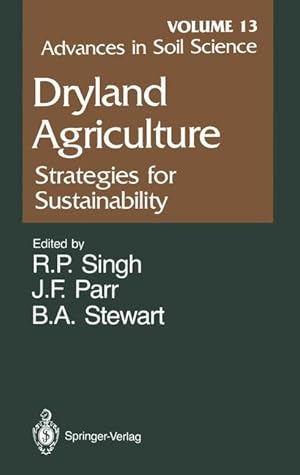
Advances in Soil Science
Librería: moluna, Greven, Alemania
Calificación del vendedor: 4 de 5 estrellas
EUR 101,04
Envío por EUR 48,99
Se envía de Alemania a Estados Unidos de AmericaCantidad disponible: Más de 20 disponibles
Añadir al carritoCondición: New. Dieser Artikel ist ein Print on Demand Artikel und wird nach Ihrer Bestellung fuer Sie gedruckt. From the beginning of agriculture until about 1950, increased food production came almost entirely from expanding the cropland base. Since 1950, however, the yield per unit of land area for major crops has increased dramatically. Much of the increase in yie.
-
Advances in Soil Science: Dryland Agriculture: Strategies for Sustainability Volume 13
Idioma: Inglés
Publicado por Springer-Verlag New York Inc., 2011
ISBN 10: 1461389844 ISBN 13: 9781461389842
Librería: THE SAINT BOOKSTORE, Southport, Reino Unido
Calificación del vendedor: 5 de 5 estrellas
EUR 135,94
Envío por EUR 19,00
Se envía de Reino Unido a Estados Unidos de AmericaCantidad disponible: Más de 20 disponibles
Añadir al carritoPaperback / softback. Condición: New. This item is printed on demand. New copy - Usually dispatched within 5-9 working days.
-

Advances in Soil Science
Idioma: Inglés
Publicado por Springer New York Dez 2011, 2011
ISBN 10: 1461389844 ISBN 13: 9781461389842
Librería: BuchWeltWeit Ludwig Meier e.K., Bergisch Gladbach, Alemania
Calificación del vendedor: 5 de 5 estrellas
EUR 112,34
Envío por EUR 23,00
Se envía de Alemania a Estados Unidos de AmericaCantidad disponible: 2 disponibles
Añadir al carritoTaschenbuch. Condición: Neu. This item is printed on demand - it takes 3-4 days longer - Neuware -From the beginning of agriculture until about 1950, increased food production came almost entirely from expanding the cropland base. Since 1950, however, the yield per unit of land area for major crops has increased dramatically. Much of the increase in yields was because of increased inputs of energy. Between 1950 and 1985, the farm tractor fleet quadrupled, world irrigated area tripled, and use of fertilizer increased ninefold. Between 1950 and 1985, the total energy used in world agriculture increased 6. 9 times. Irrigation played a particularly important role in the rapid increase in food production between 1950 and 1985. The world's irrigated land in 1950 totaled 94 million hectares but increased to 140 million by 1960, to 198 million by 1970, and to 271 million hectares in 1985. However, the current rate of expansion has slowed to less than 1 % per year. The world population continues to increase and agricultural production by the year 2000 will have to be 50 to 60% greater than in 1980 to meet demands. This continued demand for food and fiber, coupled with the sharp decline in the growth rate of irrigation development, means that much of the additional agricultural production in future years must come from cultivated land that is not irrigated. Agricultural production will be expanded in the arid and semiarid regions because these regions make up vast areas in developing countries where populations are rapidly rising. 392 pp. Englisch.
-

Advances in Soil Science
Idioma: Inglés
Publicado por Springer New York, Springer US Dez 2011, 2011
ISBN 10: 1461389844 ISBN 13: 9781461389842
Librería: buchversandmimpf2000, Emtmannsberg, BAYE, Alemania
Calificación del vendedor: 5 de 5 estrellas
EUR 117,69
Envío por EUR 60,00
Se envía de Alemania a Estados Unidos de AmericaCantidad disponible: 1 disponibles
Añadir al carritoTaschenbuch. Condición: Neu. This item is printed on demand - Print on Demand Titel. Neuware -From the beginning of agriculture until about 1950, increased food production came almost entirely from expanding the cropland base. Since 1950, however, the yield per unit of land area for major crops has increased dramatically. Much of the increase in yields was because of increased inputs of energy. Between 1950 and 1985, the farm tractor fleet quadrupled, world irrigated area tripled, and use of fertilizer increased ninefold. Between 1950 and 1985, the total energy used in world agriculture increased 6. 9 times. Irrigation played a particularly important role in the rapid increase in food production between 1950 and 1985. The world's irrigated land in 1950 totaled 94 million hectares but increased to 140 million by 1960, to 198 million by 1970, and to 271 million hectares in 1985. However, the current rate of expansion has slowed to less than 1 % per year. The world population continues to increase and agricultural production by the year 2000 will have to be 50 to 60% greater than in 1980 to meet demands. This continued demand for food and fiber, coupled with the sharp decline in the growth rate of irrigation development, means that much of the additional agricultural production in future years must come from cultivated land that is not irrigated. Agricultural production will be expanded in the arid and semiarid regions because these regions make up vast areas in developing countries where populations are rapidly rising.Springer Verlag GmbH, Tiergartenstr. 17, 69121 Heidelberg 392 pp. Englisch.


