

Importe total (1 artículo artículos):
Destino del pedido:

9781461267577 - Semantics of Type Theory: Correctness, Completeness and Independence Results (Progress in Theoretical Computer Science) de Streicher, T. (13 resultados)
Ir a los resultados principales
Filtros de búsqueda
Tipo de artículo
- Todos los tipos de productos
- Libros (13)
- Revistas y publicaciones (No hay ningún otro resultado que coincida con este filtro.)
- Cómics (No hay ningún otro resultado que coincida con este filtro.)
- Partituras (No hay ningún otro resultado que coincida con este filtro.)
- Arte, grabados y pósters (No hay ningún otro resultado que coincida con este filtro.)
- Fotografías (No hay ningún otro resultado que coincida con este filtro.)
- Mapas (No hay ningún otro resultado que coincida con este filtro.)
- Manuscritos y coleccionismo de papel (No hay ningún otro resultado que coincida con este filtro.)
Condición Más información
- Nuevo (12)
- Como nuevo, Excelente o Muy bueno (1)
- Bueno o Aceptable (No hay ningún otro resultado que coincida con este filtro.)
- Regular o Pobre (No hay ningún otro resultado que coincida con este filtro.)
- Tal como se indica (No hay ningún otro resultado que coincida con este filtro.)
Encuadernación
- Todas
- Tapa dura (No hay ningún otro resultado que coincida con este filtro.)
- Tapa blanda (13)
Más atributos
- Primera edición (No hay ningún otro resultado que coincida con este filtro.)
- Firmado (No hay ningún otro resultado que coincida con este filtro.)
- Sobrecubierta (No hay ningún otro resultado que coincida con este filtro.)
- Con imágenes (5)
- No impresión bajo demanda (7)
Idioma (1)
Precio
- Cualquier precio
- Menos de EUR 20 (No hay ningún otro resultado que coincida con este filtro.)
- EUR 20 a EUR 45 (No hay ningún otro resultado que coincida con este filtro.)
- Más de EUR 45
Gastos de envío gratis
- Envío gratis a Estados Unidos de America (No hay ningún otro resultado que coincida con este filtro.)
Ubicación del vendedor
Valoración de los vendedores
-

Semantics of Type Theory: Correctness, Completeness and Independence Results (Progress in Theoretical Computer Science)
Librería: Ria Christie Collections, Uxbridge, Reino Unido
Calificación del vendedor: 5 de 5 estrellas

EUR 98,51
Envío por EUR 14,05
Se envía de Reino Unido a Estados Unidos de AmericaCantidad disponible: Más de 20 disponibles
Añadir al carritoCondición: New. In.
-
Semantics of Type Theory (Progress in Theoretical Computer Science)
Librería: Chiron Media, Wallingford, Reino Unido
Calificación del vendedor: 5 de 5 estrellas
EUR 95,60
Envío por EUR 18,17
Se envía de Reino Unido a Estados Unidos de AmericaCantidad disponible: 10 disponibles
Añadir al carritoPaperback. Condición: New.
-
Semantics of Type Theory : Correctness, Completeness and Independence Results
Librería: GreatBookPrices, Columbia, MD, Estados Unidos de America
Calificación del vendedor: 5 de 5 estrellas
EUR 113,40
Envío por EUR 2,31
Se envía dentro de Estados Unidos de AmericaCantidad disponible: 15 disponibles
Añadir al carritoCondición: New.
-

Semantics of Type Theory : Correctness, Completeness and Independence Results
Librería: GreatBookPrices, Columbia, MD, Estados Unidos de America
Calificación del vendedor: 5 de 5 estrellas
EUR 127,62
Envío por EUR 2,31
Se envía dentro de Estados Unidos de AmericaCantidad disponible: 15 disponibles
Añadir al carritoCondición: As New. Unread book in perfect condition.
-
Semantics of Type Theory
Librería: Books Puddle, New York, NY, Estados Unidos de America
Calificación del vendedor: 4 de 5 estrellas

EUR 127,95
Envío por EUR 3,49
Se envía dentro de Estados Unidos de AmericaCantidad disponible: 4 disponibles
Añadir al carritoCondición: New. pp. 316.
-

Semantics of Type Theory
Librería: moluna, Greven, Alemania
Calificación del vendedor: 5 de 5 estrellas
EUR 79,10
Envío por EUR 48,99
Se envía de Alemania a Estados Unidos de AmericaCantidad disponible: Más de 20 disponibles
Añadir al carritoCondición: New.
-
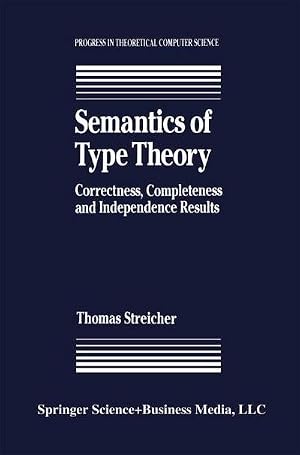
Semantics of Type Theory : Correctness, Completeness and Independence Results
Idioma: Inglés
Publicado por Birkhäuser, Birkhäuser, 2012
ISBN 10: 1461267579 ISBN 13: 9781461267577
Librería: AHA-BUCH GmbH, Einbeck, Alemania
Calificación del vendedor: 5 de 5 estrellas
EUR 98,04
Envío por EUR 62,41
Se envía de Alemania a Estados Unidos de AmericaCantidad disponible: 1 disponibles
Añadir al carritoTaschenbuch. Condición: Neu. Druck auf Anfrage Neuware - Printed after ordering - Typing plays an important role in software development. Types can be consid ered as weak specifications of programs and checking that a program is of a certain type provides a verification that a program satisfies such a weak speci fication. By translating a problem specification into a proposition in constructive logic, one can go one step further: the effectiveness and unifonnity of a con structive proof allows us to extract a program from a proof of this proposition. Thus by the 'proposition-as-types' paradigm one obtains types whose elements are considered as proofs. Each of these proofs contains a program correct w.r.t. the given problem specification. This opens the way for a coherent approach to the derivation of provably correct programs. These features have led to a 'typeful' programming style where the classi cal typing concepts such as records or (static) arrays are enhanced by polymor phic and dependent types in such a way that the types themselves get a complex mathematical structure. Systems such as Coquand and Huet's Calculus of Con structions are calculi for computing within extended type systems and provide a basis for a deduction oriented mathematical foundation of programming. On the other hand, the computational power and the expressive (impred icativity !) of these systems makes it difficult to define appropriate semantics.
-
Semantics of Type Theory (eng)
Librería: Brook Bookstore On Demand, Napoli, NA, Italia
Calificación del vendedor: 5 de 5 estrellas
EUR 74,24
Envío por EUR 5,50
Se envía de Italia a Estados Unidos de AmericaCantidad disponible: Más de 20 disponibles
Añadir al carritoCondición: new. Questo è un articolo print on demand.
-

Semantics of Type Theory
Idioma: Inglés
Publicado por Birkhäuser Boston Okt 2012, 2012
ISBN 10: 1461267579 ISBN 13: 9781461267577
Librería: BuchWeltWeit Ludwig Meier e.K., Bergisch Gladbach, Alemania
Calificación del vendedor: 5 de 5 estrellas
EUR 90,94
Envío por EUR 23,00
Se envía de Alemania a Estados Unidos de AmericaCantidad disponible: 2 disponibles
Añadir al carritoTaschenbuch. Condición: Neu. This item is printed on demand - it takes 3-4 days longer - Neuware -Typing plays an important role in software development. Types can be consid ered as weak specifications of programs and checking that a program is of a certain type provides a verification that a program satisfies such a weak speci fication. By translating a problem specification into a proposition in constructive logic, one can go one step further: the effectiveness and unifonnity of a con structive proof allows us to extract a program from a proof of this proposition. Thus by the 'proposition-as-types' paradigm one obtains types whose elements are considered as proofs. Each of these proofs contains a program correct w.r.t. the given problem specification. This opens the way for a coherent approach to the derivation of provably correct programs. These features have led to a 'typeful' programming style where the classi cal typing concepts such as records or (static) arrays are enhanced by polymor phic and dependent types in such a way that the types themselves get a complex mathematical structure. Systems such as Coquand and Huet's Calculus of Con structions are calculi for computing within extended type systems and provide a basis for a deduction oriented mathematical foundation of programming. On the other hand, the computational power and the expressive (impred icativity !) of these systems makes it difficult to define appropriate semantics. 316 pp. Englisch.
-
Semantics of Type Theory: Correctness, Completeness and Independence Results
Idioma: Inglés
Publicado por Springer-Verlag New York Inc., 2012
ISBN 10: 1461267579 ISBN 13: 9781461267577
Librería: THE SAINT BOOKSTORE, Southport, Reino Unido
Calificación del vendedor: 5 de 5 estrellas
EUR 114,43
Envío por EUR 18,18
Se envía de Reino Unido a Estados Unidos de AmericaCantidad disponible: Más de 20 disponibles
Añadir al carritoPaperback / softback. Condición: New. This item is printed on demand. New copy - Usually dispatched within 5-9 working days.
-
Semantics of Type Theory
Librería: Majestic Books, Hounslow, Reino Unido
Calificación del vendedor: 4 de 5 estrellas
EUR 132,78
Envío por EUR 7,63
Se envía de Reino Unido a Estados Unidos de AmericaCantidad disponible: 4 disponibles
Añadir al carritoCondición: New. Print on Demand pp. 316 49:B&W 6.14 x 9.21 in or 234 x 156 mm (Royal 8vo) Perfect Bound on White w/Gloss Lam.
-
Semantics of Type Theory
Librería: Biblios, Frankfurt am main, HESSE, Alemania
Calificación del vendedor: 4 de 5 estrellas
EUR 133,05
Envío por EUR 9,95
Se envía de Alemania a Estados Unidos de AmericaCantidad disponible: 4 disponibles
Añadir al carritoCondición: New. PRINT ON DEMAND pp. 316.
-

Semantics of Type Theory
Idioma: Inglés
Publicado por Birkhäuser, Birkhäuser Okt 2012, 2012
ISBN 10: 1461267579 ISBN 13: 9781461267577
Librería: buchversandmimpf2000, Emtmannsberg, BAYE, Alemania
Calificación del vendedor: 5 de 5 estrellas
EUR 90,94
Envío por EUR 60,00
Se envía de Alemania a Estados Unidos de AmericaCantidad disponible: 1 disponibles
Añadir al carritoTaschenbuch. Condición: Neu. This item is printed on demand - Print on Demand Titel. Neuware -Typing plays an important role in software development. Types can be consid ered as weak specifications of programs and checking that a program is of a certain type provides a verification that a program satisfies such a weak speci fication. By translating a problem specification into a proposition in constructive logic, one can go one step further: the effectiveness and unifonnity of a con structive proof allows us to extract a program from a proof of this proposition. Thus by the 'proposition-as-types' paradigm one obtains types whose elements are considered as proofs. Each of these proofs contains a program correct w.r.t. the given problem specification. This opens the way for a coherent approach to the derivation of provably correct programs. These features have led to a 'typeful' programming style where the classi cal typing concepts such as records or (static) arrays are enhanced by polymor phic and dependent types in such a way that the types themselves get a complex mathematical structure. Systems such as Coquand and Huet's Calculus of Con structions are calculi for computing within extended type systems and provide a basis for a deduction oriented mathematical foundation of programming. On the other hand, the computational power and the expressive (impred icativity !) of these systems makes it difficult to define appropriate semantics.Springer Basel AG in Springer Science + Business Media, Heidelberger Platz 3, 14197 Berlin 316 pp. Englisch.

