

Importe total (1 artículo artículos):
Destino del pedido:

9781441920157 - Statistical and Inductive Inference by Minimum Message Length (Information Science and Statistics) de Wallace, C.S. S. (8 resultados)
Ir a los resultados principales
Filtros de búsqueda
Tipo de artículo
- Todos los tipos de productos
- Libros (8)
- Revistas y publicaciones (No hay ningún otro resultado que coincida con este filtro.)
- Cómics (No hay ningún otro resultado que coincida con este filtro.)
- Partituras (No hay ningún otro resultado que coincida con este filtro.)
- Arte, grabados y pósters (No hay ningún otro resultado que coincida con este filtro.)
- Fotografías (No hay ningún otro resultado que coincida con este filtro.)
- Mapas (No hay ningún otro resultado que coincida con este filtro.)
- Manuscritos y coleccionismo de papel (No hay ningún otro resultado que coincida con este filtro.)
Condición Más información
- Nuevo (7)
- Como nuevo, Excelente o Muy bueno (1)
- Bueno o Aceptable (No hay ningún otro resultado que coincida con este filtro.)
- Regular o Pobre (No hay ningún otro resultado que coincida con este filtro.)
- Tal como se indica (No hay ningún otro resultado que coincida con este filtro.)
Encuadernación
- Todas
- Tapa dura (No hay ningún otro resultado que coincida con este filtro.)
- Tapa blanda (8)
Más atributos
- Primera edición (No hay ningún otro resultado que coincida con este filtro.)
- Firmado (No hay ningún otro resultado que coincida con este filtro.)
- Sobrecubierta (No hay ningún otro resultado que coincida con este filtro.)
- Con imágenes (5)
- No impresión bajo demanda (4)
Idioma (1)
Precio
- Cualquier precio
- Menos de EUR 20 (No hay ningún otro resultado que coincida con este filtro.)
- EUR 20 a EUR 40 (No hay ningún otro resultado que coincida con este filtro.)
- Más de EUR 40
Gastos de envío gratis
- Envío gratis a Estados Unidos de America (No hay ningún otro resultado que coincida con este filtro.)
Ubicación del vendedor
Valoración de los vendedores
-

Statistical and Inductive Inference by Minimum Message Length (Information Science and Statistics)
Libro 3 de 20: Information Science and StatisticsLibrería: Lucky's Textbooks, Dallas, TX, Estados Unidos de America
Calificación del vendedor: 5 de 5 estrellas

EUR 110,38
Envío por EUR 3,36
Se envía dentro de Estados Unidos de AmericaCantidad disponible: Más de 20 disponibles
Añadir al carritoCondición: New.
-
Statistical and Inductive Inference by Minimum Message Length (Information Science and Statistics)
Libro 3 de 20: Information Science and StatisticsLibrería: Ria Christie Collections, Uxbridge, Reino Unido
Calificación del vendedor: 5 de 5 estrellas
EUR 123,91
Envío por EUR 13,78
Se envía de Reino Unido a Estados Unidos de AmericaCantidad disponible: Más de 20 disponibles
Añadir al carritoCondición: New. In.
-
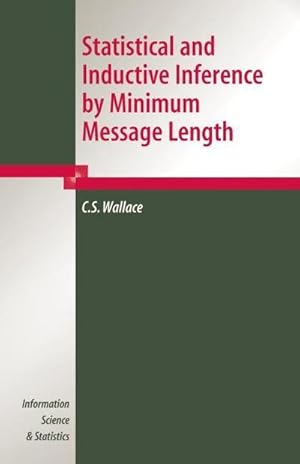
Statistical and Inductive Inference by Minimum Message Length
Libro 3 de 20: Information Science and StatisticsLibrería: AHA-BUCH GmbH, Einbeck, Alemania
Calificación del vendedor: 5 de 5 estrellas
EUR 122,12
Envío por EUR 63,37
Se envía de Alemania a Estados Unidos de AmericaCantidad disponible: 1 disponibles
Añadir al carritoTaschenbuch. Condición: Neu. Druck auf Anfrage Neuware - Printed after ordering - Mythanksareduetothemanypeoplewhohaveassistedintheworkreported here and in the preparation of this book. The work is incomplete and this account of it rougher than it might be. Such virtues as it has owe much to others; the faults are all mine. MyworkleadingtothisbookbeganwhenDavidBoultonandIattempted to develop a method for intrinsic classi cation. Given data on a sample from some population, we aimed to discover whether the population should be considered to be a mixture of di erent types, classes or species of thing, and, if so, how many classes were present, what each class looked like, and which things in the sample belonged to which class. I saw the problem as one of Bayesian inference, but with prior probability densities replaced by discrete probabilities re ecting the precision to which the data would allow parameters to be estimated. Boulton, however, proposed that a classi cation of the sample was a way of brie y encoding the data: once each class was described and each thing assigned to a class, the data for a thing would be partially implied by the characteristics of its class, and hence require little further description. After some weeks' arguing our cases, we decided on the maths for each approach, and soon discovered they gave essentially the same results. Without Boulton's insight, we may never have made the connection between inference and brief encoding, which is the heart of this work.
-
Statistical and Inductive Inference by Minimum Message Length (Information Science and Statistics)
Libro 3 de 20: Information Science and StatisticsLibrería: Mispah books, Redhill, SURRE, Reino Unido
Calificación del vendedor: 4 de 5 estrellas

EUR 175,29
Envío por EUR 28,75
Se envía de Reino Unido a Estados Unidos de AmericaCantidad disponible: 1 disponibles
Añadir al carritoPaperback. Condición: Like New. Like New. book.
-

Statistical and Inductive Inference by Minimum Message Length
Libro 3 de 20: Information Science and StatisticsIdioma: Inglés
Publicado por Springer New York Dez 2010, 2010
ISBN 10: 1441920153 ISBN 13: 9781441920157
Librería: BuchWeltWeit Ludwig Meier e.K., Bergisch Gladbach, Alemania
Calificación del vendedor: 5 de 5 estrellas
EUR 117,69
Envío por EUR 23,00
Se envía de Alemania a Estados Unidos de AmericaCantidad disponible: 2 disponibles
Añadir al carritoTaschenbuch. Condición: Neu. This item is printed on demand - it takes 3-4 days longer - Neuware -Mythanksareduetothemanypeoplewhohaveassistedintheworkreported here and in the preparation of this book. The work is incomplete and this account of it rougher than it might be. Such virtues as it has owe much to others; the faults are all mine. MyworkleadingtothisbookbeganwhenDavidBoultonandIattempted to develop a method for intrinsic classi cation. Given data on a sample from some population, we aimed to discover whether the population should be considered to be a mixture of di erent types, classes or species of thing, and, if so, how many classes were present, what each class looked like, and which things in the sample belonged to which class. I saw the problem as one of Bayesian inference, but with prior probability densities replaced by discrete probabilities re ecting the precision to which the data would allow parameters to be estimated. Boulton, however, proposed that a classi cation of the sample was a way of brie y encoding the data: once each class was described and each thing assigned to a class, the data for a thing would be partially implied by the characteristics of its class, and hence require little further description. After some weeks' arguing our cases, we decided on the maths for each approach, and soon discovered they gave essentially the same results. Without Boulton's insight, we may never have made the connection between inference and brief encoding, which is the heart of this work. 448 pp. Englisch.
-
Statistical and Inductive Inference by Minimum Message Length
Libro 3 de 20: Information Science and StatisticsLibrería: moluna, Greven, Alemania
Calificación del vendedor: 4 de 5 estrellas
EUR 98,54
Envío por EUR 48,99
Se envía de Alemania a Estados Unidos de AmericaCantidad disponible: Más de 20 disponibles
Añadir al carritoCondición: New. Dieser Artikel ist ein Print on Demand Artikel und wird nach Ihrer Bestellung fuer Sie gedruckt. Since 1965, Professor Wallace and others have been developing an approach tostatistical estimation, hypothesis testing, model selection and their applications in the Artificial Intelligence field of Machine LearningMythanksareduetothemanypeoplewh.
-
Statistical and Inductive Inference by Minimum Message Length
Libro 3 de 20: Information Science and StatisticsLibrería: preigu, Osnabrück, Alemania
Calificación del vendedor: 5 de 5 estrellas
EUR 102,20
Envío por EUR 70,00
Se envía de Alemania a Estados Unidos de AmericaCantidad disponible: 5 disponibles
Añadir al carritoTaschenbuch. Condición: Neu. Statistical and Inductive Inference by Minimum Message Length | C. S. Wallace | Taschenbuch | xvi | Englisch | 2010 | Springer | EAN 9781441920157 | Verantwortliche Person für die EU: Springer Verlag GmbH, Tiergartenstr. 17, 69121 Heidelberg, juergen[dot]hartmann[at]springer[dot]com | Anbieter: preigu Print on Demand.
-

Statistical and Inductive Inference by Minimum Message Length
Libro 3 de 20: Information Science and StatisticsIdioma: Inglés
Publicado por Springer New York, Springer US Dez 2010, 2010
ISBN 10: 1441920153 ISBN 13: 9781441920157
Librería: buchversandmimpf2000, Emtmannsberg, BAYE, Alemania
Calificación del vendedor: 5 de 5 estrellas
EUR 117,69
Envío por EUR 60,00
Se envía de Alemania a Estados Unidos de AmericaCantidad disponible: 1 disponibles
Añadir al carritoTaschenbuch. Condición: Neu. This item is printed on demand - Print on Demand Titel. Neuware -Mythanksareduetothemanypeoplewhohaveassistedintheworkreported here and in the preparation of this book. The work is incomplete and this account of it rougher than it might be. Such virtues as it has owe much to others; the faults are all mine. MyworkleadingtothisbookbeganwhenDavidBoultonandIattempted to develop a method for intrinsic classi cation. Given data on a sample from some population, we aimed to discover whether the population should be considered to be a mixture of di erent types, classes or species of thing, and, if so, how many classes were present, what each class looked like, and which things in the sample belonged to which class. I saw the problem as one of Bayesian inference, but with prior probability densities replaced by discrete probabilities re ecting the precision to which the data would allow parameters to be estimated. Boulton, however, proposed that a classi cation of the sample was a way of brie y encoding the data: once each class was described and each thing assigned to a class, the data for a thing would be partially implied by the characteristics of its class, and hence require little further description. After some weeks¿ arguing our cases, we decided on the maths for each approach, and soon discovered they gave essentially the same results. Without Boulton¿s insight, we may never have made the connection between inference and brief encoding, which is the heart of this work.Springer Verlag GmbH, Tiergartenstr. 17, 69121 Heidelberg 448 pp. Englisch.


