

Importe total (1 artículo artículos):
Destino del pedido:

9781421422671 - Emmy Noether's Wonderful Theorem de Neuenschwander, Dwight E. (30 resultados)
Ir a los resultados principales
Filtros de búsqueda
Tipo de artículo
- Todos los tipos de productos
- Libros (30)
- Revistas y publicaciones (No hay ningún otro resultado que coincida con este filtro.)
- Cómics (No hay ningún otro resultado que coincida con este filtro.)
- Partituras (No hay ningún otro resultado que coincida con este filtro.)
- Arte, grabados y pósters (No hay ningún otro resultado que coincida con este filtro.)
- Fotografías (No hay ningún otro resultado que coincida con este filtro.)
- Mapas (No hay ningún otro resultado que coincida con este filtro.)
- Manuscritos y coleccionismo de papel (No hay ningún otro resultado que coincida con este filtro.)
Condición Más información
- Nuevo (28)
- Como nuevo, Excelente o Muy bueno (2)
- Bueno o Aceptable (No hay ningún otro resultado que coincida con este filtro.)
- Regular o Pobre (No hay ningún otro resultado que coincida con este filtro.)
- Tal como se indica (No hay ningún otro resultado que coincida con este filtro.)
Encuadernación
- Todas
- Tapa dura (No hay ningún otro resultado que coincida con este filtro.)
- Tapa blanda (30)
Más atributos
- Primera edición (No hay ningún otro resultado que coincida con este filtro.)
- Firmado (No hay ningún otro resultado que coincida con este filtro.)
- Sobrecubierta (No hay ningún otro resultado que coincida con este filtro.)
- Con imágenes (13)
- No impresión bajo demanda (26)
Idioma (1)
Precio
- Cualquier precio
- Menos de EUR 20 (No hay ningún otro resultado que coincida con este filtro.)
- EUR 20 a EUR 45
- Más de EUR 45
Gastos de envío gratis
Ubicación del vendedor
Valoración de los vendedores
-
Emmy Noether's Wonderful Theorem
Idioma: Inglés
Publicado por Johns Hopkins University Press, 2017
ISBN 10: 1421422670 ISBN 13: 9781421422671
Librería: GreatBookPrices, Columbia, MD, Estados Unidos de America
Calificación del vendedor: 5 de 5 estrellas

EUR 30,58
Envío por EUR 2,32
Se envía dentro de Estados Unidos de AmericaCantidad disponible: Más de 20 disponibles
Añadir al carritoCondición: As New. Unread book in perfect condition.
-
Emmy Noether's Wonderful Theorem
Idioma: Inglés
Publicado por Johns Hopkins University Press, 2017
ISBN 10: 1421422670 ISBN 13: 9781421422671
Librería: PBShop.store UK, Fairford, GLOS, Reino Unido
Calificación del vendedor: 5 de 5 estrellas
EUR 30,47
Envío por EUR 4,82
Se envía de Reino Unido a Estados Unidos de AmericaCantidad disponible: 15 disponibles
Añadir al carritoPAP. Condición: New. New Book. Shipped from UK. Established seller since 2000.
-
Emmy Noether's Wonderful Theorem
Idioma: Inglés
Publicado por Johns Hopkins University Press, 2017
ISBN 10: 1421422670 ISBN 13: 9781421422671
Librería: GreatBookPrices, Columbia, MD, Estados Unidos de America
Calificación del vendedor: 5 de 5 estrellas
EUR 33,08
Envío por EUR 2,32
Se envía dentro de Estados Unidos de AmericaCantidad disponible: Más de 20 disponibles
Añadir al carritoCondición: New.
-
Emmy Noether's Wonderful Theorem
Idioma: Inglés
Publicado por Johns Hopkins University Press, US, 2017
ISBN 10: 1421422670 ISBN 13: 9781421422671
Librería: Rarewaves.com USA, London, LONDO, Reino Unido
Calificación del vendedor: 5 de 5 estrellas
EUR 35,47
Gastos de envío gratis
Se envía de Reino Unido a Estados Unidos de AmericaCantidad disponible: 15 disponibles
Añadir al carritoPaperback. Condición: New. revised and updated edition. "In the judgment of the most competent living mathematicians, Fraulein Noether was the most significant creative mathematical genius thus far produced since the higher education of women began."-Albert Einstein The year was 1915, and the young mathematician Emmy Noether had just settled into Gottingen University when Albert Einstein visited to lecture on his nearly finished general theory of relativity. Two leading mathematicians of the day, David Hilbert and Felix Klein, dug into the new theory with gusto, but had difficulty reconciling it with what was known about the conservation of energy. Knowing of her expertise in invariance theory, they requested Noether's help. To solve the problem, she developed a novel theorem, applicable across all of physics, which relates conservation laws to continuous symmetries-one of the most important pieces of mathematical reasoning ever developed. Noether's "first" and "second" theorem was published in 1918. The first theorem relates symmetries under global spacetime transformations to the conservation of energy and momentum, and symmetry under global gauge transformations to charge conservation.In continuum mechanics and field theories, these conservation laws are expressed as equations of continuity. The second theorem, an extension of the first, allows transformations with local gauge invariance, and the equations of continuity acquire the covariant derivative characteristic of coupled matter-field systems. General relativity, it turns out, exhibits local gauge invariance. Noether's theorem also laid the foundation for later generations to apply local gauge invariance to theories of elementary particle interactions. In Dwight E. Neuenschwander's new edition of Emmy Noether's Wonderful Theorem, readers will encounter an updated explanation of Noether's "first" theorem. The discussion of local gauge invariance has been expanded into a detailed presentation of the motivation, proof, and applications of the "second" theorem, including Noether's resolution of concerns about general relativity. Other refinements in the new edition include an enlarged biography of Emmy Noether's life and work, parallels drawn between the present approach and Noether's original 1918 paper, and a summary of the logic behind Noether's theorem.
-
Emmy Noether's Wonderful Theorem
Idioma: Inglés
Publicado por Johns Hopkins University Press, 2017
ISBN 10: 1421422670 ISBN 13: 9781421422671
Librería: PBShop.store US, Wood Dale, IL, Estados Unidos de America
Calificación del vendedor: 5 de 5 estrellas
EUR 37,01
Gastos de envío gratis
Se envía dentro de Estados Unidos de AmericaCantidad disponible: 15 disponibles
Añadir al carritoPAP. Condición: New. New Book. Shipped from UK. Established seller since 2000.
-
Emmy Noether's Wonderful Theorem (eng)
Idioma: Inglés
Publicado por Johns Hopkins University Press, 2017
ISBN 10: 1421422670 ISBN 13: 9781421422671
Librería: Brook Bookstore On Demand, Napoli, NA, Italia
Calificación del vendedor: 5 de 5 estrellas
EUR 31,29
Envío por EUR 5,50
Se envía de Italia a Estados Unidos de AmericaCantidad disponible: Más de 20 disponibles
Añadir al carritoCondición: new.
-

Emmy Noether's Wonderful Theorem (Paperback or Softback)
Idioma: Inglés
Publicado por Johns Hopkins University Press 3/6/2017, 2017
ISBN 10: 1421422670 ISBN 13: 9781421422671
Librería: BargainBookStores, Grand Rapids, MI, Estados Unidos de America
Calificación del vendedor: 5 de 5 estrellas
EUR 40,70
Gastos de envío gratis
Se envía dentro de Estados Unidos de AmericaCantidad disponible: 5 disponibles
Añadir al carritoPaperback or Softback. Condición: New. Emmy Noether's Wonderful Theorem. Book.
-

Emmy Noether's Wonderful Theorem
Idioma: Inglés
Publicado por Johns Hopkins University Press, US, 2017
ISBN 10: 1421422670 ISBN 13: 9781421422671
Librería: Rarewaves USA, OSWEGO, IL, Estados Unidos de America
Calificación del vendedor: 5 de 5 estrellas
EUR 42,98
Gastos de envío gratis
Se envía dentro de Estados Unidos de AmericaCantidad disponible: 9 disponibles
Añadir al carritoPaperback. Condición: New. revised and updated edition. "In the judgment of the most competent living mathematicians, Fraulein Noether was the most significant creative mathematical genius thus far produced since the higher education of women began."-Albert Einstein The year was 1915, and the young mathematician Emmy Noether had just settled into Gottingen University when Albert Einstein visited to lecture on his nearly finished general theory of relativity. Two leading mathematicians of the day, David Hilbert and Felix Klein, dug into the new theory with gusto, but had difficulty reconciling it with what was known about the conservation of energy. Knowing of her expertise in invariance theory, they requested Noether's help. To solve the problem, she developed a novel theorem, applicable across all of physics, which relates conservation laws to continuous symmetries-one of the most important pieces of mathematical reasoning ever developed. Noether's "first" and "second" theorem was published in 1918. The first theorem relates symmetries under global spacetime transformations to the conservation of energy and momentum, and symmetry under global gauge transformations to charge conservation.In continuum mechanics and field theories, these conservation laws are expressed as equations of continuity. The second theorem, an extension of the first, allows transformations with local gauge invariance, and the equations of continuity acquire the covariant derivative characteristic of coupled matter-field systems. General relativity, it turns out, exhibits local gauge invariance. Noether's theorem also laid the foundation for later generations to apply local gauge invariance to theories of elementary particle interactions. In Dwight E. Neuenschwander's new edition of Emmy Noether's Wonderful Theorem, readers will encounter an updated explanation of Noether's "first" theorem. The discussion of local gauge invariance has been expanded into a detailed presentation of the motivation, proof, and applications of the "second" theorem, including Noether's resolution of concerns about general relativity. Other refinements in the new edition include an enlarged biography of Emmy Noether's life and work, parallels drawn between the present approach and Noether's original 1918 paper, and a summary of the logic behind Noether's theorem.
-

Emmy Noether's Wonderful Theorem (Paperback)
Idioma: Inglés
Publicado por Johns Hopkins University Press, Baltimore, MD, 2017
ISBN 10: 1421422670 ISBN 13: 9781421422671
Librería: Grand Eagle Retail, Bensenville, IL, Estados Unidos de America
Calificación del vendedor: 5 de 5 estrellas
EUR 43,39
Gastos de envío gratis
Se envía dentro de Estados Unidos de AmericaCantidad disponible: 1 disponibles
Añadir al carritoPaperback. Condición: new. Paperback. "In the judgment of the most competent living mathematicians, Fraulein Noether was the most significant creative mathematical genius thus far produced since the higher education of women began."-Albert Einstein The year was 1915, and the young mathematician Emmy Noether had just settled into Gottingen University when Albert Einstein visited to lecture on his nearly finished general theory of relativity. Two leading mathematicians of the day, David Hilbert and Felix Klein, dug into the new theory with gusto, but had difficulty reconciling it with what was known about the conservation of energy. Knowing of her expertise in invariance theory, they requested Noether's help. To solve the problem, she developed a novel theorem, applicable across all of physics, which relates conservation laws to continuous symmetries-one of the most important pieces of mathematical reasoning ever developed. Noether's "first" and "second" theorem was published in 1918. The first theorem relates symmetries under global spacetime transformations to the conservation of energy and momentum, and symmetry under global gauge transformations to charge conservation.In continuum mechanics and field theories, these conservation laws are expressed as equations of continuity. The second theorem, an extension of the first, allows transformations with local gauge invariance, and the equations of continuity acquire the covariant derivative characteristic of coupled matter-field systems. General relativity, it turns out, exhibits local gauge invariance. Noether's theorem also laid the foundation for later generations to apply local gauge invariance to theories of elementary particle interactions. In Dwight E. Neuenschwander's new edition of Emmy Noether's Wonderful Theorem, readers will encounter an updated explanation of Noether's "first" theorem. The discussion of local gauge invariance has been expanded into a detailed presentation of the motivation, proof, and applications of the "second" theorem, including Noether's resolution of concerns about general relativity. Other refinements in the new edition include an enlarged biography of Emmy Noether's life and work, parallels drawn between the present approach and Noether's original 1918 paper, and a summary of the logic behind Noether's theorem. Other refinements in the new edition include an enlarged biography of Emmy Noether's life and work, parallels drawn between the present approach and Noether's original 1918 paper, and a summary of the logic behind Noether's theorem. Shipping may be from multiple locations in the US or from the UK, depending on stock availability.
-
Emmy Noether's Wonderful Theorem
Idioma: Inglés
Publicado por Johns Hopkins University Press, 2017
ISBN 10: 1421422670 ISBN 13: 9781421422671
Librería: Majestic Books, Hounslow, Reino Unido
Calificación del vendedor: 4 de 5 estrellas

EUR 37,17
Envío por EUR 7,53
Se envía de Reino Unido a Estados Unidos de AmericaCantidad disponible: 3 disponibles
Añadir al carritoCondición: New.
-
Emmy Noether?s Wonderful Theorem
Idioma: Inglés
Publicado por Johns Hopkins University Press, 2017
ISBN 10: 1421422670 ISBN 13: 9781421422671
Librería: Kennys Bookshop and Art Galleries Ltd., Galway, GY, Irlanda
Calificación del vendedor: 5 de 5 estrellas
EUR 33,21
Envío por EUR 10,50
Se envía de Irlanda a Estados Unidos de AmericaCantidad disponible: Más de 20 disponibles
Añadir al carritoCondición: New. Other refinements in the new edition include an enlarged biography of Emmy Noether's life and work, parallels drawn between the present approach and Noether's original 1918 paper, and a summary of the logic behind Noether's theorem. Num Pages: 344 pages, 20, 5 black & white illustrations, 15 black & white line drawings. BIC Classification: PBKQ; PBX; PH. Category: (U) Tertiary Education (US: College). Dimension: 229 x 152 x 21. . . 2017. revised and updated edition. Paperback. . . . .
-
Emmy Noether's Wonderful Theorem
Idioma: Inglés
Publicado por Johns Hopkins University Press, 2017
ISBN 10: 1421422670 ISBN 13: 9781421422671
Librería: GreatBookPricesUK, Woodford Green, Reino Unido
Calificación del vendedor: 5 de 5 estrellas
EUR 29,82
Envío por EUR 17,38
Se envía de Reino Unido a Estados Unidos de AmericaCantidad disponible: Más de 20 disponibles
Añadir al carritoCondición: New.
-
Emmy Noether's Wonderful Theorem
Idioma: Inglés
Publicado por Johns Hopkins University Press, 2017
ISBN 10: 1421422670 ISBN 13: 9781421422671
Librería: Russell Books, Victoria, BC, Canada
Calificación del vendedor: 5 de 5 estrellas
EUR 31,25
Envío por EUR 17,55
Se envía de Canada a Estados Unidos de AmericaCantidad disponible: 2 disponibles
Añadir al carritoPaperback. Condición: New. Special order direct from the distributor.
-
Emmy Noether's Wonderful Theorem
Idioma: Inglés
Publicado por Johns Hopkins University Press, 2017
ISBN 10: 1421422670 ISBN 13: 9781421422671
Librería: THE SAINT BOOKSTORE, Southport, Reino Unido
Calificación del vendedor: 5 de 5 estrellas
EUR 29,84
Envío por EUR 18,64
Se envía de Reino Unido a Estados Unidos de AmericaCantidad disponible: Más de 20 disponibles
Añadir al carritoPaperback / softback. Condición: New. New copy - Usually dispatched within 4 working days.
-
Emmy Noether`s Wonderful Theorem 2e
Idioma: Inglés
Publicado por Johns Hopkins University Press 2017-04-28, 2017
ISBN 10: 1421422670 ISBN 13: 9781421422671
Librería: Chiron Media, Wallingford, Reino Unido
Calificación del vendedor: 5 de 5 estrellas
EUR 31,49
Envío por EUR 17,95
Se envía de Reino Unido a Estados Unidos de AmericaCantidad disponible: 17 disponibles
Añadir al carritoPaperback. Condición: New.
-
Emmy Noether s Wonderful Theorem
Idioma: Inglés
Publicado por Johns Hopkins University Press, 2017
ISBN 10: 1421422670 ISBN 13: 9781421422671
Librería: Kennys Bookstore, Olney, MD, Estados Unidos de America
Calificación del vendedor: 5 de 5 estrellas
EUR 40,92
Envío por EUR 9,22
Se envía dentro de Estados Unidos de AmericaCantidad disponible: Más de 20 disponibles
Añadir al carritoCondición: New. Other refinements in the new edition include an enlarged biography of Emmy Noether's life and work, parallels drawn between the present approach and Noether's original 1918 paper, and a summary of the logic behind Noether's theorem. Num Pages: 344 pages, 20, 5 black & white illustrations, 15 black & white line drawings. BIC Classification: PBKQ; PBX; PH. Category: (U) Tertiary Education (US: College). Dimension: 229 x 152 x 21. . . 2017. revised and updated edition. Paperback. . . . . Books ship from the US and Ireland.
-
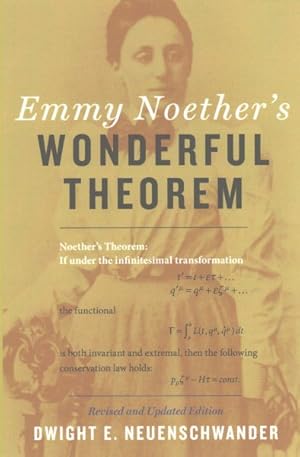
Emmy Noether's Wonderful Theorem
Idioma: Inglés
Publicado por Johns Hopkins University Press, 2017
ISBN 10: 1421422670 ISBN 13: 9781421422671
Librería: GreatBookPricesUK, Woodford Green, Reino Unido
Calificación del vendedor: 5 de 5 estrellas
EUR 32,77
Envío por EUR 17,38
Se envía de Reino Unido a Estados Unidos de AmericaCantidad disponible: Más de 20 disponibles
Añadir al carritoCondición: As New. Unread book in perfect condition.
-
Emmy Noether's Wonderful Theorem
Idioma: Inglés
Publicado por Johns Hopkins University Press, 2017
ISBN 10: 1421422670 ISBN 13: 9781421422671
Librería: Ria Christie Collections, Uxbridge, Reino Unido
Calificación del vendedor: 5 de 5 estrellas
EUR 36,58
Envío por EUR 13,88
Se envía de Reino Unido a Estados Unidos de AmericaCantidad disponible: Más de 20 disponibles
Añadir al carritoCondición: New. In.
-
Emmy Noether's Wonderful Theorem
Idioma: Inglés
Publicado por Johns Hopkins University Press, 2017
ISBN 10: 1421422670 ISBN 13: 9781421422671
Librería: Books Puddle, New York, NY, Estados Unidos de America
Calificación del vendedor: 4 de 5 estrellas
EUR 49,67
Envío por EUR 3,50
Se envía dentro de Estados Unidos de AmericaCantidad disponible: 3 disponibles
Añadir al carritoCondición: New.
-
Emmy Noether's Wonderful Theorem
Idioma: Inglés
Publicado por Johns Hopkins University Press, 2017
ISBN 10: 1421422670 ISBN 13: 9781421422671
Librería: Biblios, Frankfurt am main, HESSE, Alemania
Calificación del vendedor: 4 de 5 estrellas
EUR 44,33
Envío por EUR 9,95
Se envía de Alemania a Estados Unidos de AmericaCantidad disponible: 3 disponibles
Añadir al carritoCondición: New.
-
Emmy Noether`s Wonderful Theorem 2e
Librería: Revaluation Books, Exeter, Reino Unido
Calificación del vendedor: 5 de 5 estrellas
EUR 55,75
Envío por EUR 11,59
Se envía de Reino Unido a Estados Unidos de AmericaCantidad disponible: 2 disponibles
Añadir al carritoPaperback. Condición: Brand New. 2nd revised updated edition. 328 pages. 9.00x6.00x0.79 inches. In Stock.
-
EMMY NOETHERS WONDERFUL THEOREM
Idioma: Inglés
Publicado por Johns Hopkins University Press, 2017
ISBN 10: 1421422670 ISBN 13: 9781421422671
Librería: Speedyhen, Hertfordshire, Reino Unido
Calificación del vendedor: 5 de 5 estrellas
EUR 30,00
Envío por EUR 47,50
Se envía de Reino Unido a Estados Unidos de AmericaCantidad disponible: 17 disponibles
Añadir al carritoCondición: NEW.
-

Emmy Noether's Wonderful Theorem
Idioma: Inglés
Publicado por Johns Hopkins University Press, US, 2017
ISBN 10: 1421422670 ISBN 13: 9781421422671
Librería: Rarewaves USA United, OSWEGO, IL, Estados Unidos de America
Calificación del vendedor: 5 de 5 estrellas
EUR 44,83
Envío por EUR 43,89
Se envía dentro de Estados Unidos de AmericaCantidad disponible: 9 disponibles
Añadir al carritoPaperback. Condición: New. revised and updated edition. "In the judgment of the most competent living mathematicians, Fraulein Noether was the most significant creative mathematical genius thus far produced since the higher education of women began."-Albert Einstein The year was 1915, and the young mathematician Emmy Noether had just settled into Gottingen University when Albert Einstein visited to lecture on his nearly finished general theory of relativity. Two leading mathematicians of the day, David Hilbert and Felix Klein, dug into the new theory with gusto, but had difficulty reconciling it with what was known about the conservation of energy. Knowing of her expertise in invariance theory, they requested Noether's help. To solve the problem, she developed a novel theorem, applicable across all of physics, which relates conservation laws to continuous symmetries-one of the most important pieces of mathematical reasoning ever developed. Noether's "first" and "second" theorem was published in 1918. The first theorem relates symmetries under global spacetime transformations to the conservation of energy and momentum, and symmetry under global gauge transformations to charge conservation.In continuum mechanics and field theories, these conservation laws are expressed as equations of continuity. The second theorem, an extension of the first, allows transformations with local gauge invariance, and the equations of continuity acquire the covariant derivative characteristic of coupled matter-field systems. General relativity, it turns out, exhibits local gauge invariance. Noether's theorem also laid the foundation for later generations to apply local gauge invariance to theories of elementary particle interactions. In Dwight E. Neuenschwander's new edition of Emmy Noether's Wonderful Theorem, readers will encounter an updated explanation of Noether's "first" theorem. The discussion of local gauge invariance has been expanded into a detailed presentation of the motivation, proof, and applications of the "second" theorem, including Noether's resolution of concerns about general relativity. Other refinements in the new edition include an enlarged biography of Emmy Noether's life and work, parallels drawn between the present approach and Noether's original 1918 paper, and a summary of the logic behind Noether's theorem.
-

Emmy Noether\ s Wonderful Theorem
Librería: moluna, Greven, Alemania
Calificación del vendedor: 5 de 5 estrellas
EUR 38,65
Envío por EUR 48,99
Se envía de Alemania a Estados Unidos de AmericaCantidad disponible: Más de 20 disponibles
Añadir al carritoCondición: New. Other refinements in the new edition include an enlarged biography of Emmy Noether s life and work, parallels drawn between the present approach and Noether s original 1918 paper, and a summary of the logic behind Noether s theorem.Über den Aut.
-

Emmy Noether's Wonderful Theorem (Paperback)
Idioma: Inglés
Publicado por Johns Hopkins University Press, Baltimore, MD, 2017
ISBN 10: 1421422670 ISBN 13: 9781421422671
Librería: AussieBookSeller, Truganina, VIC, Australia
Calificación del vendedor: 5 de 5 estrellas
EUR 64,34
Envío por EUR 32,48
Se envía de Australia a Estados Unidos de AmericaCantidad disponible: 1 disponibles
Añadir al carritoPaperback. Condición: new. Paperback. "In the judgment of the most competent living mathematicians, Fraulein Noether was the most significant creative mathematical genius thus far produced since the higher education of women began."-Albert Einstein The year was 1915, and the young mathematician Emmy Noether had just settled into Gottingen University when Albert Einstein visited to lecture on his nearly finished general theory of relativity. Two leading mathematicians of the day, David Hilbert and Felix Klein, dug into the new theory with gusto, but had difficulty reconciling it with what was known about the conservation of energy. Knowing of her expertise in invariance theory, they requested Noether's help. To solve the problem, she developed a novel theorem, applicable across all of physics, which relates conservation laws to continuous symmetries-one of the most important pieces of mathematical reasoning ever developed. Noether's "first" and "second" theorem was published in 1918. The first theorem relates symmetries under global spacetime transformations to the conservation of energy and momentum, and symmetry under global gauge transformations to charge conservation.In continuum mechanics and field theories, these conservation laws are expressed as equations of continuity. The second theorem, an extension of the first, allows transformations with local gauge invariance, and the equations of continuity acquire the covariant derivative characteristic of coupled matter-field systems. General relativity, it turns out, exhibits local gauge invariance. Noether's theorem also laid the foundation for later generations to apply local gauge invariance to theories of elementary particle interactions. In Dwight E. Neuenschwander's new edition of Emmy Noether's Wonderful Theorem, readers will encounter an updated explanation of Noether's "first" theorem. The discussion of local gauge invariance has been expanded into a detailed presentation of the motivation, proof, and applications of the "second" theorem, including Noether's resolution of concerns about general relativity. Other refinements in the new edition include an enlarged biography of Emmy Noether's life and work, parallels drawn between the present approach and Noether's original 1918 paper, and a summary of the logic behind Noether's theorem. Other refinements in the new edition include an enlarged biography of Emmy Noether's life and work, parallels drawn between the present approach and Noether's original 1918 paper, and a summary of the logic behind Noether's theorem. Shipping may be from our Sydney, NSW warehouse or from our UK or US warehouse, depending on stock availability.
-

Emmy Noether's Wonderful Theorem
Idioma: Inglés
Publicado por Johns Hopkins University Press, US, 2017
ISBN 10: 1421422670 ISBN 13: 9781421422671
Librería: Rarewaves.com UK, London, Reino Unido
Calificación del vendedor: 5 de 5 estrellas
EUR 32,00
Envío por EUR 75,31
Se envía de Reino Unido a Estados Unidos de AmericaCantidad disponible: 15 disponibles
Añadir al carritoPaperback. Condición: New. revised and updated edition. "In the judgment of the most competent living mathematicians, Fraulein Noether was the most significant creative mathematical genius thus far produced since the higher education of women began."-Albert Einstein The year was 1915, and the young mathematician Emmy Noether had just settled into Gottingen University when Albert Einstein visited to lecture on his nearly finished general theory of relativity. Two leading mathematicians of the day, David Hilbert and Felix Klein, dug into the new theory with gusto, but had difficulty reconciling it with what was known about the conservation of energy. Knowing of her expertise in invariance theory, they requested Noether's help. To solve the problem, she developed a novel theorem, applicable across all of physics, which relates conservation laws to continuous symmetries-one of the most important pieces of mathematical reasoning ever developed. Noether's "first" and "second" theorem was published in 1918. The first theorem relates symmetries under global spacetime transformations to the conservation of energy and momentum, and symmetry under global gauge transformations to charge conservation.In continuum mechanics and field theories, these conservation laws are expressed as equations of continuity. The second theorem, an extension of the first, allows transformations with local gauge invariance, and the equations of continuity acquire the covariant derivative characteristic of coupled matter-field systems. General relativity, it turns out, exhibits local gauge invariance. Noether's theorem also laid the foundation for later generations to apply local gauge invariance to theories of elementary particle interactions. In Dwight E. Neuenschwander's new edition of Emmy Noether's Wonderful Theorem, readers will encounter an updated explanation of Noether's "first" theorem. The discussion of local gauge invariance has been expanded into a detailed presentation of the motivation, proof, and applications of the "second" theorem, including Noether's resolution of concerns about general relativity. Other refinements in the new edition include an enlarged biography of Emmy Noether's life and work, parallels drawn between the present approach and Noether's original 1918 paper, and a summary of the logic behind Noether's theorem.
-
Emmy Noether`s Wonderful Theorem 2e
Librería: Revaluation Books, Exeter, Reino Unido
Calificación del vendedor: 5 de 5 estrellas
EUR 38,14
Envío por EUR 11,59
Se envía de Reino Unido a Estados Unidos de AmericaCantidad disponible: 2 disponibles
Añadir al carritoPaperback. Condición: Brand New. 2nd revised updated edition. 328 pages. 9.00x6.00x0.79 inches. In Stock. This item is printed on demand.
-
Emmy Noether's Wonderful Theorem (Paperback)
Idioma: Inglés
Publicado por Johns Hopkins University Press, Baltimore, MD, 2017
ISBN 10: 1421422670 ISBN 13: 9781421422671
Librería: CitiRetail, Stevenage, Reino Unido
Calificación del vendedor: 5 de 5 estrellas
EUR 42,95
Envío por EUR 42,87
Se envía de Reino Unido a Estados Unidos de AmericaCantidad disponible: 1 disponibles
Añadir al carritoPaperback. Condición: new. Paperback. "In the judgment of the most competent living mathematicians, Fraulein Noether was the most significant creative mathematical genius thus far produced since the higher education of women began."-Albert Einstein The year was 1915, and the young mathematician Emmy Noether had just settled into Gottingen University when Albert Einstein visited to lecture on his nearly finished general theory of relativity. Two leading mathematicians of the day, David Hilbert and Felix Klein, dug into the new theory with gusto, but had difficulty reconciling it with what was known about the conservation of energy. Knowing of her expertise in invariance theory, they requested Noether's help. To solve the problem, she developed a novel theorem, applicable across all of physics, which relates conservation laws to continuous symmetries-one of the most important pieces of mathematical reasoning ever developed. Noether's "first" and "second" theorem was published in 1918. The first theorem relates symmetries under global spacetime transformations to the conservation of energy and momentum, and symmetry under global gauge transformations to charge conservation.In continuum mechanics and field theories, these conservation laws are expressed as equations of continuity. The second theorem, an extension of the first, allows transformations with local gauge invariance, and the equations of continuity acquire the covariant derivative characteristic of coupled matter-field systems. General relativity, it turns out, exhibits local gauge invariance. Noether's theorem also laid the foundation for later generations to apply local gauge invariance to theories of elementary particle interactions. In Dwight E. Neuenschwander's new edition of Emmy Noether's Wonderful Theorem, readers will encounter an updated explanation of Noether's "first" theorem. The discussion of local gauge invariance has been expanded into a detailed presentation of the motivation, proof, and applications of the "second" theorem, including Noether's resolution of concerns about general relativity. Other refinements in the new edition include an enlarged biography of Emmy Noether's life and work, parallels drawn between the present approach and Noether's original 1918 paper, and a summary of the logic behind Noether's theorem. Other refinements in the new edition include an enlarged biography of Emmy Noether's life and work, parallels drawn between the present approach and Noether's original 1918 paper, and a summary of the logic behind Noether's theorem. This item is printed on demand. Shipping may be from our UK warehouse or from our Australian or US warehouses, depending on stock availability.
-

Emmy Noether's Wonderful Theorem (Revised and Updated)
Idioma: Inglés
Publicado por Johns Hopkins University Press, 2017
ISBN 10: 1421422670 ISBN 13: 9781421422671
Librería: AHA-BUCH GmbH, Einbeck, Alemania
Calificación del vendedor: 5 de 5 estrellas
EUR 39,03
Envío por EUR 62,81
Se envía de Alemania a Estados Unidos de AmericaCantidad disponible: 2 disponibles
Añadir al carritoTaschenbuch. Condición: Neu. nach der Bestellung gedruckt Neuware - Printed after ordering - One of the most important--and beautiful--mathematical solutions ever devised, Noether's theorem touches on every aspect of physics.'In the judgment of the most competent living mathematicians, Fräulein Noether was the most significant creative mathematical genius thus far produced since the higher education of women began.'--Albert EinsteinThe year was 1915, and the young mathematician Emmy Noether had just settled into Göttingen University when Albert Einstein visited to lecture on his nearly finished general theory of relativity. Two leading mathematicians of the day, David Hilbert and Felix Klein, dug into the new theory with gusto, but had difficulty reconciling it with what was known about the conservation of energy. Knowing of her expertise in invariance theory, they requested Noether's help. To solve the problem, she developed a novel theorem, applicable across all of physics, which relates conservation laws to continuous symmetries--one of the most important pieces of mathematical reasoning ever developed.Noether's 'first' and 'second' theorem was published in 1918. The first theorem relates symmetries under global spacetime transformations to the conservation of energy and momentum, and symmetry under global gauge transformations to charge conservation. In continuum mechanics and field theories, these conservation laws are expressed as equations of continuity. The second theorem, an extension of the first, allows transformations with local gauge invariance, and the equations of continuity acquire the covariant derivative characteristic of coupled matter-field systems. General relativity, it turns out, exhibits local gauge invariance. Noether's theorem also laid the foundation for later generations to apply local gauge invariance to theories of elementary particle interactions.In Dwight E. Neuenschwander's new edition of Emmy Noether's Wonderful Theorem, readers will encounter an updated explanation of Noether's 'first' theorem. The discussion of local gauge invariance has been expanded into a detailed presentation of the motivation, proof, and applications of the 'second' theorem, including Noether's resolution of concerns about general relativity. Other refinements in the new edition include an enlarged biography of Emmy Noether's life and work, parallels drawn between the present approach and Noether's original 1918 paper, and a summary of the logic behind Noether's theorem.
-

Emmy Noether's Wonderful Theorem (Revised and Updated)
Idioma: Inglés
Publicado por Johns Hopkins University Press, 2017
ISBN 10: 1421422670 ISBN 13: 9781421422671
Librería: preigu, Osnabrück, Alemania
Calificación del vendedor: 5 de 5 estrellas
EUR 46,50
Envío por EUR 70,00
Se envía de Alemania a Estados Unidos de AmericaCantidad disponible: 5 disponibles
Añadir al carritoTaschenbuch. Condición: Neu. Emmy Noether's Wonderful Theorem (Revised and Updated) | Dwight E Neuenschwander | Taschenbuch | Einband - flex.(Paperback) | Englisch | 2017 | Johns Hopkins University Press | EAN 9781421422671 | Verantwortliche Person für die EU: Libri GmbH, Europaallee 1, 36244 Bad Hersfeld, gpsr[at]libri[dot]de | Anbieter: preigu Print on Demand.

