

Importe total (1 artículo artículos):
Destino del pedido:

9781330486290 - Railway Tariffs and the Interstate Commerce Law (Classic Reprint) de Seligman, Edwin R. A. (4 resultados)
Ir a los resultados principales
Filtros de búsqueda
Tipo de artículo
- Todos los tipos de productos
- Libros (4)
- Revistas y publicaciones (No hay ningún otro resultado que coincida con este filtro.)
- Cómics (No hay ningún otro resultado que coincida con este filtro.)
- Partituras (No hay ningún otro resultado que coincida con este filtro.)
- Arte, grabados y pósters (No hay ningún otro resultado que coincida con este filtro.)
- Fotografías (No hay ningún otro resultado que coincida con este filtro.)
- Mapas (No hay ningún otro resultado que coincida con este filtro.)
- Manuscritos y coleccionismo de papel (No hay ningún otro resultado que coincida con este filtro.)
Condición Más información
- Nuevo (4)
- Como nuevo, Excelente o Muy bueno (No hay ningún otro resultado que coincida con este filtro.)
- Bueno o Aceptable (No hay ningún otro resultado que coincida con este filtro.)
- Regular o Pobre (No hay ningún otro resultado que coincida con este filtro.)
- Tal como se indica (No hay ningún otro resultado que coincida con este filtro.)
Encuadernación
- Todas
- Tapa dura (No hay ningún otro resultado que coincida con este filtro.)
- Tapa blanda (4)
Más atributos
- Primera edición (No hay ningún otro resultado que coincida con este filtro.)
- Firmado (No hay ningún otro resultado que coincida con este filtro.)
- Sobrecubierta (No hay ningún otro resultado que coincida con este filtro.)
- Con imágenes (2)
- No impresión bajo demanda (3)
Idioma (1)
Precio
- Cualquier precio
- Menos de EUR 20
- EUR 20 a EUR 45
- Más de EUR 45 (No hay ningún otro resultado que coincida con este filtro.)
Gastos de envío gratis
Ubicación del vendedor
Valoración de los vendedores
-
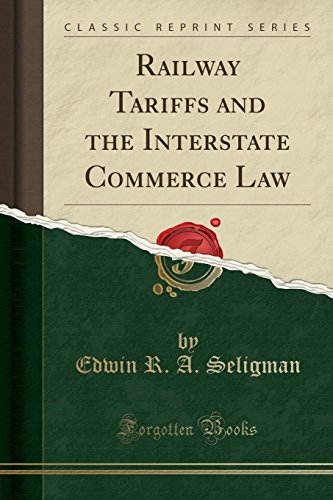
Railway Tariffs and the Interstate Commerce Law (Classic Reprint)
Librería: PBShop.store US, Wood Dale, IL, Estados Unidos de America
Calificación del vendedor: 5 de 5 estrellas

EUR 23,07
Gastos de envío gratis
Se envía dentro de Estados Unidos de AmericaCantidad disponible: 15 disponibles
Añadir al carritoPAP. Condición: New. New Book. Shipped from UK. Established seller since 2000.
-
Railway Tariffs and the Interstate Commerce Law (Classic Reprint)
Librería: PBShop.store UK, Fairford, GLOS, Reino Unido
Calificación del vendedor: 4 de 5 estrellas

EUR 21,49
Envío por EUR 3,82
Se envía de Reino Unido a Estados Unidos de AmericaCantidad disponible: 15 disponibles
Añadir al carritoPAP. Condición: New. New Book. Shipped from UK. Established seller since 2000.
-
Railway Tariffs and the Interstate Commerce Law (Classic Reprint)
Librería: Forgotten Books, London, Reino Unido
Calificación del vendedor: 4 de 5 estrellas
EUR 16,18
Gastos de envío gratis
Se envía de Reino Unido a Estados Unidos de AmericaCantidad disponible: Más de 20 disponibles
Añadir al carritoPaperback. Condición: New. Print on Demand. This book, published in 1887, explores the history and justification of railway tariffs and the impact of charging different rates to different customers. The author argues that the principle of cost of service alone cannot be a fair basis for determining railway tariffs, and that the value of service must also be taken into account. This value-of-service principle has historically been used to justify classication (different rates for different types of goods) and local discrimination (different rates for different locations). While acknowledging that there is a legitimate role for classication and differential rates, the author also raises concerns about the potential for abuse and argues for the need for regulation to prevent unfair discrimination. The author's insights provide valuable historical context for understanding the complexities of railway tariff regulation and the ongoing debate over the balance between private interests and the public good in transportation policy. This book is a reproduction of an important historical work, digitally reconstructed using state-of-the-art technology to preserve the original format. In rare cases, an imperfection in the original, such as a blemish or missing page, may be replicated in the book. print-on-demand item.
-

RAILWAY TARIFFS & THE INTERSTA
Librería: moluna, Greven, Alemania
Calificación del vendedor: 5 de 5 estrellas
EUR 22,61
Envío por EUR 48,99
Se envía de Alemania a Estados Unidos de AmericaCantidad disponible: Más de 20 disponibles
Añadir al carritoCondición: New. KlappentextrnrnExcerpt from Railway Tariffs and the Interstate Commerce LawThe inequality of railroad charges forms the pith Of the com plaints usually made. It is the crucial point Of corporate management. On the one hand we have the an.


