

Importe total (1 artículo artículos):
Destino del pedido:

9781138687486 - The New Critical Thinking: An Empirically Informed Introduction de Lyons, Jack; Ward, Barry (15 resultados)
Ir a los resultados principales
Filtros de búsqueda
Tipo de artículo
- Todos los tipos de productos
- Libros (15)
- Revistas y publicaciones (No hay ningún otro resultado que coincida con este filtro.)
- Cómics (No hay ningún otro resultado que coincida con este filtro.)
- Partituras (No hay ningún otro resultado que coincida con este filtro.)
- Arte, grabados y pósters (No hay ningún otro resultado que coincida con este filtro.)
- Fotografías (No hay ningún otro resultado que coincida con este filtro.)
- Mapas (No hay ningún otro resultado que coincida con este filtro.)
- Manuscritos y coleccionismo de papel (No hay ningún otro resultado que coincida con este filtro.)
Condición Más información
- Nuevo (10)
- Como nuevo, Excelente o Muy bueno (2)
- Bueno o Aceptable (2)
- Regular o Pobre (1)
- Tal como se indica (No hay ningún otro resultado que coincida con este filtro.)
Encuadernación
- Todas
- Tapa dura (No hay ningún otro resultado que coincida con este filtro.)
- Tapa blanda (14)
Más atributos
- Primera edición (3)
- Firmado (No hay ningún otro resultado que coincida con este filtro.)
- Sobrecubierta (No hay ningún otro resultado que coincida con este filtro.)
- Con imágenes (4)
- No impresión bajo demanda (15)
Idioma (2)
Precio
- Cualquier precio
- Menos de EUR 20 (No hay ningún otro resultado que coincida con este filtro.)
- EUR 20 a EUR 45
- Más de EUR 45
Gastos de envío gratis
Ubicación del vendedor
Valoración de los vendedores
-

The New Critical Thinking: An Empirically Informed Introduction
Librería: A Team Books, Conway, AR, Estados Unidos de America
Calificación del vendedor: 5 de 5 estrellas

EUR 20,93
Envío por EUR 2,63
Se envía dentro de Estados Unidos de AmericaCantidad disponible: 1 disponibles
Añadir al carritopaperback. Condición: Acceptable. Used books may not include access codes or one time use codes. Proven Seller with Excellent Customer Service. Choose expedited shipping and get it FAST.
-
The New Critical Thinking: An Empirically Informed Introduction
Librería: GoldBooks, Denver, CO, Estados Unidos de America
Calificación del vendedor: 5 de 5 estrellas
EUR 51,46
Envío por EUR 4,82
Se envía dentro de Estados Unidos de AmericaCantidad disponible: 1 disponibles
Añadir al carritoPaperback. Condición: new. New Copy. Customer Service Guaranteed.
-
The New Critical Thinking: An Empirically Informed Introduction
Librería: Textbooks_Source, Columbia, MO, Estados Unidos de America
Calificación del vendedor: 5 de 5 estrellas
Original o primera edición
EUR 62,09
Envío por EUR 3,50
Se envía dentro de Estados Unidos de AmericaCantidad disponible: 4 disponibles
Añadir al carritopaperback. Condición: Good. 1st Edition. Ships in a BOX from Central Missouri! May not include working access code. Will not include dust jacket. Has used sticker(s) and some writing or highlighting. UPS shipping for most packages, (Priority Mail for AK/HI/APO/PO Boxes).
-
The New Critical Thinking: An Empirically Informed Introduction
Librería: Textbooks_Source, Columbia, MO, Estados Unidos de America
Calificación del vendedor: 5 de 5 estrellas
Original o primera edición
EUR 62,09
Envío por EUR 3,50
Se envía dentro de Estados Unidos de AmericaCantidad disponible: 3 disponibles
Añadir al carritopaperback. Condición: New. 1st Edition. Ships in a BOX from Central Missouri! UPS shipping for most packages, (Priority Mail for AK/HI/APO/PO Boxes).
-
New Critical Thinking : An Empirically Informed Introduction
Librería: GreatBookPrices, Columbia, MD, Estados Unidos de America
Calificación del vendedor: 5 de 5 estrellas
EUR 75,73
Envío por EUR 2,31
Se envía dentro de Estados Unidos de AmericaCantidad disponible: 2 disponibles
Añadir al carritoCondición: New.
-
The New Critical Thinking (Paperback)
Idioma: Inglés
Publicado por Taylor & Francis Ltd, London, 2017
ISBN 10: 1138687480 ISBN 13: 9781138687486
Librería: Grand Eagle Retail, Bensenville, IL, Estados Unidos de America
Calificación del vendedor: 5 de 5 estrellas
EUR 78,11
Gastos de envío gratis
Se envía dentro de Estados Unidos de AmericaCantidad disponible: 1 disponibles
Añadir al carritoPaperback. Condición: new. Paperback. Why is it so hard to learn critical thinking skills? Traditional textbooks focus almost exclusively on logic and fallacious reasoning, ignoring two crucial problems. As psychologists have demonstrated recently, many of our mistakes are not caused by formal reasoning gone awry, but by our bypassing it completely. We instead favor more comfortable, but often unreliable, intuitive methods. Second, the evaluation of premises is of fundamental importance, especially in this era of fake news and politicized science.This highly innovative text is psychologically informed, both in its diagnosis of inferential errors, and in teaching students how to watch out for and work around their natural intellectual blind spots. It also incorporates insights from epistemology and philosophy of science that are indispensable for learning how to evaluate premises. The result is a hands-on primer for real world critical thinking. The authors bring over four combined decades of classroom experience and a fresh approach to the traditional challenges of a critical thinking course: effectively explaining the nature of validity, assessing deductive arguments, reconstructing, identifying and diagramming arguments, and causal and probabilistic inference. Additionally, they discuss in detail, important, frequently neglected topics, including testimony, the nature and credibility of science, rhetoric, and dialectical argumentation.Key Features and Benefits: Uses contemporary psychological explanations of, and remedies for, pervasive errors in belief formation. There is no other critical thinking text that generally applies this psychological approach. Assesses premises, notably premises based on the testimony of others, and evaluation of news and other information sources. No other critical thinking textbook gives detailed treatment of this crucial topic. Typically, they only provide a few remarks about when to accept expert opinion / argument from authority. Carefully explains the concept of validity, paying particular attention in distinguishing logical possibility from other species of possibility, and demonstrates how we may mistakenly judge invalid arguments as valid because of belief bias. Instead of assessing an arguments validity using formal/mathematical methods (i.e., truth tables for propositional logic and Venn diagrams for categorical logic), provides one technique that is generally applicable: explicitly showing that it is impossible to make the conclusion false and the premises true together. For instructors who like the more formal approach, the text also includes standard treatments using truth tables and Venn diagrams. Uses frequency trees and the frequency approach to probability more generally, a simple method for understanding and evaluating quite complex probabilistic information Uses arguments maps, which have been shown to significantly improve students reasoning and argument evaluation This highly innovative textbook incorporates contemporary psychology, epistemology, and philosophy of science to address problems with logic and fallacious reasoning, providing an experienced, but fresh, approach to traditional critical thinking material. Shipping may be from multiple locations in the US or from the UK, depending on stock availability.
-
New Critical Thinking : An Empirically Informed Introduction
Librería: GreatBookPrices, Columbia, MD, Estados Unidos de America
Calificación del vendedor: 5 de 5 estrellas
EUR 77,33
Envío por EUR 2,31
Se envía dentro de Estados Unidos de AmericaCantidad disponible: 2 disponibles
Añadir al carritoCondición: As New. Unread book in perfect condition.
-
The New Critical Thinking: An Empirically Informed Introduction
Librería: Kennys Bookshop and Art Galleries Ltd., Galway, GY, Irlanda
Calificación del vendedor: 5 de 5 estrellas
Original o primera edición
EUR 85,02
Envío por EUR 10,50
Se envía de Irlanda a Estados Unidos de AmericaCantidad disponible: 2 disponibles
Añadir al carritoCondición: New. Num Pages: 450 pages. BIC Classification: HPK; HPL. Category: (G) General (US: Trade); (U) Tertiary Education (US: College). Dimension: 254 x 178. . . 2017. 1st Edition. Paperback. . . . .
-
New Critical Thinking : An Empirically Informed Introduction
Librería: GreatBookPricesUK, Woodford Green, Reino Unido
Calificación del vendedor: 5 de 5 estrellas
EUR 84,63
Envío por EUR 17,61
Se envía de Reino Unido a Estados Unidos de AmericaCantidad disponible: 2 disponibles
Añadir al carritoCondición: As New. Unread book in perfect condition.
-
New Critical Thinking : An Empirically Informed Introduction
Librería: GreatBookPricesUK, Woodford Green, Reino Unido
Calificación del vendedor: 5 de 5 estrellas
EUR 93,53
Envío por EUR 17,61
Se envía de Reino Unido a Estados Unidos de AmericaCantidad disponible: 2 disponibles
Añadir al carritoCondición: New.
-
The New Critical Thinking: An Empirically Informed Introduction
Librería: Kennys Bookstore, Olney, MD, Estados Unidos de America
Calificación del vendedor: 5 de 5 estrellas
EUR 107,84
Envío por EUR 9,21
Se envía dentro de Estados Unidos de AmericaCantidad disponible: 2 disponibles
Añadir al carritoCondición: New. Num Pages: 450 pages. BIC Classification: HPK; HPL. Category: (G) General (US: Trade); (U) Tertiary Education (US: College). Dimension: 254 x 178. . . 2017. 1st Edition. Paperback. . . . . Books ship from the US and Ireland.
-
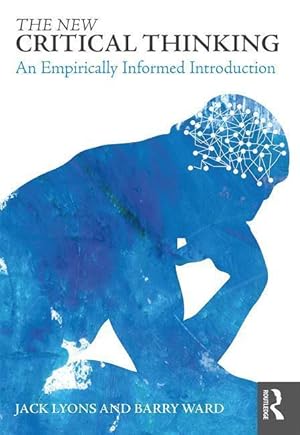
Lyons, J: The New Critical Thinking
Librería: moluna, Greven, Alemania
Calificación del vendedor: 5 de 5 estrellas
EUR 84,74
Envío por EUR 48,99
Se envía de Alemania a Estados Unidos de AmericaCantidad disponible: 2 disponibles
Añadir al carritoKartoniert / Broschiert. Condición: New. Why is it so hard to learn critical thinking skills? Traditional textbooks focus almost exclusively on logic and fallacious reasoning, ignoring two crucial problems. As psychologists have demonstrated recently, many of our mistakes are not caused .
-
The New Critical Thinking (Paperback)
Idioma: Inglés
Publicado por Taylor & Francis Ltd, London, 2017
ISBN 10: 1138687480 ISBN 13: 9781138687486
Librería: AussieBookSeller, Truganina, VIC, Australia
Calificación del vendedor: 5 de 5 estrellas
EUR 127,27
Envío por EUR 32,44
Se envía de Australia a Estados Unidos de AmericaCantidad disponible: 1 disponibles
Añadir al carritoPaperback. Condición: new. Paperback. Why is it so hard to learn critical thinking skills? Traditional textbooks focus almost exclusively on logic and fallacious reasoning, ignoring two crucial problems. As psychologists have demonstrated recently, many of our mistakes are not caused by formal reasoning gone awry, but by our bypassing it completely. We instead favor more comfortable, but often unreliable, intuitive methods. Second, the evaluation of premises is of fundamental importance, especially in this era of fake news and politicized science.This highly innovative text is psychologically informed, both in its diagnosis of inferential errors, and in teaching students how to watch out for and work around their natural intellectual blind spots. It also incorporates insights from epistemology and philosophy of science that are indispensable for learning how to evaluate premises. The result is a hands-on primer for real world critical thinking. The authors bring over four combined decades of classroom experience and a fresh approach to the traditional challenges of a critical thinking course: effectively explaining the nature of validity, assessing deductive arguments, reconstructing, identifying and diagramming arguments, and causal and probabilistic inference. Additionally, they discuss in detail, important, frequently neglected topics, including testimony, the nature and credibility of science, rhetoric, and dialectical argumentation.Key Features and Benefits: Uses contemporary psychological explanations of, and remedies for, pervasive errors in belief formation. There is no other critical thinking text that generally applies this psychological approach. Assesses premises, notably premises based on the testimony of others, and evaluation of news and other information sources. No other critical thinking textbook gives detailed treatment of this crucial topic. Typically, they only provide a few remarks about when to accept expert opinion / argument from authority. Carefully explains the concept of validity, paying particular attention in distinguishing logical possibility from other species of possibility, and demonstrates how we may mistakenly judge invalid arguments as valid because of belief bias. Instead of assessing an arguments validity using formal/mathematical methods (i.e., truth tables for propositional logic and Venn diagrams for categorical logic), provides one technique that is generally applicable: explicitly showing that it is impossible to make the conclusion false and the premises true together. For instructors who like the more formal approach, the text also includes standard treatments using truth tables and Venn diagrams. Uses frequency trees and the frequency approach to probability more generally, a simple method for understanding and evaluating quite complex probabilistic information Uses arguments maps, which have been shown to significantly improve students reasoning and argument evaluation This highly innovative textbook incorporates contemporary psychology, epistemology, and philosophy of science to address problems with logic and fallacious reasoning, providing an experienced, but fresh, approach to traditional critical thinking material. Shipping may be from our Sydney, NSW warehouse or from our UK or US warehouse, depending on stock availability.
-
The New Critical Thinking: An Empirically Informed Introduction
Librería: Mispah books, Redhill, SURRE, Reino Unido
Calificación del vendedor: 4 de 5 estrellas

EUR 145,08
Envío por EUR 29,34
Se envía de Reino Unido a Estados Unidos de AmericaCantidad disponible: 1 disponibles
Añadir al carritoPaperback. Condición: New. NEW. SHIPS FROM MULTIPLE LOCATIONS. book.
-

The New Critical Thinking: An Empirically Informed Introduction
Publicado por Routledge
ISBN 10: 1138687480 ISBN 13: 9781138687486
Librería: FirstClassBooks, Little Rock, AR, Estados Unidos de America
Calificación del vendedor: 5 de 5 estrellas
EUR 182,08
Envío por EUR 3,51
Se envía dentro de Estados Unidos de AmericaCantidad disponible: 1 disponibles
Añadir al carritoCondición: Good. Used books cannot guarantee unused access codes or working CD's!


