

Importe total (1 artículo artículos):
Destino del pedido:

9780823255719 - Giving Beyond the Gift: Apophasis and Overcoming Theomania de Wolfson, Elliot R. (18 resultados)
Ir a los resultados principales
Filtros de búsqueda
Tipo de artículo
- Todos los tipos de productos
- Libros (18)
- Revistas y publicaciones (No hay ningún otro resultado que coincida con este filtro.)
- Cómics (No hay ningún otro resultado que coincida con este filtro.)
- Partituras (No hay ningún otro resultado que coincida con este filtro.)
- Arte, grabados y pósters (No hay ningún otro resultado que coincida con este filtro.)
- Fotografías (No hay ningún otro resultado que coincida con este filtro.)
- Mapas (No hay ningún otro resultado que coincida con este filtro.)
- Manuscritos y coleccionismo de papel (No hay ningún otro resultado que coincida con este filtro.)
Condición Más información
- Nuevo (11)
- Como nuevo, Excelente o Muy bueno (1)
- Bueno o Aceptable (6)
- Regular o Pobre (No hay ningún otro resultado que coincida con este filtro.)
- Tal como se indica (No hay ningún otro resultado que coincida con este filtro.)
Encuadernación
- Todas
- Tapa dura (No hay ningún otro resultado que coincida con este filtro.)
- Tapa blanda (18)
Más atributos
- Primera edición (2)
- Firmado (No hay ningún otro resultado que coincida con este filtro.)
- Sobrecubierta (No hay ningún otro resultado que coincida con este filtro.)
- Con imágenes (4)
- No impresión bajo demanda (17)
Idioma (1)
Gastos de envío gratis
Ubicación del vendedor
Valoración de los vendedores
-

Giving Beyond the Gift : Apophasis and Overcoming Theomania
Idioma: Inglés
Publicado por Fordham University Press, 2014
ISBN 10: 0823255719 ISBN 13: 9780823255719
Librería: Better World Books, Mishawaka, IN, Estados Unidos de America
Calificación del vendedor: 5 de 5 estrellas

EUR 12,90
Gastos de envío gratis
Se envía dentro de Estados Unidos de AmericaCantidad disponible: 1 disponibles
Añadir al carritoCondición: Good. Pages intact with minimal writing/highlighting. The binding may be loose and creased. Dust jackets/supplements are not included. Stock photo provided. Product includes identifying sticker. Better World Books: Buy Books. Do Good.
-
Giving Beyond the Gift Apophasis and Overcoming Theomania
Idioma: Inglés
Publicado por Fordham University Press, 2014
ISBN 10: 0823255719 ISBN 13: 9780823255719
Librería: Powell's Bookstores Chicago, ABAA, Chicago, IL, Estados Unidos de America
Miembro de asociación: ABAA ILAB
Calificación del vendedor: 5 de 5 estrellas
EUR 9,28
Envío por EUR 3,86
Se envía dentro de Estados Unidos de AmericaCantidad disponible: 16 disponibles
Añadir al carritoPaperback. Condición: NEW. 1.
-
Giving Beyond the Gift: Apophasis and Overcoming Theomania
Idioma: Inglés
Publicado por Fordham University Press, 2014
ISBN 10: 0823255719 ISBN 13: 9780823255719
Librería: Greenway, Chattanooga, TN, Estados Unidos de America
Calificación del vendedor: 5 de 5 estrellas
EUR 17,19
Envío por EUR 3,43
Se envía dentro de Estados Unidos de AmericaCantidad disponible: 1 disponibles
Añadir al carritopaperback. Condición: Very good condition. In very clean condition. Ships quickly.
-
Giving Beyond the Gift: Apophasis and Overcoming Theomania
Idioma: Inglés
Publicado por Fordham University Press, 2014
ISBN 10: 0823255719 ISBN 13: 9780823255719
Librería: Kennys Bookstore, Olney, MD, Estados Unidos de America
Calificación del vendedor: 4 de 5 estrellas

EUR 19,55
Envío por EUR 9,01
Se envía dentro de Estados Unidos de AmericaCantidad disponible: 2 disponibles
Añadir al carritoCondición: New. 2014. paperback. . . . . . Books ship from the US and Ireland.
-
Giving Beyond the Gift: Apophasis and Overcoming Theomania
Idioma: Inglés
Publicado por Fordham University Press, 2014
ISBN 10: 0823255719 ISBN 13: 9780823255719
Librería: HPB-Red, Dallas, TX, Estados Unidos de America
Calificación del vendedor: 5 de 5 estrellas
EUR 26,63
Envío por EUR 3,22
Se envía dentro de Estados Unidos de AmericaCantidad disponible: 1 disponibles
Añadir al carritopaperback. Condición: Good. Connecting readers with great books since 1972! Used textbooks may not include companion materials such as access codes, etc. May have some wear or writing/highlighting. We ship orders daily and Customer Service is our top priority!
-
Giving Beyond the Gift: Apophasis and Overcoming Theomania
Idioma: Inglés
Publicado por Fordham University Press, 2014
ISBN 10: 0823255719 ISBN 13: 9780823255719
Librería: Kennys Bookshop and Art Galleries Ltd., Galway, GY, Irlanda
Calificación del vendedor: 5 de 5 estrellas
EUR 20,89
Envío por EUR 10,50
Se envía de Irlanda a Estados Unidos de AmericaCantidad disponible: 2 disponibles
Añadir al carritoCondición: New. 2014. paperback. . . . . .
-
Giving Beyond the Gift: Apophasis and Overcoming Theomania
Idioma: Inglés
Publicado por Fordham University Press, New York, 2014
ISBN 10: 0823255719 ISBN 13: 9780823255719
Librería: Salsus Books (P.B.F.A.), Kidderminster, Reino Unido
Miembro de asociación: PBFA
Calificación del vendedor: 5 de 5 estrellas
Original o primera edición
EUR 23,66
Envío por EUR 17,23
Se envía de Reino Unido a Estados Unidos de AmericaCantidad disponible: 1 disponibles
Añadir al carritoSoft cover. Condición: Very Good. 1st Edition. 576pp paperback, ownership signature.
-

Giving Beyond the Gift: Apophasis and Overcoming Theomania (Paperback or Softback)
Idioma: Inglés
Publicado por Fordham University Press 2/3/2014, 2014
ISBN 10: 0823255719 ISBN 13: 9780823255719
Librería: BargainBookStores, Grand Rapids, MI, Estados Unidos de America
Calificación del vendedor: 5 de 5 estrellas
EUR 44,12
Gastos de envío gratis
Se envía dentro de Estados Unidos de AmericaCantidad disponible: 5 disponibles
Añadir al carritoPaperback or Softback. Condición: New. Giving Beyond the Gift: Apophasis and Overcoming Theomania. Book.
-
Giving Beyond the Gift: Apophasis and Overcoming Theomania
Idioma: Inglés
Publicado por Fordham University Press, 2014
ISBN 10: 0823255719 ISBN 13: 9780823255719
Librería: Black Gull Books (P.B.F.A.), St Leonard's on Sea, Reino Unido
Miembro de asociación: PBFA
Calificación del vendedor: 5 de 5 estrellas
EUR 29,58
Envío por EUR 14,93
Se envía de Reino Unido a Estados Unidos de AmericaCantidad disponible: 1 disponibles
Añadir al carritopaperback. Condición: Very Good. First edition. Minor creasing to base of spine.
-
Giving Beyond the Gift - Apophasis and Overcoming Theomania
Idioma: Inglés
Publicado por ME - Fordham University Press, 2014
ISBN 10: 0823255719 ISBN 13: 9780823255719
Librería: PBShop.store UK, Fairford, GLOS, Reino Unido
Calificación del vendedor: 4 de 5 estrellas
EUR 38,14
Envío por EUR 6,74
Se envía de Reino Unido a Estados Unidos de AmericaCantidad disponible: 1 disponibles
Añadir al carritoPAP. Condición: New. New Book. Shipped from UK. Established seller since 2000.
-

Giving Beyond the Gift
Idioma: Inglés
Publicado por Fordham University Press, US, 2014
ISBN 10: 0823255719 ISBN 13: 9780823255719
Librería: Rarewaves USA, OSWEGO, IL, Estados Unidos de America
Calificación del vendedor: 5 de 5 estrellas
EUR 48,61
Gastos de envío gratis
Se envía dentro de Estados Unidos de AmericaCantidad disponible: Más de 20 disponibles
Añadir al carritoPaperback. Condición: New. This book explores the co-dependency of monotheism and idolatry by examining the thought of several prominent twentieth-century Jewish philosophers-Cohen, Buber, Rosenzweig, and Levinas. While all of these thinkers were keenly aware of the pitfalls of scriptural theism, to differing degrees they each succumbed to the temptation to personify transcendence, even as they tried either to circumvent or to restrain it by apophatically purging kataphatic descriptions of the deity. Derrida and Wyschogrod, by contrast, carried the project of denegation one step further, embarking on a path that culminated in the aporetic suspension of belief and the consequent removal of all images from God, a move that seriously compromises the viability of devotional piety. The inquiry into apophasis, transcendence, and immanence in these Jewish thinkers is symptomatic of a larger question. Recent attempts to harness the apophatic tradition to construct a viable postmodern negative theology, a religion without religion, are not radical enough. Not only are these philosophies of transcendence guilty of a turn to theology that defies the phenomenological presupposition of an immanent phenomenality, but they fall short on their own terms, inasmuch as they persist in employing metaphorical language that personalizes transcendence and thereby runs the risk of undermining the irreducible alterity and invisibility attributed to the transcendent other. The logic of apophasis, if permitted to run its course fully, would exceed the need to posit some form of transcendence that is not ultimately a facet of immanence. Apophatic theologies, accordingly, must be supplanted by a more far-reaching apophasis that surpasses the theolatrous impulse lying coiled at the crux of theism, an apophasis of apophasis, based on accepting an absolute nothingness-to be distinguished from the nothingness of an absolute-that does not signify the unknowable One but rather the manifold that is the pleromatic abyss at being's core. Hence, the much-celebrated metaphor of the gift must give way to the more neutral and less theologically charged notion of an unconditional givenness in which the distinction between giver and given collapses. To think givenness in its most elemental, phenomenological sense is to allow the apparent to appear as given without presuming a causal agency that would turn that given into a gift.
-
Giving Beyond the Gift: Apophasis and Overcoming Theomania
Idioma: Inglés
Publicado por Fordham University Press, 2014
ISBN 10: 0823255719 ISBN 13: 9780823255719
Librería: MostlyAcademic, Berrima, NSW, Australia
Calificación del vendedor: 5 de 5 estrellas
Original o primera edición
EUR 24,88
Envío por EUR 29,98
Se envía de Australia a Estados Unidos de AmericaCantidad disponible: 1 disponibles
Añadir al carritoSoft cover. Condición: As New. 1st Edition.
-
Giving Beyond the Gift: Apophasis and Overcoming Theomania
Idioma: Inglés
Publicado por Fordham University Press, 2014
ISBN 10: 0823255719 ISBN 13: 9780823255719
Librería: THE SAINT BOOKSTORE, Southport, Reino Unido
Calificación del vendedor: 5 de 5 estrellas
EUR 38,14
Envío por EUR 21,83
Se envía de Reino Unido a Estados Unidos de AmericaCantidad disponible: 1 disponibles
Añadir al carritoPaperback / softback. Condición: New. New copy - Usually dispatched within 4 working days.
-
Giving Beyond the Gift: Apophasis and Overcoming Theomania
Idioma: Inglés
Publicado por Fordham University Press, 2014
ISBN 10: 0823255719 ISBN 13: 9780823255719
Librería: London Bridge Books, London, Reino Unido
Calificación del vendedor: 5 de 5 estrellas
EUR 23,97
Envío por EUR 51,69
Se envía de Reino Unido a Estados Unidos de AmericaCantidad disponible: 1 disponibles
Añadir al carritopaperback. Condición: Good.
-
Giving Beyond the Gift Apophasis and Overcoming Theomania
Librería: Revaluation Books, Exeter, Reino Unido
Calificación del vendedor: 5 de 5 estrellas
EUR 64,82
Envío por EUR 14,36
Se envía de Reino Unido a Estados Unidos de AmericaCantidad disponible: 2 disponibles
Añadir al carritoPaperback. Condición: Brand New. 1st edition. 576 pages. 9.25x6.25x1.50 inches. In Stock.
-
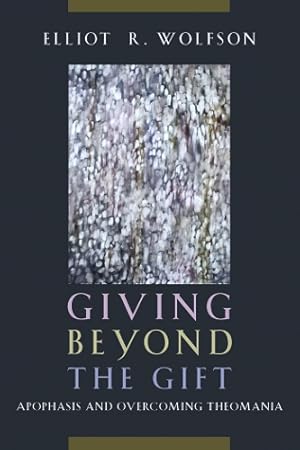
Giving Beyond the Gift
Idioma: Inglés
Publicado por Fordham University Press, US, 2014
ISBN 10: 0823255719 ISBN 13: 9780823255719
Librería: Rarewaves USA United, OSWEGO, IL, Estados Unidos de America
Calificación del vendedor: 5 de 5 estrellas
EUR 50,19
Envío por EUR 42,89
Se envía dentro de Estados Unidos de AmericaCantidad disponible: Más de 20 disponibles
Añadir al carritoPaperback. Condición: New. This book explores the co-dependency of monotheism and idolatry by examining the thought of several prominent twentieth-century Jewish philosophers-Cohen, Buber, Rosenzweig, and Levinas. While all of these thinkers were keenly aware of the pitfalls of scriptural theism, to differing degrees they each succumbed to the temptation to personify transcendence, even as they tried either to circumvent or to restrain it by apophatically purging kataphatic descriptions of the deity. Derrida and Wyschogrod, by contrast, carried the project of denegation one step further, embarking on a path that culminated in the aporetic suspension of belief and the consequent removal of all images from God, a move that seriously compromises the viability of devotional piety. The inquiry into apophasis, transcendence, and immanence in these Jewish thinkers is symptomatic of a larger question. Recent attempts to harness the apophatic tradition to construct a viable postmodern negative theology, a religion without religion, are not radical enough. Not only are these philosophies of transcendence guilty of a turn to theology that defies the phenomenological presupposition of an immanent phenomenality, but they fall short on their own terms, inasmuch as they persist in employing metaphorical language that personalizes transcendence and thereby runs the risk of undermining the irreducible alterity and invisibility attributed to the transcendent other. The logic of apophasis, if permitted to run its course fully, would exceed the need to posit some form of transcendence that is not ultimately a facet of immanence. Apophatic theologies, accordingly, must be supplanted by a more far-reaching apophasis that surpasses the theolatrous impulse lying coiled at the crux of theism, an apophasis of apophasis, based on accepting an absolute nothingness-to be distinguished from the nothingness of an absolute-that does not signify the unknowable One but rather the manifold that is the pleromatic abyss at being's core. Hence, the much-celebrated metaphor of the gift must give way to the more neutral and less theologically charged notion of an unconditional givenness in which the distinction between giver and given collapses. To think givenness in its most elemental, phenomenological sense is to allow the apparent to appear as given without presuming a causal agency that would turn that given into a gift.
-

Giving Beyond the Gift : Apophasis and Overcoming Theomania
Idioma: Inglés
Publicado por Fordham University Press Feb 2014, 2014
ISBN 10: 0823255719 ISBN 13: 9780823255719
Librería: AHA-BUCH GmbH, Einbeck, Alemania
Calificación del vendedor: 5 de 5 estrellas
EUR 65,78
Envío por EUR 63,97
Se envía de Alemania a Estados Unidos de AmericaCantidad disponible: 1 disponibles
Añadir al carritoTaschenbuch. Condición: Neu. Neuware - This book explores the co-dependency of monotheism and idolatry by examining the thought of several prominent twentieth-century Jewish philosophers-Cohen, Buber, Rosenzweig, and Levinas. While all of these thinkers were keenly aware of the pitfalls of scriptural theism, to differing degrees they each succumbed to the temptation to personify transcendence, even as they tried either to circumvent or to restrain it by apophatically purging kataphatic descriptions of the deity. Derrida and Wyschogrod, by contrast, carried the project of denegation one step further, embarking on a path that culminated in the aporetic suspension of belief and the consequent removal of all images from God, a move that seriously compromises the viability of devotional piety. The inquiry into apophasis, transcendence, and immanence in these Jewish thinkers is symptomatic of a larger question. Recent attempts to harness the apophatic tradition to construct a viable postmodern negative theology, a religion without religion, are not radical enough. Not only are these philosophies of transcendence guilty of a turn to theology that defies the phenomenological presupposition of an immanent phenomenality, but they fall short on their own terms, inasmuch as they persist in employing metaphorical language that personalizes transcendence and thereby runs the risk of undermining the irreducible alterity and invisibility attributed to the transcendent other. The logic of apophasis, if permitted to run its course fully, would exceed the need to posit some form of transcendence that is not ultimately a facet of immanence. Apophatic theologies, accordingly, must be supplanted by a more far-reaching apophasis that surpasses the theolatrous impulse lying coiled at the crux of theism, an apophasis of apophasis, based on accepting an absolute nothingness-to be distinguished from the nothingness of an absolute-that does not signify the unknowable One but rather the manifold that is the pleromatic abyss at being's core. Hence, the much-celebrated metaphor of the gift must give way to the more neutral and less theologically charged notion of an unconditional givenness in which the distinction between giver and given collapses. To think givenness in its most elemental, phenomenological sense is to allow the apparent to appear as given without presuming a causal agency that would turn that given into a gift.
-
Giving Beyond the Gift Apophasis and Overcoming Theomania
Librería: Revaluation Books, Exeter, Reino Unido
Calificación del vendedor: 5 de 5 estrellas
EUR 39,79
Envío por EUR 14,36
Se envía de Reino Unido a Estados Unidos de AmericaCantidad disponible: 1 disponibles
Añadir al carritoPaperback. Condición: Brand New. 1st edition. 576 pages. 9.25x6.25x1.50 inches. In Stock. This item is printed on demand.

