

Importe total (1 artículo artículos):
Destino del pedido:

9780814730591 - Loving to Survive: Sexual Terror, Men's Violence, and Women's Lives: 3 (Feminist Crosscurrents) de Graham, Dee L. R.; Bellesiles, Michael A.; Johnson, Suzanne (22 resultados)
Ir a los resultados principales
Filtros de búsqueda
Tipo de artículo
- Todos los tipos de productos
- Libros (22)
- Revistas y publicaciones (No hay ningún otro resultado que coincida con este filtro.)
- Cómics (No hay ningún otro resultado que coincida con este filtro.)
- Partituras (No hay ningún otro resultado que coincida con este filtro.)
- Arte, grabados y pósters (No hay ningún otro resultado que coincida con este filtro.)
- Fotografías (No hay ningún otro resultado que coincida con este filtro.)
- Mapas (No hay ningún otro resultado que coincida con este filtro.)
- Manuscritos y coleccionismo de papel (No hay ningún otro resultado que coincida con este filtro.)
Condición Más información
- Nuevo (17)
- Como nuevo, Excelente o Muy bueno (2)
- Bueno o Aceptable (3)
- Regular o Pobre (No hay ningún otro resultado que coincida con este filtro.)
- Tal como se indica (No hay ningún otro resultado que coincida con este filtro.)
Encuadernación
- Todas
- Tapa dura (No hay ningún otro resultado que coincida con este filtro.)
- Tapa blanda (22)
Más atributos
- Primera edición (2)
- Firmado (No hay ningún otro resultado que coincida con este filtro.)
- Sobrecubierta (No hay ningún otro resultado que coincida con este filtro.)
- Con imágenes (9)
- No impresión bajo demanda (21)
Idioma (1)
Gastos de envío gratis
Ubicación del vendedor
Valoración de los vendedores
-
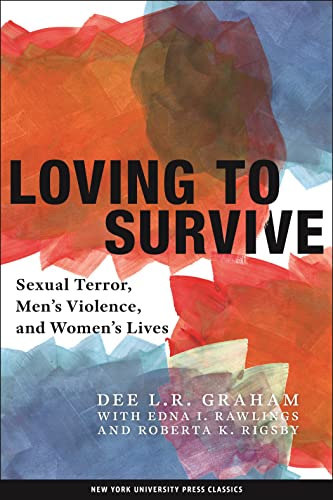
Loving to Survive: Sexual Terror, Men's Violence, and Women's Lives (Feminist Crosscurrents, 3)
Librería: HPB-Red, Dallas, TX, Estados Unidos de America
Calificación del vendedor: 5 de 5 estrellas

EUR 4,37
Envío por EUR 3,18
Se envía dentro de Estados Unidos de AmericaCantidad disponible: 1 disponibles
Añadir al carritopaperback. Condición: Good. Connecting readers with great books since 1972! Used textbooks may not include companion materials such as access codes, etc. May have some wear or writing/highlighting. We ship orders daily and Customer Service is our top priority!
-
Loving to Survive: Sexual Terror, Men's Violence, and Women's Lives (Feminist Crosscurrents, 3)
Librería: HPB Inc., Dallas, TX, Estados Unidos de America
Calificación del vendedor: 5 de 5 estrellas
EUR 8,51
Envío por EUR 3,18
Se envía dentro de Estados Unidos de AmericaCantidad disponible: 1 disponibles
Añadir al carritopaperback. Condición: Very Good. Connecting readers with great books since 1972! Used books may not include companion materials, and may have some shelf wear or limited writing. We ship orders daily and Customer Service is our top priority!
-
Loving to Survive
Idioma: Inglés
Publicado por New York University Press, 1995
ISBN 10: 0814730590 ISBN 13: 9780814730591
Librería: Southampton Books, Sag Harbor, NY, Estados Unidos de America
Calificación del vendedor: 5 de 5 estrellas
Original o primera edición
EUR 21,84
Envío por EUR 3,38
Se envía dentro de Estados Unidos de AmericaCantidad disponible: 1 disponibles
Añadir al carritoTrade Paperback. Condición: Like New. First Edition. First Edition, First Printing. Published by NYU, 1994. Octavo. Paperback. Book is like new. 100% positive feedback. 30 day money back guarantee. NEXT DAY SHIPPING! Excellent customer service. Please email with any questions or if you would like a photo. All books packed carefully and ship with free delivery confirmation/tracking. All books come with free bookmarks. Ships from Sag Harbor, New York.
-

Loving to Survive: Sexual Terror, Men's Violence, and Women's Lives: 3 (Feminist Crosscurrents)
Librería: WeBuyBooks, Rossendale, LANCS, Reino Unido
Calificación del vendedor: 5 de 5 estrellas
EUR 20,51
Envío por EUR 7,61
Se envía de Reino Unido a Estados Unidos de AmericaCantidad disponible: 1 disponibles
Añadir al carritoCondición: Good. Most items will be dispatched the same or the next working day. A copy that has been read but remains in clean condition. All of the pages are intact and the cover is intact and the spine may show signs of wear. The book may have minor markings which are not specifically mentioned.
-

Loving to Survive
Idioma: Inglés
Publicado por New York University Press, US, 1995
ISBN 10: 0814730590 ISBN 13: 9780814730591
Librería: Rarewaves USA, OSWEGO, IL, Estados Unidos de America
Calificación del vendedor: 5 de 5 estrellas
EUR 42,57
Gastos de envío gratis
Se envía dentro de Estados Unidos de AmericaCantidad disponible: Más de 20 disponibles
Añadir al carritoPaperback. Condición: New. A selection of insights into the relationship between men and women Have you wondered: Why women are more sympathetic than men toward O. J. Simpson? Why women were no more supportive of the Equal Rights Amendment than men? Why women are no more likely than men to support a female political candidate? Why women are no more likely than men to embrace feminism-a movement by, about, and for women? Why some women stay with men who abuse them? Loving to Survive addresses just these issues and poses a surprising answer. Likening women's situation to that of hostages, Dee L. R. Graham and her co- authors argue that women bond with men and adopt men's perspective in an effort to escape the threat of men's violence against them. Dee Graham's announcement, in 1991, of her research on male-female bonding was immediately followed by a national firestorm of media interest. Her startling and provocative conclusion was covered in dozens of national newspapers and heatedly debated. In Loving to Survive, Graham provides us with a complete account of her remarkable insights into relationships between men and women. In 1973, three women and one man were held hostage in one of the largest banks in Stockholm by two ex-convicts. These two men threatened their lives, but also showed them kindness. Over the course of the long ordeal, the hostages came to identify with their captors, developing an emotional bond with them. They began to perceive the police, their prospective liberators, as their enemies, and their captors as their friends, as a source of security. This seemingly bizarre reaction to captivity, in which the hostages and captors mutually bond to one another, has been documented in other cases as well, and has become widely known as Stockholm Syndrome. The authors of this book take this syndrome as their starting point to develop a new way of looking at male-female relationships. Loving to Survive considers men's violence against women as crucial to understanding women's current psychology. Men's violence creates ever-present, and therefore often unrecognized, terror in women. This terror is often experienced as a fear for any woman of rape by any man or as a fear of making any man angry. They propose that women's current psychology is actually a psychology of women under conditions of captivitythat is, under conditions of terror caused by male violence against women. Therefore, women's responses to men, and to male violence, resemble hostages' responses to captors. Loving to Survive explores women's bonding to men as it relates to men's violence against women. It proposes that, like hostages who work to placate their captors lest they kill them, women work to please men, and from this springs women's femininity. Femininity describes a set of behaviors that please men because they communicate a woman's acceptance of her subordinate status. Thus, feminine behaviors are, in essence, survival strategies. Like hostages who bond to their captors, women bond to.
-

Loving to Survive (Paperback or Softback)
Idioma: Inglés
Publicado por New York University Press 7/1/1995, 1995
ISBN 10: 0814730590 ISBN 13: 9780814730591
Librería: BargainBookStores, Grand Rapids, MI, Estados Unidos de America
Calificación del vendedor: 5 de 5 estrellas
EUR 42,58
Gastos de envío gratis
Se envía dentro de Estados Unidos de AmericaCantidad disponible: 5 disponibles
Añadir al carritoPaperback or Softback. Condición: New. Loving to Survive. Book.
-
Loving to Survive: Sexual Terror, Men's Violence, and Women's Lives (Feminist Crosscurrents, 3)
Librería: Pulpfiction Books, Vancouver, BC, Canada
Calificación del vendedor: 5 de 5 estrellas
Original o primera edición
EUR 30,58
Envío por EUR 12,72
Se envía de Canada a Estados Unidos de AmericaCantidad disponible: 1 disponibles
Añadir al carritoSoft cover. Condición: Fine. 1st Edition. First edition, first printing. Fine trade paper original, clean and unmarked.
-

Loving to Survive
Idioma: Inglés
Publicado por New York University Press, US, 1995
ISBN 10: 0814730590 ISBN 13: 9780814730591
Librería: Rarewaves.com USA, London, LONDO, Reino Unido
Calificación del vendedor: 5 de 5 estrellas
EUR 45,45
Gastos de envío gratis
Se envía de Reino Unido a Estados Unidos de AmericaCantidad disponible: Más de 20 disponibles
Añadir al carritoPaperback. Condición: New. A selection of insights into the relationship between men and women Have you wondered: Why women are more sympathetic than men toward O. J. Simpson? Why women were no more supportive of the Equal Rights Amendment than men? Why women are no more likely than men to support a female political candidate? Why women are no more likely than men to embrace feminism-a movement by, about, and for women? Why some women stay with men who abuse them? Loving to Survive addresses just these issues and poses a surprising answer. Likening women's situation to that of hostages, Dee L. R. Graham and her co- authors argue that women bond with men and adopt men's perspective in an effort to escape the threat of men's violence against them. Dee Graham's announcement, in 1991, of her research on male-female bonding was immediately followed by a national firestorm of media interest. Her startling and provocative conclusion was covered in dozens of national newspapers and heatedly debated. In Loving to Survive, Graham provides us with a complete account of her remarkable insights into relationships between men and women. In 1973, three women and one man were held hostage in one of the largest banks in Stockholm by two ex-convicts. These two men threatened their lives, but also showed them kindness. Over the course of the long ordeal, the hostages came to identify with their captors, developing an emotional bond with them. They began to perceive the police, their prospective liberators, as their enemies, and their captors as their friends, as a source of security. This seemingly bizarre reaction to captivity, in which the hostages and captors mutually bond to one another, has been documented in other cases as well, and has become widely known as Stockholm Syndrome. The authors of this book take this syndrome as their starting point to develop a new way of looking at male-female relationships. Loving to Survive considers men's violence against women as crucial to understanding women's current psychology. Men's violence creates ever-present, and therefore often unrecognized, terror in women. This terror is often experienced as a fear for any woman of rape by any man or as a fear of making any man angry. They propose that women's current psychology is actually a psychology of women under conditions of captivitythat is, under conditions of terror caused by male violence against women. Therefore, women's responses to men, and to male violence, resemble hostages' responses to captors. Loving to Survive explores women's bonding to men as it relates to men's violence against women. It proposes that, like hostages who work to placate their captors lest they kill them, women work to please men, and from this springs women's femininity. Femininity describes a set of behaviors that please men because they communicate a woman's acceptance of her subordinate status. Thus, feminine behaviors are, in essence, survival strategies. Like hostages who bond to their captors, women bond to.
-
Loving to Survive: Sexual Terror, Men's Violence, and Women's Lives (eng)
Librería: Brook Bookstore On Demand, Napoli, NA, Italia
Calificación del vendedor: 4 de 5 estrellas

EUR 38,48
Envío por EUR 6,80
Se envía de Italia a Estados Unidos de AmericaCantidad disponible: Más de 20 disponibles
Añadir al carritoCondición: new.
-
Loving To Survive
Idioma: Inglés
Publicado por New York University Press, 1995
ISBN 10: 0814730590 ISBN 13: 9780814730591
Librería: Majestic Books, Hounslow, Reino Unido
Calificación del vendedor: 4 de 5 estrellas
EUR 42,84
Envío por EUR 7,43
Se envía de Reino Unido a Estados Unidos de AmericaCantidad disponible: 3 disponibles
Añadir al carritoCondición: New. pp. 346.
-
Loving to Survive: Sexual Terror, Men's Violence, and Women's Lives (Feminist Crosscurrents)
Librería: Revaluation Books, Exeter, Reino Unido
Calificación del vendedor: 5 de 5 estrellas
EUR 38,14
Envío por EUR 11,44
Se envía de Reino Unido a Estados Unidos de AmericaCantidad disponible: 2 disponibles
Añadir al carritoPaperback. Condición: Brand New. reprint edition. 346 pages. 9.50x6.00x1.00 inches. In Stock.
-
Loving to Survive: Sexual Terror, Men's Violence, and Women's Lives (Feminist Crosscurrents)
Librería: Kennys Bookshop and Art Galleries Ltd., Galway, GY, Irlanda
Calificación del vendedor: 5 de 5 estrellas
EUR 41,83
Envío por EUR 10,50
Se envía de Irlanda a Estados Unidos de AmericaCantidad disponible: Más de 20 disponibles
Añadir al carritoCondición: New. 1995. Reprint. Paperback. . . . . .
-
Loving to Survive: Sexual Terror, Men's Violence, and Women's Lives (Feminist Crosscurrents, 3)
Librería: Ria Christie Collections, Uxbridge, Reino Unido
Calificación del vendedor: 5 de 5 estrellas
EUR 39,88
Envío por EUR 13,70
Se envía de Reino Unido a Estados Unidos de AmericaCantidad disponible: Más de 20 disponibles
Añadir al carritoCondición: New. In.
-
Loving To Survive
Idioma: Inglés
Publicado por New York University Press NYU Press, 1995
ISBN 10: 0814730590 ISBN 13: 9780814730591
Librería: Books Puddle, New York, NY, Estados Unidos de America
Calificación del vendedor: 4 de 5 estrellas
EUR 53,78
Envío por EUR 3,38
Se envía dentro de Estados Unidos de AmericaCantidad disponible: 3 disponibles
Añadir al carritoCondición: New. pp. 346.
-
Loving to Survive: Sexual Terror, Men's Violence, and Women's Lives
Idioma: Inglés
Publicado por New York University Press, 1995
ISBN 10: 0814730590 ISBN 13: 9780814730591
Librería: THE SAINT BOOKSTORE, Southport, Reino Unido
Calificación del vendedor: 5 de 5 estrellas
EUR 37,13
Envío por EUR 18,57
Se envía de Reino Unido a Estados Unidos de AmericaCantidad disponible: Más de 20 disponibles
Añadir al carritoPaperback / softback. Condición: New. New copy - Usually dispatched within 4 working days.
-
Loving to Survive: Sexual Terror, Men's Violence, and Women's Lives (Feminist Crosscurrents)
Librería: Kennys Bookstore, Olney, MD, Estados Unidos de America
Calificación del vendedor: 4 de 5 estrellas
EUR 50,96
Envío por EUR 8,91
Se envía dentro de Estados Unidos de AmericaCantidad disponible: Más de 20 disponibles
Añadir al carritoCondición: New. 1995. Reprint. Paperback. . . . . . Books ship from the US and Ireland.
-
Loving to Survive: Sexual Terror, Men's Violence, and Women's Lives (Feminist Crosscurrents)
Librería: Revaluation Books, Exeter, Reino Unido
Calificación del vendedor: 5 de 5 estrellas
EUR 60,14
Envío por EUR 11,44
Se envía de Reino Unido a Estados Unidos de AmericaCantidad disponible: 2 disponibles
Añadir al carritoPaperback. Condición: Brand New. reprint edition. 346 pages. 9.50x6.00x1.00 inches. In Stock.
-

Loving to Survive
Idioma: Inglés
Publicado por New York University Press, US, 1995
ISBN 10: 0814730590 ISBN 13: 9780814730591
Librería: Rarewaves USA United, OSWEGO, IL, Estados Unidos de America
Calificación del vendedor: 5 de 5 estrellas
EUR 41,88
Envío por EUR 42,42
Se envía dentro de Estados Unidos de AmericaCantidad disponible: Más de 20 disponibles
Añadir al carritoPaperback. Condición: New. A selection of insights into the relationship between men and women Have you wondered: Why women are more sympathetic than men toward O. J. Simpson? Why women were no more supportive of the Equal Rights Amendment than men? Why women are no more likely than men to support a female political candidate? Why women are no more likely than men to embrace feminism-a movement by, about, and for women? Why some women stay with men who abuse them? Loving to Survive addresses just these issues and poses a surprising answer. Likening women's situation to that of hostages, Dee L. R. Graham and her co- authors argue that women bond with men and adopt men's perspective in an effort to escape the threat of men's violence against them. Dee Graham's announcement, in 1991, of her research on male-female bonding was immediately followed by a national firestorm of media interest. Her startling and provocative conclusion was covered in dozens of national newspapers and heatedly debated. In Loving to Survive, Graham provides us with a complete account of her remarkable insights into relationships between men and women. In 1973, three women and one man were held hostage in one of the largest banks in Stockholm by two ex-convicts. These two men threatened their lives, but also showed them kindness. Over the course of the long ordeal, the hostages came to identify with their captors, developing an emotional bond with them. They began to perceive the police, their prospective liberators, as their enemies, and their captors as their friends, as a source of security. This seemingly bizarre reaction to captivity, in which the hostages and captors mutually bond to one another, has been documented in other cases as well, and has become widely known as Stockholm Syndrome. The authors of this book take this syndrome as their starting point to develop a new way of looking at male-female relationships. Loving to Survive considers men's violence against women as crucial to understanding women's current psychology. Men's violence creates ever-present, and therefore often unrecognized, terror in women. This terror is often experienced as a fear for any woman of rape by any man or as a fear of making any man angry. They propose that women's current psychology is actually a psychology of women under conditions of captivitythat is, under conditions of terror caused by male violence against women. Therefore, women's responses to men, and to male violence, resemble hostages' responses to captors. Loving to Survive explores women's bonding to men as it relates to men's violence against women. It proposes that, like hostages who work to placate their captors lest they kill them, women work to please men, and from this springs women's femininity. Femininity describes a set of behaviors that please men because they communicate a woman's acceptance of her subordinate status. Thus, feminine behaviors are, in essence, survival strategies. Like hostages who bond to their captors, women bond to.
-

EUR 47,02
Envío por EUR 48,99
Se envía de Alemania a Estados Unidos de AmericaCantidad disponible: Más de 20 disponibles
Añadir al carritoKartoniert / Broschiert. Condición: New. In 1973, three women and two men were held hostage in a bank in Stockholm by two ex-convicts. This book describes how the hostages and their captors formed a bond (now known as the Stockholm Syndrome ) and how survival mechanisms for the women could be se.
-

Loving to Survive
Idioma: Inglés
Publicado por New York University Press, US, 1995
ISBN 10: 0814730590 ISBN 13: 9780814730591
Librería: Rarewaves.com UK, London, Reino Unido
Calificación del vendedor: 5 de 5 estrellas
EUR 41,86
Envío por EUR 74,34
Se envía de Reino Unido a Estados Unidos de AmericaCantidad disponible: Más de 20 disponibles
Añadir al carritoPaperback. Condición: New. A selection of insights into the relationship between men and women Have you wondered: Why women are more sympathetic than men toward O. J. Simpson? Why women were no more supportive of the Equal Rights Amendment than men? Why women are no more likely than men to support a female political candidate? Why women are no more likely than men to embrace feminism-a movement by, about, and for women? Why some women stay with men who abuse them? Loving to Survive addresses just these issues and poses a surprising answer. Likening women's situation to that of hostages, Dee L. R. Graham and her co- authors argue that women bond with men and adopt men's perspective in an effort to escape the threat of men's violence against them. Dee Graham's announcement, in 1991, of her research on male-female bonding was immediately followed by a national firestorm of media interest. Her startling and provocative conclusion was covered in dozens of national newspapers and heatedly debated. In Loving to Survive, Graham provides us with a complete account of her remarkable insights into relationships between men and women. In 1973, three women and one man were held hostage in one of the largest banks in Stockholm by two ex-convicts. These two men threatened their lives, but also showed them kindness. Over the course of the long ordeal, the hostages came to identify with their captors, developing an emotional bond with them. They began to perceive the police, their prospective liberators, as their enemies, and their captors as their friends, as a source of security. This seemingly bizarre reaction to captivity, in which the hostages and captors mutually bond to one another, has been documented in other cases as well, and has become widely known as Stockholm Syndrome. The authors of this book take this syndrome as their starting point to develop a new way of looking at male-female relationships. Loving to Survive considers men's violence against women as crucial to understanding women's current psychology. Men's violence creates ever-present, and therefore often unrecognized, terror in women. This terror is often experienced as a fear for any woman of rape by any man or as a fear of making any man angry. They propose that women's current psychology is actually a psychology of women under conditions of captivitythat is, under conditions of terror caused by male violence against women. Therefore, women's responses to men, and to male violence, resemble hostages' responses to captors. Loving to Survive explores women's bonding to men as it relates to men's violence against women. It proposes that, like hostages who work to placate their captors lest they kill them, women work to please men, and from this springs women's femininity. Femininity describes a set of behaviors that please men because they communicate a woman's acceptance of her subordinate status. Thus, feminine behaviors are, in essence, survival strategies. Like hostages who bond to their captors, women bond to.
-

Loving to Survive
Idioma: Inglés
Publicado por New York University Press Jul 1995, 1995
ISBN 10: 0814730590 ISBN 13: 9780814730591
Librería: AHA-BUCH GmbH, Einbeck, Alemania
Calificación del vendedor: 5 de 5 estrellas
EUR 58,30
Envío por EUR 62,47
Se envía de Alemania a Estados Unidos de AmericaCantidad disponible: 1 disponibles
Añadir al carritoTaschenbuch. Condición: Neu. Neuware - A selection of insights into the relationship between men and women Have you wondered: Why women are more sympathetic than men toward O. J. Simpson Why women were no more supportive of the Equal Rights Amendment than men Why women are no more likely than men to support a female political candidate Why women are no more likely than men to embrace feminism-a movement by, about, and for women Why some women stay with men who abuse them Loving to Survive addresses just these issues and poses a surprising answer. Likening women's situation to that of hostages, Dee L. R. Graham and her co- authors argue that women bond with men and adopt men's perspective in an effort to escape the threat of men's violence against them. Dee Graham's announcement, in 1991, of her research on male-female bonding was immediately followed by a national firestorm of media interest. Her startling and provocative conclusion was covered in dozens of national newspapers and heatedly debated. In Loving to Survive, Graham provides us with a complete account of her remarkable insights into relationships between men and women. In 1973, three women and one man were held hostage in one of the largest banks in Stockholm by two ex-convicts. These two men threatened their lives, but also showed them kindness. Over the course of the long ordeal, the hostages came to identify with their captors, developing an emotional bond with them. They began to perceive the police, their prospective liberators, as their enemies, and their captors as their friends, as a source of security. This seemingly bizarre reaction to captivity, in which the hostages and captors mutually bond to one another, has been documented in other cases as well, and has become widely known as Stockholm Syndrome. The authors of this book take this syndrome as their starting point to develop a new way of looking at male-female relationships. Loving to Survive considers men's violence against women as crucial to understanding women's current psychology. Men's violence creates ever-present, and therefore often unrecognized, terror in women. This terror is often experienced as a fear for any woman of rape by any man or as a fear of making any man angry. They propose that women's current psychology is actually a psychology of women under conditions of captivitythat is, under conditions of terror caused by male violence against women. Therefore, women's responses to men, and to male violence, resemble hostages' responses to captors. Loving to Survive explores women's bonding to men as it relates to men's violence against women. It proposes that, like hostages who work to placate their captors lest they kill them, women work to please men, and from this springs women's femininity. Femininity describes a set of behaviors that please men because they communicate a woman's acceptance of her subordinate status. Thus, feminine behaviors are, in essence, survival strategies. Like hostages who bond to their captors, women bond to men in an effort to survive. This is a book that will forever change the way we look at male-female relationships and women's lives.
-
Loving to Survive: Sexual Terror, Men's Violence, and Women's Lives
Idioma: Inglés
Publicado por New York University Press, 1995
ISBN 10: 0814730590 ISBN 13: 9780814730591
Librería: THE SAINT BOOKSTORE, Southport, Reino Unido
Calificación del vendedor: 5 de 5 estrellas
EUR 45,37
Envío por EUR 18,57
Se envía de Reino Unido a Estados Unidos de AmericaCantidad disponible: Más de 20 disponibles
Añadir al carritoPaperback / softback. Condición: New. This item is printed on demand. New copy - Usually dispatched within 5-9 working days 549.


