

Importe total (1 artículo artículos):
Destino del pedido:

9780812272444 - The Writer's Way in France (Anniversary Collection) de Cohn, Robert Greer (10 resultados)
Ir a los resultados principales
Filtros de búsqueda
Tipo de artículo
- Todos los tipos de productos
- Libros (10)
- Revistas y publicaciones (No hay ningún otro resultado que coincida con este filtro.)
- Cómics (No hay ningún otro resultado que coincida con este filtro.)
- Partituras (No hay ningún otro resultado que coincida con este filtro.)
- Arte, grabados y pósters (No hay ningún otro resultado que coincida con este filtro.)
- Fotografías (No hay ningún otro resultado que coincida con este filtro.)
- Mapas (No hay ningún otro resultado que coincida con este filtro.)
- Manuscritos y coleccionismo de papel (No hay ningún otro resultado que coincida con este filtro.)
Condición Más información
- Nuevo (8)
- Como nuevo, Excelente o Muy bueno (2)
- Bueno o Aceptable (No hay ningún otro resultado que coincida con este filtro.)
- Regular o Pobre (No hay ningún otro resultado que coincida con este filtro.)
- Tal como se indica (No hay ningún otro resultado que coincida con este filtro.)
Encuadernación
- Todas
- Tapa dura (10)
- Tapa blanda (No hay ningún otro resultado que coincida con este filtro.)
Más atributos
- Primera edición (No hay ningún otro resultado que coincida con este filtro.)
- Firmado (No hay ningún otro resultado que coincida con este filtro.)
- Sobrecubierta (No hay ningún otro resultado que coincida con este filtro.)
- Con imágenes (8)
- No impresión bajo demanda (10)
Idioma (1)
Precio
- Cualquier precio
- Menos de EUR 20 (No hay ningún otro resultado que coincida con este filtro.)
- EUR 20 a EUR 45 (No hay ningún otro resultado que coincida con este filtro.)
- Más de EUR 45
Gastos de envío gratis
Ubicación del vendedor
Valoración de los vendedores
-

Writer's Way in France
Idioma: Inglés
Publicado por University of Pennsylvania Press Anniversary Collection, 1960
ISBN 10: 0812272447 ISBN 13: 9780812272444
Librería: GreatBookPrices, Columbia, MD, Estados Unidos de America
Calificación del vendedor: 5 de 5 estrellas

EUR 111,94
Envío por EUR 2,27
Se envía dentro de Estados Unidos de AmericaCantidad disponible: Más de 20 disponibles
Añadir al carritoCondición: New.
-

The Writer's Way in France
Idioma: Inglés
Publicado por University of Pennsylvania Press, US, 1960
ISBN 10: 0812272447 ISBN 13: 9780812272444
Librería: Rarewaves USA, OSWEGO, IL, Estados Unidos de America
Calificación del vendedor: 5 de 5 estrellas
EUR 114,28
Gastos de envío gratis
Se envía dentro de Estados Unidos de AmericaCantidad disponible: Más de 20 disponibles
Añadir al carritoHardback. Condición: New. This book is an attempt to present a new, integral approach to French literature. Acknowledging his debts to numerous post-Hegelian philosophers or psychologists and modern critics, Professor Cohn offers a lucid and swift-paced account of an original view of literature which bears particular kinship to the artistic visions of Joyce, MallarmÉ, and Proust. In Part I the creative temperament is defined in terms of a subtly recognizable rhythm of human nature which appears in varying forms or "syncopations." In Part II the evolution of the rhythm is followed through changing themes, images, styles, and genres from the earliest known native origins to the crowning work of the Symbolists. Parts I and II together constitute a method, the purpose of which is to maintain, as tactfully as possible, a sense of direction as we move through the complexities of lively art. The method is brought to bear on extensive texts in Part III, with closely detailed studies of Rimbaud and Proust. These individual studies are offered' as examples; more are promised in subsequent volumes. In addition, the present state of criticism is discussed in an Introduction; lengthy appendices are devoted to some important modes of lyric poetry and the author's "precritical," or epistemological, concepts; and a briefer appendix takes up the idea of Progress in Art. The Writer's Way in France is a work of unusual perception, of great importance to all students of literature who are interested in fresh ideas and methods.
-

The Writer's Way in France (Anniversary Collection)
Idioma: Inglés
Publicado por University of Pennsylvania Press Anniversary Collection, 1960
ISBN 10: 0812272447 ISBN 13: 9780812272444
Librería: California Books, Miami, FL, Estados Unidos de America
Calificación del vendedor: 5 de 5 estrellas
EUR 115,08
Gastos de envío gratis
Se envía dentro de Estados Unidos de AmericaCantidad disponible: Más de 20 disponibles
Añadir al carritoCondición: New.
-

Writer's Way in France
Idioma: Inglés
Publicado por University of Pennsylvania Press Anniversary Collection, 1960
ISBN 10: 0812272447 ISBN 13: 9780812272444
Librería: GreatBookPrices, Columbia, MD, Estados Unidos de America
Calificación del vendedor: 5 de 5 estrellas
EUR 120,88
Envío por EUR 2,27
Se envía dentro de Estados Unidos de AmericaCantidad disponible: Más de 20 disponibles
Añadir al carritoCondición: As New. Unread book in perfect condition.
-

Writer's Way in France
Idioma: Inglés
Publicado por University of Pennsylvania Press Anniversary Collection, 1960
ISBN 10: 0812272447 ISBN 13: 9780812272444
Librería: GreatBookPricesUK, Woodford Green, Reino Unido
Calificación del vendedor: 5 de 5 estrellas
EUR 123,11
Envío por EUR 17,24
Se envía de Reino Unido a Estados Unidos de AmericaCantidad disponible: Más de 20 disponibles
Añadir al carritoCondición: New.
-

Writer's Way in France
Idioma: Inglés
Publicado por University of Pennsylvania Press Anniversary Collection, 1960
ISBN 10: 0812272447 ISBN 13: 9780812272444
Librería: GreatBookPricesUK, Woodford Green, Reino Unido
Calificación del vendedor: 5 de 5 estrellas
EUR 128,31
Envío por EUR 17,24
Se envía de Reino Unido a Estados Unidos de AmericaCantidad disponible: Más de 20 disponibles
Añadir al carritoCondición: As New. Unread book in perfect condition.
-

The Writer's Way in France
Idioma: Inglés
Publicado por University of Pennsylvania Press, US, 1960
ISBN 10: 0812272447 ISBN 13: 9780812272444
Librería: Rarewaves USA United, OSWEGO, IL, Estados Unidos de America
Calificación del vendedor: 5 de 5 estrellas
EUR 123,10
Envío por EUR 42,97
Se envía dentro de Estados Unidos de AmericaCantidad disponible: Más de 20 disponibles
Añadir al carritoHardback. Condición: New. This book is an attempt to present a new, integral approach to French literature. Acknowledging his debts to numerous post-Hegelian philosophers or psychologists and modern critics, Professor Cohn offers a lucid and swift-paced account of an original view of literature which bears particular kinship to the artistic visions of Joyce, MallarmÉ, and Proust. In Part I the creative temperament is defined in terms of a subtly recognizable rhythm of human nature which appears in varying forms or "syncopations." In Part II the evolution of the rhythm is followed through changing themes, images, styles, and genres from the earliest known native origins to the crowning work of the Symbolists. Parts I and II together constitute a method, the purpose of which is to maintain, as tactfully as possible, a sense of direction as we move through the complexities of lively art. The method is brought to bear on extensive texts in Part III, with closely detailed studies of Rimbaud and Proust. These individual studies are offered' as examples; more are promised in subsequent volumes. In addition, the present state of criticism is discussed in an Introduction; lengthy appendices are devoted to some important modes of lyric poetry and the author's "precritical," or epistemological, concepts; and a briefer appendix takes up the idea of Progress in Art. The Writer's Way in France is a work of unusual perception, of great importance to all students of literature who are interested in fresh ideas and methods.
-
The Writer's Way in France
Idioma: Inglés
Publicado por Univ of Pennsylvania Pr, 1960
ISBN 10: 0812272447 ISBN 13: 9780812272444
Librería: Revaluation Books, Exeter, Reino Unido
Calificación del vendedor: 5 de 5 estrellas
EUR 155,38
Envío por EUR 14,36
Se envía de Reino Unido a Estados Unidos de AmericaCantidad disponible: 2 disponibles
Añadir al carritoHardcover. Condición: Brand New. 448 pages. 8.25x5.50x9.21 inches. In Stock.
-
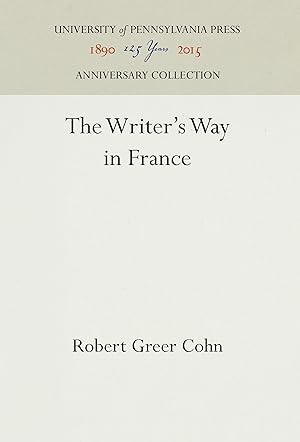
The Writer\ s Way in France
Librería: moluna, Greven, Alemania
Calificación del vendedor: 4 de 5 estrellas

EUR 116,38
Envío por EUR 48,99
Se envía de Alemania a Estados Unidos de AmericaCantidad disponible: Más de 20 disponibles
Añadir al carritoCondición: New. No detailed description available for The Writer s Way in France .Über den AutorRobert Greer CohnInhaltsverzeichnisPrefaceIntroductionPART I: THE CREATIVE TEMPERAMENTPART II: THE WR.
-

The Writer's Way in France
Idioma: Inglés
Publicado por University Of Pennsylvania Press Jun 1960, 1960
ISBN 10: 0812272447 ISBN 13: 9780812272444
Librería: AHA-BUCH GmbH, Einbeck, Alemania
Calificación del vendedor: 5 de 5 estrellas
EUR 159,90
Envío por EUR 64,08
Se envía de Alemania a Estados Unidos de AmericaCantidad disponible: 2 disponibles
Añadir al carritoBuch. Condición: Neu. Neuware - Acknowledging his debts to numerous post-Hegelian philosophers or psychologists and modern critics, Robert Greer Cohn offers a lucid and swift-paced account of an original view of literature that bears particular kinship to the artistic visions of Joyce, Mallarmé, and Proust.

