

Importe total (1 artículo artículos):
Destino del pedido:

9780804738743 - Selling the True Time: Nineteenth-Century Timekeeping in America de Bartky, Ian (23 resultados)
Ir a los resultados principales
Filtros de búsqueda
Tipo de artículo
- Todos los tipos de productos
- Libros (23)
- Revistas y publicaciones (No hay ningún otro resultado que coincida con este filtro.)
- Cómics (No hay ningún otro resultado que coincida con este filtro.)
- Partituras (No hay ningún otro resultado que coincida con este filtro.)
- Arte, grabados y pósters (No hay ningún otro resultado que coincida con este filtro.)
- Fotografías (No hay ningún otro resultado que coincida con este filtro.)
- Mapas (No hay ningún otro resultado que coincida con este filtro.)
- Manuscritos y coleccionismo de papel (No hay ningún otro resultado que coincida con este filtro.)
Condición Más información
- Nuevo (16)
- Como nuevo, Excelente o Muy bueno (3)
- Bueno o Aceptable (4)
- Regular o Pobre (No hay ningún otro resultado que coincida con este filtro.)
- Tal como se indica (No hay ningún otro resultado que coincida con este filtro.)
Encuadernación
- Todas
- Tapa dura (23)
- Tapa blanda (No hay ningún otro resultado que coincida con este filtro.)
Más atributos
Idioma (2)
Precio
- Cualquier precio
- Menos de EUR 20 (No hay ningún otro resultado que coincida con este filtro.)
- EUR 20 a EUR 45
- Más de EUR 45
Gastos de envío gratis
Ubicación del vendedor
Valoración de los vendedores
-

Selling the True Time: Nineteenth-Century Timekeeping in America
Idioma: Inglés
Publicado por Stanford University Press, 2000
ISBN 10: 0804738742 ISBN 13: 9780804738743
Librería: Anybook.com, Lincoln, Reino Unido
Calificación del vendedor: 5 de 5 estrellas

EUR 24,89
Envío por EUR 15,72
Se envía de Reino Unido a Estados Unidos de AmericaCantidad disponible: 1 disponibles
Añadir al carritoCondición: Good. This is an ex-library book and may have the usual library/used-book markings inside.This book has hardback covers. In good all round condition. No dust jacket. Please note the Image in this listing is a stock photo and may not match the covers of the actual item,900grams, ISBN:0804738742.
-
Selling the True Time: Nineteenth-Century Timekeeping in America
Idioma: Inglés
Publicado por Stanford University Press, 2000
ISBN 10: 0804738742 ISBN 13: 9780804738743
Librería: Kisharon Langdon New Chapters, HARROW, Reino Unido
Calificación del vendedor: 3 de 5 estrellas

EUR 30,94
Envío por EUR 11,55
Se envía de Reino Unido a Estados Unidos de AmericaCantidad disponible: 1 disponibles
Añadir al carritoCondición: Good. DUST JACKET A WEE BIT TORN ON TOP OF THE SPINE. Sold by Kisharon Langdon, the UK charity offering support and opportunities for people in the autism and disability community.
-
Selling the True Time: Nineteenth-Century Timekeeping in America
Idioma: Inglés
Publicado por Stanford: Stanford University Press, 2000., 2000
ISBN 10: 0804738742 ISBN 13: 9780804738743
Librería: Free Play Books, NEW HAVEN, CT, Estados Unidos de America
Calificación del vendedor: 5 de 5 estrellas
Original o primera edición
EUR 44,35
Envío por EUR 3,88
Se envía dentro de Estados Unidos de AmericaCantidad disponible: 1 disponibles
Añadir al carritoHardcover. Condición: Fine. Estado de la sobrecubierta: Near Fine. 1st Edition. First Edition. 8vo. xvi, 310 pp. b/w illustrations. Creme cloth lettered in gilt. Illustrated jacket. Light edge-wear. Fine in Near Fine dust jacket. In archival mylar sleeve.
-
Selling the True Time: Nineteenth-Century Timekeeping in America
Idioma: Inglés
Publicado por Stanford University Press, 2000
ISBN 10: 0804738742 ISBN 13: 9780804738743
Librería: Lakeside Books, Benton Harbor, MI, Estados Unidos de America
Calificación del vendedor: 5 de 5 estrellas
EUR 46,86
Envío por EUR 3,44
Se envía dentro de Estados Unidos de AmericaCantidad disponible: Más de 20 disponibles
Añadir al carritoCondición: New. Brand New! Not Overstocks or Low Quality Book Club Editions! Direct From the Publisher! We're not a giant, faceless warehouse organization! We're a small town bookstore that loves books and loves it's customers! Buy from Lakeside Books!
-
Selling the True Time: Nineteenth-Century Timekeeping in America
Idioma: Inglés
Publicado por Stanford University Press, 2000
ISBN 10: 0804738742 ISBN 13: 9780804738743
Librería: California Books, Miami, FL, Estados Unidos de America
Calificación del vendedor: 4 de 5 estrellas

EUR 54,99
Gastos de envío gratis
Se envía dentro de Estados Unidos de AmericaCantidad disponible: Más de 20 disponibles
Añadir al carritoCondición: New.
-

Selling the True Time
Idioma: Inglés
Publicado por Stanford University Press, US, 2000
ISBN 10: 0804738742 ISBN 13: 9780804738743
Librería: Rarewaves USA, OSWEGO, IL, Estados Unidos de America
Calificación del vendedor: 5 de 5 estrellas
EUR 55,94
Gastos de envío gratis
Se envía dentro de Estados Unidos de AmericaCantidad disponible: Más de 20 disponibles
Añadir al carritoHardback. Condición: New. This book studies the transition from local to national timekeeping, a process that led to Standard Time-the world-wide system of timekeeping by which we all live. Prior to the railroads' adoption of Standard Railway Time in 1883, timekeeping was entirely a local matter, and America lacked any uniform system to coordinate times and public activities. For example, in the middle of the nineteenth century, Boston had three authoritative times, which differed by seconds and minutes. The story begins in the 1830s with the building of the first railroads. Since railway safety depended upon maintaining the temporal separation of trains through precise timing, railroads were the first to establish time standards to govern their operations. The railroads' switch to five time standards indexed to the Greenwich meridian inaugurated the modern era of public timekeeping and led directly to cities adopting Greenwich-indexed civil time zones. Central to the story are those college and university astronomers who, starting in the 1850s, sold time signals to nearby cities and railroads. From the start, they competed with other entrepreneurs trying to make money by selling time. Decades of negotiations, government lobbying, and battles over customers followed, all in the name of "public service." Improvements by a host of clockmakers, civil and electrical engineers, telegraph and railway technicians, and instrument makers finally changed the market for accurate time. Public timekeeping became the realm of business investors. Despite the efforts of astronomers and various of their Congressional supporters, who argued for the necessity of a national system of time authorized by the federal government, the railroads' success with their own system blocked legislation for a national system of time until the First World War. By then, a single source for correct time dominated the public's timekeeping: the U.S. Naval Observatory's noon signal. In this first comprehensive, scholarly history of timekeeping in America, the author has drawn upon a rich, untapped archival record, municipal and legislative documents, newspapers, and science and engineering journals to challenge several myths that have grown up around the subject.
-
Selling the True Time: Nineteenth-century Timekeeping in America
Idioma: Inglés
Publicado por Stanford University Press, California USA, 2000
ISBN 10: 0804738742 ISBN 13: 9780804738743
Librería: Peter Sheridan Books Bought and Sold, West Molesey, Surrey, Reino Unido
Calificación del vendedor: 5 de 5 estrellas
Original o primera edición
EUR 33,34
Envío por EUR 25,36
Se envía de Reino Unido a Estados Unidos de AmericaCantidad disponible: 1 disponibles
Añadir al carritoHardcover. Condición: Very Good. Estado de la sobrecubierta: Very Good. First Edition. California USA: Stanford University Press , 2000. Very bright clean hardcover in dustwrapper, many photographs and illustrations accompany the text. 310 pages, a very nice example of this book SEE IMAGES. DETAILED IMAGES AVAILABLE ON REQUEST . First Edition. Cloth Covered Boards. Very Good/Very Good. 26 x 18.5 Cms. Hardcover.
-
Selling the True Time
Idioma: Inglés
Publicado por Stanford University Press, 2000
ISBN 10: 0804738742 ISBN 13: 9780804738743
Librería: PBShop.store UK, Fairford, GLOS, Reino Unido
Calificación del vendedor: 5 de 5 estrellas
EUR 60,26
Envío por EUR 6,79
Se envía de Reino Unido a Estados Unidos de AmericaCantidad disponible: 15 disponibles
Añadir al carritoHRD. Condición: New. New Book. Shipped from UK. Established seller since 2000.
-
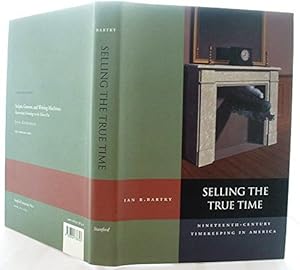
Selling the True Time: Nineteenth-Century Timekeeping in America [Signed]
Publicado por Stanford University Press, Stanford, CA, 2000
ISBN 10: 0804738742 ISBN 13: 9780804738743
Librería: Dennis Holzman Antiques, Cohoes, NY, Estados Unidos de America
Calificación del vendedor: 5 de 5 estrellas
Original o primera edición Ejemplar firmado
EUR 44,35
Envío por EUR 6,03
Se envía dentro de Estados Unidos de AmericaCantidad disponible: 1 disponibles
Añadir al carritoHardcover. Condición: Very Good. Estado de la sobrecubierta: Very Good. First Edition. Signed by Author. Size: 10 1/4" x 7 1/4". Text body is clean, and free from previous owner annotation, underlining and highlighting. Gilt-stamped gray cloth over boards, 310 pages, illustrated in black and white. Inscribed and signed by the author on the title page. "This book studies the transition from local to national timekeeping, a process that led to Standard Time." In an illustrated dust jacket that is bumped at corners and spine ends. Quantity Available: 1. Shipped Weight: 2 lbs 15 oz. Category: History; Signed by Author. ISBN: 0804738742. ISBN/EAN: 9780804738743. Pictures of this item not already displayed here available upon request. Inventory No: 015193.
-
Selling the True Time - Nineteenth-Century Timekeeping in America (eng)
Idioma: Inglés
Publicado por Stanford University Press, 2000
ISBN 10: 0804738742 ISBN 13: 9780804738743
Librería: Brook Bookstore On Demand, Napoli, NA, Italia
Calificación del vendedor: 3 de 5 estrellas
EUR 80,20
Envío por EUR 8,00
Se envía de Italia a Estados Unidos de AmericaCantidad disponible: Más de 20 disponibles
Añadir al carritoCondición: new.
-
Selling the True Time NineteenthCentury Timekeeping in America
Librería: Revaluation Books, Exeter, Reino Unido
Calificación del vendedor: 5 de 5 estrellas
EUR 76,35
Envío por EUR 14,45
Se envía de Reino Unido a Estados Unidos de AmericaCantidad disponible: 2 disponibles
Añadir al carritoHardcover. Condición: Brand New. 1st edition. 310 pages. 10.00x7.25x1.25 inches. In Stock.
-
Selling the True Time
Idioma: Inglés
Publicado por Stanford University Press, 2000
ISBN 10: 0804738742 ISBN 13: 9780804738743
Librería: Majestic Books, Hounslow, Reino Unido
Calificación del vendedor: 4 de 5 estrellas
EUR 85,21
Envío por EUR 7,51
Se envía de Reino Unido a Estados Unidos de AmericaCantidad disponible: 3 disponibles
Añadir al carritoCondición: New. pp. xvi + 310 Illus.
-
Selling the True Time
Idioma: Inglés
Publicado por Stanford University Press, 2000
ISBN 10: 0804738742 ISBN 13: 9780804738743
Librería: Books Puddle, New York, NY, Estados Unidos de America
Calificación del vendedor: 4 de 5 estrellas
EUR 100,39
Envío por EUR 3,44
Se envía dentro de Estados Unidos de AmericaCantidad disponible: 3 disponibles
Añadir al carritoCondición: New. pp. xvi + 310 1st Edition.
-
Selling the True Time
Idioma: Inglés
Publicado por Stanford University Press, 2000
ISBN 10: 0804738742 ISBN 13: 9780804738743
Librería: Kennys Bookshop and Art Galleries Ltd., Galway, GY, Irlanda
Calificación del vendedor: 5 de 5 estrellas
EUR 90,72
Envío por EUR 10,50
Se envía de Irlanda a Estados Unidos de AmericaCantidad disponible: Más de 20 disponibles
Añadir al carritoCondición: New. This book studies the transition from local to national timekeeping, inthe USA, aprocess that led to Standard Time the world-wide system of timekeeping by which everyone lives. Num Pages: 328 pages, 26 half-tones. BIC Classification: 1KBB; 3JH; HBJK; HBLL; PGZ. Category: (P) Professional & Vocational; (UP) Postgraduate, Research & Scholarly; (UU) Undergraduate. Dimension: 255 x 186 x 28. Weight in Grams: 834. . 2000. Hardback. . . . .
-
Selling the True Time: Nineteenth-Century Timekeeping in America
Idioma: Inglés
Publicado por Stanford University Press, 2000
ISBN 10: 0804738742 ISBN 13: 9780804738743
Librería: BennettBooksLtd, Los Angeles, CA, Estados Unidos de America
Calificación del vendedor: 5 de 5 estrellas
EUR 98,57
Envío por EUR 5,98
Se envía dentro de Estados Unidos de AmericaCantidad disponible: 1 disponibles
Añadir al carritohardcover. Condición: New. In shrink wrap. Looks like an interesting title!
-

Selling the True Time
Idioma: Inglés
Publicado por Stanford University Press, US, 2000
ISBN 10: 0804738742 ISBN 13: 9780804738743
Librería: Rarewaves USA United, OSWEGO, IL, Estados Unidos de America
Calificación del vendedor: 5 de 5 estrellas
EUR 60,25
Envío por EUR 43,06
Se envía dentro de Estados Unidos de AmericaCantidad disponible: Más de 20 disponibles
Añadir al carritoHardback. Condición: New. This book studies the transition from local to national timekeeping, a process that led to Standard Time-the world-wide system of timekeeping by which we all live. Prior to the railroads' adoption of Standard Railway Time in 1883, timekeeping was entirely a local matter, and America lacked any uniform system to coordinate times and public activities. For example, in the middle of the nineteenth century, Boston had three authoritative times, which differed by seconds and minutes. The story begins in the 1830s with the building of the first railroads. Since railway safety depended upon maintaining the temporal separation of trains through precise timing, railroads were the first to establish time standards to govern their operations. The railroads' switch to five time standards indexed to the Greenwich meridian inaugurated the modern era of public timekeeping and led directly to cities adopting Greenwich-indexed civil time zones. Central to the story are those college and university astronomers who, starting in the 1850s, sold time signals to nearby cities and railroads. From the start, they competed with other entrepreneurs trying to make money by selling time. Decades of negotiations, government lobbying, and battles over customers followed, all in the name of "public service." Improvements by a host of clockmakers, civil and electrical engineers, telegraph and railway technicians, and instrument makers finally changed the market for accurate time. Public timekeeping became the realm of business investors. Despite the efforts of astronomers and various of their Congressional supporters, who argued for the necessity of a national system of time authorized by the federal government, the railroads' success with their own system blocked legislation for a national system of time until the First World War. By then, a single source for correct time dominated the public's timekeeping: the U.S. Naval Observatory's noon signal. In this first comprehensive, scholarly history of timekeeping in America, the author has drawn upon a rich, untapped archival record, municipal and legislative documents, newspapers, and science and engineering journals to challenge several myths that have grown up around the subject.
-

Selling the True Time: Nineteenth Century Timekeeping in America
Librería: moluna, Greven, Alemania
Calificación del vendedor: 5 de 5 estrellas
EUR 58,98
Envío por EUR 48,99
Se envía de Alemania a Estados Unidos de AmericaCantidad disponible: Más de 20 disponibles
Añadir al carritoCondición: New. This first comprehensive, scholarly history of timekeeping in America studies the transition from local to national timekeeping, a process that led to Standard Time-the worldwide system of timekeeping by which we all live. The book describes the contributio.
-
Selling the True Time
Idioma: Inglés
Publicado por Stanford University Press, 2000
ISBN 10: 0804738742 ISBN 13: 9780804738743
Librería: Kennys Bookstore, Olney, MD, Estados Unidos de America
Calificación del vendedor: 5 de 5 estrellas
EUR 113,09
Envío por EUR 9,04
Se envía dentro de Estados Unidos de AmericaCantidad disponible: Más de 20 disponibles
Añadir al carritoCondición: New. This book studies the transition from local to national timekeeping, inthe USA, aprocess that led to Standard Time the world-wide system of timekeeping by which everyone lives. Num Pages: 328 pages, 26 half-tones. BIC Classification: 1KBB; 3JH; HBJK; HBLL; PGZ. Category: (P) Professional & Vocational; (UP) Postgraduate, Research & Scholarly; (UU) Undergraduate. Dimension: 255 x 186 x 28. Weight in Grams: 834. . 2000. Hardback. . . . . Books ship from the US and Ireland.
-
Selling the True Time: Nineteenth-Century Timekeeping in America
Idioma: Inglés
Publicado por Stanford University Press, 2000
ISBN 10: 0804738742 ISBN 13: 9780804738743
Librería: Mispah books, Redhill, SURRE, Reino Unido
Calificación del vendedor: 4 de 5 estrellas
EUR 135,72
Envío por EUR 28,90
Se envía de Reino Unido a Estados Unidos de AmericaCantidad disponible: 1 disponibles
Añadir al carritoHardcover. Condición: Like New. LIKE NEW. SHIPS FROM MULTIPLE LOCATIONS. book.
-

Selling the True Time: Nineteenth-Century Timekeeping in America
Idioma: Inglés
Publicado por Stanford Univ Pr, Chicago, Illinois, U.S.A., 2000
ISBN 10: 0804738742 ISBN 13: 9780804738743
Librería: Pistil Books Online, IOBA, Seattle, WA, Estados Unidos de America
Miembro de asociación: IOBA
Calificación del vendedor: 5 de 5 estrellas
Original o primera edición Ejemplar firmado
EUR 244,81
Envío por EUR 5,17
Se envía dentro de Estados Unidos de AmericaCantidad disponible: 1 disponibles
Añadir al carritoHard Cover. Condición: Fine. Estado de la sobrecubierta: Near Fine. First Edition. Book is in excellent condition in every respect. Covers are straight with sharp corners, no marking of any kind to text/interior. Dust jacket shows very light shelf wear and very slight edge wear only. Wrapped in protective mylar jacket. Book is inscribed to ". my patient, long-suffering and excellent editor." in a lengthy inscription, then signed and dated August 2000. Keywords: Standard Time, Railroads, Astronomy. Inscribed By Author.
-
Selling the True Time: Nineteenth-Century Timekeeping in America
Idioma: Inglés
Publicado por Stanford University Press, 2000
ISBN 10: 0804738742 ISBN 13: 9780804738743
Librería: THE SAINT BOOKSTORE, Southport, Reino Unido
Calificación del vendedor: 5 de 5 estrellas
EUR 68,05
Envío por EUR 22,42
Se envía de Reino Unido a Estados Unidos de AmericaCantidad disponible: Más de 20 disponibles
Añadir al carritoHardback. Condición: New. This item is printed on demand. New copy - Usually dispatched within 5-9 working days.
-

Selling the True Time
Idioma: Inglés
Publicado por Stanford University Press Aug 2000, 2000
ISBN 10: 0804738742 ISBN 13: 9780804738743
Librería: BuchWeltWeit Ludwig Meier e.K., Bergisch Gladbach, Alemania
Calificación del vendedor: 5 de 5 estrellas
EUR 73,83
Envío por EUR 23,00
Se envía de Alemania a Estados Unidos de AmericaCantidad disponible: 2 disponibles
Añadir al carritoBuch. Condición: Neu. This item is printed on demand - it takes 3-4 days longer - Neuware -This book studies the transition from local to national timekeeping, a process that led to Standard Time-the world-wide system of timekeeping by which we all live. Prior to the railroads' adoption of Standard Railway Time in 1883, timekeeping was entirely a local matter, and America lacked any uniform system to coordinate times and public activities. For example, in the middle of the nineteenth century, Boston had three authoritative times, which differed by seconds and minutes. The story begins in the 1830s with the building of the first railroads. Since railway safety depended upon maintaining the temporal separation of trains through precise timing, railroads were the first to establish time standards to govern their operations. The railroads' switch to five time standards indexed to the Greenwich meridian inaugurated the modern era of public timekeeping and led directly to cities adopting Greenwich-indexed civil time zones. Central to the story are those college and university astronomers who, starting in the 1850s, sold time signals to nearby cities and railroads. From the start, they competed with other entrepreneurs trying to make money by selling time. Decades of negotiations, government lobbying, and battles over customers followed, all in the name of 'public service.' Improvements by a host of clockmakers, civil and electrical engineers, telegraph and railway technicians, and instrument makers finally changed the market for accurate time. Public timekeeping became the realm of business investors. Despite the efforts of astronomers and various of their Congressional supporters, who argued for the necessity of a national system of time authorized by the federal government, the railroads' success with their own system blocked legislation for a national system of time until the First World War. By then, a single source for correct time dominated the public's timekeeping: the U.S. Naval Observatory's noon signal. In this first comprehensive, scholarly history of timekeeping in America, the author has drawn upon a rich, untapped archival record, municipal and legislative documents, newspapers, and science and engineering journals to challenge several myths that have grown up around the subject. 328 pp. Englisch.
-

Selling the True Time : Nineteenth Century Timekeeping in America
Idioma: Inglés
Publicado por Stanford University Press, 2000
ISBN 10: 0804738742 ISBN 13: 9780804738743
Librería: AHA-BUCH GmbH, Einbeck, Alemania
Calificación del vendedor: 5 de 5 estrellas
EUR 77,92
Envío por EUR 64,06
Se envía de Alemania a Estados Unidos de AmericaCantidad disponible: 2 disponibles
Añadir al carritoBuch. Condición: Neu. nach der Bestellung gedruckt Neuware - Printed after ordering - This book studies the transition from local to national timekeeping, a process that led to Standard Time-the world-wide system of timekeeping by which we all live. Prior to the railroads' adoption of Standard Railway Time in 1883, timekeeping was entirely a local matter, and America lacked any uniform system to coordinate times and public activities. For example, in the middle of the nineteenth century, Boston had three authoritative times, which differed by seconds and minutes. The story begins in the 1830s with the building of the first railroads. Since railway safety depended upon maintaining the temporal separation of trains through precise timing, railroads were the first to establish time standards to govern their operations. The railroads' switch to five time standards indexed to the Greenwich meridian inaugurated the modern era of public timekeeping and led directly to cities adopting Greenwich-indexed civil time zones. Central to the story are those college and university astronomers who, starting in the 1850s, sold time signals to nearby cities and railroads. From the start, they competed with other entrepreneurs trying to make money by selling time. Decades of negotiations, government lobbying, and battles over customers followed, all in the name of 'public service.' Improvements by a host of clockmakers, civil and electrical engineers, telegraph and railway technicians, and instrument makers finally changed the market for accurate time. Public timekeeping became the realm of business investors. Despite the efforts of astronomers and various of their Congressional supporters, who argued for the necessity of a national system of time authorized by the federal government, the railroads' success with their own system blocked legislation for a national system of time until the First World War. By then, a single source for correct time dominated the public's timekeeping: the U.S. Naval Observatory's noon signal. In this first comprehensive, scholarly history of timekeeping in America, the author has drawn upon a rich, untapped archival record, municipal and legislative documents, newspapers, and science and engineering journals to challenge several myths that have grown up around the subject.


![Imagen del vendedor de Selling the True Time: Nineteenth-Century Timekeeping in America [Signed] a la venta por Dennis Holzman Antiques](https://pictures.abebooks.com/inventory/md/md31428046672.jpg)