

Importe total (1 artículo artículos):
Destino del pedido:

9780792327486 - Adaptive Optics for Astronomy: 423 (Nato Science Series C:, 423) (8 resultados)
Ir a los resultados principales
Filtros de búsqueda
Tipo de artículo
- Todos los tipos de productos
- Libros (8)
- Revistas y publicaciones (No hay ningún otro resultado que coincida con este filtro.)
- Cómics (No hay ningún otro resultado que coincida con este filtro.)
- Partituras (No hay ningún otro resultado que coincida con este filtro.)
- Arte, grabados y pósters (No hay ningún otro resultado que coincida con este filtro.)
- Fotografías (No hay ningún otro resultado que coincida con este filtro.)
- Mapas (No hay ningún otro resultado que coincida con este filtro.)
- Manuscritos y coleccionismo de papel (No hay ningún otro resultado que coincida con este filtro.)
Condición Más información
- Nuevo (6)
- Como nuevo, Excelente o Muy bueno (2)
- Bueno o Aceptable (No hay ningún otro resultado que coincida con este filtro.)
- Regular o Pobre (No hay ningún otro resultado que coincida con este filtro.)
- Tal como se indica (No hay ningún otro resultado que coincida con este filtro.)
Encuadernación
- Todas
- Tapa dura (8)
- Tapa blanda (No hay ningún otro resultado que coincida con este filtro.)
Más atributos
- Primera edición (No hay ningún otro resultado que coincida con este filtro.)
- Firmado (No hay ningún otro resultado que coincida con este filtro.)
- Sobrecubierta (No hay ningún otro resultado que coincida con este filtro.)
- Con imágenes (5)
- No impresión bajo demanda (5)
Idioma (1)
Precio
- Cualquier precio
- Menos de EUR 20 (No hay ningún otro resultado que coincida con este filtro.)
- EUR 20 a EUR 45 (No hay ningún otro resultado que coincida con este filtro.)
- Más de EUR 45
Gastos de envío gratis
- Envío gratis a Estados Unidos de America (No hay ningún otro resultado que coincida con este filtro.)
Ubicación del vendedor
Valoración de los vendedores
-
![Imagen de archivo de Adaptive Optics for Astronomy (Nato Science Series C:, 423) [Hardcover] Alloin, D.M. and Mariotti, Jean-Marie a la venta por Bibliomonster Books](https://pictures.abebooks.com/isbn/9780792327486-es-300.jpg)
Adaptive Optics for Astronomy (Nato Science Series C:, 423) [Hardcover] Alloin, D.M. and Mariotti, Jean-Marie
Librería: Bibliomonster Books, Rancho Cucamonga, CA, Estados Unidos de America
Calificación del vendedor: 4 de 5 estrellas

EUR 61,19
Envío por EUR 5,17
Se envía dentro de Estados Unidos de AmericaCantidad disponible: 1 disponibles
Añadir al carritohardcover. Condición: As New. Used, hardcover like new. Sharp, square, clean, fresh & serviceable copy. No highlighting, or tears. This title is from the effects of former JPL/NASA Exoplanet Exploration Chief Scientist, Dr. Wesley A. Traub. The book may have very minor marginal annotations or a neat ownership name on a preliminary page indicating his ownership.
-
Adaptive Optics for Astronomy (Nato Science Series C:, 423)
Librería: Ria Christie Collections, Uxbridge, Reino Unido
Calificación del vendedor: 5 de 5 estrellas

EUR 225,15
Envío por EUR 13,85
Se envía de Reino Unido a Estados Unidos de AmericaCantidad disponible: Más de 20 disponibles
Añadir al carritoCondición: New. In.
-

Adaptive Optics for Astronomy
Librería: GreatBookPrices, Columbia, MD, Estados Unidos de America
Calificación del vendedor: 5 de 5 estrellas
EUR 242,23
Envío por EUR 2,27
Se envía dentro de Estados Unidos de AmericaCantidad disponible: 15 disponibles
Añadir al carritoCondición: As New. Unread book in perfect condition.
-
Adaptive Optics for Astronomy
Librería: GreatBookPrices, Columbia, MD, Estados Unidos de America
Calificación del vendedor: 5 de 5 estrellas
EUR 243,82
Envío por EUR 2,27
Se envía dentro de Estados Unidos de AmericaCantidad disponible: 15 disponibles
Añadir al carritoCondición: New.
-
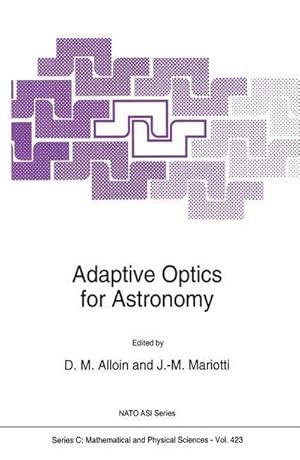
Adaptive Optics for Astronomy
Idioma: Inglés
Publicado por Springer Netherlands, Springer Netherlands, 1994
ISBN 10: 0792327489 ISBN 13: 9780792327486
Librería: AHA-BUCH GmbH, Einbeck, Alemania
Calificación del vendedor: 5 de 5 estrellas
EUR 223,11
Envío por EUR 63,53
Se envía de Alemania a Estados Unidos de AmericaCantidad disponible: 1 disponibles
Añadir al carritoBuch. Condición: Neu. Druck auf Anfrage Neuware - Printed after ordering - For many astronomers, Adaptive Optics is something like a dream coming true. Sinee 1609 and the first observations of celestial bodies performed with the help of an optieal teleseope, astronomers have always fighted to improve the 'resolving power' of their instruments. For a long time, engineers have trimmed the optieal quality of the teleseopes, until they finally reaehed the barrier set by the atmospherie turbulence, a few seconds of are. At that point, the intrinsic quality of the site beeame a major issue to establish new observatories with modern telescopes, and astronomers started to desert the urban skies and to migrate toward mountains and deserts. This quest has been sueeessful and a few privileged sites, where the average natural 'seeing' is close to 0. 5', are now hosting clusters of giant telescopes of the 4 m and soon 10 m class. Yet, this atmospherie limit corresponds in the visible wavelength range to the diffraetion limit of a 20 em telescope only. The loss was severe: a faetor 20 in angular and several hundred in peak energy eoncentration, i. e. in deteetivity of resolution very faint objeets. In the beginning of the seventies, two doors half opened to provide a way out of this dead-end. First, the technique of speckle interferometry (and its various related developments) has allowed to restore the diffraetion limit of large telescopes at visible and infrared wavelengths (see, e. g.
-

Adaptive Optics for Astronomy
Idioma: Inglés
Publicado por Springer Netherlands Mrz 1994, 1994
ISBN 10: 0792327489 ISBN 13: 9780792327486
Librería: BuchWeltWeit Ludwig Meier e.K., Bergisch Gladbach, Alemania
Calificación del vendedor: 5 de 5 estrellas
EUR 213,99
Envío por EUR 23,00
Se envía de Alemania a Estados Unidos de AmericaCantidad disponible: 2 disponibles
Añadir al carritoBuch. Condición: Neu. This item is printed on demand - it takes 3-4 days longer - Neuware -For many astronomers, Adaptive Optics is something like a dream coming true. Sinee 1609 and the first observations of celestial bodies performed with the help of an optieal teleseope, astronomers have always fighted to improve the 'resolving power' of their instruments. For a long time, engineers have trimmed the optieal quality of the teleseopes, until they finally reaehed the barrier set by the atmospherie turbulence, a few seconds of are. At that point, the intrinsic quality of the site beeame a major issue to establish new observatories with modern telescopes, and astronomers started to desert the urban skies and to migrate toward mountains and deserts. This quest has been sueeessful and a few privileged sites, where the average natural 'seeing' is close to 0. 5', are now hosting clusters of giant telescopes of the 4 m and soon 10 m class. Yet, this atmospherie limit corresponds in the visible wavelength range to the diffraetion limit of a 20 em telescope only. The loss was severe: a faetor 20 in angular and several hundred in peak energy eoncentration, i. e. in deteetivity of resolution very faint objeets. In the beginning of the seventies, two doors half opened to provide a way out of this dead-end. First, the technique of speckle interferometry (and its various related developments) has allowed to restore the diffraetion limit of large telescopes at visible and infrared wavelengths (see, e. g. 360 pp. Englisch.
-

Adaptive Optics for Astronomy
Librería: preigu, Osnabrück, Alemania
Calificación del vendedor: 5 de 5 estrellas
EUR 186,70
Envío por EUR 70,00
Se envía de Alemania a Estados Unidos de AmericaCantidad disponible: 5 disponibles
Añadir al carritoBuch. Condición: Neu. Adaptive Optics for Astronomy | Jean-Marie Mariotti (u. a.) | Buch | Einband - fest (Hardcover) | Englisch | 1994 | Springer Netherland | EAN 9780792327486 | Verantwortliche Person für die EU: Springer Netherlands, Haberstr. 7, 69126 Heidelberg, buchhandel-buch[at]springer[dot]com | Anbieter: preigu Print on Demand.
-

Adaptive Optics for Astronomy
Idioma: Inglés
Publicado por Springer Netherlands, Springer Netherlands Mär 1994, 1994
ISBN 10: 0792327489 ISBN 13: 9780792327486
Librería: buchversandmimpf2000, Emtmannsberg, BAYE, Alemania
Calificación del vendedor: 5 de 5 estrellas
EUR 213,99
Envío por EUR 60,00
Se envía de Alemania a Estados Unidos de AmericaCantidad disponible: 1 disponibles
Añadir al carritoBuch. Condición: Neu. This item is printed on demand - Print on Demand Titel. Neuware -For many astronomers, Adaptive Optics is something like a dream coming true. Sinee 1609 and the first observations of celestial bodies performed with the help of an optieal teleseope, astronomers have always fighted to improve the 'resolving power' of their instruments. For a long time, engineers have trimmed the optieal quality of the teleseopes, until they finally reaehed the barrier set by the atmospherie turbulence, a few seconds of are. At that point, the intrinsic quality of the site beeame a major issue to establish new observatories with modern telescopes, and astronomers started to desert the urban skies and to migrate toward mountains and deserts. This quest has been sueeessful and a few privileged sites, where the average natural 'seeing' is close to 0. 5', are now hosting clusters of giant telescopes of the 4 m and soon 10 m class. Yet, this atmospherie limit corresponds in the visible wavelength range to the diffraetion limit of a 20 em telescope only. The loss was severe: a faetor 20 in angular and several hundred in peak energy eoncentration, i. e. in deteetivity of resolution very faint objeets. In the beginning of the seventies, two doors half opened to provide a way out of this dead-end. First, the technique of speckle interferometry (and its various related developments) has allowed to restore the diffraetion limit of large telescopes at visible and infrared wavelengths (see, e. g.Springer Verlag GmbH, Tiergartenstr. 17, 69121 Heidelberg 360 pp. Englisch.

