

Importe total (1 artículo artículos):
Destino del pedido:

9780387275819 - Risk Management in a Hazardous Environment: A Comparative Study of two Pastoral Societies: 2 (Studies in Human Ecology and Adaptation, 2) de Bollig, Michael (13 resultados)
Ir a los resultados principales
Filtros de búsqueda
Tipo de artículo
- Todos los tipos de productos
- Libros (13)
- Revistas y publicaciones (No hay ningún otro resultado que coincida con este filtro.)
- Cómics (No hay ningún otro resultado que coincida con este filtro.)
- Partituras (No hay ningún otro resultado que coincida con este filtro.)
- Arte, grabados y pósters (No hay ningún otro resultado que coincida con este filtro.)
- Fotografías (No hay ningún otro resultado que coincida con este filtro.)
- Mapas (No hay ningún otro resultado que coincida con este filtro.)
- Manuscritos y coleccionismo de papel (No hay ningún otro resultado que coincida con este filtro.)
Condición Más información
- Nuevo (9)
- Como nuevo, Excelente o Muy bueno (2)
- Bueno o Aceptable (2)
- Regular o Pobre (No hay ningún otro resultado que coincida con este filtro.)
- Tal como se indica (No hay ningún otro resultado que coincida con este filtro.)
Encuadernación
- Todas
- Tapa dura (13)
- Tapa blanda (No hay ningún otro resultado que coincida con este filtro.)
Más atributos
- Primera edición (1)
- Firmado (No hay ningún otro resultado que coincida con este filtro.)
- Sobrecubierta (No hay ningún otro resultado que coincida con este filtro.)
- Con imágenes (4)
- No impresión bajo demanda (8)
Idioma (1)
Gastos de envío gratis
- Envío gratis a Estados Unidos de America (No hay ningún otro resultado que coincida con este filtro.)
Ubicación del vendedor
Valoración de los vendedores
-

Risk Management in a Hazardous Environment: A Comparative Study of Two Pastoral Societies
Idioma: Inglés
Publicado por Springer, New York, NY, 2006
ISBN 10: 0387275819 ISBN 13: 9780387275819
Librería: Book Bear, West Brookfield, MA, Estados Unidos de America
Miembro de asociación: SNEAB
Calificación del vendedor: 5 de 5 estrellas

Original o primera edición
EUR 17,95
Envío por EUR 4,34
Se envía dentro de Estados Unidos de AmericaCantidad disponible: 1 disponibles
Añadir al carritoHardcover. Condición: Good. 1st Edition. 442 pp. Tightly bound. Corners not bumped. Text is Free of Markings. No ownership markings. Published without a dust jacket. NOTE: The word "USED" is neatly stamped on top fore-edge. The printed boards no longer show as glossy as when new.
-
Risk Management in a Hazardous Environment: A Comparative Study of two Pastoral Societies (Studies in Human Ecology and Adaptation, 2)
Librería: Midtown Scholar Bookstore, Harrisburg, PA, Estados Unidos de America
Calificación del vendedor: 5 de 5 estrellas
EUR 28,09
Envío por EUR 5,23
Se envía dentro de Estados Unidos de AmericaCantidad disponible: 1 disponibles
Añadir al carritohardcover. Condición: Very Good. no dust jacket as issued No dust jacket. Very Good hardcover with light shelfwear - NICE! Standard-sized.
-
Risk Management in a Hazardous Environment: A Comparative Study of two Pastoral Societies (Studies in Human Ecology and Adaptation, 2)
Librería: Ria Christie Collections, Uxbridge, Reino Unido
Calificación del vendedor: 5 de 5 estrellas
EUR 115,07
Envío por EUR 13,81
Se envía de Reino Unido a Estados Unidos de AmericaCantidad disponible: Más de 20 disponibles
Añadir al carritoCondición: New. In.
-
Risk Management in a Hazardous Environment : A Comparative Study of Two Pastoral Societies
Librería: GreatBookPrices, Columbia, MD, Estados Unidos de America
Calificación del vendedor: 5 de 5 estrellas
EUR 130,07
Envío por EUR 2,30
Se envía dentro de Estados Unidos de AmericaCantidad disponible: 15 disponibles
Añadir al carritoCondición: New.
-
Risk Management in a Hazardous Environment
Librería: Books Puddle, New York, NY, Estados Unidos de America
Calificación del vendedor: 4 de 5 estrellas

EUR 150,10
Envío por EUR 3,48
Se envía dentro de Estados Unidos de AmericaCantidad disponible: 4 disponibles
Añadir al carritoCondición: New. pp. 472,
-

Risk Management in a Hazardous Environment : A Comparative Study of two Pastoral Societies
Idioma: Inglés
Publicado por Springer US, Springer US, 2005
ISBN 10: 0387275819 ISBN 13: 9780387275819
Librería: AHA-BUCH GmbH, Einbeck, Alemania
Calificación del vendedor: 5 de 5 estrellas
EUR 111,53
Envío por EUR 64,35
Se envía de Alemania a Estados Unidos de AmericaCantidad disponible: 1 disponibles
Añadir al carritoBuch. Condición: Neu. Druck auf Anfrage Neuware - Printed after ordering - A research focus on hazards, risk perception and risk minimizing strategies is relatively new in the social and environmental sciences. This volume by a prominent scholar of East African societies is a powerful example of this growing interest. Earlier theory and research tended to describe social and economic systems in some form of equilibrium. However recent thinking in human ecology, evolutionary biology, not to mention in economic and political theory has come to assign to 'risk' a prominent role in predictive modeling of behavior. It turns out that risk minimalization is central to the understanding of individual strategies and numerous social institutions. It is not simply a peripheral and transient moment in a group's history. Anthropologists interested in forager societies have emphasized risk management strategies as a major force shaping hunting and gathering routines and structuring institutions of food sharing and territorial behavior. This book builds on some of these developments but through the analysis of quite complex pastoral and farming peoples and in populations with substantial known histories. The method of analysis depends heavily on the controlled comparisons of different populations sharing some cultural characteristics but differing in exposure to certain risks or hazards.The central questions guiding this approach are: 1) How are hazards generated through environmental variation and degradation, through increasing internal stratification, violent conflicts and marginalization 2) How do these hazards result in damages to single households or to individual actors and how do these costs vary within one society 3) How are hazards perceived by the people affected 4) How do actors of different wealth, social status, age and gender try to minimize risks by delimiting the effect of damages during an on-going crisis and what kind of institutionalized measures do they design to insure themselves against hazards, preventing theiroccurrence or limiting their effects 5) How is risk minimization affected by cultural innovation and how can the importance of the quest for enhanced security as a driving force of cultural evolution be estimated.
-
Risk Management in a Hazardous Environment: A Comparative Study of two Pastoral Societies (Studies in Human Ecology and Adaptation)
Librería: Mispah books, Redhill, SURRE, Reino Unido
Calificación del vendedor: 4 de 5 estrellas
EUR 162,72
Envío por EUR 28,83
Se envía de Reino Unido a Estados Unidos de AmericaCantidad disponible: 1 disponibles
Añadir al carritoHardcover. Condición: Like New. Like New. book.
-
Risk Management in a Hazardous Environment : A Comparative Study of Two Pastoral Societies
Librería: GreatBookPrices, Columbia, MD, Estados Unidos de America
Calificación del vendedor: 5 de 5 estrellas
EUR 194,44
Envío por EUR 2,30
Se envía dentro de Estados Unidos de AmericaCantidad disponible: 15 disponibles
Añadir al carritoCondición: As New. Unread book in perfect condition.
-
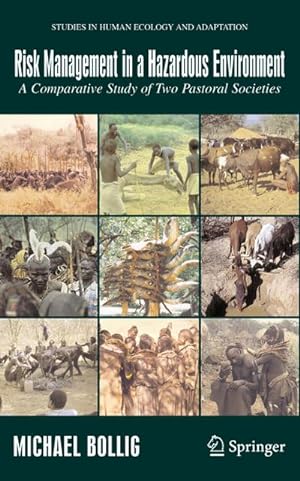
Risk Management in a Hazardous Environment
Librería: BuchWeltWeit Ludwig Meier e.K., Bergisch Gladbach, Alemania
Calificación del vendedor: 5 de 5 estrellas
EUR 106,99
Envío por EUR 23,00
Se envía de Alemania a Estados Unidos de AmericaCantidad disponible: 2 disponibles
Añadir al carritoBuch. Condición: Neu. This item is printed on demand - it takes 3-4 days longer - Neuware -A research focus on hazards, risk perception and risk minimizing strategies is relatively new in the social and environmental sciences. This volume by a prominent scholar of East African societies is a powerful example of this growing interest. Earlier theory and research tended to describe social and economic systems in some form of equilibrium. However recent thinking in human ecology, evolutionary biology, not to mention in economic and political theory has come to assign to 'risk' a prominent role in predictive modeling of behavior. It turns out that risk minimalization is central to the understanding of individual strategies and numerous social institutions. It is not simply a peripheral and transient moment in a group's history. Anthropologists interested in forager societies have emphasized risk management strategies as a major force shaping hunting and gathering routines and structuring institutions of food sharing and territorial behavior. This book builds on some of these developments but through the analysis of quite complex pastoral and farming peoples and in populations with substantial known histories. The method of analysis depends heavily on the controlled comparisons of different populations sharing some cultural characteristics but differing in exposure to certain risks or hazards.The central questions guiding this approach are: 1) How are hazards generated through environmental variation and degradation, through increasing internal stratification, violent conflicts and marginalization 2) How do these hazards result in damages to single households or to individual actors and how do these costs vary within one society 3) How are hazards perceived by the people affected 4) How do actors of different wealth, social status, age and gender try to minimize risks by delimiting the effect of damages during an on-going crisis and what kind of institutionalized measures do they design to insure themselves against hazards, preventing their occurrence or limiting their effects 5) How is risk minimization affected by cultural innovation and how can the importance of the quest for enhanced security as a driving force of cultural evolution be estimated 472 pp. Englisch.
-

Risk Management in a Hazardous Environment
Librería: moluna, Greven, Alemania
Calificación del vendedor: 5 de 5 estrellas
EUR 89,99
Envío por EUR 48,99
Se envía de Alemania a Estados Unidos de AmericaCantidad disponible: Más de 20 disponibles
Añadir al carritoCondición: New. Dieser Artikel ist ein Print on Demand Artikel und wird nach Ihrer Bestellung fuer Sie gedruckt. This comparative ethnographic study of risk-related strategies is unique because of its comparative dimension in the research, the author s address of risk and consequent societal adaptations in groups dependent of primary subsistence, and the well-designed.
-
Risk Management in a Hazardous Environment
Librería: Majestic Books, Hounslow, Reino Unido
Calificación del vendedor: 4 de 5 estrellas
EUR 154,21
Envío por EUR 7,50
Se envía de Reino Unido a Estados Unidos de AmericaCantidad disponible: 4 disponibles
Añadir al carritoCondición: New. Print on Demand pp. 472.
-
Risk Management in a Hazardous Environment
Librería: Biblios, Frankfurt am main, HESSE, Alemania
Calificación del vendedor: 4 de 5 estrellas
EUR 153,33
Envío por EUR 9,95
Se envía de Alemania a Estados Unidos de AmericaCantidad disponible: 4 disponibles
Añadir al carritoCondición: New. PRINT ON DEMAND pp. 472.
-

Risk Management in a Hazardous Environment
Idioma: Inglés
Publicado por Springer US, Springer US Nov 2005, 2005
ISBN 10: 0387275819 ISBN 13: 9780387275819
Librería: buchversandmimpf2000, Emtmannsberg, BAYE, Alemania
Calificación del vendedor: 5 de 5 estrellas
EUR 106,99
Envío por EUR 60,00
Se envía de Alemania a Estados Unidos de AmericaCantidad disponible: 1 disponibles
Añadir al carritoBuch. Condición: Neu. This item is printed on demand - Print on Demand Titel. Neuware -A research focus on hazards, risk perception and risk minimizing strategies is relatively new in the social and environmental sciences. This volume by a prominent scholar of East African societies is a powerful example of this growing interest. Earlier theory and research tended to describe social and economic systems in some form of equilibrium. However recent thinking in human ecology, evolutionary biology, not to mention in economic and political theory has come to assign to 'risk' a prominent role in predictive modeling of behavior. It turns out that risk minimalization is central to the understanding of individual strategies and numerous social institutions. It is not simply a peripheral and transient moment in a group¿s history. Anthropologists interested in forager societies have emphasized risk management strategies as a major force shaping hunting and gathering routines and structuring institutions of food sharing and territorial behavior. This book builds on some of these developments but through the analysis of quite complex pastoral and farming peoples and in populations with substantial known histories. The method of analysis depends heavily on the controlled comparisons of different populations sharing some cultural characteristics but differing in exposure to certain risks or hazards.The central questions guiding this approach are: 1) How are hazards generated through environmental variation and degradation, through increasing internal stratification, violent conflicts and marginalization 2) How do these hazards result in damages to single households or to individual actors and how do these costs vary within one society 3) How are hazards perceived by the people affected 4) How do actors of different wealth, social status, age and gender try to minimize risks by delimiting the effect of damages during an on-going crisis and what kind of institutionalized measures do they design to insure themselves against hazards, preventing theiroccurrence or limiting their effects 5) How is risk minimization affected by cultural innovation and how can the importance of the quest for enhanced security as a driving force of cultural evolution be estimated Springer-Verlag GmbH, Tiergartenstr. 17, 69121 Heidelberg 472 pp. Englisch.

