

Importe total (1 artículo artículos):
Destino del pedido:

9780306464898 - Developmental Psychobiology (Handbooks of Behavioral Neurobiology): 13 (7 resultados)
Ir a los resultados principales
Filtros de búsqueda
Tipo de artículo
- Todos los tipos de productos
- Libros (7)
- Revistas y publicaciones (No hay ningún otro resultado que coincida con este filtro.)
- Cómics (No hay ningún otro resultado que coincida con este filtro.)
- Partituras (No hay ningún otro resultado que coincida con este filtro.)
- Arte, grabados y pósters (No hay ningún otro resultado que coincida con este filtro.)
- Fotografías (No hay ningún otro resultado que coincida con este filtro.)
- Mapas (No hay ningún otro resultado que coincida con este filtro.)
- Manuscritos y coleccionismo de papel (No hay ningún otro resultado que coincida con este filtro.)
Condición Más información
- Nuevo (7)
- Como nuevo, Excelente o Muy bueno (No hay ningún otro resultado que coincida con este filtro.)
- Bueno o Aceptable (No hay ningún otro resultado que coincida con este filtro.)
- Regular o Pobre (No hay ningún otro resultado que coincida con este filtro.)
- Tal como se indica (No hay ningún otro resultado que coincida con este filtro.)
Encuadernación
- Todas
- Tapa dura (7)
- Tapa blanda (No hay ningún otro resultado que coincida con este filtro.)
Más atributos
- Primera edición (No hay ningún otro resultado que coincida con este filtro.)
- Firmado (No hay ningún otro resultado que coincida con este filtro.)
- Sobrecubierta (No hay ningún otro resultado que coincida con este filtro.)
- Con imágenes (4)
- No impresión bajo demanda (4)
Idioma (1)
Precio
- Cualquier precio
- Menos de EUR 20 (No hay ningún otro resultado que coincida con este filtro.)
- EUR 20 a EUR 45 (No hay ningún otro resultado que coincida con este filtro.)
- Más de EUR 45
Gastos de envío gratis
Ubicación del vendedor
Valoración de los vendedores
-

Developmental Psychobiology
Librería: Romtrade Corp., STERLING HEIGHTS, MI, Estados Unidos de America
Calificación del vendedor: 5 de 5 estrellas

EUR 126,81
Gastos de envío gratis
Se envía dentro de Estados Unidos de AmericaCantidad disponible: 1 disponibles
Añadir al carritoCondición: New. This is a Brand-new US Edition. This Item may be shipped from US or any other country as we have multiple locations worldwide.
-
Developmental Psychobiology
Librería: Basi6 International, Irving, TX, Estados Unidos de America
Calificación del vendedor: 5 de 5 estrellas
EUR 127,83
Gastos de envío gratis
Se envía dentro de Estados Unidos de AmericaCantidad disponible: 1 disponibles
Añadir al carritoCondición: Brand New. New. US edition. Expediting shipping for all USA and Europe orders excluding PO Box. Excellent Customer Service.
-
Developmental Psychobiology (Handbooks of Behavioral Neurobiology, 13)
Librería: Ria Christie Collections, Uxbridge, Reino Unido
Calificación del vendedor: 5 de 5 estrellas
EUR 228,34
Envío por EUR 14,05
Se envía de Reino Unido a Estados Unidos de AmericaCantidad disponible: Más de 20 disponibles
Añadir al carritoCondición: New. In.
-
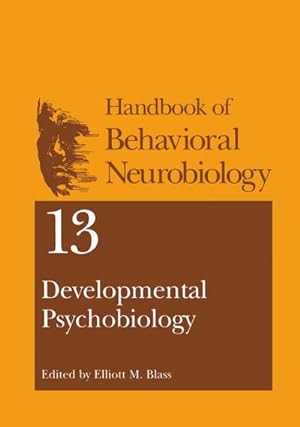
Developmental Psychobiology
Idioma: Inglés
Publicado por Springer US, Springer US, 2001
ISBN 10: 0306464896 ISBN 13: 9780306464898
Librería: AHA-BUCH GmbH, Einbeck, Alemania
Calificación del vendedor: 5 de 5 estrellas
EUR 225,03
Envío por EUR 66,92
Se envía de Alemania a Estados Unidos de AmericaCantidad disponible: 1 disponibles
Añadir al carritoBuch. Condición: Neu. Druck auf Anfrage Neuware - Printed after ordering - ELLIOTT M. BLASS Fifteen years have passed since the first volume on developmental psychobiology (Blass, 1986) appeared in this series and 13 since the publication of the second volume (Blass, 1988). These volumes documented the status of the broad domain of scientific inquiry called developmental psychobiology and were also written with an eye to the future. The future has been revolutionary in at least three ways. First, there was the demise of a descriptive ethology as we had known it, to be replaced first by sociobiology and later by its more sophisticated versions based on quantitative predictions of social interactions that reflected relatedness and inclu sive fitness. Second, there was the emergence of cognitive science, including cogni tive development, as an enormously strong and interactive multidisciplinary effort. Making the 'functional' brain more accessible made this revolution all the more relevant to our discipline. In the laboratory, immunocytochemical detection of immediate / early genes, such as los, now allows us to trace neuronal circuits activated during complex behaviors. The 'functional' brain of primates, especially humans, was also made very accessible through neuroimaging with which we can look at and into brains as they solve and attempt to solve particular tasks. Those of us who were trained in neurology as graduate students two or three decades ago recognize only the people in white coats and patients in beds or on gurneys when we visit neurologi cal units today. The rest is essentially new.
-
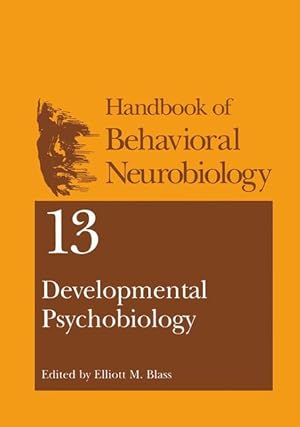
Developmental Psychobiology
Librería: moluna, Greven, Alemania
Calificación del vendedor: 5 de 5 estrellas
EUR 180,07
Envío por EUR 48,99
Se envía de Alemania a Estados Unidos de AmericaCantidad disponible: Más de 20 disponibles
Añadir al carritoGebunden. Condición: New. Dieser Artikel ist ein Print on Demand Artikel und wird nach Ihrer Bestellung fuer Sie gedruckt. ELLIOTT M. BLASS Fifteen years have passed since the first volume on developmental psychobiology (Blass, 1986) appeared in this series and 13 since the publication of the second volume (Blass, 1988). These volumes documented the status of the broad domain o.
-

Developmental Psychobiology
Idioma: Inglés
Publicado por Springer US, Springer US Sep 2001, 2001
ISBN 10: 0306464896 ISBN 13: 9780306464898
Librería: buchversandmimpf2000, Emtmannsberg, BAYE, Alemania
Calificación del vendedor: 5 de 5 estrellas
EUR 213,99
Envío por EUR 60,00
Se envía de Alemania a Estados Unidos de AmericaCantidad disponible: 1 disponibles
Añadir al carritoBuch. Condición: Neu. This item is printed on demand - Print on Demand Titel. Neuware -ELLIOTT M. BLASS Fifteen years have passed since the first volume on developmental psychobiology (Blass, 1986) appeared in this series and 13 since the publication of the second volume (Blass, 1988). These volumes documented the status of the broad domain of scientific inquiry called developmental psychobiology and were also written with an eye to the future. The future has been revolutionary in at least three ways. First, there was the demise of a descriptive ethology as we had known it, to be replaced first by sociobiology and later by its more sophisticated versions based on quantitative predictions of social interactions that reflected relatedness and inclu sive fitness. Second, there was the emergence of cognitive science, including cogni tive development, as an enormously strong and interactive multidisciplinary effort. Making the 'functional' brain more accessible made this revolution all the more relevant to our discipline. In the laboratory, immunocytochemical detection of immediate / early genes, such as los, now allows us to trace neuronal circuits activated during complex behaviors. The 'functional' brain of primates, especially humans, was also made very accessible through neuroimaging with which we can look at and into brains as they solve and attempt to solve particular tasks. Those of us who were trained in neurology as graduate students two or three decades ago recognize only the people in white coats and patients in beds or on gurneys when we visit neurologi cal units today. The rest is essentially new.Springer Verlag GmbH, Tiergartenstr. 17, 69121 Heidelberg 640 pp. Englisch.
-
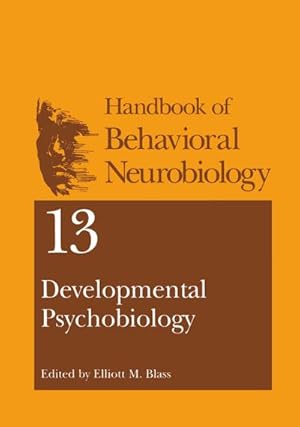
Developmental Psychobiology
Librería: BuchWeltWeit Ludwig Meier e.K., Bergisch Gladbach, Alemania
Calificación del vendedor: 5 de 5 estrellas
EUR 287,83
Envío por EUR 23,00
Se envía de Alemania a Estados Unidos de AmericaCantidad disponible: 2 disponibles
Añadir al carritoBuch. Condición: Neu. This item is printed on demand - it takes 3-4 days longer - Neuware -ELLIOTT M. BLASS Fifteen years have passed since the first volume on developmental psychobiology (Blass, 1986) appeared in this series and 13 since the publication of the second volume (Blass, 1988). These volumes documented the status of the broad domain of scientific inquiry called developmental psychobiology and were also written with an eye to the future. The future has been revolutionary in at least three ways. First, there was the demise of a descriptive ethology as we had known it, to be replaced first by sociobiology and later by its more sophisticated versions based on quantitative predictions of social interactions that reflected relatedness and inclu sive fitness. Second, there was the emergence of cognitive science, including cogni tive development, as an enormously strong and interactive multidisciplinary effort. Making the 'functional' brain more accessible made this revolution all the more relevant to our discipline. In the laboratory, immunocytochemical detection of immediate / early genes, such as los, now allows us to trace neuronal circuits activated during complex behaviors. The 'functional' brain of primates, especially humans, was also made very accessible through neuroimaging with which we can look at and into brains as they solve and attempt to solve particular tasks. Those of us who were trained in neurology as graduate students two or three decades ago recognize only the people in white coats and patients in beds or on gurneys when we visit neurologi cal units today. The rest is essentially new. 640 pp. Englisch.
