

Importe total (1 artículo artículos):
Destino del pedido:

9780306455506 - Recurrence in Topological Dynamics: Furstenberg Families and Ellis Actions (University Series in Mathematics) de Akin, Ethan (12 resultados)
Ir a los resultados principales
Filtros de búsqueda
Tipo de artículo
- Todos los tipos de productos
- Libros (12)
- Revistas y publicaciones (No hay ningún otro resultado que coincida con este filtro.)
- Cómics (No hay ningún otro resultado que coincida con este filtro.)
- Partituras (No hay ningún otro resultado que coincida con este filtro.)
- Arte, grabados y pósters (No hay ningún otro resultado que coincida con este filtro.)
- Fotografías (No hay ningún otro resultado que coincida con este filtro.)
- Mapas (No hay ningún otro resultado que coincida con este filtro.)
- Manuscritos y coleccionismo de papel (No hay ningún otro resultado que coincida con este filtro.)
Condición Más información
- Nuevo (10)
- Como nuevo, Excelente o Muy bueno (2)
- Bueno o Aceptable (No hay ningún otro resultado que coincida con este filtro.)
- Regular o Pobre (No hay ningún otro resultado que coincida con este filtro.)
- Tal como se indica (No hay ningún otro resultado que coincida con este filtro.)
Encuadernación
- Todas
- Tapa dura (12)
- Tapa blanda (No hay ningún otro resultado que coincida con este filtro.)
Más atributos
- Primera edición (No hay ningún otro resultado que coincida con este filtro.)
- Firmado (No hay ningún otro resultado que coincida con este filtro.)
- Sobrecubierta (No hay ningún otro resultado que coincida con este filtro.)
- Con imágenes (4)
- No impresión bajo demanda (6)
Idioma (1)
Precio
- Cualquier precio
- Menos de EUR 20 (No hay ningún otro resultado que coincida con este filtro.)
- EUR 20 a EUR 45 (No hay ningún otro resultado que coincida con este filtro.)
- Más de EUR 45
Gastos de envío gratis
- Envío gratis a Estados Unidos de America (No hay ningún otro resultado que coincida con este filtro.)
Ubicación del vendedor
Valoración de los vendedores
-

Recurrence in Topological Dynamics: Furstenberg Families and Ellis Actions (University Series in Mathematics)
Librería: Ria Christie Collections, Uxbridge, Reino Unido
Calificación del vendedor: 5 de 5 estrellas

EUR 115,34
Envío por EUR 13,85
Se envía de Reino Unido a Estados Unidos de AmericaCantidad disponible: Más de 20 disponibles
Añadir al carritoCondición: New. In.
-
Recurrence in Topological Dynamics : Furstenberg Families and Ellis Actions
Librería: GreatBookPrices, Columbia, MD, Estados Unidos de America
Calificación del vendedor: 5 de 5 estrellas
EUR 130,69
Envío por EUR 2,29
Se envía dentro de Estados Unidos de AmericaCantidad disponible: 15 disponibles
Añadir al carritoCondición: New.
-
Recurrence in Topological Dynamics
Librería: Books Puddle, New York, NY, Estados Unidos de America
Calificación del vendedor: 4 de 5 estrellas

EUR 146,39
Envío por EUR 3,47
Se envía dentro de Estados Unidos de AmericaCantidad disponible: 4 disponibles
Añadir al carritoCondición: New. pp. 284.
-
Recurrence in Topological Dynamics: Furstenberg Families and Ellis Actions (University Series in Mathematics)
Librería: Mispah books, Redhill, SURRE, Reino Unido
Calificación del vendedor: 4 de 5 estrellas
EUR 144,05
Envío por EUR 28,90
Se envía de Reino Unido a Estados Unidos de AmericaCantidad disponible: 1 disponibles
Añadir al carritoHardcover. Condición: Like New. LIKE NEW. SHIPS FROM MULTIPLE LOCATIONS. book.
-
Recurrence in Topological Dynamics : Furstenberg Families and Ellis Actions
Librería: GreatBookPrices, Columbia, MD, Estados Unidos de America
Calificación del vendedor: 5 de 5 estrellas
EUR 175,77
Envío por EUR 2,29
Se envía dentro de Estados Unidos de AmericaCantidad disponible: 15 disponibles
Añadir al carritoCondición: As New. Unread book in perfect condition.
-

Recurrence in Topological Dynamics : Furstenberg Families and Ellis Actions
Librería: AHA-BUCH GmbH, Einbeck, Alemania
Calificación del vendedor: 5 de 5 estrellas
EUR 114,36
Envío por EUR 62,94
Se envía de Alemania a Estados Unidos de AmericaCantidad disponible: 1 disponibles
Añadir al carritoBuch. Condición: Neu. Druck auf Anfrage Neuware - Printed after ordering - In the long run of a dynamical system, after transient phenomena have passed away, what remains is recurrence. An orbit is recurrent when it returns repeatedly to each neighborhood of its initial position. We can sharpen the concept by insisting that the returns occur with at least some prescribed frequency. For example, an orbit lies in some minimal subset if and only if it returns almost periodically to each neighborhood of the initial point. That is, each return time set is a so-called syndetic subset ofT= the positive reals (continuous time system) or T = the positive integers (discrete time system). This is a prototype for many of the results in this book. In particular, frequency is measured by membership in a family of subsets of the space modeling time, in this case the family of syndetic subsets of T. In applying dynamics to combinatorial number theory, Furstenberg introduced a large number of such families. Our first task is to describe explicitly the calculus of families implicit in Furstenberg's original work and in the results which have proliferated since. There are general constructions on families, e. g. , the dual of a family and the product of families. Other natural constructions arise from a topology or group action on the underlying set. The foundations are laid, in perhaps tedious detail, in Chapter 2. The family machinery is then applied in Chapters 3 and 4 to describe family versions of recurrence, topological transitivity, distality and rigidity.
-
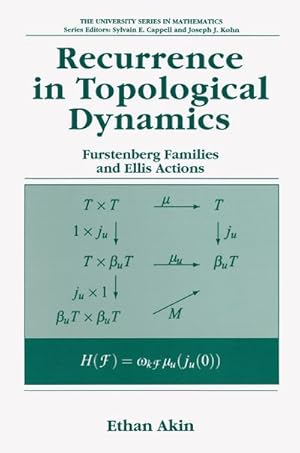
Recurrence in Topological Dynamics
Idioma: Inglés
Publicado por Springer US, Springer US Jul 1997, 1997
ISBN 10: 0306455501 ISBN 13: 9780306455506
Librería: BuchWeltWeit Ludwig Meier e.K., Bergisch Gladbach, Alemania
Calificación del vendedor: 5 de 5 estrellas
EUR 106,99
Envío por EUR 23,00
Se envía de Alemania a Estados Unidos de AmericaCantidad disponible: 2 disponibles
Añadir al carritoBuch. Condición: Neu. This item is printed on demand - it takes 3-4 days longer - Neuware -In the long run of a dynamical system, after transient phenomena have passed away, what remains is recurrence. An orbit is recurrent when it returns repeatedly to each neighborhood of its initial position. We can sharpen the concept by insisting that the returns occur with at least some prescribed frequency. For example, an orbit lies in some minimal subset if and only if it returns almost periodically to each neighborhood of the initial point. That is, each return time set is a so-called syndetic subset ofT= the positive reals (continuous time system) or T = the positive integers (discrete time system). This is a prototype for many of the results in this book. In particular, frequency is measured by membership in a family of subsets of the space modeling time, in this case the family of syndetic subsets of T. In applying dynamics to combinatorial number theory, Furstenberg introduced a large number of such families. Our first task is to describe explicitly the calculus of families implicit in Furstenberg's original work and in the results which have proliferated since. There are general constructions on families, e. g. , the dual of a family and the product of families. Other natural constructions arise from a topology or group action on the underlying set. The foundations are laid, in perhaps tedious detail, in Chapter 2. The family machinery is then applied in Chapters 3 and 4 to describe family versions of recurrence, topological transitivity, distality and rigidity. 280 pp. Englisch.
-

Recurrence in Topological Dynamics
Librería: moluna, Greven, Alemania
Calificación del vendedor: 5 de 5 estrellas
EUR 92,27
Envío por EUR 48,99
Se envía de Alemania a Estados Unidos de AmericaCantidad disponible: Más de 20 disponibles
Añadir al carritoCondición: New. Dieser Artikel ist ein Print on Demand Artikel und wird nach Ihrer Bestellung fuer Sie gedruckt. In the long run of a dynamical system, after transient phenomena have passed away, what remains is recurrence. An orbit is recurrent when it returns repeatedly to each neighborhood of its initial position. We can sharpen the concept by insisting that the re.
-
Recurrence in Topological Dynamics
Librería: Majestic Books, Hounslow, Reino Unido
Calificación del vendedor: 4 de 5 estrellas
EUR 151,33
Envío por EUR 7,51
Se envía de Reino Unido a Estados Unidos de AmericaCantidad disponible: 4 disponibles
Añadir al carritoCondición: New. Print on Demand pp. 284 54:B&W 6.14 x 9.21in or 234 x 156mm (Royal 8vo) Blue Cloth w/Jacket on White w/Gloss Lam.
-
Recurrence in Topological Dynamics
Librería: Biblios, Frankfurt am main, HESSE, Alemania
Calificación del vendedor: 4 de 5 estrellas
EUR 149,27
Envío por EUR 9,95
Se envía de Alemania a Estados Unidos de AmericaCantidad disponible: 4 disponibles
Añadir al carritoCondición: New. PRINT ON DEMAND pp. 284.
-
Recurrence in Topological Dynamics: Furstenberg Families and Ellis Actions
Idioma: Inglés
Publicado por Springer Science+Business Media, 1997
ISBN 10: 0306455501 ISBN 13: 9780306455506
Librería: THE SAINT BOOKSTORE, Southport, Reino Unido
Calificación del vendedor: 5 de 5 estrellas
EUR 138,04
Envío por EUR 27,10
Se envía de Reino Unido a Estados Unidos de AmericaCantidad disponible: Más de 20 disponibles
Añadir al carritoHardback. Condición: New. This item is printed on demand. New copy - Usually dispatched within 5-9 working days.
-

Recurrence in Topological Dynamics
Idioma: Inglés
Publicado por Springer, Springer Jul 1997, 1997
ISBN 10: 0306455501 ISBN 13: 9780306455506
Librería: buchversandmimpf2000, Emtmannsberg, BAYE, Alemania
Calificación del vendedor: 5 de 5 estrellas
EUR 106,99
Envío por EUR 60,00
Se envía de Alemania a Estados Unidos de AmericaCantidad disponible: 1 disponibles
Añadir al carritoBuch. Condición: Neu. This item is printed on demand - Print on Demand Titel. Neuware -In the long run of a dynamical system, after transient phenomena have passed away, what remains is recurrence. An orbit is recurrent when it returns repeatedly to each neighborhood of its initial position. We can sharpen the concept by insisting that the returns occur with at least some prescribed frequency. For example, an orbit lies in some minimal subset if and only if it returns almost periodically to each neighborhood of the initial point. That is, each return time set is a so-called syndetic subset ofT= the positive reals (continuous time system) or T = the positive integers (discrete time system). This is a prototype for many of the results in this book. In particular, frequency is measured by membership in a family of subsets of the space modeling time, in this case the family of syndetic subsets of T. In applying dynamics to combinatorial number theory, Furstenberg introduced a large number of such families. Our first task is to describe explicitly the calculus of families implicit in Furstenberg's original work and in the results which have proliferated since. There are general constructions on families, e. g. , the dual of a family and the product of families. Other natural constructions arise from a topology or group action on the underlying set. The foundations are laid, in perhaps tedious detail, in Chapter 2. The family machinery is then applied in Chapters 3 and 4 to describe family versions of recurrence, topological transitivity, distality and rigidity.Springer-Verlag KG, Sachsenplatz 4-6, 1201 Wien 280 pp. Englisch.

