

Importe total (1 artículo artículos):
Destino del pedido:

9780300230512 - The Moral Economy: Why Good Incentives Are No Substitute for Good Citizens (Castle Lecture Series) de Bowles, Samuel (33 resultados)
Ir a los resultados principales
Filtros de búsqueda
Tipo de artículo
- Todos los tipos de productos
- Libros (33)
- Revistas y publicaciones (No hay ningún otro resultado que coincida con este filtro.)
- Cómics (No hay ningún otro resultado que coincida con este filtro.)
- Partituras (No hay ningún otro resultado que coincida con este filtro.)
- Arte, grabados y pósters (No hay ningún otro resultado que coincida con este filtro.)
- Fotografías (No hay ningún otro resultado que coincida con este filtro.)
- Mapas (No hay ningún otro resultado que coincida con este filtro.)
- Manuscritos y coleccionismo de papel (No hay ningún otro resultado que coincida con este filtro.)
Condición Más información
- Nuevo (24)
- Como nuevo, Excelente o Muy bueno (2)
- Bueno o Aceptable (6)
- Regular o Pobre (1)
- Tal como se indica (No hay ningún otro resultado que coincida con este filtro.)
Encuadernación
- Todas
- Tapa dura (No hay ningún otro resultado que coincida con este filtro.)
- Tapa blanda (33)
Más atributos
- Primera edición (No hay ningún otro resultado que coincida con este filtro.)
- Firmado (No hay ningún otro resultado que coincida con este filtro.)
- Sobrecubierta (No hay ningún otro resultado que coincida con este filtro.)
- Con imágenes (15)
- No impresión bajo demanda (33)
Idioma (1)
Gastos de envío gratis
Ubicación del vendedor
Valoración de los vendedores
-
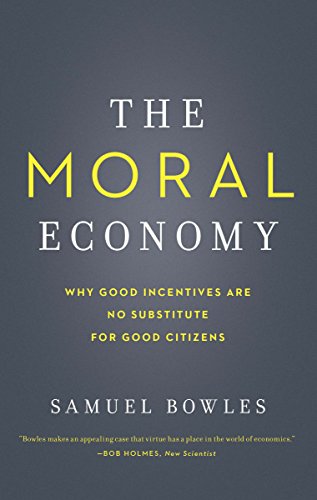
The Moral Economy: Why Good Incentives Are No Substitute for Good Citizens (Castle Lecture Series)
Libro 5 de 9: Castle Lecture SeriesLibrería: World of Books (was SecondSale), Montgomery, IL, Estados Unidos de America
Calificación del vendedor: 5 de 5 estrellas

EUR 7,01
Gastos de envío gratis
Se envía dentro de Estados Unidos de AmericaCantidad disponible: 1 disponibles
Añadir al carritoCondición: Very Good. Item in very good condition! Textbooks may not include supplemental items i.e. CDs, access codes etc.
-
The Moral Economy: Why Good Incentives Are No Substitute for Good Citizens (Castle Lecture Series)
Libro 5 de 9: Castle Lecture SeriesIdioma: Inglés
Publicado por Yale University Press (edition Reprint), 2017
ISBN 10: 0300230516 ISBN 13: 9780300230512
Librería: BooksRun, Philadelphia, PA, Estados Unidos de America
Calificación del vendedor: 5 de 5 estrellas
EUR 7,02
Gastos de envío gratis
Se envía dentro de Estados Unidos de AmericaCantidad disponible: 1 disponibles
Añadir al carritoPaperback. Condición: Very Good. Reprint. It's a well-cared-for item that has seen limited use. The item may show minor signs of wear. All the text is legible, with all pages included. It may have slight markings and/or highlighting.
-
The Moral Economy : Why Good Incentives Are No Substitute for Good Citizens
Libro 5 de 9: Castle Lecture SeriesLibrería: Better World Books, Mishawaka, IN, Estados Unidos de America
Calificación del vendedor: 5 de 5 estrellas
EUR 7,12
Gastos de envío gratis
Se envía dentro de Estados Unidos de AmericaCantidad disponible: 1 disponibles
Añadir al carritoCondición: Good. Pages intact with minimal writing/highlighting. The binding may be loose and creased. Dust jackets/supplements are not included. Stock photo provided. Product includes identifying sticker. Better World Books: Buy Books. Do Good.
-

The Moral Economy: Why Good Incentives Are No Substitute for Good Citizens (Castle Lecture Series)
Libro 5 de 9: Castle Lecture SeriesLibrería: Goodwill of Central and Coastal Virginia, Richmond, VA, Estados Unidos de America
Calificación del vendedor: 3 de 5 estrellas

EUR 5,13
Envío por EUR 5,02
Se envía dentro de Estados Unidos de AmericaCantidad disponible: 1 disponibles
Añadir al carritoCondición: acceptable.
-

The Moral Economy: Why Good Incentives Are No Substitute for Good Citizens (Castle Lecture Series)
Libro 5 de 9: Castle Lecture SeriesLibrería: Solr Books, Lincolnwood, IL, Estados Unidos de America
Calificación del vendedor: 5 de 5 estrellas
EUR 8,98
Envío por EUR 6,98
Se envía dentro de Estados Unidos de AmericaCantidad disponible: 1 disponibles
Añadir al carritoCondición: good. This book is in Good condition. There may be some notes and highligting but otherwise the book is in overall good condition.
-

Moral Economy : Why Good Incentives Are No Substitute for Good Citizens
Libro 5 de 9: Castle Lecture SeriesLibrería: GreatBookPrices, Columbia, MD, Estados Unidos de America
Calificación del vendedor: 5 de 5 estrellas
EUR 21,65
Envío por EUR 2,31
Se envía dentro de Estados Unidos de AmericaCantidad disponible: 1 disponibles
Añadir al carritoCondición: New.
-
The Moral Economy
Libro 5 de 9: Castle Lecture SeriesLibrería: PBShop.store US, Wood Dale, IL, Estados Unidos de America
Calificación del vendedor: 5 de 5 estrellas
EUR 24,04
Gastos de envío gratis
Se envía dentro de Estados Unidos de AmericaCantidad disponible: 13 disponibles
Añadir al carritoPAP. Condición: New. New Book. Shipped from UK. Established seller since 2000.
-

The Moral Economy
Libro 5 de 9: Castle Lecture SeriesIdioma: Inglés
Publicado por Yale University Press, US, 2017
ISBN 10: 0300230516 ISBN 13: 9780300230512
Librería: Rarewaves.com USA, London, LONDO, Reino Unido
Calificación del vendedor: 5 de 5 estrellas
EUR 24,35
Gastos de envío gratis
Se envía de Reino Unido a Estados Unidos de AmericaCantidad disponible: 6 disponibles
Añadir al carritoPaperback. Condición: New. Why do policies and business practices that ignore the moral and generous side of human nature often fail? Should the idea of economic man-the amoral and self-interested Homo economicus-determine how we expect people to respond to monetary rewards, punishments, and other incentives? Samuel Bowles answers with a resounding "no." Policies that follow from this paradigm, he shows, may "crowd out" ethical and generous motives and thus backfire. But incentives per se are not really the culprit. Bowles shows that crowding out occurs when the message conveyed by fines and rewards is that self-interest is expected, that the employer thinks the workforce is lazy, or that the citizen cannot otherwise be trusted to contribute to the public good. Using historical and recent case studies as well as behavioral experiments, Bowles shows how well-designed incentives can crowd in the civic motives on which good governance depends.
-

Moral Economy : Why Good Incentives Are No Substitute for Good Citizens
Libro 5 de 9: Castle Lecture SeriesLibrería: GreatBookPrices, Columbia, MD, Estados Unidos de America
Calificación del vendedor: 5 de 5 estrellas
EUR 23,75
Envío por EUR 2,31
Se envía dentro de Estados Unidos de AmericaCantidad disponible: 1 disponibles
Añadir al carritoCondición: As New. Unread book in perfect condition.
-
The Moral Economy
Libro 5 de 9: Castle Lecture SeriesLibrería: PBShop.store UK, Fairford, GLOS, Reino Unido
Calificación del vendedor: 5 de 5 estrellas
EUR 22,59
Envío por EUR 4,86
Se envía de Reino Unido a Estados Unidos de AmericaCantidad disponible: 12 disponibles
Añadir al carritoPAP. Condición: New. New Book. Shipped from UK. Established seller since 2000.
-
The Moral Economy: Why Good Incentives Are No Substitute for Good Citizens (Castle Lectures)
Libro 5 de 9: Castle Lecture SeriesLibrería: medimops, Berlin, Alemania
Calificación del vendedor: 5 de 5 estrellas
EUR 16,52
Envío por EUR 10,00
Se envía de Alemania a Estados Unidos de AmericaCantidad disponible: 1 disponibles
Añadir al carritoCondición: very good. Gut/Very good: Buch bzw. Schutzumschlag mit wenigen Gebrauchsspuren an Einband, Schutzumschlag oder Seiten. / Describes a book or dust jacket that does show some signs of wear on either the binding, dust jacket or pages.
-

The Moral Economy
Libro 5 de 9: Castle Lecture SeriesIdioma: Inglés
Publicado por Yale University Press, US, 2017
ISBN 10: 0300230516 ISBN 13: 9780300230512
Librería: Rarewaves USA, OSWEGO, IL, Estados Unidos de America
Calificación del vendedor: 5 de 5 estrellas
EUR 29,55
Gastos de envío gratis
Se envía dentro de Estados Unidos de AmericaCantidad disponible: 1 disponibles
Añadir al carritoPaperback. Condición: New. Why do policies and business practices that ignore the moral and generous side of human nature often fail? Should the idea of economic man-the amoral and self-interested Homo economicus-determine how we expect people to respond to monetary rewards, punishments, and other incentives? Samuel Bowles answers with a resounding "no." Policies that follow from this paradigm, he shows, may "crowd out" ethical and generous motives and thus backfire. But incentives per se are not really the culprit. Bowles shows that crowding out occurs when the message conveyed by fines and rewards is that self-interest is expected, that the employer thinks the workforce is lazy, or that the citizen cannot otherwise be trusted to contribute to the public good. Using historical and recent case studies as well as behavioral experiments, Bowles shows how well-designed incentives can crowd in the civic motives on which good governance depends.
-
MORAL ECONOMY: Why Good Incentives Are No Substitute for Good Citizens (Castle Lectures)
Libro 5 de 9: Castle Lecture SeriesLibrería: Majestic Books, Hounslow, Reino Unido
Calificación del vendedor: 4 de 5 estrellas

EUR 21,87
Envío por EUR 7,59
Se envía de Reino Unido a Estados Unidos de AmericaCantidad disponible: 3 disponibles
Añadir al carritoCondición: New. pp. 288.
-
The Moral Economy: Why Good Incentives Are No Substitute for Good Citizens (eng)
Libro 5 de 9: Castle Lecture SeriesLibrería: Brook Bookstore On Demand, Napoli, NA, Italia
Calificación del vendedor: 5 de 5 estrellas
EUR 23,31
Envío por EUR 5,50
Se envía de Italia a Estados Unidos de AmericaCantidad disponible: 12 disponibles
Añadir al carritoCondición: new.
-

The Moral Economy (Paperback)
Libro 5 de 9: Castle Lecture SeriesIdioma: Inglés
Publicado por Yale University Press, New Haven, 2017
ISBN 10: 0300230516 ISBN 13: 9780300230512
Librería: Grand Eagle Retail, Bensenville, IL, Estados Unidos de America
Calificación del vendedor: 5 de 5 estrellas
EUR 30,67
Gastos de envío gratis
Se envía dentro de Estados Unidos de AmericaCantidad disponible: 1 disponibles
Añadir al carritoPaperback. Condición: new. Paperback. Why do policies and business practices that ignore the moral and generous side of human nature often fail? Should the idea of economic manthe amoral and self-interested Homo economicusdetermine how we expect people to respond to monetary rewards, punishments, and other incentives? Samuel Bowles answers with a resounding no. Policies that follow from this paradigm, he shows, may crowd out ethical and generous motives and thus backfire. But incentives per se are not really the culprit. Bowles shows that crowding out occurs when the message conveyed by fines and rewards is that self-interest is expected, that the employer thinks the workforce is lazy, or that the citizen cannot otherwise be trusted to contribute to the public good. Using historical and recent case studies as well as behavioral experiments, Bowles shows how well-designed incentives can crowd in the civic motives on which good governance depends. Why policies and business practices that ignore the moral side of human nature often fail. Shipping may be from multiple locations in the US or from the UK, depending on stock availability.
-
The Moral Economy Why Good Incentives Are No Substitute for Good Citizens
Libro 5 de 9: Castle Lecture SeriesLibrería: Revaluation Books, Exeter, Reino Unido
Calificación del vendedor: 5 de 5 estrellas
EUR 20,16
Envío por EUR 11,67
Se envía de Reino Unido a Estados Unidos de AmericaCantidad disponible: 2 disponibles
Añadir al carritoPaperback. Condición: Brand New. reprint edition. 288 pages. 8.00x5.25x0.75 inches. In Stock.
-
The Moral Economy: Why Good Incentives Are No Substitute for Good Citizens
Libro 5 de 9: Castle Lecture SeriesLibrería: Kennys Bookshop and Art Galleries Ltd., Galway, GY, Irlanda
Calificación del vendedor: 5 de 5 estrellas
EUR 20,83
Envío por EUR 10,50
Se envía de Irlanda a Estados Unidos de AmericaCantidad disponible: 12 disponibles
Añadir al carritoCondición: New. 2017. Reprint. Paperback. . . . . .
-
The Moral Economy: Why Good Incentives Are No Substitute for Good Citizens
Libro 5 de 9: Castle Lecture SeriesLibrería: Kennys Bookstore, Olney, MD, Estados Unidos de America
Calificación del vendedor: 5 de 5 estrellas
EUR 24,79
Envío por EUR 9,18
Se envía dentro de Estados Unidos de AmericaCantidad disponible: 12 disponibles
Añadir al carritoCondición: New. 2017. Reprint. Paperback. . . . . . Books ship from the US and Ireland.
-
MORAL ECONOMY: Why Good Incentives Are No Substitute for Good Citizens (Castle Lectures)
Libro 5 de 9: Castle Lecture SeriesLibrería: Books Puddle, New York, NY, Estados Unidos de America
Calificación del vendedor: 4 de 5 estrellas
EUR 32,83
Envío por EUR 3,49
Se envía dentro de Estados Unidos de AmericaCantidad disponible: 3 disponibles
Añadir al carritoCondición: New. pp. 288.
-
The Moral Economy: Why Good Incentives Are No Substitute for Good Citizens
Libro 5 de 9: Castle Lecture SeriesLibrería: THE SAINT BOOKSTORE, Southport, Reino Unido
Calificación del vendedor: 5 de 5 estrellas
EUR 21,82
Envío por EUR 16,63
Se envía de Reino Unido a Estados Unidos de AmericaCantidad disponible: Más de 20 disponibles
Añadir al carritoPaperback / softback. Condición: New. New copy - Usually dispatched within 4 working days.
-
The Moral Economy: Why Good Incentives Are No Substitute for Good Citizens (Castle Lectures Series) (Castle Lecture Series)
Libro 5 de 9: Castle Lecture SeriesIdioma: Inglés
Publicado por Yale University Press 2017-10-24, 2017
ISBN 10: 0300230516 ISBN 13: 9780300230512
Librería: Chiron Media, Wallingford, Reino Unido
Calificación del vendedor: 5 de 5 estrellas
EUR 21,27
Envío por EUR 18,08
Se envía de Reino Unido a Estados Unidos de AmericaCantidad disponible: 1 disponibles
Añadir al carritoPaperback. Condición: New.
-
Moral Economy : Why Good Incentives Are No Substitute for Good Citizens
Libro 5 de 9: Castle Lecture SeriesLibrería: GreatBookPricesUK, Woodford Green, Reino Unido
Calificación del vendedor: 5 de 5 estrellas
EUR 22,58
Envío por EUR 17,51
Se envía de Reino Unido a Estados Unidos de AmericaCantidad disponible: 19 disponibles
Añadir al carritoCondición: New.
-
The Moral Economy: Why Good Incentives Are No Substitute for Good Citizens (Castle Lecture Series)
Libro 5 de 9: Castle Lecture SeriesLibrería: Ria Christie Collections, Uxbridge, Reino Unido
Calificación del vendedor: 5 de 5 estrellas
EUR 26,60
Envío por EUR 13,98
Se envía de Reino Unido a Estados Unidos de AmericaCantidad disponible: 2 disponibles
Añadir al carritoCondición: New. In.
-

Moral Economy : Why Good Incentives Are No Substitute for Good Citizens
Libro 5 de 9: Castle Lecture SeriesLibrería: GreatBookPricesUK, Woodford Green, Reino Unido
Calificación del vendedor: 5 de 5 estrellas
EUR 26,92
Envío por EUR 17,51
Se envía de Reino Unido a Estados Unidos de AmericaCantidad disponible: 19 disponibles
Añadir al carritoCondición: As New. Unread book in perfect condition.
-
The Moral Economy: Why Good Incentives Are No Substitute for Good Citizens (Castle Lecture Series)
Libro 5 de 9: Castle Lecture SeriesLibrería: Mooney's bookstore, Den Helder, Holanda
Calificación del vendedor: 4 de 5 estrellas
EUR 34,00
Envío por EUR 14,95
Se envía de Holanda a Estados Unidos de AmericaCantidad disponible: 1 disponibles
Añadir al carritoCondición: Very good.
-
MORAL ECONOMY THE
Libro 5 de 9: Castle Lecture SeriesLibrería: Speedyhen, Hertfordshire, Reino Unido
Calificación del vendedor: 5 de 5 estrellas
EUR 21,83
Envío por EUR 47,86
Se envía de Reino Unido a Estados Unidos de AmericaCantidad disponible: 2 disponibles
Añadir al carritoCondición: NEW.
-

The Moral Economy (Paperback)
Libro 5 de 9: Castle Lecture SeriesIdioma: Inglés
Publicado por Yale University Press, New Haven, 2017
ISBN 10: 0300230516 ISBN 13: 9780300230512
Librería: CitiRetail, Stevenage, Reino Unido
Calificación del vendedor: 5 de 5 estrellas
EUR 27,04
Envío por EUR 43,19
Se envía de Reino Unido a Estados Unidos de AmericaCantidad disponible: 1 disponibles
Añadir al carritoPaperback. Condición: new. Paperback. Why do policies and business practices that ignore the moral and generous side of human nature often fail? Should the idea of economic manthe amoral and self-interested Homo economicusdetermine how we expect people to respond to monetary rewards, punishments, and other incentives? Samuel Bowles answers with a resounding no. Policies that follow from this paradigm, he shows, may crowd out ethical and generous motives and thus backfire. But incentives per se are not really the culprit. Bowles shows that crowding out occurs when the message conveyed by fines and rewards is that self-interest is expected, that the employer thinks the workforce is lazy, or that the citizen cannot otherwise be trusted to contribute to the public good. Using historical and recent case studies as well as behavioral experiments, Bowles shows how well-designed incentives can crowd in the civic motives on which good governance depends. Why policies and business practices that ignore the moral side of human nature often fail. Shipping may be from our UK warehouse or from our Australian or US warehouses, depending on stock availability.
-

The Moral Economy
Libro 5 de 9: Castle Lecture SeriesIdioma: Inglés
Publicado por Yale University Press, US, 2017
ISBN 10: 0300230516 ISBN 13: 9780300230512
Librería: Rarewaves USA United, OSWEGO, IL, Estados Unidos de America
Calificación del vendedor: 5 de 5 estrellas
EUR 31,17
Envío por EUR 43,71
Se envía dentro de Estados Unidos de AmericaCantidad disponible: 1 disponibles
Añadir al carritoPaperback. Condición: New. Why do policies and business practices that ignore the moral and generous side of human nature often fail? Should the idea of economic man-the amoral and self-interested Homo economicus-determine how we expect people to respond to monetary rewards, punishments, and other incentives? Samuel Bowles answers with a resounding "no." Policies that follow from this paradigm, he shows, may "crowd out" ethical and generous motives and thus backfire. But incentives per se are not really the culprit. Bowles shows that crowding out occurs when the message conveyed by fines and rewards is that self-interest is expected, that the employer thinks the workforce is lazy, or that the citizen cannot otherwise be trusted to contribute to the public good. Using historical and recent case studies as well as behavioral experiments, Bowles shows how well-designed incentives can crowd in the civic motives on which good governance depends.
-

The Moral Economy: Why Good Incentives Are No Substitute for Good Citizens
Libro 5 de 9: Castle Lecture SeriesLibrería: moluna, Greven, Alemania
Calificación del vendedor: 5 de 5 estrellas
EUR 28,13
Envío por EUR 48,99
Se envía de Alemania a Estados Unidos de AmericaCantidad disponible: 2 disponibles
Añadir al carritoKartoniert / Broschiert. Condición: New. Why do policies and business practices that ignore the moral and generous side of human nature often fail?Samuel Bowles directs the Behavioral Sciences Program at the Santa Fe Institute and is the author of Microeconomics: Behavior, Institutions, and Ev.
-

The Moral Economy (Paperback)
Libro 5 de 9: Castle Lecture SeriesIdioma: Inglés
Publicado por Yale University Press, New Haven, 2017
ISBN 10: 0300230516 ISBN 13: 9780300230512
Librería: AussieBookSeller, Truganina, VIC, Australia
Calificación del vendedor: 5 de 5 estrellas
EUR 47,36
Envío por EUR 32,34
Se envía de Australia a Estados Unidos de AmericaCantidad disponible: 1 disponibles
Añadir al carritoPaperback. Condición: new. Paperback. Why do policies and business practices that ignore the moral and generous side of human nature often fail? Should the idea of economic manthe amoral and self-interested Homo economicusdetermine how we expect people to respond to monetary rewards, punishments, and other incentives? Samuel Bowles answers with a resounding no. Policies that follow from this paradigm, he shows, may crowd out ethical and generous motives and thus backfire. But incentives per se are not really the culprit. Bowles shows that crowding out occurs when the message conveyed by fines and rewards is that self-interest is expected, that the employer thinks the workforce is lazy, or that the citizen cannot otherwise be trusted to contribute to the public good. Using historical and recent case studies as well as behavioral experiments, Bowles shows how well-designed incentives can crowd in the civic motives on which good governance depends. Why policies and business practices that ignore the moral side of human nature often fail. Shipping may be from our Sydney, NSW warehouse or from our UK or US warehouse, depending on stock availability.


