
Importe total (1 artículo artículos):
Destino del pedido:

9780271035833 - The Sensual Icon: Space, Ritual, and the Senses in Byzantium de Pentcheva, Bissera V. (12 resultados)
Ir a los resultados principales
Filtros de búsqueda
Tipo de artículo
- Todos los tipos de productos
- Libros (12)
- Revistas y publicaciones (No hay ningún otro resultado que coincida con este filtro.)
- Cómics (No hay ningún otro resultado que coincida con este filtro.)
- Partituras (No hay ningún otro resultado que coincida con este filtro.)
- Arte, grabados y pósters (No hay ningún otro resultado que coincida con este filtro.)
- Fotografías (No hay ningún otro resultado que coincida con este filtro.)
- Mapas (No hay ningún otro resultado que coincida con este filtro.)
- Manuscritos y coleccionismo de papel (No hay ningún otro resultado que coincida con este filtro.)
Condición Más información
- Nuevo (8)
- Como nuevo, Excelente o Muy bueno (2)
- Bueno o Aceptable (2)
- Regular o Pobre (No hay ningún otro resultado que coincida con este filtro.)
- Tal como se indica (No hay ningún otro resultado que coincida con este filtro.)
Encuadernación
- Todas
- Tapa dura (No hay ningún otro resultado que coincida con este filtro.)
- Tapa blanda (12)
Más atributos
- Primera edición (1)
- Firmado (No hay ningún otro resultado que coincida con este filtro.)
- Sobrecubierta (1)
- Con imágenes (6)
- No impresión bajo demanda (12)
Idioma (1)
Precio
- Cualquier precio
- Menos de EUR 20 (No hay ningún otro resultado que coincida con este filtro.)
- EUR 20 a EUR 40
- Más de EUR 40
Gastos de envío gratis
Ubicación del vendedor
Valoración de los vendedores
-

The Sensual Icon: Space, Ritual, and the Senses in Byzantium
Idioma: Inglés
Publicado por Penn State University Press, 2013
ISBN 10: 0271035838 ISBN 13: 9780271035833
Librería: HPB-Red, Dallas, TX, Estados Unidos de America
Calificación del vendedor: 5 de 5 estrellas

EUR 39,50
Envío por EUR 3,17
Se envía dentro de Estados Unidos de AmericaCantidad disponible: 1 disponibles
Añadir al carritopaperback. Condición: Good. Connecting readers with great books since 1972! Used textbooks may not include companion materials such as access codes, etc. May have some wear or writing/highlighting. We ship orders daily and Customer Service is our top priority!
-
Sensual Icon : Space, Ritual, and the Senses in Byzantium
Idioma: Inglés
Publicado por Penn State University Press, 2013
ISBN 10: 0271035838 ISBN 13: 9780271035833
Librería: GreatBookPrices, Columbia, MD, Estados Unidos de America
Calificación del vendedor: 5 de 5 estrellas
EUR 46,33
Envío por EUR 2,23
Se envía dentro de Estados Unidos de AmericaCantidad disponible: 3 disponibles
Añadir al carritoCondición: As New. Unread book in perfect condition.
-

Sensual Icon : Space, Ritual, and the Senses in Byzantium
Idioma: Inglés
Publicado por Penn State University Press, 2013
ISBN 10: 0271035838 ISBN 13: 9780271035833
Librería: GreatBookPricesUK, Woodford Green, Reino Unido
Calificación del vendedor: 5 de 5 estrellas
EUR 46,66
Envío por EUR 17,26
Se envía de Reino Unido a Estados Unidos de AmericaCantidad disponible: 3 disponibles
Añadir al carritoCondición: As New. Unread book in perfect condition.
-
The Sensual Icon: Space, Ritual, and the Senses in Byzantium
Idioma: Inglés
Publicado por Pennsylvania State University Press, 2013
ISBN 10: 0271035838 ISBN 13: 9780271035833
Librería: Kennys Bookshop and Art Galleries Ltd., Galway, GY, Irlanda
Calificación del vendedor: 5 de 5 estrellas
EUR 53,95
Envío por EUR 10,50
Se envía de Irlanda a Estados Unidos de AmericaCantidad disponible: 1 disponibles
Añadir al carritoCondición: New. 2013. Paperback. . . . . .
-

The Sensual Icon
Idioma: Inglés
Publicado por Pennsylvania State University Press, US, 2013
ISBN 10: 0271035838 ISBN 13: 9780271035833
Librería: Rarewaves.com USA, London, LONDO, Reino Unido
Calificación del vendedor: 5 de 5 estrellas
EUR 67,02
Gastos de envío gratis
Se envía de Reino Unido a Estados Unidos de AmericaCantidad disponible: 2 disponibles
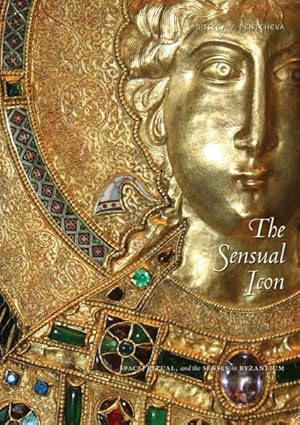
Añadir al carritoPaperback. Condición: New. Today we take the word "icon" to mean "a sign," or we equate it with portraits of Christ and the saints. In The Sensual Icon, Bissera Pentcheva demonstrates how icons originally manifested the presence of the Holy Spirit in matter. Christ was the ideal icon, emerging through the Incarnation; so, too, were the bodies of the stylites (column-saints) penetrated by the divine pneuma (breath or spirit), or the Eucharist, or the Justinianic space of Hagia Sophia filled with the reverberations of chants and the smoke of incense. Iconoclasm (726-843) challenged these Spirit-centered definitions of the icon, eventually restricting the word to mean only the lifeless imprint (typos) of Christ's visual characteristics on matter. By the tenth century, mixed-media relief icons in gold, repoussé, enamel, and filigree offered a new paradigm. The sun's rays or flickering candlelight, stirred by drafts of air and human breath, animated the rich surfaces of these objects; changing shadows endowed their eyes with life. The Byzantines called this spectacle of polymorphous appearance poikilia, that is, presence effects sensually experienced. These icons enabled viewers in Constantinople to detect animation in phenomenal changes rather than in pictorial or sculptural naturalism. "Liveliness," as the goal of the Byzantine mixed-media relief icon, thus challenges the Renaissance ideal of "lifelikeness," which dominated the Western artistic tradition before the arrival of the modern. Through a close examination of works of art and primary texts and language associated with these objects, and through her new photographs and film capturing their changing appearances, Pentcheva uncovers the icons' power to transform the viewer from observer to participant, communing with the divine.
-

Sensual Icon : Space, Ritual, and the Senses in Byzantium
Idioma: Inglés
Publicado por Penn State University Press, 2013
ISBN 10: 0271035838 ISBN 13: 9780271035833
Librería: GreatBookPrices, Columbia, MD, Estados Unidos de America
Calificación del vendedor: 5 de 5 estrellas
EUR 64,72
Envío por EUR 2,23
Se envía dentro de Estados Unidos de AmericaCantidad disponible: 3 disponibles
Añadir al carritoCondición: New.
-
The Sensual Icon: Space, Ritual, and the Senses in Byzantium
Idioma: Inglés
Publicado por Pennsylvania State University Press, 2013
ISBN 10: 0271035838 ISBN 13: 9780271035833
Librería: Kennys Bookstore, Olney, MD, Estados Unidos de America
Calificación del vendedor: 4 de 5 estrellas

EUR 57,99
Envío por EUR 8,88
Se envía dentro de Estados Unidos de AmericaCantidad disponible: 1 disponibles
Añadir al carritoCondición: New. 2013. Paperback. . . . . . Books ship from the US and Ireland.
-
The Sensual Icon Space, Ritual, and the Senses in Byzantium
Idioma: Inglés
Publicado por Pennsylvania State Univ Pr, 2013
ISBN 10: 0271035838 ISBN 13: 9780271035833
Librería: Revaluation Books, Exeter, Reino Unido
Calificación del vendedor: 5 de 5 estrellas
EUR 51,63
Envío por EUR 17,26
Se envía de Reino Unido a Estados Unidos de AmericaCantidad disponible: 2 disponibles
Añadir al carritoPaperback. Condición: Brand New. 1st edition. 320 pages. 9.75x7.25x0.75 inches. In Stock.
-

Sensual Icon : Space, Ritual, and the Senses in Byzantium
Idioma: Inglés
Publicado por Penn State University Press, 2013
ISBN 10: 0271035838 ISBN 13: 9780271035833
Librería: GreatBookPricesUK, Woodford Green, Reino Unido
Calificación del vendedor: 5 de 5 estrellas
EUR 53,98
Envío por EUR 17,26
Se envía de Reino Unido a Estados Unidos de AmericaCantidad disponible: 3 disponibles
Añadir al carritoCondición: New.
-
The Sensual Icon: Space, Ritual, and the Senses in Byzantium
Idioma: Inglés
Publicado por Pennsylvania State University Press, 2013
ISBN 10: 0271035838 ISBN 13: 9780271035833
Librería: THE SAINT BOOKSTORE, Southport, Reino Unido
Calificación del vendedor: 5 de 5 estrellas
EUR 54,07
Envío por EUR 26,06
Se envía de Reino Unido a Estados Unidos de AmericaCantidad disponible: 3 disponibles
Añadir al carritoPaperback / softback. Condición: New. New copy - Usually dispatched within 4 working days.
-
The Sensual Icon.Space,ritual and the sensesin Byzantium
Idioma: Inglés
Publicado por Pennsylvania State University Press, Pennsylvania, 2010
ISBN 10: 0271035838 ISBN 13: 9780271035833
Librería: Luigi De Bei, PREGANZIOL, TV, Italia
Calificación del vendedor: 3 de 5 estrellas

Original o primera edición
EUR 85,00
Envío por EUR 37,00
Se envía de Italia a Estados Unidos de AmericaCantidad disponible: 1 disponibles
Añadir al carritobrossura. Condición: buone condizioni. Estado de la sobrecubierta: buone condizioni. prima edizione. The Sensual Icon.Space,ritual and the sensesin Byzantium,by Bissera V .Pentcheva.Pennsylvania 2010 The Pennsylvania State University Press. Pages 327 ills. paperback Language : english text - codice articolo 012370.
-

The Sensual Icon
Idioma: Inglés
Publicado por Pennsylvania State University Press, US, 2013
ISBN 10: 0271035838 ISBN 13: 9780271035833
Librería: Rarewaves.com UK, London, Reino Unido
Calificación del vendedor: 5 de 5 estrellas
EUR 53,99
Envío por EUR 74,80
Se envía de Reino Unido a Estados Unidos de AmericaCantidad disponible: 2 disponibles
Añadir al carritoPaperback. Condición: New. Today we take the word "icon" to mean "a sign," or we equate it with portraits of Christ and the saints. In The Sensual Icon, Bissera Pentcheva demonstrates how icons originally manifested the presence of the Holy Spirit in matter. Christ was the ideal icon, emerging through the Incarnation; so, too, were the bodies of the stylites (column-saints) penetrated by the divine pneuma (breath or spirit), or the Eucharist, or the Justinianic space of Hagia Sophia filled with the reverberations of chants and the smoke of incense. Iconoclasm (726-843) challenged these Spirit-centered definitions of the icon, eventually restricting the word to mean only the lifeless imprint (typos) of Christ's visual characteristics on matter. By the tenth century, mixed-media relief icons in gold, repoussé, enamel, and filigree offered a new paradigm. The sun's rays or flickering candlelight, stirred by drafts of air and human breath, animated the rich surfaces of these objects; changing shadows endowed their eyes with life. The Byzantines called this spectacle of polymorphous appearance poikilia, that is, presence effects sensually experienced. These icons enabled viewers in Constantinople to detect animation in phenomenal changes rather than in pictorial or sculptural naturalism. "Liveliness," as the goal of the Byzantine mixed-media relief icon, thus challenges the Renaissance ideal of "lifelikeness," which dominated the Western artistic tradition before the arrival of the modern. Through a close examination of works of art and primary texts and language associated with these objects, and through her new photographs and film capturing their changing appearances, Pentcheva uncovers the icons' power to transform the viewer from observer to participant, communing with the divine.


