

Importe total (1 artículo artículos):
Destino del pedido:

9780195174083 - Exceeding Our Grasp: Science, History, and the Problem of Unconceived Alternatives de Stanford, P. Kyle (22 resultados)
Ir a los resultados principales
Filtros de búsqueda
Tipo de artículo
- Todos los tipos de productos
- Libros (22)
- Revistas y publicaciones (No hay ningún otro resultado que coincida con este filtro.)
- Cómics (No hay ningún otro resultado que coincida con este filtro.)
- Partituras (No hay ningún otro resultado que coincida con este filtro.)
- Arte, grabados y pósters (No hay ningún otro resultado que coincida con este filtro.)
- Fotografías (No hay ningún otro resultado que coincida con este filtro.)
- Mapas (No hay ningún otro resultado que coincida con este filtro.)
- Manuscritos y coleccionismo de papel (No hay ningún otro resultado que coincida con este filtro.)
Condición Más información
- Nuevo (17)
- Como nuevo, Excelente o Muy bueno (2)
- Bueno o Aceptable (3)
- Regular o Pobre (No hay ningún otro resultado que coincida con este filtro.)
- Tal como se indica (No hay ningún otro resultado que coincida con este filtro.)
Encuadernación
- Todas
- Tapa dura (22)
- Tapa blanda (No hay ningún otro resultado que coincida con este filtro.)
Más atributos
- Primera edición (No hay ningún otro resultado que coincida con este filtro.)
- Firmado (No hay ningún otro resultado que coincida con este filtro.)
- Sobrecubierta (No hay ningún otro resultado que coincida con este filtro.)
- Con imágenes (10)
- No impresión bajo demanda (12)
Idioma (1)
Precio
- Cualquier precio
- Menos de EUR 20 (No hay ningún otro resultado que coincida con este filtro.)
- EUR 20 a EUR 45
- Más de EUR 45
Gastos de envío gratis
Ubicación del vendedor
Valoración de los vendedores
-

Exceeding Our Grasp: Science, History, and the Problem of Unconceived Alternatives
Idioma: Inglés
Publicado por Oxford University Press, 2006
ISBN 10: 0195174089 ISBN 13: 9780195174083
Librería: HPB-Movies, Dallas, TX, Estados Unidos de America
Calificación del vendedor: 4 de 5 estrellas

EUR 29,35
Envío por EUR 3,27
Se envía dentro de Estados Unidos de AmericaCantidad disponible: 1 disponibles
Añadir al carritohardcover. Condición: Very Good. Connecting readers with great books since 1972! Used books may not include companion materials, and may have some shelf wear or limited writing. We ship orders daily and Customer Service is our top priority!
-
Exceeding Our Grasp : Science, History, and the Problem of Unconceived Alternatives
Idioma: Inglés
Publicado por Oxford University Press, Incorporated, 2006
ISBN 10: 0195174089 ISBN 13: 9780195174083
Librería: Better World Books, Mishawaka, IN, Estados Unidos de America
Calificación del vendedor: 5 de 5 estrellas

EUR 41,80
Gastos de envío gratis
Se envía dentro de Estados Unidos de AmericaCantidad disponible: 1 disponibles
Añadir al carritoCondición: Good. Former library copy. Pages intact with minimal writing/highlighting. The binding may be loose and creased. Dust jackets/supplements are not included. Includes library markings. Stock photo provided. Product includes identifying sticker. Better World Books: Buy Books. Do Good.
-
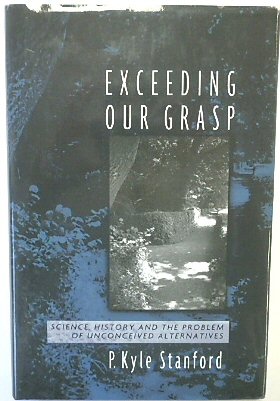
Exceeding Our Grasp: Science, History, and the Problem of Unconceived Alternatives
Idioma: Inglés
Publicado por Oxford University Press, New York, 2006
ISBN 10: 0195174089 ISBN 13: 9780195174083
Librería: PsychoBabel & Skoob Books, Didcot, Reino Unido
Calificación del vendedor: 5 de 5 estrellas
EUR 35,66
Envío por EUR 14,43
Se envía de Reino Unido a Estados Unidos de AmericaCantidad disponible: 1 disponibles
Añadir al carritoHardcover. Condición: Very Good. Hardcover in unclipped dust jacket, very good condition. Wear to leading corners of jacket and faint wear to jacket spine head. Pages are sound and internally clean throughout. TA. Used.
-
Exceeding Our Grasp: Science, History, and the Problem of Unconceived Alternatives
Idioma: Inglés
Publicado por Oxford University Press, USA, 2006
ISBN 10: 0195174089 ISBN 13: 9780195174083
Librería: GoldBooks, Denver, CO, Estados Unidos de America
Calificación del vendedor: 5 de 5 estrellas
EUR 71,84
Envío por EUR 3,71
Se envía dentro de Estados Unidos de AmericaCantidad disponible: 1 disponibles
Añadir al carritoCondición: new.
-

Exceeding Our Grasp : Science, History, And the Problem of Unconceived Alternatives
Idioma: Inglés
Publicado por Oxford University Press, 2006
ISBN 10: 0195174089 ISBN 13: 9780195174083
Librería: GreatBookPrices, Columbia, MD, Estados Unidos de America
Calificación del vendedor: 5 de 5 estrellas
EUR 78,05
Envío por EUR 2,30
Se envía dentro de Estados Unidos de AmericaCantidad disponible: Más de 20 disponibles
Añadir al carritoCondición: New.
-
Exceeding Our Grasp: Science, History, and the Problem of Unconceived Alternatives
Idioma: Inglés
Publicado por Oxford University Press, 2006
ISBN 10: 0195174089 ISBN 13: 9780195174083
Librería: BennettBooksLtd, Los Angeles, CA, Estados Unidos de America
Calificación del vendedor: 5 de 5 estrellas
EUR 74,19
Envío por EUR 6,06
Se envía dentro de Estados Unidos de AmericaCantidad disponible: 1 disponibles
Añadir al carritohardcover. Condición: New. In shrink wrap. Looks like an interesting title!
-

Exceeding Our Grasp : Science, History, And the Problem of Unconceived Alternatives
Idioma: Inglés
Publicado por Oxford University Press, 2006
ISBN 10: 0195174089 ISBN 13: 9780195174083
Librería: GreatBookPrices, Columbia, MD, Estados Unidos de America
Calificación del vendedor: 5 de 5 estrellas
EUR 91,45
Envío por EUR 2,30
Se envía dentro de Estados Unidos de AmericaCantidad disponible: Más de 20 disponibles
Añadir al carritoCondición: As New. Unread book in perfect condition.
-
Exceeding Our Grasp: Science, History, and the Problem of Unconceived Alternatives
Idioma: Inglés
Publicado por Oxford University Press, 2006
ISBN 10: 0195174089 ISBN 13: 9780195174083
Librería: Ria Christie Collections, Uxbridge, Reino Unido
Calificación del vendedor: 5 de 5 estrellas
EUR 83,04
Envío por EUR 13,83
Se envía de Reino Unido a Estados Unidos de AmericaCantidad disponible: Más de 20 disponibles
Añadir al carritoCondición: New. In.
-

Exceeding Our Grasp : Science, History, And the Problem of Unconceived Alternatives
Idioma: Inglés
Publicado por Oxford University Press, 2006
ISBN 10: 0195174089 ISBN 13: 9780195174083
Librería: GreatBookPricesUK, Woodford Green, Reino Unido
Calificación del vendedor: 5 de 5 estrellas
EUR 83,03
Envío por EUR 17,31
Se envía de Reino Unido a Estados Unidos de AmericaCantidad disponible: Más de 20 disponibles
Añadir al carritoCondición: New.
-

Exceeding Our Grasp
Idioma: Inglés
Publicado por Oxford University Press Inc, US, 2006
ISBN 10: 0195174089 ISBN 13: 9780195174083
Librería: Rarewaves.com USA, London, LONDO, Reino Unido
Calificación del vendedor: 5 de 5 estrellas
EUR 109,59
Gastos de envío gratis
Se envía de Reino Unido a Estados Unidos de AmericaCantidad disponible: Más de 20 disponibles
Añadir al carritoHardback. Condición: New. The incredible achievements of modern scientific theories lead most of us to embrace scientific realism: the view that our best theories offer us at least roughly accurate descriptions of otherwise inaccessible parts of the world like genes, atoms, and the big bang. In Exceeding Our Grasp, Stanford argues that careful attention to the history of scientific investigation invites a challenge to this view that is not well represented in contemporary debates about the nature of the scientific enterprise. The historical record of scientific inquiry, Stanford suggests, is characterized by what he calls the problem of unconceived alternatives. Past scientists have routinely failed even to conceive of alternatives to their own theories and lines of theoretical investigation, alternatives that were both well-confirmed by the evidence available at the time and sufficiently serious as to be ultimately accepted by later scientific communities. Stanford supports this claim with a detailed investigation of the mid-to-late 19th century theories of inheritance and generation proposed in turn by Charles Darwin, Francis Galton, and August Weismann. He goes on to argue that this historical pattern strongly suggests that there are equally well-confirmed and scientifically serious alternatives to our own best theories that remain currently unconceived. Moreover, this challenge is more serious than those rooted in either the so-called pessimistic induction or the underdetermination of theories by evidence, in part because existing realist responses to these latter challenges offer no relief from the problem of unconceived alternatives itself. Stanford concludes by investigating what positive account of the spectacularly successful edifice of modern theoretical science remains open to us if we accept that our best scientific theories are powerful conceptual tools for accomplishing our practical goals, but abandon the view that the descriptions of the world around us that they offer are therefore even probably or approximately true.
-

Exceeding Our Grasp : Science, History, And the Problem of Unconceived Alternatives
Idioma: Inglés
Publicado por Oxford University Press, 2006
ISBN 10: 0195174089 ISBN 13: 9780195174083
Librería: GreatBookPricesUK, Woodford Green, Reino Unido
Calificación del vendedor: 5 de 5 estrellas
EUR 93,20
Envío por EUR 17,31
Se envía de Reino Unido a Estados Unidos de AmericaCantidad disponible: Más de 20 disponibles
Añadir al carritoCondición: As New. Unread book in perfect condition.
-

Exceeding Our Grasp
Idioma: Inglés
Publicado por Oxford University Press Inc, US, 2006
ISBN 10: 0195174089 ISBN 13: 9780195174083
Librería: Rarewaves.com UK, London, Reino Unido
Calificación del vendedor: 5 de 5 estrellas
EUR 100,95
Envío por EUR 75,01
Se envía de Reino Unido a Estados Unidos de AmericaCantidad disponible: Más de 20 disponibles
Añadir al carritoHardback. Condición: New. The incredible achievements of modern scientific theories lead most of us to embrace scientific realism: the view that our best theories offer us at least roughly accurate descriptions of otherwise inaccessible parts of the world like genes, atoms, and the big bang. In Exceeding Our Grasp, Stanford argues that careful attention to the history of scientific investigation invites a challenge to this view that is not well represented in contemporary debates about the nature of the scientific enterprise. The historical record of scientific inquiry, Stanford suggests, is characterized by what he calls the problem of unconceived alternatives. Past scientists have routinely failed even to conceive of alternatives to their own theories and lines of theoretical investigation, alternatives that were both well-confirmed by the evidence available at the time and sufficiently serious as to be ultimately accepted by later scientific communities. Stanford supports this claim with a detailed investigation of the mid-to-late 19th century theories of inheritance and generation proposed in turn by Charles Darwin, Francis Galton, and August Weismann. He goes on to argue that this historical pattern strongly suggests that there are equally well-confirmed and scientifically serious alternatives to our own best theories that remain currently unconceived. Moreover, this challenge is more serious than those rooted in either the so-called pessimistic induction or the underdetermination of theories by evidence, in part because existing realist responses to these latter challenges offer no relief from the problem of unconceived alternatives itself. Stanford concludes by investigating what positive account of the spectacularly successful edifice of modern theoretical science remains open to us if we accept that our best scientific theories are powerful conceptual tools for accomplishing our practical goals, but abandon the view that the descriptions of the world around us that they offer are therefore even probably or approximately true.
-
Exceeding Our Grasp
Idioma: Inglés
Publicado por Oxford University Press, 2006
ISBN 10: 0195174089 ISBN 13: 9780195174083
Librería: PBShop.store US, Wood Dale, IL, Estados Unidos de America
Calificación del vendedor: 5 de 5 estrellas
EUR 91,04
Gastos de envío gratis
Se envía dentro de Estados Unidos de AmericaCantidad disponible: Más de 20 disponibles
Añadir al carritoHRD. Condición: New. New Book. Shipped from UK. THIS BOOK IS PRINTED ON DEMAND. Established seller since 2000.
-
Exceeding Our Grasp
Idioma: Inglés
Publicado por Oxford University Press, 2006
ISBN 10: 0195174089 ISBN 13: 9780195174083
Librería: PBShop.store UK, Fairford, GLOS, Reino Unido
Calificación del vendedor: 4 de 5 estrellas
EUR 85,41
Envío por EUR 5,79
Se envía de Reino Unido a Estados Unidos de AmericaCantidad disponible: Más de 20 disponibles
Añadir al carritoHRD. Condición: New. New Book. Delivered from our UK warehouse in 4 to 14 business days. THIS BOOK IS PRINTED ON DEMAND. Established seller since 2000.
-
Exceeding Our Grasp: Science, History, and the Problem of Unconceived Alternatives (eng)
Librería: Brook Bookstore On Demand, Napoli, NA, Italia
Calificación del vendedor: 4 de 5 estrellas
EUR 103,37
Envío por EUR 5,50
Se envía de Italia a Estados Unidos de AmericaCantidad disponible: Más de 20 disponibles
Añadir al carritoCondición: new. Questo è un articolo print on demand.
-
Exceeding Our Grasp: Science, History, and the Problem of Unconceived Alternatives
Idioma: Inglés
Publicado por Oxford University Press Inc, 2006
ISBN 10: 0195174089 ISBN 13: 9780195174083
Librería: THE SAINT BOOKSTORE, Southport, Reino Unido
Calificación del vendedor: 5 de 5 estrellas
EUR 98,64
Envío por EUR 18,67
Se envía de Reino Unido a Estados Unidos de AmericaCantidad disponible: Más de 20 disponibles
Añadir al carritoHardback. Condición: New. This item is printed on demand. New copy - Usually dispatched within 5-9 working days.
-
Exceeding Our Grasp (Hardcover)
Idioma: Inglés
Publicado por Oxford University Press Inc, New York, 2006
ISBN 10: 0195174089 ISBN 13: 9780195174083
Librería: CitiRetail, Stevenage, Reino Unido
Calificación del vendedor: 5 de 5 estrellas
EUR 92,10
Envío por EUR 42,70
Se envía de Reino Unido a Estados Unidos de AmericaCantidad disponible: 1 disponibles
Añadir al carritoHardcover. Condición: new. Hardcover. The incredible achievements of modern scientific theories lead most of us to embrace scientific realism: the view that our best theories offer us at least roughly accurate descriptions of otherwise inaccessible parts of the world like genes, atoms, and the big bang. In Exceeding Our Grasp, Stanford argues that careful attention to the history of scientific investigation invites a challenge to this view that is not well represented in contemporary debatesabout the nature of the scientific enterprise. The historical record of scientific inquiry, Stanford suggests, is characterized by what he calls the problem of unconceived alternatives. Pastscientists have routinely failed even to conceive of alternatives to their own theories and lines of theoretical investigation, alternatives that were both well-confirmed by the evidence available at the time and sufficiently serious as to be ultimately accepted by later scientific communities. Stanford supports this claim with a detailed investigation of the mid-to-late 19th century theories of inheritance and generation proposed in turn by Charles Darwin, Francis Galton, and August Weismann.He goes on to argue that this historical pattern strongly suggests that there are equally well-confirmed and scientifically serious alternatives to our own best theories that remain currentlyunconceived. Moreover, this challenge is more serious than those rooted in either the so-called pessimistic induction or the underdetermination of theories by evidence, in part because existing realist responses to these latter challenges offer no relief from the problem of unconceived alternatives itself. Stanford concludes by investigating what positive account of the spectacularly successful edifice of modern theoretical science remains open to us if we accept that our bestscientific theories are powerful conceptual tools for accomplishing our practical goals, but abandon the view that the descriptions of the world around us that they offer are therefore even probably orapproximately true. History reveals our routine failure to even conceive of well-confirmed alternatives to our scientific theories, Stanford argues, and similar alternatives to our own theories likely remain presently unconceived. Stanford shows why existing defences of scientific realism cannot evade the problem and propose an alternative positive image of the scientific enterprise. This item is printed on demand. Shipping may be from our UK warehouse or from our Australian or US warehouses, depending on stock availability.
-
Exceeding Our Grasp
Idioma: Inglés
Publicado por Oxford University Press OUP, 2006
ISBN 10: 0195174089 ISBN 13: 9780195174083
Librería: Books Puddle, New York, NY, Estados Unidos de America
Calificación del vendedor: 4 de 5 estrellas
EUR 151,95
Envío por EUR 3,48
Se envía dentro de Estados Unidos de AmericaCantidad disponible: 4 disponibles
Añadir al carritoCondición: New. Print on Demand pp. 248.
-
Exceeding Our Grasp
Idioma: Inglés
Publicado por Oxford University Press, 2006
ISBN 10: 0195174089 ISBN 13: 9780195174083
Librería: Biblios, Frankfurt am main, HESSE, Alemania
Calificación del vendedor: 4 de 5 estrellas
EUR 143,07
Envío por EUR 9,95
Se envía de Alemania a Estados Unidos de AmericaCantidad disponible: 4 disponibles
Añadir al carritoCondición: New. PRINT ON DEMAND pp. 248.
-

Exceeding Our Grasp : Science, History, and the Problem of Unconceived Alternatives
Idioma: Inglés
Publicado por Oxford University Press, 2006
ISBN 10: 0195174089 ISBN 13: 9780195174083
Librería: AHA-BUCH GmbH, Einbeck, Alemania
Calificación del vendedor: 5 de 5 estrellas
EUR 116,15
Envío por EUR 62,80
Se envía de Alemania a Estados Unidos de AmericaCantidad disponible: 2 disponibles
Añadir al carritoBuch. Condición: Neu. nach der Bestellung gedruckt Neuware - Printed after ordering - The incredible achievements of modern scientific theories lead most of us to embrace scientific realism: the view that our best theories offer us at least roughly accurate descriptions of otherwise inaccessible parts of the world like genes, atoms, and the big bang. In Exceeding Our Grasp, Stanford argues that careful attention to the history of scientific investigation invites a challenge to this view that is not well represented in contemporary debates about the nature of the scientific enterprise. The historical record of scientific inquiry, Stanford suggests, is characterized by what he calls the problem of unconceived alternatives. Past scientists have routinely failed even to conceive of alternatives to their own theories and lines of theoretical investigation, alternatives that were both well-confirmed by the evidence available at the time and sufficiently serious as to be ultimately accepted by later scientific communities. Stanford supports this claim with a detailed investigation of the mid-to-late 19th century theories of inheritance and generation proposed in turn by Charles Darwin, Francis Galton, and August Weismann. He goes on to argue that this historical pattern strongly suggests that there are equally well-confirmed and scientifically serious alternatives to our own best theories that remain currently unconceived. Moreover, this challenge is more serious than those rooted in either the so-called pessimistic induction or the underdetermination of theories by evidence, in part because existing realist responses to these latter challenges offer no relief from the problem of unconceived alternatives itself. Stanford concludes by investigating what positive account of the spectacularly successful edifice of modern theoretical science remains open to us if we accept that our best scientific theories are powerful conceptual tools for accomplishing our practical goals, but abandon the view that the descriptions of the world around us that they offer are therefore even probably or approximately true.
-

Exceeding Our Grasp: Science, History, and the Problem of Unconceived Alternatives
Idioma: Inglés
Publicado por Oxford University Press, 2006
ISBN 10: 0195174089 ISBN 13: 9780195174083
Librería: moluna, Greven, Alemania
Calificación del vendedor: 4 de 5 estrellas
EUR 140,96
Envío por EUR 48,99
Se envía de Alemania a Estados Unidos de AmericaCantidad disponible: Más de 20 disponibles
Añadir al carritoGebunden. Condición: New. Dieser Artikel ist ein Print on Demand Artikel und wird nach Ihrer Bestellung fuer Sie gedruckt. History reveals our routine failure to even conceive of well-confirmed alternatives to our scientific theories, Stanford argues, and similar alternatives to our own theories likely remain presently unconceived. Stanford shows why existing defences of scient.
-

Exceeding Our Grasp | Science, History, and the Problem of Unconceived Alternatives
Idioma: Inglés
Publicado por Oxford University Press, 2006
ISBN 10: 0195174089 ISBN 13: 9780195174083
Librería: preigu, Osnabrück, Alemania
Calificación del vendedor: 5 de 5 estrellas
EUR 146,15
Envío por EUR 70,00
Se envía de Alemania a Estados Unidos de AmericaCantidad disponible: 5 disponibles
Añadir al carritoBuch. Condición: Neu. Exceeding Our Grasp | Science, History, and the Problem of Unconceived Alternatives | P. Kyle Stanford | Buch | Gebunden | Englisch | 2006 | Oxford University Press | EAN 9780195174083 | Verantwortliche Person für die EU: Deutsche Bibelgesellschaft, Postfach:81 03 40, 70567 Stuttgart, vertrieb[at]dbg[dot]de | Anbieter: preigu Print on Demand.

