

Importe total (1 artículo artículos):
Destino del pedido:

harmony books 1996 (16 resultados)
Editorial :
harmony books 1996
Refinar con la Búsqueda avanzada
Ir a los resultados principales
Filtros de búsqueda
Tipo de artículo
- Todos los tipos de productos
- Libros (16)
- Revistas y publicaciones (No hay ningún otro resultado que coincida con este filtro.)
- Cómics (No hay ningún otro resultado que coincida con este filtro.)
- Partituras (No hay ningún otro resultado que coincida con este filtro.)
- Arte, grabados y pósters (No hay ningún otro resultado que coincida con este filtro.)
- Fotografías (No hay ningún otro resultado que coincida con este filtro.)
- Mapas (No hay ningún otro resultado que coincida con este filtro.)
- Manuscritos y coleccionismo de papel (No hay ningún otro resultado que coincida con este filtro.)
Condición Más información
- Nuevo (No hay ningún otro resultado que coincida con este filtro.)
- Como nuevo, Excelente o Muy bueno (3)
- Bueno o Aceptable (2)
- Regular o Pobre (1)
- Tal como se indica (10)
Encuadernación
Más atributos
Idioma (2)
Gastos de envío gratis
Ubicación del vendedor
Valoración de los vendedores
-
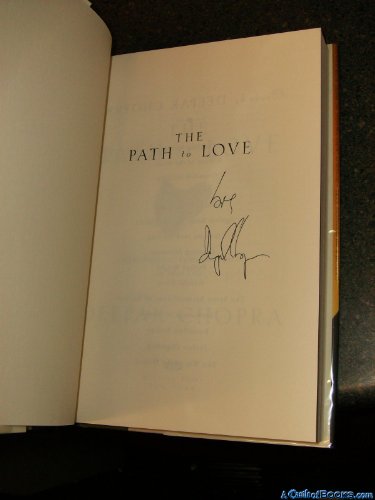
The Path to Love: Renewing the Power of Spirit in Your Life
Idioma: Inglés
Publicado por Harmony Books December 1996, 1996
ISBN 10: 0517706229 ISBN 13: 9780517706220
Librería: Isle of Books, Bozeman, MT, Estados Unidos de America
Calificación del vendedor: 4 de 5 estrellas

EUR 11,54
Gastos de envío gratis
Se envía dentro de Estados Unidos de AmericaCantidad disponible: 1 disponibles
Añadir al carritoHardcover. Condición: Good. Estado de la sobrecubierta: Very Good.
-

A Woman's Guide to a Simpler Life
Librería: Virtuous Volumes et al., Wilson, WI, Estados Unidos de America
Calificación del vendedor: 5 de 5 estrellas

Original o primera edición
EUR 7,55
Envío por EUR 3,88
Se envía dentro de Estados Unidos de AmericaCantidad disponible: 1 disponibles
Añadir al carritoHard Cover. Fine/Near Fine d/j. 1st printing? 12mo - over 6¾" - 7¾" tall. ISBN:0-517-70698-9. D/j corners very slightly rubbed. 241 pages.
-
The Path to Love: Renewing the Power of Spirit in Your Life
Idioma: Inglés
Publicado por Harmony Books December 1996, 1996
ISBN 10: 0517706229 ISBN 13: 9780517706220
Librería: R Bookmark, Youngtown, AZ, Estados Unidos de America
Calificación del vendedor: 5 de 5 estrellas
Original o primera edición
EUR 7,11
Envío por EUR 5,28
Se envía dentro de Estados Unidos de AmericaCantidad disponible: 1 disponibles
Añadir al carritoHardcover. Condición: Collectible-Good. Estado de la sobrecubierta: Good. First Edition. First edition by number code.
-

The Pope's Rhinoceros
Librería: Reed's Rare Books, Palm Springs, CA, Estados Unidos de America
Calificación del vendedor: 5 de 5 estrellas
Original o primera edición
EUR 8,88
Envío por EUR 4,31
Se envía dentro de Estados Unidos de AmericaCantidad disponible: 1 disponibles
Añadir al carritoHardcover. Condición: Near Fine. Estado de la sobrecubierta: Near Fine. 1st Edition. 1st U.S. edition NF/NF.
-

The Island of the Mapmaker's Wife and Other Tales
Idioma: Inglés
Publicado por New York, New York, USA: Harmony Books, 1996. first Printing, First Edition, 1996
ISBN 10: 0517703955 ISBN 13: 9780517703953
Librería: Virginia Martin, aka bookwitch, Concord, CA, Estados Unidos de America
Calificación del vendedor: 5 de 5 estrellas
Original o primera edición
EUR 8,88
Envío por EUR 4,74
Se envía dentro de Estados Unidos de AmericaCantidad disponible: 1 disponibles
Añadir al carritoHardcover. Condición: Collectible, Fine. Estado de la sobrecubierta: Fine. 1st Edition. Octavo, hardcover, fine in fine dj. Giftable. A collection of five love stories noted for the author's ability to bring to life richly detailed worlds. The author's first book. The title story was included in the 1990 "O. Henry Prize Collection". She has received the Best Emerging Fiction Writer award from "The Kenyon Review". 277pp.
-
Full House: The Spread of Excellence from Plato to Darwin
Idioma: Inglés
Publicado por Harmony Books; (1996), NY, 1996
ISBN 10: 0517703947 ISBN 13: 9780517703946
Librería: Tulsa Books, Tulsa, OK, Estados Unidos de America
Calificación del vendedor: 5 de 5 estrellas
Original o primera edición
EUR 9,76
Envío por EUR 4,74
Se envía dentro de Estados Unidos de AmericaCantidad disponible: 1 disponibles
Añadir al carritoHardcover. Condición: Fine. Estado de la sobrecubierta: Fine. First Edition. First printing, fine in a fine dust jacket. Includes numerous illustrations, bibliography, and an index; 244 pages. $25.00 price on jacket flap; no names or other marking in or on the book. 0.
-

FULL HOUSE: THE SPREAD OF EXCELLENCE FROM PLATO TO DARWIN.
Idioma: Inglés
Publicado por New York: Harmony Books 1996., 1996
ISBN 10: 0787111252 ISBN 13: 9780787111250
Librería: de Wit Books, HUTCHINSON, KS, Estados Unidos de America
Calificación del vendedor: 5 de 5 estrellas
EUR 13,32
Envío por EUR 4,31
Se envía dentro de Estados Unidos de AmericaCantidad disponible: 1 disponibles
Añadir al carritoFine, unmarked hardback; DJ-Fine. 244 pp.
-

FULL BLOOM: Thoughts From an Opinionated Gardener
Publicado por (NY: Harmony Books, 1996), 1996
Librería: Warren F. Broderick - Books, Troy, NY, Estados Unidos de America
Calificación del vendedor: 5 de 5 estrellas
EUR 4,44
Envío por EUR 6,03
Se envía dentro de Estados Unidos de AmericaCantidad disponible: 1 disponibles
Añadir al carritosmall format octavo, 276 pp., ill. with drawings in the text by Lourdes Livingston. Highly readable essays on various aspects of gardening by a noted rosarian. very good copy in d.j.
-
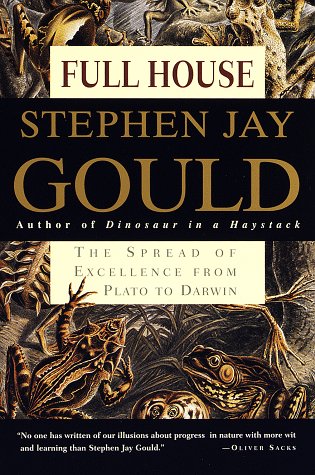
FULL HOUSE: THE SPREAD OF EXCELLENCE FROM PLATO TO DARWIN
Idioma: Inglés
Publicado por NEW YORK NY HARMONY BOOKS PUB 1996., 1997
ISBN 10: 0609801406 ISBN 13: 9780609801406
Librería: JOHN LUTSCHAK BOOKS, BURLINGTON, WI, Estados Unidos de America
Calificación del vendedor: 5 de 5 estrellas
Original o primera edición
EUR 26,63
Envío por EUR 4,74
Se envía dentro de Estados Unidos de AmericaCantidad disponible: 1 disponibles
Añadir al carritoF WRAPS. UNCORRECTED PROOF COPY. FIRST EDITION. Binding is PAPERBACK.
-
Full House: The Spread of Excellence From Plato to Darwin
Publicado por New York: Harmony Books, 1996. Illustrated., 1996
Librería: Waverly & Rugby Books, Pinehurst, NC, Estados Unidos de America
Calificación del vendedor: 5 de 5 estrellas
Original o primera edición
EUR 15,54
Envío por EUR 6,03
Se envía dentro de Estados Unidos de AmericaCantidad disponible: 1 disponibles
Añadir al carritoCondición: Fine. First printing. Hardcover. Fine condition in fine dust jacket.
-
Out of Eden
Publicado por Harmony Books 1996, 1996
Librería: Hard to Find Books NZ (Internet) Ltd., Dunedin, OTAGO, Nueva Zelanda
Miembro de asociación: IOBA
Calificación del vendedor: 5 de 5 estrellas
Original o primera edición
EUR 5,20
Envío por EUR 22,99
Se envía de Nueva Zelanda a Estados Unidos de AmericaCantidad disponible: 1 disponibles
Añadir al carritoFirst edition Octavo hardcover (VG+) d/w (VG-); all our specials have minimal description to keep listing them viable. They are at least reading copies, complete and in reasonable condition, but usually secondhand; frequently they are superior examples. Ordering more than one book will reduce your overall postage cost.
-
Full House: The Spread of Excellence from Plato to Darwin
Publicado por Harmony Books New York 1996, 1996
EUR 8,00
Envío por EUR 32,00
Se envía de Italia a Estados Unidos de AmericaCantidad disponible: 1 disponibles
Añadir al carritoHard Cover.in dj. Condición: Acceptable. Estado de la sobrecubierta: Acceptable. 8vo, hardcover in dj, ex-library, but internally good, 264pp. Synopsis: Few would question the truism that humankind is the crowning achievement of evolution; that the defining thrust of life's history yields progress over time from the primitive and simple to the more advanced and complex; that the disappearance of .400 hitting in baseball is a fact to be bemoaned; or that identifying an existing trend can be helpful in making important life decisions. Few, that is, except Stephen Jay Gould who, in his new book Full House: The Spread of Excellence from Plato to Darwin, proves that all of these intuitive truths are, in fact, wrong. "All of these mistaken beliefs arise out of the same analytical flaw in our reasoning, our Platonic tendency to reduce a broad spectrum to a single, pinpointed essence," says Gould. "This way of thinking allows us to confirm our most ingrained biases that humans are the supreme being on this planet; that all things are inherently driven to become more complex; and that almost any subject can be expressed and understood in terms of an average." In Full House, Gould shows why a more accurate way of understanding our world (and the history of life) is to look at a given subject within its own context, to see it as a part of a spectrum of variation rather than as an isolated "thing" and then to reconceptualize trends as expansion or contraction of this "full house" of variation, and not as the progress or degeneration of an average value, or single thing. When approached in such a way, the disappearance of .400 hitting becomes a cause for celebration, signaling not a decline in greatness but instead an improvement in the overall level of play in baseball; trends become subject to suspicion, and too often, only a tool of those seeking to advance a particular agenda; and the "Age of Man" (a claim rooted in hubris, not in fact) more accurately becomes the "Age of Bacteria." "The traditional mode of thinking has led us to draw many conclusions that don't make satisfying sense," says Gould. "It tells us that .400 hitting has disappeared because batters have gotten worse, but how can that be true when record performances have improved in almost any athletic activity?" In a personal eureka!, Gould realized that we were looking at the picture backward, and that a simple conceptual inversion would resolve a number of the paradoxes of the conventional view. While Full House deftly reveals the shortcomings of the popular reasoning we apply to everyday life situations, Gould also explores his beloved realm of natural history as well. Whether debunking the myth of the successful evolution of the horse (he grants that the story still deserves distinction, but as the icon of evolutionary failure); presenting evidence that the vaunted "progress of life" is really random motion away from simple beginnings, not directed impetus toward complexity; or relegating the kingdoms of Animalai and Plantae to their proper positions on the genealogical chart for all of life (as mere twigs on one of the three bushes), Full House asks nothing less than that we reconceptualize our view of life in a fundamental way. Review: The human mind has a trusty device for simplifying a complex world: reduce to averages and identify trends. Although valuable, the risk is that we ignore variations and end up with a skewed view of reality. In evolutionary terms, the result is a view in which humans are the inevitable pinnacle of evolutionary progress, instead of, as Stephen Jay Gould patiently argues, "a cosmic accident that would never arise again if the tree of life could be replanted." The implications of Gould's argument may threaten certain of our philosophical and religious foundations but will in the end provide us with a clearer view of, and a greater appreciation for, the complexities of our world. Ex-Library.
-
Full House: The Spread of Excellence from Plato to Darwin
Publicado por Harmony Books New York 1996, 1996
Librería: Andrew Barnes Books / Military Melbourne, Melbourne, VIC, Australia
Calificación del vendedor: 4 de 5 estrellas
Original o primera edición
EUR 46,16
Envío por EUR 17,24
Se envía de Australia a Estados Unidos de AmericaCantidad disponible: 1 disponibles
Añadir al carrito1st edition / 1st printing hardback with dust jacket As New octavo 244pp., b/w plates, text ills., bibliog., index, 'A paradigm-shattering book.' Gould corrects the prevalent anthropocentric view of the world arguing that variety not complexity is the true measure of excellence.
-
FULL HOUSE: THE SPREAD OF EXCELLENCE FROM PLATO TO DARWIN
Publicado por N.Y. Harmony Books, [1996], 1996
Librería: Tall Tales, Renton, WA, Estados Unidos de America
Calificación del vendedor: 5 de 5 estrellas
Original o primera edición Ejemplar firmado
EUR 96,98
Envío por EUR 4,31
Se envía dentro de Estados Unidos de AmericaCantidad disponible: 1 disponibles
Añadir al carritoFirst edition. Signed. Very fine in very fine dust jacket.
-
Full House: The Spread of Excellence from Plato to Darwin
Publicado por Harmony Books New York 1996, 1996
Librería: Andrew Barnes Books / Military Melbourne, Melbourne, VIC, Australia
Calificación del vendedor: 4 de 5 estrellas
Original o primera edición Ejemplar firmado
EUR 89,65
Envío por EUR 17,24
Se envía de Australia a Estados Unidos de AmericaCantidad disponible: 1 disponibles
Añadir al carrito1st edition / 1st printing hardback with dust jacket As New octavo 244pp., b/w plates, text ills., bibliog., index, Signed by Stephen Jay Gould (dec. 2002) on the first prelim.
-

Full House. The Spread of Excellence from Plato to Darwin. INSCRIBED BY STEPHEN JAY GOULD TO BENOIT MANDELBROT.
Publicado por New York: Harmony Books, 1996., 1996
Librería: Scientia Books, ABAA ILAB, Arlington, MA, Estados Unidos de America
Miembro de asociación: ABAA ILAB SNEAB
Calificación del vendedor: 4 de 5 estrellas
Original o primera edición
EUR 665,75
Envío por EUR 6,89
Se envía dentro de Estados Unidos de AmericaCantidad disponible: 1 disponibles
Añadir al carrito6 leaves, 244 pp; 36 figs. Original cloth-backed boards. Near Fine, in dust jacket. First Edition. INSCRIBED BY STEPHEN JAY GOULD TO BENOIT MANDELBROT: "For Benoit Mandelbrot/ Best wishes &/ thanks for all your insights/ Steve/ Stephen Jay Gould." "In the mid-1970s, I often saw Stephen Jay Gould (1941-2002), a lively paleontologist with multiple appointments at Harvard. Quite independently, we had become two very visible champions of discontinuity--he in paleontology and I in the variation of financial prices. Early in 1977, I was visiting Boston and called him to see if he was free for lunch while I was in town. He was, and a date was set" (The Fractalist, p. 251).


