Importe total (1 artículo artículos):
Destino del pedido:

nomaden (3 resultados)
Ir a los resultados principales
Filtros de búsqueda
Tipo de artículo
- Todos los tipos de productos
- Libros (3)
- Revistas y publicaciones (No hay ningún otro resultado que coincida con este filtro.)
- Cómics (No hay ningún otro resultado que coincida con este filtro.)
- Partituras (No hay ningún otro resultado que coincida con este filtro.)
- Arte, grabados y pósters (No hay ningún otro resultado que coincida con este filtro.)
- Fotografías (No hay ningún otro resultado que coincida con este filtro.)
- Mapas (No hay ningún otro resultado que coincida con este filtro.)
- Manuscritos y coleccionismo de papel (No hay ningún otro resultado que coincida con este filtro.)
Condición Más información
- Nuevo (1)
- Como nuevo, Excelente o Muy bueno (No hay ningún otro resultado que coincida con este filtro.)
- Bueno o Aceptable (No hay ningún otro resultado que coincida con este filtro.)
- Regular o Pobre (No hay ningún otro resultado que coincida con este filtro.)
- Tal como se indica (2)
Encuadernación
Más atributos
- Primera edición (No hay ningún otro resultado que coincida con este filtro.)
- Firmado (1)
- Sobrecubierta (No hay ningún otro resultado que coincida con este filtro.)
- Con imágenes (2)
- No impresión bajo demanda (3)
Idioma (2)
Gastos de envío gratis
- Envío gratis a Estados Unidos de America (No hay ningún otro resultado que coincida con este filtro.)
Ubicación del vendedor
Valoración de los vendedores
-

Tagesplaner undatiert: Tolles Geschenk für Blogger I Schnell & Einfach: Für Termine, Ziele, tägliche To-Do-Liste, Notizen I Journal für privaten & beruflichen Erfolg I Ohne Kalendarium
Idioma: Alemán
Publicado por Independently published, 2019
ISBN 10: 167311511X ISBN 13: 9781673115116
Librería: Revaluation Books, Exeter, Reino Unido
Calificación del vendedor: 5 de 5 estrellas

EUR 12,45
EUR 11,47 shipping
Se envía de Reino Unido a Estados Unidos de AmericaCantidad disponible: 1 disponibles
Añadir al carritoPaperback. Condición: Brand New. 120 pages. German language. 9.00x6.00x0.28 inches. In Stock.
-

Die Goldene Horde und ihre Vorgänger.
Publicado por Leipzig, Koehler & Amelang., 1972
Librería: ANTIQUARIAT MATTHIAS LOIDL, Unterreit-Stadl, Alemania
Miembro de asociación: ILAB VDA
Calificación del vendedor: 5 de 5 estrellas
EUR 8,00
EUR 19,50 shipping
Se envía de Alemania a Estados Unidos de AmericaCantidad disponible: 1 disponibles
Añadir al carrito19 x 22 cm. 190, (2) S. mit Abbildungen im Text u. 120 Abb. auf Tafeln, 1 gefalt. Karte, illustr. OPp. Gutes Exemplar. DEA.
-
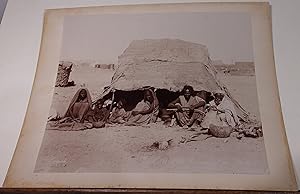
"N. 591. Nubie. {??}pement des Becharins." Schönes Motiv von ägyptischen Nomaden, eine Familie vor einem Zelt sitzend. -- Über diese Völker: "Becharins, nomades qui vivant de la recherche du sené dans le désert; les Nubiens, les matelots de Nil"; Quelle: M.J. Plichon: Egypte, in: Bulletin de la Société de géographie de Lille, Jg. 1882, S. 229ff., speziell S. 239).
Publicado por Ägypten um 1875, 1875
Librería: Antiquariat Thomas Mertens, Berlin, Alemania
Miembro de asociación: GIAQ ILAB VDA
Calificación del vendedor: 4 de 5 estrellas

Ejemplar firmado
EUR 240,00
EUR 55,00 shipping
Se envía de Alemania a Estados Unidos de AmericaCantidad disponible: 1 disponibles
Añadir al carritoAlbumin-Abzug der Zeit (Vintage). Format: 22 x 27 cm; montiert auf Trägerpappe (25 x 33 cm). -- Zustand: Pappe gebogen und etwas fleckig; Foto in gutem Zustand. Über die Fotografen (Quelle: engl. wikipedia): The Adelphoi Zangaki (Zangaki Brothers), known by their probable initials C. and G. Zangaki, were two brothers of Greek origin, active as photographers in Ottoman Egypt from the 1860s through to the 1890s. They specialized in photographing ancient monuments and scenes of everyday life, producing photographic prints for the tourist trade. They occasionally worked with the French photographer Hippolyte Arnoux in Port Said, documenting the works on the Suez Canal. Further, they were among the first commercial photographers to produce large scale images of late 19th- century Egypt. Background: Little is known about the Zangaki brothers, except their initials, C. and G., and that they worked out of Port Said and Cairo from around the 1860s through to at least the 1890s. Many of the Zangaki photographs are signed with a brother's initial and/or a place of business, e.g., "C. Zangaki" or "Zangaki, Cairo" or occasionally "A. Zangaki". For a long time, it was believed that "A. Zangaki" was a single photographer. However, with the discovery of a signboard with the name "Adelphoi Zangaki", it became clear that these were brothers. Scholars believe that their names were George and Constantinos (or Costas), and that they were born on the Greek island of Milos, while others have suggested that they were Cypriot. However, no definitive evidence pertaining to their place and date of birth extists. How they came to learn photography is also unclear. However, shortly after their arrival in Egypt they had become established photographers with studios in Cairo and Port Said. Early photographers in Egypt: By the 1850s, tourist travel to Egypt created strong demand for photographs as souvenirs. A small group of early photographers, mostly of French origin, made their way to Cairo and the Nile valley to capitalise on this demand. These pioneering photographers included Félix Bonfils (1831-1885); Gustave Le Gray (1820-1884), Emile Béchard (his brother Henri signed some of his photographs; active 1860-1890); the British-Italian brothers Antonio Beato (c. 1832-1906) and Felice Beato (1832-1909) as well as Hippolyte Arnoux (active between 1860 and 1890) and some years later, Gabriel Lekegian (1853-1920). -- Career: Photographs taken by the Zangaki brothers are found in tourists' albums assembled in the Middle East in the second half of the 19th century. From their Port Said studio, they were ideally situated to sell to Europeans visiting Egypt as part of a Grand Tour. The Zangaki brothers traveled along the Nile, accompanied by a horse-drawn darkroom wagon to document the Egyptian scenery, architecture and events. Images included views of the pyramids at Giza or the Sphinx and cities, such as Suez or Alexandria, as well of Egyptians going about their daily lives, e.g., a teacher and pupils, men working by the Nile or women at home. They may have worked with the French photographer Hippolyte Arnoux to document the construction of the Suez Canal. Most scholars believe that Arnoux was the official Suez photographer and that the Zangaki Brothers may have assisted him. However, the precise nature of their relationship is unclear, since Arnoux's biography is just as enigmatic as that of the Zangaki brothers. Their relationship soured in 1874, when Arnoux instigated litigation against the Zangaki Brothers and one Spiridion Antippa, accusing them of usurping his intellectual property. Arnoux was successful, as on 29 June 1876, the Court of Ismailia recognized them as "guilty of usurpation of artistic and industrial property and unfair competition." Recognition: Art historian John Hannavy acknowledged that the Zangaki brothers "produced some of the finest images" of the late 19th century in Egypt. Mainly produced for the expectations of the flourishing European tourist trade in Egypt, they are highly prized by historians and collectors for their representations of life at the time.