

Importe total (1 artículo artículos):
Destino del pedido:

n kapany (11 resultados)
Ir a los resultados principales
Filtros de búsqueda
Tipo de artículo
- Todos los tipos de productos
- Libros (11)
- Revistas y publicaciones (No hay ningún otro resultado que coincida con este filtro.)
- Cómics (No hay ningún otro resultado que coincida con este filtro.)
- Partituras (No hay ningún otro resultado que coincida con este filtro.)
- Arte, grabados y pósters (No hay ningún otro resultado que coincida con este filtro.)
- Fotografías (No hay ningún otro resultado que coincida con este filtro.)
- Mapas (No hay ningún otro resultado que coincida con este filtro.)
- Manuscritos y coleccionismo de papel (No hay ningún otro resultado que coincida con este filtro.)
Condición Más información
Encuadernación
Más atributos
- Primera edición (2)
- Firmado (No hay ningún otro resultado que coincida con este filtro.)
- Sobrecubierta (2)
- Con imágenes (2)
- No impresión bajo demanda (11)
Idioma (2)
Gastos de envío gratis
Ubicación del vendedor
Valoración de los vendedores
-

Fiber Optics: Principles and Applications
Publicado por Academic Press, 1968
Librería: BookDepart, Shepherdstown, WV, Estados Unidos de America
Calificación del vendedor: 5 de 5 estrellas

EUR 13,02
Envío por EUR 7,39
Se envía dentro de Estados Unidos de AmericaCantidad disponible: 1 disponibles
Añadir al carritoHardcover. Condición: UsedGood. Hardcover; 2nd printing of a 1967 copyright; surplus library copy with the usual stampings; reference number taped to spine; fading and shelf wear to exterior; in good condition with clean text, firm binding. No dust jacket.
-
Optical Wavelength
Publicado por Academic Press, 1972
Librería: Anybook.com, Lincoln, Reino Unido
Calificación del vendedor: 5 de 5 estrellas
EUR 8,83
Envío por EUR 15,77
Se envía de Reino Unido a Estados Unidos de AmericaCantidad disponible: 1 disponibles
Añadir al carritoCondición: Good. This is an ex-library book and may have the usual library/used-book markings inside.This book has hardback covers. In good all round condition. No dust jacket. Please note the Image in this listing is a stock photo and may not match the covers of the actual item,800grams, ISBN:
-
"Recent Developments in Infrared Fiber Optics." In: Infrared Physics: An International Research Journal, Vol. 5, No. 2, June 1965, pp. 69-80.
Publicado por Pergamon Press, 1965., Oxford, et al.:, 1965
Librería: Jeff Weber Rare Books, Neuchatel, NEUCH, Suiza
Miembro de asociación: ABAA ILAB
Calificación del vendedor: 5 de 5 estrellas
EUR 18,03
Envío por EUR 25,00
Se envía de Suiza a Estados Unidos de AmericaCantidad disponible: 1 disponibles
Añadir al carrito8vo. 57-97 pp. Plates, figs., tables. Printed wrappers; spine frayed. Library stamp on front cover. Good.
-
Optical Waveguides, principles and applications
Publicado por Academic Press, London 1972, 1972
Librería: Antiquariat Thomas & Reinhard, Recklinghausen, NRW, Alemania
Calificación del vendedor: 5 de 5 estrellas
EUR 17,00
Envío por EUR 19,00
Se envía de Alemania a Estados Unidos de AmericaCantidad disponible: 1 disponibles
Añadir al carritodies ist ein regulär ausgesondertes Bibliotheksexemplar aus einer wissenschaftlichen Bibliothek mit der üblichen Signatur und Stempel, keine Markierungen-Anstreichungen-Stempel im Text, LEINENAUSGABE, 328 Seiten, Format groß 8°, goldgeprägte Titel, hinterer Deckel etwas Staubfleckchen, ansonsten gut erhaltenes Buch----------- Library-Ex with usual signature and stamps, text clean no markings, LINEN BINDING, gold stamped title, good condition. Shipping to abroad insured with tracking number.
-
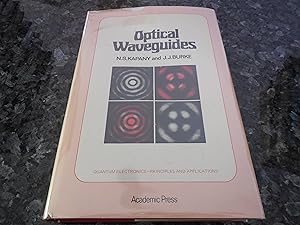
Optical Waveguides
Libro 2 de 10: Quantum Electronics-Principles and ApplicationsLibrería: Veronica's Books, Gig Harbor, WA, Estados Unidos de America
Calificación del vendedor: 5 de 5 estrellas
Original o primera edición
EUR 85,63
Envío por EUR 5,69
Se envía dentro de Estados Unidos de AmericaCantidad disponible: 1 disponibles
Añadir al carritoHardcover. Condición: Near Fine. Estado de la sobrecubierta: Good. 1st Edition. Tight copy with owner address stamp on fly. 328pp. Small chips out of upper edge of dust jacket which is now in protective mylar.
-

Optical Waveguides
Libro 2 de 10: Quantum Electronics-Principles and ApplicationsIdioma: Inglés
Publicado por Elsevier Science & Technology, 1973
ISBN 10: 0123967600 ISBN 13: 9780123967602
Librería: Better World Books, Mishawaka, IN, Estados Unidos de America
Calificación del vendedor: 5 de 5 estrellas
EUR 101,40
Gastos de envío gratis
Se envía dentro de Estados Unidos de AmericaCantidad disponible: 1 disponibles
Añadir al carritoCondición: Good. Former library copy. Pages intact with minimal writing/highlighting. The binding may be loose and creased. Dust jackets/supplements are not included. Includes library markings. Stock photo provided. Product includes identifying sticker. Better World Books: Buy Books. Do Good.
-
Optical Waveguides
Libro 2 de 10: Quantum Electronics-Principles and ApplicationsLibrería: ThriftBooks-Dallas, Dallas, TX, Estados Unidos de America
Calificación del vendedor: 5 de 5 estrellas
EUR 101,66
Gastos de envío gratis
Se envía dentro de Estados Unidos de AmericaCantidad disponible: 1 disponibles
Añadir al carritoHardcover. Condición: Good. No Jacket. Missing dust jacket; Pages can have notes/highlighting. Spine may show signs of wear. ~ ThriftBooks: Read More, Spend Less.
-

Optical Waveguides
Libro 2 de 10: Quantum Electronics-Principles and ApplicationsLibrería: Revaluation Books, Exeter, Reino Unido
Calificación del vendedor: 5 de 5 estrellas
EUR 100,88
Envío por EUR 14,49
Se envía de Reino Unido a Estados Unidos de AmericaCantidad disponible: 1 disponibles
Añadir al carritoPaperback. Condición: Brand New. 340 pages. 9.25x0.77x6.00 inches. In Stock.
-
Optical Waveguides (Quantum Electronics - Principles and Applications)
Libro 2 de 10: Quantum Electronics-Principles and ApplicationsLibrería: Anybook.com, Lincoln, Reino Unido
Calificación del vendedor: 5 de 5 estrellas
EUR 91,32
Envío por EUR 36,40
Se envía de Reino Unido a Estados Unidos de AmericaCantidad disponible: 1 disponibles
Añadir al carritoCondición: Fair. This is an ex-library book and may have the usual library/used-book markings inside.This book has hardback covers. In fair condition, suitable as a study copy. Dust jacket in poor condition. Please note the Image in this listing is a stock photo and may not match the covers of the actual item,850grams, ISBN:0123967600.
-
Fibre Optics - Principles and Applications
Publicado por Academic Press, UK, 1968
Librería: Harry Righton, Evesham, Reino Unido
Calificación del vendedor: 5 de 5 estrellas
EUR 53,73
Envío por EUR 23,19
Se envía de Reino Unido a Estados Unidos de AmericaCantidad disponible: 1 disponibles
Añadir al carritoHardcover. Condición: Good. No Jacket. No dustjacket. 2nd printing. binding tight.text VG. couple of biro marks to endpapers. Size: 8vo - over 7¾ - 9¾" tall. Book.
-
[Fiber Optics] "A New Method of transporting Optical Images without Aberrations" and "A Flexible Fibrescope, using Static Scanning"
Publicado por MacMillan & Co., Ltd, London, 1954
Librería: Kuenzig Books ( ABAA / ILAB ), Topsfield, MA, Estados Unidos de America
Miembro de asociación: ABAA ESA ILAB IOBA SNEAB
Calificación del vendedor: 5 de 5 estrellas
Original o primera edición
EUR 743,66
Envío por EUR 5,24
Se envía dentro de Estados Unidos de AmericaCantidad disponible: 1 disponibles
Añadir al carritoWraps. Condición: Very Good. First Edition. First Edition. x, 22, viii, 23-46, xi-xviii pages. The entire issue offered. Self wrappers, stapled. Rusty staples, light soiling to the wrappers. Clean internally. Wraps. A major issue in the early development of modern fiber optics was the leakage of light from the fibers, reflections internal to the medium, and crossover of light contamination (crosstalk) from one fiber to the next. Van Heel (and his uncredited research partner Brian O'Brien) discovered a solution to this conundrum (cladding the fibers), enabling furture research and the practical exploration of the use of fiber optics in many fields. Van Heel's letter to Nature was to have established his precedence in the matter (his letter was dated May 21st of 1953), but Nature's unexplained delay in publication meant that a more detailed description Van Heel submitted to a Dutch paper De Ingenier, rushed into print in the June 12, 1953 issue, established that precedence. The little known Dutch publication however received little notice. Nature, with it's reputation and wide reach made the discovery much more widely known. Separately, Harold Horace Hopkins, a "young rising star in the little world of European optics" was asked by a physician if he might develop a flexible device to replace rigid gastroscopes used at the time for endoscopies. He, and a researcher he hired Narinder S. Kapany, set to work trying to figure out how to align the fibers (unclad) in such a way as to transmit light images from one end of a fiber bundle to the other (a non-trival task, something we call coherent fibre optics). They were able to accomplish achieving good image transmission through a large bundle of optical fibers for the first time without clading the fibers, and the second paper here describes that accomplishment. Kapany eventually coined the term fiber optics. Kapany and Hopkins, Van Heel and O'Brien were at serious odds with each other throughout and after the publications of these papers, something Hecht goes into in some detail. Jeff Hecht, in his excellent book "City of Light, The Story of Fiber Optics" which much of this description is based on, offers this realization: "Neither paper was quite sufficient by itself. Yet taken together, the two papers in one of the world's most widely read scientific journals launched modern fiber optics." We have provided the abstract for each paper below from Nature for the reader. Van Heel article abstract: "The transportation of optical images has been carried out hitherto with the aid of lenses or mirrors or both. As with all optical systems, aberrations are introduced and the parts have to be aligned carefully ; it seemed worth while, therefore, to search for a method by which no aberrations are introduced and which allows (strong) deviations from alignment without deterioration of the image. Consideration of the construction of the eye of some insects suggested another approach. If a bundle or sheaf of thin transparent fibres is cut off perpendicularly at both ends and an optical image is formed on one end, it will be seen at the other end, as the light entering one fibre can only leave this at the other end, provided leakage of light from one fibre to another of the bundle is prevented. Moreover, the cylindrical wall of each fibre must reflect the light as nearly completely as possible, because of the very numerous reflexions occurring when the fibres are thin compared to their length. Preliminary experiments, started in January 1950, have shown that coating the fibres with silver or any other metal yields an unsatisfactory transmission. A much better result was obtained when the fibres were coated with a layer of lower refractive index, which ensured total reflexion. This coating was isolated from the neighbouring fibres by a thin coat of black paint. In this way, flexible 'image rods' have been obtained with satisfactory transmission, a very good contrast in the end image, and with the possibility of using forms bent in any directi.


![Imagen del vendedor de [Fiber Optics] "A New Method of transporting Optical Images without Aberrations" and "A Flexible Fibrescope, using Static Scanning" a la venta por Kuenzig Books ( ABAA / ILAB )](https://pictures.abebooks.com/inventory/md/md32338911359.jpg)