Importe total (1 artículo artículos):
Destino del pedido:

lord wharncliffe editor (6 resultados)
Ir a los resultados principales
Filtros de búsqueda
Tipo de artículo
- Todos los tipos de productos
- Libros (6)
- Revistas y publicaciones (No hay ningún otro resultado que coincida con este filtro.)
- Cómics (No hay ningún otro resultado que coincida con este filtro.)
- Partituras (No hay ningún otro resultado que coincida con este filtro.)
- Arte, grabados y pósters (No hay ningún otro resultado que coincida con este filtro.)
- Fotografías (No hay ningún otro resultado que coincida con este filtro.)
- Mapas (No hay ningún otro resultado que coincida con este filtro.)
- Manuscritos y coleccionismo de papel (No hay ningún otro resultado que coincida con este filtro.)
Condición Más información
- Nuevo (No hay ningún otro resultado que coincida con este filtro.)
- Como nuevo, Excelente o Muy bueno (No hay ningún otro resultado que coincida con este filtro.)
- Bueno o Aceptable (5)
- Regular o Pobre (No hay ningún otro resultado que coincida con este filtro.)
- Tal como se indica (1)
Encuadernación
- Todas
- Tapa dura (5)
- Tapa blanda (No hay ningún otro resultado que coincida con este filtro.)
Más atributos
- Primera edición (No hay ningún otro resultado que coincida con este filtro.)
- Firmado (No hay ningún otro resultado que coincida con este filtro.)
- Sobrecubierta (No hay ningún otro resultado que coincida con este filtro.)
- Con imágenes (3)
- No impresión bajo demanda (6)
Idioma (1)
Precio
- Cualquier precio
- Menos de EUR 20 (No hay ningún otro resultado que coincida con este filtro.)
- EUR 20 a EUR 45 (No hay ningún otro resultado que coincida con este filtro.)
- Más de EUR 45
Gastos de envío gratis
- Envío gratis a Estados Unidos de America (No hay ningún otro resultado que coincida con este filtro.)
Ubicación del vendedor
Valoración de los vendedores
-

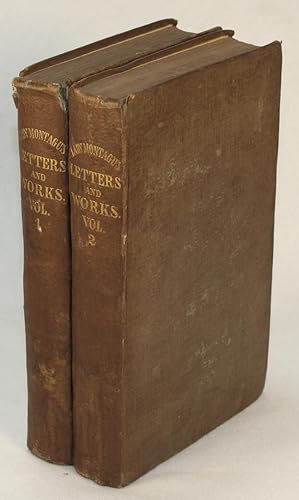
The Letters and Works of Lady Mary Wortley Montagu, in Three Volumes (3 vol. set)
Publicado por Carey, Lea, and Blanchard, 1837
Librería: Visible Voice Books, Cleveland, OH, Estados Unidos de America
Calificación del vendedor: 5 de 5 estrellas

EUR 45,21
Envío por EUR 3,95
Se envía dentro de Estados Unidos de AmericaCantidad disponible: 1 disponibles
Añadir al carritoHardcover. Condición: Very Good. Carey, Lea, and Blanchard January 1837 Binding: Hardcover Binding is loose, spines are missing leather, boards. Vol. I front board detached but present. Overall complete set is in poor to fair condition.
-
THE LETTERS AND WORKS OF LADY MARY WORTLEY MONTAGU, VOLUME I
Publicado por Richard Bentley, London, 1837
Librería: The Story Shop, Elwood, IN, Estados Unidos de America
Calificación del vendedor: 4 de 5 estrellas

EUR 45,17
Envío por EUR 5,22
Se envía dentro de Estados Unidos de AmericaCantidad disponible: 1 disponibles
Añadir al carritoHardcover. Condición: Very Good-. Estado de la sobrecubierta: No Dust Jacket. 1. Rebound in circa 1930s cloth with what appears to be the original spine title now cut out and adhered to the spine. Nice, sound, clean. ; Lxiv + 402 pages. Volume I only. ; 8vo 8" - 9" tall.
-
The Letters and Works of Lady Mary Wortley Montagu
Publicado por Richard Bentley, 1837
Librería: Books for Libraries, Inc., Santa Clarita, CA, Estados Unidos de America
Calificación del vendedor: 5 de 5 estrellas
EUR 94,94
Envío por EUR 4,17
Se envía dentro de Estados Unidos de AmericaCantidad disponible: 1 disponibles
Añadir al carritoHardcover. Condición: Good. 1837 Hardcover 3 Volume Set, complete. NOT a facsimile. Second Edition, revised. B & W illustrations, frontispiece in Vol 1 with tissue. Ex-Library. Text is clean, very minor foxing on first & last few pages. Binding is strong. Rebound in very nice dark rust-colored and tan cloth covers. **NO International shipping (outside of the USA) and NO Expedited shipping available for this large, heavy book set.**.
-
The Letters and works of Lady Mary Wortley Montagu in two volumes, Vol. II
Publicado por Baudry's European Library, Paris, 1837
Librería: Versandantiquariat Funke, Dresden, Alemania
Calificación del vendedor: 4 de 5 estrellas
EUR 55,00
Envío por EUR 55,10
Se envía de Alemania a Estados Unidos de AmericaCantidad disponible: 1 disponibles
Añadir al carritoCondición: guter Zustand. F. guter Zustand, geringe Gebrauchs- und Alterungsspuren: Einbandecken gering abgenutzt - Titel mit altem Namenszug - Seiten überwiegend sauber und ordentlich, gelegentlich gering stockfleckig, die ersten 20 Blatt etwas mehr fleckig - Seite 53 unten mit kleinem Eckabriss im Angebot nur Band 2 "Lady Mary Wortley Montagu (* 26. Mai 1689 in Thoresby, Nottinghamshire; ? 21. August 1762 London) war eine englische Schriftstellerin und Lyrikerin. Die Briefe, die sie während ihres Aufenthalts in Konstantinopel schrieb und posthum als Turkish Embassy Letters veröffentlicht wurden, machten sie europaweit bekannt. Bekannt wurde Lady Mary zu ihrer Lebenszeit auch als Mittelpunkt einer literarischen und intellektuellen Szene aus Dichtern wie Alexander Pope, John Gay oder Mary Astell. Lady Mary setzte sich ferner für die Variolation bei Pocken ein . Lady Mary Wortley Montagu hat im Laufe ihres Lebens eine Vielzahl von Gedichten, Briefen und weitere Prosatexte wie Romanzen verfasst. Außerdem war sie eine produktive Tagebuchschreiberin. Zu Lebzeiten etablierte sie bereits einen Ruf als Dichterin und Intellektuelle durch ihre Briefe, die sie mit wichtigen Persönlichkeiten in England wechselte, und durch ihre Gedichte, die hauptsächlich in Manuskriptform unter ihren Freunden zirkulierten. Als Mitglied der adeligen Oberschicht und als Frau galt es als unpassend, eigene Schriften zu veröffentlichen, so dass zu Lady Marys Lebzeiten nur wenige ihrer Texte veröffentlicht wurden, meist ohne ihr Einverständnis. So wurden z. B. ihre Stadteklogen (Town Eclogues), die sie mit Alexander Pope und John Gay verfasste, bereits 1716 als Raubkopien veröffentlicht. Auch die Publikation eines Briefs an Abbé Conti aus Konstantinopel, der auch ihren ersten Ruhm als brillante Briefeschreiberin begründete, kam 1719 ohne ihr Einverständnis zustande. Lady Marys Ruf als ernstzunehmende Schriftstellerin begründet sich vor allem auf ihren posthum veröffentlichten Briefen, die sie während ihrer Zeit auf der Reise nach und in Konstantinopel verfasst hat und die unter dem Titel Embassy Letters bekannt wurden. Ihre Lyrik ist erst in den letzten Jahren von der Literaturwissenschaft entdeckt worden. Themen von Lady Marys Lyrik reichen von Satire über Liebeslyrik bis hin zu Kritik der damaligen Männer- und Frauenrollen. Ein großer Teil von Lady Mary Wortley Montagus Werk ist jedoch für die Nachwelt verloren. Da zu ihren Lebzeiten Gedichte nur selten und häufig anonym veröffentlicht wurden, ist es häufig schwierig, Gedichte ihr als Autorin korrekt zuzuordnen. Viele ihrer Schriften, so auch ihr Tagebuch, wurden schon zu Lebzeiten oder nach ihrem Tod vernichtet. Seit den 1960er Jahren gibt es eine zunehmende Zahl von modernen Editionen ihrer Werke, so von ihren Briefen, ihren Gedichten und ihren Romanzen. In Konstantinopel wurde Lady Mary Zeugin von Pockenimpfungen (eigentlich Variolation), ihre Beobachtungen ließ sie per Brief ihrer Freundin am 1. April 1717 zukommen. Im Frühling 1717 ließ sie ihren Sohn durch den dort praktizierenden englischen Arzt Dr. Charles Maitland inoculieren. Als 1721 die Pocken in England ausbrachen und viele Tote kosteten, ließ sie auch ihre Tochter impfen. Ferner versuchte sie in ihrem Umkreis für die Pockenimpfung zu werben. So gelang es ihr, König Georg I. zu überzeugen, seine Enkel von Jan Ingenhousz inoculieren zu lassen ? wenn auch nach Tests an Waisen und Strafgefangenen. Von diesem Zeitpunkt an verbreitete sich die Variolation in Großbritannien, allerdings blieb sie weiterhin Gegenstand hitziger Kontroversen in den Zeitungen. Die Variolation blieb umstritten, auch weil sie nicht immer zuverlässig funktionierte, bis der Arzt Edward Jenner 1796 ein besseres Verfahren entwickelte ("Vakzination") ." (Wikipedia) Buchreihe: Collection of ancient and modern British Novels and Romances, Vol. CLXIX Seitenanzahl: 365 Seiten Format: ca. 13,5 x 21 Leinen Englisch.
-
The Letters and Works of Lady Mary Wortley Montagu, in three volumes
Publicado por Richard Bentley, London, 1837
Librería: Stanley Louis Remarkable Books, Saint Charles, IL, Estados Unidos de America
Calificación del vendedor: 5 de 5 estrellas
EUR 183,00
Envío por EUR 5,71
Se envía dentro de Estados Unidos de AmericaCantidad disponible: 1 disponibles
Añadir al carritoHardcover. Condición: Good+. First. Lady Mary Wortley Montagu (1689 - 1762) was an English aristocrat, medical pioneer, writer, and poet. In 1712, she married Edward Wortley Montagu, who later served as the British ambassador to the Sublime Porte. She joined her husband on the Ottoman excursion, where she was to spend the next two years of her life. During her time there, Lady Mary wrote extensively on her experience as a woman in Ottoman Constantinople. After her return to England, Lady Mary devoted her attention to the upbringing of her family before dying of cancer in 1762. This set of three volumes is good+ in 1/2 leather on marbled boards with gilt titles and raised bands on the spine. There is typical aging of the leather spines, with a couple of small tears in the leather and a small chip missing at the top of the spine of Vol. II. Otherwise, just light wear on the covers. The front hinge is cracked in Vol. III, but holding, and the bindings are otherwise sound. There is light foxing on the text, almost entirely limited to the endpapers and first few pages of each volume. The personal bookplate of E.H. Greenly is affixed to the front pastedown of each volume, and the ink signature of the same owner and date of 1837 is at the top of the half title page of Vol. I. No other marks or damage.
-
The Letters and Works of Lady Mary Wortley Montagu
Publicado por Carey, Lea, and Blanchard, Philadelphia, 1837
Librería: Walkabout Books, ABAA, Curtis, WA, Estados Unidos de America
Miembro de asociación: ABAA CBA ESA ILAB
Calificación del vendedor: 4 de 5 estrellas
EUR 135,63
Envío por EUR 5,05
Se envía dentro de Estados Unidos de AmericaCantidad disponible: 1 disponibles
Añadir al carritoFirst American edition, complete in two volumes. 8vo, pp xlv (memoir of the author by Dalloway), 397 + ads; [13]-444, including index. Robinson (Wayward Woman) says Lady Montagu (1689-1762) was "the first authoress to travel abroad for mere curiosity's sake and call herself, with pride, a traveller," and praises "the unprecedented adventurousness of her journey to Turkey and the skill with which she described its strangeness." She left England with her husband (who had been appointed ambassador to Turkey) in 1716. The journey to Constantinople overland from Holland took them a year, and they remained there for eighteen months. Her letters, circulated in manuscript during her lifetime but published posthumously, "revealed to their readers for the first time what lay behind the jewelled curtain of the East: an it was not at all what they might have expected. The slave of the seraglio, she said, were far less put-upon than servants back home, and Turkish women had far more liberty than English woman. Disguised and unrecognizable in their capes and veils. they lived delicious lives of 'perpetual masquerade': the perfect front for intrigue and adventurism. And far from swooning over the fabled excesses of Turkish life, Lady Mary merely concluded that 'gallantry and good breeding are as different, in different climates, as morality and religion. Who have the rightest notions of both, we shall never know." (Robinson p. 33). Scarce in this edition.