
Importe total (1 artículo artículos):
Destino del pedido:

laurence tratt (6 resultados)
Ir a los resultados principales
Filtros de búsqueda
Tipo de artículo
- Todos los tipos de productos
- Libros (6)
- Revistas y publicaciones (No hay ningún otro resultado que coincida con este filtro.)
- Cómics (No hay ningún otro resultado que coincida con este filtro.)
- Partituras (No hay ningún otro resultado que coincida con este filtro.)
- Arte, grabados y pósters (No hay ningún otro resultado que coincida con este filtro.)
- Fotografías (No hay ningún otro resultado que coincida con este filtro.)
- Mapas (No hay ningún otro resultado que coincida con este filtro.)
- Manuscritos y coleccionismo de papel (No hay ningún otro resultado que coincida con este filtro.)
Condición Más información
- Nuevo (4)
- Como nuevo, Excelente o Muy bueno (1)
- Bueno o Aceptable (1)
- Regular o Pobre (No hay ningún otro resultado que coincida con este filtro.)
- Tal como se indica (No hay ningún otro resultado que coincida con este filtro.)
Encuadernación
- Todas
- Tapa dura (No hay ningún otro resultado que coincida con este filtro.)
- Tapa blanda (6)
Más atributos
- Primera edición (No hay ningún otro resultado que coincida con este filtro.)
- Firmado (No hay ningún otro resultado que coincida con este filtro.)
- Sobrecubierta (No hay ningún otro resultado que coincida con este filtro.)
- Con imágenes (2)
- No impresión bajo demanda (6)
Idioma (1)
Gastos de envío gratis
Ubicación del vendedor
Valoración de los vendedores
-
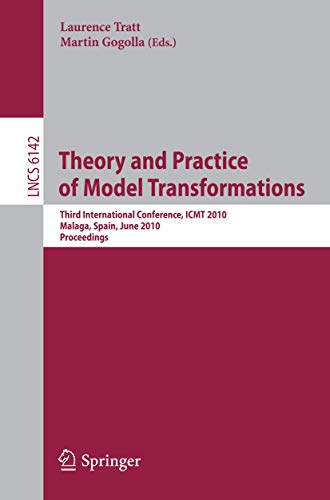
Theory and Practice of Model Transformations: Third International Conference, ICMT 2010, Malaga, Spain, June 28-July 2, 2010. Proceedings (Lecture Notes in Computer Science)
Librería: medimops, Berlin, Alemania
Calificación del vendedor: 5 de 5 estrellas

EUR 9,95
Envío por EUR 15,00
Se envía de Alemania a Estados Unidos de AmericaCantidad disponible: 1 disponibles
Añadir al carritoCondición: good. Befriedigend/Good: Durchschnittlich erhaltenes Buch bzw. Schutzumschlag mit Gebrauchsspuren, aber vollständigen Seiten. / Describes the average WORN book or dust jacket that has all the pages present.
-
Theory and Practice of Model Transformations (Paperback)
Idioma: Inglés
Publicado por Springer-Verlag Berlin and Heidelberg GmbH & Co. KG, Berlin, 2010
ISBN 10: 3642136877 ISBN 13: 9783642136870
Librería: Grand Eagle Retail, Bensenville, IL, Estados Unidos de America
Calificación del vendedor: 5 de 5 estrellas
EUR 67,25
Gastos de envío gratis
Se envía dentro de Estados Unidos de AmericaCantidad disponible: 1 disponibles
Añadir al carritoPaperback. Condición: new. Paperback. Model transformations are the glue that tie modelling activities together. If youve used modelling in anger then, whether you know it or not, youve used model transformations. They come in all shapes and sizes from moving models between di?erent tools to generating implementations. Model transformations have humble beginningsat one point, not long ago, it was said by many in the know that the way forward in model transformations was to use XSLT. That this idea now raises a wry smile shows how far the model transformation community has come in a short time. Where once model transformations were hacked together in a variety of unsuitable languages, we now have a number of powerful, dedicated languages and theories at our disposal. Since 2008, the ICMT conference series has played a huge part in advancing the subject, and this third edition was no di?erent. The theories and languages presented at ICMT have allowed principled model transformations to play an ever greater part in real systems. Of course there is still much more to do: we need our model transformations, languages, and theories to scale further, allow greater expressivity, be more ?exible, and aid reusability; and we lack empirically backed studies of model transformations in use. Doubtless you can think of other gaps. Yet, though some real-world challenges lie just beyond our reach,eachyearseesonce-dauntingproblemsconquered.Muchofthatprogressis nowdriven byICMT, andthis yearsedition showedhow model transformations are increasingly being used in previously unfamiliar areas. Model transformations are the glue that tie modelling activities together. Model transformations have humble beginningsat one point, not long ago, it was said by many in the know that the way forward in model transformations was to use XSLT. Shipping may be from multiple locations in the US or from the UK, depending on stock availability.
-
Theory and Practice of Model Transformations: Third International Conference, Icmt 2010 Malaga, Spain, June 28-july 2, 2010, Proceedings
Idioma: Inglés
Publicado por Springer-Verlag New York Inc, 2010
ISBN 10: 3642136877 ISBN 13: 9783642136870
Librería: Revaluation Books, Exeter, Reino Unido
Calificación del vendedor: 5 de 5 estrellas
EUR 79,03
Envío por EUR 14,44
Se envía de Reino Unido a Estados Unidos de AmericaCantidad disponible: 2 disponibles
Añadir al carritoPaperback. Condición: Brand New. 275 pages. 9.25x6.25x0.75 inches. In Stock.
-

Theory and Practice of Model Transformations
Idioma: Inglés
Publicado por Springer Berlin Heidelberg, 2010
ISBN 10: 3642136877 ISBN 13: 9783642136870
Librería: moluna, Greven, Alemania
Calificación del vendedor: 4 de 5 estrellas

EUR 64,08
Envío por EUR 48,99
Se envía de Alemania a Estados Unidos de AmericaCantidad disponible: 3 disponibles
Añadir al carritoCondición: New.
-
Theory and Practice of Model Transformations : Third International Conference, ICMT 2010, Malaga, Spain, June 28-July 2, 2010. Proceedings
Librería: Buchpark, Trebbin, Alemania
Calificación del vendedor: 5 de 5 estrellas
EUR 12,42
Envío por EUR 105,00
Se envía de Alemania a Estados Unidos de AmericaCantidad disponible: 1 disponibles
Añadir al carritoCondición: Sehr gut. Zustand: Sehr gut | Seiten: 275 | Sprache: Englisch | Produktart: Bücher | Keine Beschreibung verfügbar.
-

Theory and Practice of Model Transformations : Third International Conference, ICMT 2010, Malaga, Spain, June 28-July 2, 2010. Proceedings
Idioma: Inglés
Publicado por Springer, Berlin, Springer, 2010
ISBN 10: 3642136877 ISBN 13: 9783642136870
Librería: AHA-BUCH GmbH, Einbeck, Alemania
Calificación del vendedor: 5 de 5 estrellas
EUR 79,32
Envío por EUR 63,18
Se envía de Alemania a Estados Unidos de AmericaCantidad disponible: 2 disponibles
Añadir al carritoTaschenbuch. Condición: Neu. Neuware - Model transformations are the glue that tie modelling activities together. If you've used modelling in anger then, whether you know it or not, you've used model transformations. They come in all shapes and sizes from moving models between di erent tools to generating implementations. Model transformations have humble beginnings-at one point, not long ago, it was said by many 'in the know' that the way forward in model transformations was to use XSLT. That this idea now raises a wry smile shows how far the model transformation community has come in a short time. Where once model transformations were hacked together in a variety of unsuitable languages, we now have a number of powerful, dedicated languages and theories at our disposal. Since 2008, the ICMT conference series has played a huge part in advancing the subject, and this third edition was no di erent. The theories and languages presented at ICMT have allowed principled model transformations to play an ever greater part in real systems. Of course there is still much more to do: we need our model transformations, languages, and theories to scale further, allow greater expressivity, be more exible, and aid reusability; and we lack empirically backed studies of model transformations in use. Doubtless you can think of other gaps. Yet, though some real-world challenges lie just beyond our reach,eachyearseesonce-dauntingproblemsconquered.Muchofthatprogress is nowdriven byICMT, andthis year'sedition showedhow model transformations are increasingly being used in previously unfamiliar areas.

