

Importe total (1 artículo artículos):
Destino del pedido:

kalf george (28 resultados)
Ir a los resultados principales
Filtros de búsqueda
Tipo de artículo
- Todos los tipos de productos
- Libros (28)
- Revistas y publicaciones (No hay ningún otro resultado que coincida con este filtro.)
- Cómics (No hay ningún otro resultado que coincida con este filtro.)
- Partituras (No hay ningún otro resultado que coincida con este filtro.)
- Arte, grabados y pósters (No hay ningún otro resultado que coincida con este filtro.)
- Fotografías (No hay ningún otro resultado que coincida con este filtro.)
- Mapas (No hay ningún otro resultado que coincida con este filtro.)
- Manuscritos y coleccionismo de papel (No hay ningún otro resultado que coincida con este filtro.)
Condición Más información
- Nuevo (22)
- Como nuevo, Excelente o Muy bueno (5)
- Bueno o Aceptable (1)
- Regular o Pobre (No hay ningún otro resultado que coincida con este filtro.)
- Tal como se indica (No hay ningún otro resultado que coincida con este filtro.)
Encuadernación
Más atributos
- Primera edición (No hay ningún otro resultado que coincida con este filtro.)
- Firmado (No hay ningún otro resultado que coincida con este filtro.)
- Sobrecubierta (4)
- Con imágenes (18)
- No impresión bajo demanda (18)
Idioma (1)
Gastos de envío gratis
Ubicación del vendedor
Valoración de los vendedores
-
![Imagen de archivo de Biological Reactive Intermediates V: Basic Mechanistic Research in Toxicology and Human Risk Assessment [Advances in Experimental Medicine and Biology, Volume 387] a la venta por Tiber Books](https://pictures.abebooks.com/isbn/9780306451973-es-300.jpg)
Biological Reactive Intermediates V: Basic Mechanistic Research in Toxicology and Human Risk Assessment [Advances in Experimental Medicine and Biology, Volume 387]
Idioma: Inglés
Publicado por Plenum Press, New York., 1996
ISBN 10: 0306451972 ISBN 13: 9780306451973
Librería: Tiber Books, Cockeysville, MD, Estados Unidos de America
Calificación del vendedor: 5 de 5 estrellas

EUR 19,60
Envío por EUR 4,75
Se envía dentro de Estados Unidos de AmericaCantidad disponible: 1 disponibles
Añadir al carritoHardcover. Condición: Very Good. 8vo, hardcover. No dj. Vg condition. Non-circulating ex-lib copy w/ light markings to opening, top text-block edge stamped; contents bright & clean, binding tight; rear cover lightly smudged. xiv, 461 p., illus. Proceedings of the Fifth International Symposium on Biological Reactive Intermediates, held January 4-8, 1995, in Munich, Germany.
-
Biological Reactive Intermediates IV : Molecular and Cellular Effects and Their Impact on Human Health
Librería: GreatBookPrices, Columbia, MD, Estados Unidos de America
Calificación del vendedor: 5 de 5 estrellas
EUR 115,24
Envío por EUR 2,28
Se envía dentro de Estados Unidos de AmericaCantidad disponible: Más de 20 disponibles
Añadir al carritoCondición: New.
-

Biological Reactive Intermediates IV: Molecular and Cellular Effects and Their Impact on Human Health (Advances in Experimental Medicine and Biology, 283)
Librería: California Books, Miami, FL, Estados Unidos de America
Calificación del vendedor: 5 de 5 estrellas
EUR 117,60
Gastos de envío gratis
Se envía dentro de Estados Unidos de AmericaCantidad disponible: Más de 20 disponibles
Añadir al carritoCondición: New.
-
Biological Reactive Intermediates IV: Molecular and Cellular Effects and Their Impact on Human Health (Advances in Experimental Medicine and Biology, 283)
Librería: Ria Christie Collections, Uxbridge, Reino Unido
Calificación del vendedor: 5 de 5 estrellas
EUR 112,01
Envío por EUR 13,82
Se envía de Reino Unido a Estados Unidos de AmericaCantidad disponible: Más de 20 disponibles
Añadir al carritoCondición: New. In.
-

Biological Reactive Intermediates IV : Molecular and Cellular Effects and Their Impact on Human Health
Librería: GreatBookPricesUK, Woodford Green, Reino Unido
Calificación del vendedor: 5 de 5 estrellas
EUR 112,00
Envío por EUR 17,30
Se envía de Reino Unido a Estados Unidos de AmericaCantidad disponible: Más de 20 disponibles
Añadir al carritoCondición: New.
-
Biological Reactive Intermediates IV | Molecular and Cellular Effects and Their Impact on Human Health
Librería: preigu, Osnabrück, Alemania
Calificación del vendedor: 5 de 5 estrellas
EUR 95,70
Envío por EUR 70,00
Se envía de Alemania a Estados Unidos de AmericaCantidad disponible: 5 disponibles
Añadir al carritoTaschenbuch. Condición: Neu. Biological Reactive Intermediates IV | Molecular and Cellular Effects and Their Impact on Human Health | Charlotte M. Witmer (u. a.) | Taschenbuch | 912 S. | Englisch | 2012 | Springer | EAN 9781468458794 | Verantwortliche Person für die EU: Springer Verlag GmbH, Tiergartenstr. 17, 69121 Heidelberg, juergen[dot]hartmann[at]springer[dot]com | Anbieter: preigu.
-

Biological Reactive Intermediates IV
Idioma: Inglés
Publicado por Springer US, Springer New York Jul 2012, 2012
ISBN 10: 1468458795 ISBN 13: 9781468458794
Librería: buchversandmimpf2000, Emtmannsberg, BAYE, Alemania
Calificación del vendedor: 5 de 5 estrellas
EUR 106,99
Envío por EUR 60,00
Se envía de Alemania a Estados Unidos de AmericaCantidad disponible: 2 disponibles
Añadir al carritoTaschenbuch. Condición: Neu. Neuware -The finding that chemicals can be metabolically activated to yield reactive chemical species capable of covalently binding to cellular macromolecules and the concept that these reactions could initiate toxicological and carcinogenic events stimulated a meeting by a small group of toxicologists at the University of Turku, in Finland, in 1975 (Jollow et al. , 1977). The growing interest in this field of research led to subsequent symposia at the University of Surrey, in England in 1980 (Snyder et al. , 1982), and the University of Maryland in the U. S. A. in 1985 (Kocsis et al. , 1986). The Fourth International Symposium on Biological Reactive Intermediates was hosted by the Center for Toxicology at the University of Arizona and convened in Tucson, Arizona, January 14-17, 1990. Over 300 people attended. There were 60 platform presentations by invited speakers, and 96 volunteer communications in the form of posters were offered. These meetings have grown from a small group of scientists working in closely related areas to a major international series of symposia which convene every five years to review, and place in context, the latest advances in our understanding of the formation, fate and consequences of biological reactive intermediates. The Organizing Committee: Allan H. Conney, Robert Snyder (Co-chairman), and Charlotte M. Witmer (Rutgers University, Piscataway, NJ), David J. Jollow Co chairman) (Medical University, South Carolina, Charleston, SC), 1. Glenn Sipes (Co chairman) (University of Arizona, Tucson, AZ), James J. Kocsis and George F.Springer Verlag GmbH, Tiergartenstr. 17, 69121 Heidelberg 916 pp. Englisch.
-
Biological Reactive Intermediates IV : Molecular and Cellular Effects and Their Impact on Human Health
Librería: Buchpark, Trebbin, Alemania
Calificación del vendedor: 5 de 5 estrellas
OportunidadEUR 72,24
Envío por EUR 105,00
Se envía de Alemania a Estados Unidos de AmericaCantidad disponible: 1 disponibles
Añadir al carritoCondición: Sehr gut. Zustand: Sehr gut | Seiten: 916 | Sprache: Englisch | Produktart: Bücher | The finding that chemicals can be metabolically activated to yield reactive chemical species capable of covalently binding to cellular macromolecules and the concept that these reactions could initiate toxicological and carcinogenic events stimulated a meeting by a small group of toxicologists at the University of Turku, in Finland, in 1975 (Jollow et al. , 1977). The growing interest in this field of research led to subsequent symposia at the University of Surrey, in England in 1980 (Snyder et al. , 1982), and the University of Maryland in the U. S. A. in 1985 (Kocsis et al. , 1986). The Fourth International Symposium on Biological Reactive Intermediates was hosted by the Center for Toxicology at the University of Arizona and convened in Tucson, Arizona, January 14-17, 1990. Over 300 people attended. There were 60 platform presentations by invited speakers, and 96 volunteer communications in the form of posters were offered. These meetings have grown from a small group of scientists working in closely related areas to a major international series of symposia which convene every five years to review, and place in context, the latest advances in our understanding of the formation, fate and consequences of biological reactive intermediates. The Organizing Committee: Allan H. Conney, Robert Snyder (Co-chairman), and Charlotte M. Witmer (Rutgers University, Piscataway, NJ), David J. Jollow Co chairman) (Medical University, South Carolina, Charleston, SC), 1. Glenn Sipes (Co chairman) (University of Arizona, Tucson, AZ), James J. Kocsis and George F.
-
Biological Reactive Intermediates IV: Molecular and Cellular Effects and Their Impact on Human Health
Librería: Revaluation Books, Exeter, Reino Unido
Calificación del vendedor: 5 de 5 estrellas
EUR 164,42
Envío por EUR 23,06
Se envía de Reino Unido a Estados Unidos de AmericaCantidad disponible: 2 disponibles
Añadir al carritoPaperback. Condición: Brand New. reprint edition. 912 pages. 9.61x6.69x1.81 inches. In Stock.
-
Biological Reactive Intermediates IV : Molecular and Cellular Effects and Their Impact on Human Health
Idioma: Inglés
Publicado por Springer US, Springer New York, 2012
ISBN 10: 1468458795 ISBN 13: 9781468458794
Librería: AHA-BUCH GmbH, Einbeck, Alemania
Calificación del vendedor: 5 de 5 estrellas
EUR 116,27
Envío por EUR 67,73
Se envía de Alemania a Estados Unidos de AmericaCantidad disponible: 1 disponibles
Añadir al carritoTaschenbuch. Condición: Neu. Druck auf Anfrage Neuware - Printed after ordering - The finding that chemicals can be metabolically activated to yield reactive chemical species capable of covalently binding to cellular macromolecules and the concept that these reactions could initiate toxicological and carcinogenic events stimulated a meeting by a small group of toxicologists at the University of Turku, in Finland, in 1975 (Jollow et al. , 1977). The growing interest in this field of research led to subsequent symposia at the University of Surrey, in England in 1980 (Snyder et al. , 1982), and the University of Maryland in the U. S. A. in 1985 (Kocsis et al. , 1986). The Fourth International Symposium on Biological Reactive Intermediates was hosted by the Center for Toxicology at the University of Arizona and convened in Tucson, Arizona, January 14-17, 1990. Over 300 people attended. There were 60 platform presentations by invited speakers, and 96 volunteer communications in the form of posters were offered. These meetings have grown from a small group of scientists working in closely related areas to a major international series of symposia which convene every five years to review, and place in context, the latest advances in our understanding of the formation, fate and consequences of biological reactive intermediates. The Organizing Committee: Allan H. Conney, Robert Snyder (Co-chairman), and Charlotte M. Witmer (Rutgers University, Piscataway, NJ), David J. Jollow Co chairman) (Medical University, South Carolina, Charleston, SC), 1. Glenn Sipes (Co chairman) (University of Arizona, Tucson, AZ), James J. Kocsis and George F.
-

Biological Reactive Intermediates IV : Molecular and Cellular Effects and Their Impact on Human Health
Librería: GreatBookPricesUK, Woodford Green, Reino Unido
Calificación del vendedor: 5 de 5 estrellas
EUR 201,92
Envío por EUR 17,30
Se envía de Reino Unido a Estados Unidos de AmericaCantidad disponible: Más de 20 disponibles
Añadir al carritoCondición: As New. Unread book in perfect condition.
-
Biological Reactive Intermediates IV: Molecular and Cellular Effects and Their Impact on Human Health (Advances in Experimental Medicine and Biology, 283)
Librería: Mispah books, Redhill, SURRE, Reino Unido
Calificación del vendedor: 4 de 5 estrellas

EUR 192,43
Envío por EUR 28,83
Se envía de Reino Unido a Estados Unidos de AmericaCantidad disponible: 1 disponibles
Añadir al carritoPaperback. Condición: Like New. Like New. book.
-
Biological Reactive Intermediates IV : Molecular and Cellular Effects and Their Impact on Human Health
Librería: GreatBookPrices, Columbia, MD, Estados Unidos de America
Calificación del vendedor: 5 de 5 estrellas
EUR 225,60
Envío por EUR 2,28
Se envía dentro de Estados Unidos de AmericaCantidad disponible: Más de 20 disponibles
Añadir al carritoCondición: As New. Unread book in perfect condition.
-
Biological Reactive Intermediates V: Basic Mechanistic Research in Toxicology and Human Risk Assessment (Advances in Experimental Medicine and Biology, 387)
Librería: Ria Christie Collections, Uxbridge, Reino Unido
Calificación del vendedor: 5 de 5 estrellas
EUR 218,92
Envío por EUR 13,82
Se envía de Reino Unido a Estados Unidos de AmericaCantidad disponible: Más de 20 disponibles
Añadir al carritoCondición: New. In.
-

Biological Reactive Intermediates V: Basic Mechanistic Research in Toxicology and Human Risk Assessment (Advances in Experimental Medicine and Biology, 387)
Librería: Ria Christie Collections, Uxbridge, Reino Unido
Calificación del vendedor: 5 de 5 estrellas
EUR 218,92
Envío por EUR 13,82
Se envía de Reino Unido a Estados Unidos de AmericaCantidad disponible: Más de 20 disponibles
Añadir al carritoCondición: New. In.
-
Biological Reactive Intermediates V : Basic Mechanistic Research in Toxicology and Human Risk Assessment
Idioma: Inglés
Publicado por Springer US, Springer US, 2013
ISBN 10: 1475794827 ISBN 13: 9781475794823
Librería: AHA-BUCH GmbH, Einbeck, Alemania
Calificación del vendedor: 5 de 5 estrellas
EUR 223,11
Envío por EUR 63,58
Se envía de Alemania a Estados Unidos de AmericaCantidad disponible: 1 disponibles
Añadir al carritoTaschenbuch. Condición: Neu. Druck auf Anfrage Neuware - Printed after ordering - Much of organic chemistry is based on the ability of suitably structured chemicals to bind together through the formation of covalent bonds. Biochemistry is replete with exam ples of enzymatically catalyzed reactions in which normal body constituents can be linked through covalent bonds during the process of intermediary metabolism. The finding that xenobiotic chemicals that enter the body from the environment, are metabolized to highly reactive species, and then covalently react with cellular macromolecules to induce toxic and carcinogenic effects was an observation that spawned the research featured in the Fifth International Symposium on Biological Reactive Intermediates (BRI V). The group of investigators that became fascinated with this process and its signifi cance in terms of human health began their discussions in Turku, Finland (J 975), and continued them at Guildford, England (1980), College Park, Maryland (1985), Tucson, Arizona (1990), and Munich, Germany (1995). Among the results were a series of reports listed below, as well as the book for which this serves as the Preface. - Jollow, DJ., Kocsis, J.J., Snyder, R. and Vainio, H. (eds), Biological Reactive Intermediates: Formation, Toxicity and Inactivation, Plenum Press, NY, 1975. - Snyder, R., Park, D.V., Kocsis, J.J., Jollow, D.V., Gibson, G.G. and Witmer, C.M. (eds), Biological Reactive Intermediates II: Chemical Mechanisms and Biological Effects, Plenum Press, N.Y., 1982.
-
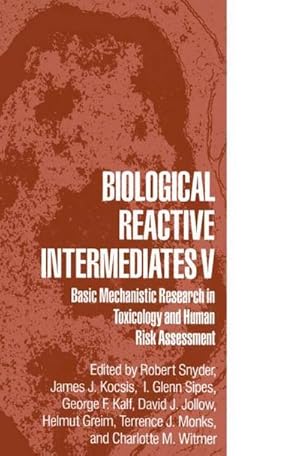
Biological Reactive Intermediates V : Basic Mechanistic Research in Toxicology and Human Risk Assessment
Idioma: Inglés
Publicado por Springer US, Springer US, 1996
ISBN 10: 0306451972 ISBN 13: 9780306451973
Librería: AHA-BUCH GmbH, Einbeck, Alemania
Calificación del vendedor: 5 de 5 estrellas
EUR 223,11
Envío por EUR 64,44
Se envía de Alemania a Estados Unidos de AmericaCantidad disponible: 1 disponibles
Añadir al carritoBuch. Condición: Neu. Druck auf Anfrage Neuware - Printed after ordering - Much of organic chemistry is based on the ability of suitably structured chemicals to bind together through the formation of covalent bonds. Biochemistry is replete with exam ples of enzymatically catalyzed reactions in which normal body constituents can be linked through covalent bonds during the process of intermediary metabolism. The finding that xenobiotic chemicals that enter the body from the environment, are metabolized to highly reactive species, and then covalently react with cellular macromolecules to induce toxic and carcinogenic effects was an observation that spawned the research featured in the Fifth International Symposium on Biological Reactive Intermediates (BRI V). The group of investigators that became fascinated with this process and its signifi cance in terms of human health began their discussions in Turku, Finland (J 975), and continued them at Guildford, England (1980), College Park, Maryland (1985), Tucson, Arizona (1990), and Munich, Germany (1995). Among the results were a series of reports listed below, as well as the book for which this serves as the Preface. - Jollow, DJ., Kocsis, J.J., Snyder, R. and Vainio, H. (eds), Biological Reactive Intermediates: Formation, Toxicity and Inactivation, Plenum Press, NY, 1975. - Snyder, R., Park, D.V., Kocsis, J.J., Jollow, D.V., Gibson, G.G. and Witmer, C.M. (eds), Biological Reactive Intermediates II: Chemical Mechanisms and Biological Effects, Plenum Press, N.Y., 1982.
-
Biological Reactive Intermediates V: Basic Mechanistic Research in Toxicology and Human Risk Assessment (Advances in Experimental Medicine and Biology, 387)
Librería: Mispah books, Redhill, SURRE, Reino Unido
Calificación del vendedor: 4 de 5 estrellas
EUR 334,97
Envío por EUR 28,83
Se envía de Reino Unido a Estados Unidos de AmericaCantidad disponible: 1 disponibles
Añadir al carritoHardcover. Condición: Like New. Like New. book.
-
Biological Reactive Intermediates IV (eng)
Librería: Brook Bookstore On Demand, Napoli, NA, Italia
Calificación del vendedor: 4 de 5 estrellas
EUR 86,24
Envío por EUR 13,50
Se envía de Italia a Estados Unidos de AmericaCantidad disponible: Más de 20 disponibles
Añadir al carritoCondición: new. Questo è un articolo print on demand.
-
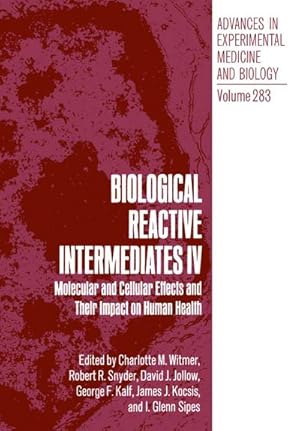
Biological Reactive Intermediates IV
Librería: BuchWeltWeit Ludwig Meier e.K., Bergisch Gladbach, Alemania
Calificación del vendedor: 5 de 5 estrellas
EUR 106,99
Envío por EUR 23,00
Se envía de Alemania a Estados Unidos de AmericaCantidad disponible: 2 disponibles
Añadir al carritoTaschenbuch. Condición: Neu. This item is printed on demand - it takes 3-4 days longer - Neuware -The finding that chemicals can be metabolically activated to yield reactive chemical species capable of covalently binding to cellular macromolecules and the concept that these reactions could initiate toxicological and carcinogenic events stimulated a meeting by a small group of toxicologists at the University of Turku, in Finland, in 1975 (Jollow et al. , 1977). The growing interest in this field of research led to subsequent symposia at the University of Surrey, in England in 1980 (Snyder et al. , 1982), and the University of Maryland in the U. S. A. in 1985 (Kocsis et al. , 1986). The Fourth International Symposium on Biological Reactive Intermediates was hosted by the Center for Toxicology at the University of Arizona and convened in Tucson, Arizona, January 14-17, 1990. Over 300 people attended. There were 60 platform presentations by invited speakers, and 96 volunteer communications in the form of posters were offered. These meetings have grown from a small group of scientists working in closely related areas to a major international series of symposia which convene every five years to review, and place in context, the latest advances in our understanding of the formation, fate and consequences of biological reactive intermediates. The Organizing Committee: Allan H. Conney, Robert Snyder (Co-chairman), and Charlotte M. Witmer (Rutgers University, Piscataway, NJ), David J. Jollow Co chairman) (Medical University, South Carolina, Charleston, SC), 1. Glenn Sipes (Co chairman) (University of Arizona, Tucson, AZ), James J. Kocsis and George F. 916 pp. Englisch.
-
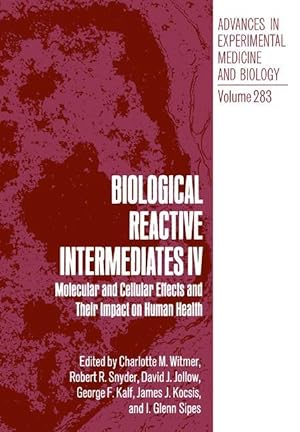
Biological Reactive Intermediates IV
Librería: moluna, Greven, Alemania
Calificación del vendedor: 4 de 5 estrellas
EUR 92,27
Envío por EUR 48,99
Se envía de Alemania a Estados Unidos de AmericaCantidad disponible: Más de 20 disponibles
Añadir al carritoCondición: New. Dieser Artikel ist ein Print on Demand Artikel und wird nach Ihrer Bestellung fuer Sie gedruckt. Proceedings of the Fourth International Symposium, held in Tucson, Arizona, January 14--17, 1990 The finding that chemicals can be metabolically activated to yield reactive chemical species capable of covalently binding to cellular macromolecules and t.
-
Biological Reactive Intermediates V
Librería: moluna, Greven, Alemania
Calificación del vendedor: 4 de 5 estrellas
EUR 180,07
Envío por EUR 48,99
Se envía de Alemania a Estados Unidos de AmericaCantidad disponible: Más de 20 disponibles
Añadir al carritoCondición: New. Dieser Artikel ist ein Print on Demand Artikel und wird nach Ihrer Bestellung fuer Sie gedruckt. Proceedings of the Fifth International Symposium held in Munich, Germany, January 4-8, 1995. Much of organic chemistry is based on the ability of suitably structured chemicals to bind together through the formation of covalent bonds. Biochemistry is re.
-
Biological Reactive Intermediates V
Librería: moluna, Greven, Alemania
Calificación del vendedor: 4 de 5 estrellas
EUR 180,07
Envío por EUR 48,99
Se envía de Alemania a Estados Unidos de AmericaCantidad disponible: Más de 20 disponibles
Añadir al carritoGebunden. Condición: New. Dieser Artikel ist ein Print on Demand Artikel und wird nach Ihrer Bestellung fuer Sie gedruckt. Proceedings of the Fifth International Symposium held in Munich, Germany, January 4-8, 1995. Much of organic chemistry is based on the ability of suitably structured chemicals to bind together through the formation of covalent bonds. Biochemistry is re.
-
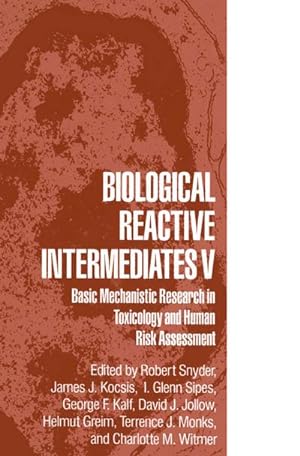
Biological Reactive Intermediates V
Librería: BuchWeltWeit Ludwig Meier e.K., Bergisch Gladbach, Alemania
Calificación del vendedor: 5 de 5 estrellas
EUR 213,99
Envío por EUR 23,00
Se envía de Alemania a Estados Unidos de AmericaCantidad disponible: 2 disponibles
Añadir al carritoBuch. Condición: Neu. This item is printed on demand - it takes 3-4 days longer - Neuware -Much of organic chemistry is based on the ability of suitably structured chemicals to bind together through the formation of covalent bonds. Biochemistry is replete with exam ples of enzymatically catalyzed reactions in which normal body constituents can be linked through covalent bonds during the process of intermediary metabolism. The finding that xenobiotic chemicals that enter the body from the environment, are metabolized to highly reactive species, and then covalently react with cellular macromolecules to induce toxic and carcinogenic effects was an observation that spawned the research featured in the Fifth International Symposium on Biological Reactive Intermediates (BRI V). The group of investigators that became fascinated with this process and its signifi cance in terms of human health began their discussions in Turku, Finland (J 975), and continued them at Guildford, England (1980), College Park, Maryland (1985), Tucson, Arizona (1990), and Munich, Germany (1995). Among the results were a series of reports listed below, as well as the book for which this serves as the Preface. - Jollow, DJ., Kocsis, J.J., Snyder, R. and Vainio, H. (eds), Biological Reactive Intermediates: Formation, Toxicity and Inactivation, Plenum Press, NY, 1975. - Snyder, R., Park, D.V., Kocsis, J.J., Jollow, D.V., Gibson, G.G. and Witmer, C.M. (eds), Biological Reactive Intermediates II: Chemical Mechanisms and Biological Effects, Plenum Press, N.Y., 1982. 484 pp. Englisch.
-
Biological Reactive Intermediates V | Basic Mechanistic Research in Toxicology and Human Risk Assessment
Librería: preigu, Osnabrück, Alemania
Calificación del vendedor: 5 de 5 estrellas
EUR 186,70
Envío por EUR 70,00
Se envía de Alemania a Estados Unidos de AmericaCantidad disponible: 5 disponibles
Añadir al carritoBuch. Condición: Neu. Biological Reactive Intermediates V | Basic Mechanistic Research in Toxicology and Human Risk Assessment | Robert R. Snyder (u. a.) | Buch | xiv | Englisch | 1996 | Springer US | EAN 9780306451973 | Verantwortliche Person für die EU: Springer Verlag GmbH, Tiergartenstr. 17, 69121 Heidelberg, juergen[dot]hartmann[at]springer[dot]com | Anbieter: preigu Print on Demand.
-

Biological Reactive Intermediates V
Idioma: Inglés
Publicado por Springer US, Springer US Jun 1996, 1996
ISBN 10: 0306451972 ISBN 13: 9780306451973
Librería: buchversandmimpf2000, Emtmannsberg, BAYE, Alemania
Calificación del vendedor: 5 de 5 estrellas
EUR 213,99
Envío por EUR 60,00
Se envía de Alemania a Estados Unidos de AmericaCantidad disponible: 1 disponibles
Añadir al carritoBuch. Condición: Neu. This item is printed on demand - Print on Demand Titel. Neuware -Much of organic chemistry is based on the ability of suitably structured chemicals to bind together through the formation of covalent bonds. Biochemistry is replete with exam ples of enzymatically catalyzed reactions in which normal body constituents can be linked through covalent bonds during the process of intermediary metabolism. The finding that xenobiotic chemicals that enter the body from the environment, are metabolized to highly reactive species, and then covalently react with cellular macromolecules to induce toxic and carcinogenic effects was an observation that spawned the research featured in the Fifth International Symposium on Biological Reactive Intermediates (BRI V). The group of investigators that became fascinated with this process and its signifi cance in terms of human health began their discussions in Turku, Finland (J 975), and continued them at Guildford, England (1980), College Park, Maryland (1985), Tucson, Arizona (1990), and Munich, Germany (1995). Among the results were a series of reports listed below, as well as the book for which this serves as the Preface. ¿ Jollow, DJ., Kocsis, J.J., Snyder, R. and Vainio, H. (eds), Biological Reactive Intermediates: Formation, Toxicity and Inactivation, Plenum Press, NY, 1975. ¿ Snyder, R., Park, D.V., Kocsis, J.J., Jollow, D.V., Gibson, G.G. and Witmer, C.M. (eds), Biological Reactive Intermediates II: Chemical Mechanisms and Biological Effects, Plenum Press, N.Y., 1982.Springer Verlag GmbH, Tiergartenstr. 17, 69121 Heidelberg 484 pp. Englisch.
-

Biological Reactive Intermediates V
Idioma: Inglés
Publicado por Springer US, Springer US Jun 2013, 2013
ISBN 10: 1475794827 ISBN 13: 9781475794823
Librería: buchversandmimpf2000, Emtmannsberg, BAYE, Alemania
Calificación del vendedor: 5 de 5 estrellas
EUR 213,99
Envío por EUR 60,00
Se envía de Alemania a Estados Unidos de AmericaCantidad disponible: 1 disponibles
Añadir al carritoTaschenbuch. Condición: Neu. This item is printed on demand - Print on Demand Titel. Neuware -Much of organic chemistry is based on the ability of suitably structured chemicals to bind together through the formation of covalent bonds. Biochemistry is replete with exam ples of enzymatically catalyzed reactions in which normal body constituents can be linked through covalent bonds during the process of intermediary metabolism. The finding that xenobiotic chemicals that enter the body from the environment, are metabolized to highly reactive species, and then covalently react with cellular macromolecules to induce toxic and carcinogenic effects was an observation that spawned the research featured in the Fifth International Symposium on Biological Reactive Intermediates (BRI V). The group of investigators that became fascinated with this process and its signifi cance in terms of human health began their discussions in Turku, Finland (J 975), and continued them at Guildford, England (1980), College Park, Maryland (1985), Tucson, Arizona (1990), and Munich, Germany (1995). Among the results were a series of reports listed below, as well as the book for which this serves as the Preface. ¿ Jollow, DJ., Kocsis, J.J., Snyder, R. and Vainio, H. (eds), Biological Reactive Intermediates: Formation, Toxicity and Inactivation, Plenum Press, NY, 1975. ¿ Snyder, R., Park, D.V., Kocsis, J.J., Jollow, D.V., Gibson, G.G. and Witmer, C.M. (eds), Biological Reactive Intermediates II: Chemical Mechanisms and Biological Effects, Plenum Press, N.Y., 1982.Springer Verlag GmbH, Tiergartenstr. 17, 69121 Heidelberg 476 pp. Englisch.
-
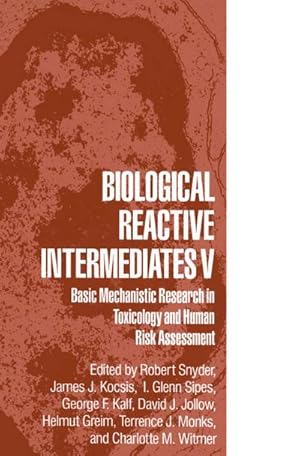
Biological Reactive Intermediates V
Librería: BuchWeltWeit Ludwig Meier e.K., Bergisch Gladbach, Alemania
Calificación del vendedor: 5 de 5 estrellas
EUR 266,43
Envío por EUR 23,00
Se envía de Alemania a Estados Unidos de AmericaCantidad disponible: 2 disponibles
Añadir al carritoTaschenbuch. Condición: Neu. This item is printed on demand - it takes 3-4 days longer - Neuware -Much of organic chemistry is based on the ability of suitably structured chemicals to bind together through the formation of covalent bonds. Biochemistry is replete with exam ples of enzymatically catalyzed reactions in which normal body constituents can be linked through covalent bonds during the process of intermediary metabolism. The finding that xenobiotic chemicals that enter the body from the environment, are metabolized to highly reactive species, and then covalently react with cellular macromolecules to induce toxic and carcinogenic effects was an observation that spawned the research featured in the Fifth International Symposium on Biological Reactive Intermediates (BRI V). The group of investigators that became fascinated with this process and its signifi cance in terms of human health began their discussions in Turku, Finland (J 975), and continued them at Guildford, England (1980), College Park, Maryland (1985), Tucson, Arizona (1990), and Munich, Germany (1995). Among the results were a series of reports listed below, as well as the book for which this serves as the Preface. - Jollow, DJ., Kocsis, J.J., Snyder, R. and Vainio, H. (eds), Biological Reactive Intermediates: Formation, Toxicity and Inactivation, Plenum Press, NY, 1975. - Snyder, R., Park, D.V., Kocsis, J.J., Jollow, D.V., Gibson, G.G. and Witmer, C.M. (eds), Biological Reactive Intermediates II: Chemical Mechanisms and Biological Effects, Plenum Press, N.Y., 1982. 476 pp. Englisch.


