

Importe total (1 artículo artículos):
Destino del pedido:

jeffrey mangum (19 resultados)
Ir a los resultados principales
Filtros de búsqueda
Tipo de artículo
- Todos los tipos de productos
- Libros (19)
- Revistas y publicaciones (No hay ningún otro resultado que coincida con este filtro.)
- Cómics (No hay ningún otro resultado que coincida con este filtro.)
- Partituras (No hay ningún otro resultado que coincida con este filtro.)
- Arte, grabados y pósters (No hay ningún otro resultado que coincida con este filtro.)
- Fotografías (No hay ningún otro resultado que coincida con este filtro.)
- Mapas (No hay ningún otro resultado que coincida con este filtro.)
- Manuscritos y coleccionismo de papel (No hay ningún otro resultado que coincida con este filtro.)
Condición Más información
- Nuevo (13)
- Como nuevo, Excelente o Muy bueno (No hay ningún otro resultado que coincida con este filtro.)
- Bueno o Aceptable (4)
- Regular o Pobre (No hay ningún otro resultado que coincida con este filtro.)
- Tal como se indica (2)
Encuadernación
Más atributos
- Primera edición (No hay ningún otro resultado que coincida con este filtro.)
- Firmado (No hay ningún otro resultado que coincida con este filtro.)
- Sobrecubierta (No hay ningún otro resultado que coincida con este filtro.)
- Con imágenes (11)
- No impresión bajo demanda (14)
Idioma (2)
Precio
- Cualquier precio
- Menos de EUR 20 (No hay ningún otro resultado que coincida con este filtro.)
- EUR 20 a EUR 40
- Más de EUR 40
Gastos de envío gratis
- Envío gratis a Estados Unidos de America (No hay ningún otro resultado que coincida con este filtro.)
Ubicación del vendedor
Valoración de los vendedores
-

Imaging at radio through submillimeter wavelengths. Proceedings of a meeting held at Loews Ventana Canyon Resort, Tucson, Arizona, USA, 6 - 9 June 1999.
Idioma: Inglés
Publicado por San Francisco, Astronomical Society of the Pacific, 2000
ISBN 13: 9791583810490
Librería: Antiquariat Bookfarm, Löbnitz, Alemania
Calificación del vendedor: 5 de 5 estrellas

EUR 22,50
Envío por EUR 40,00
Se envía de Alemania a Estados Unidos de AmericaCantidad disponible: 1 disponibles
Añadir al carritoHardcover. 382 S. Ehem. Bibliotheksexemplar mit Signatur und Stempel. GUTER Zustand, ein paar Gebrauchsspuren. Ex-library with stamp and library-signature. GOOD condition, some traces of use. L12534 9791583810490 Sprache: Englisch Gewicht in Gramm: 720.
-

CO Twenty-Five Years of Millimeter-Wave Spectroscopy
Librería: Isaiah Thomas Books & Prints, Inc., Cotuit, MA, Estados Unidos de America
Miembro de asociación: ABAA ILAB SNEAB
Calificación del vendedor: 2 de 5 estrellas

EUR 65,57
Envío por EUR 4,20
Se envía dentro de Estados Unidos de AmericaCantidad disponible: 1 disponibles
Añadir al carritoPaperback. Condición: Very Good. White wraps lightly edge worn, tips bumped. Clean, tight and unmarked interior.; 9.0 X 6.1 X 1.2 inches; 532 pages.
-

The Interstellar Medium in High Redshift Galaxies Comes of Age. Proceedings of a Symposium held at National Radio Astronomy Observatory, 13-15, September 2012. National Radio Astronomy Observatory Conference Series, Volume 28
Publicado por NRAO, 2013
Librería: Zubal-Books, Since 1961, Cleveland, OH, Estados Unidos de America
Calificación del vendedor: 5 de 5 estrellas
EUR 31,56
Envío por EUR 3,82
Se envía dentro de Estados Unidos de AmericaCantidad disponible: 1 disponibles
Añadir al carritoCondición: Very Good. *Price HAS BEEN REDUCED by 10% until Monday, April 20 (weekend SALE item)* 143 pp., Paperback, very good. - If you are reading this, this item is actually (physically) in our stock and ready for shipment once ordered. We are not bookjackers. Buyer is responsible for any additional duties, taxes, or fees required by recipient's country.
-

CO: Twenty-Five Years of Millimeter-Wave Spectroscopy
Librería: Solr Books, Lincolnwood, IL, Estados Unidos de America
Calificación del vendedor: 5 de 5 estrellas
EUR 87,43
Envío por EUR 6,77
Se envía dentro de Estados Unidos de AmericaCantidad disponible: 1 disponibles
Añadir al carritoCondición: very_good. This books is in Very good condition. There may be a few flaws like shelf wear and some light wear.
-

CO: Twenty-Five Years of Millimeter-Wave Spectroscopy (International Astronomical Union Symposia)
Librería: Bookmonger.Ltd, HILLSIDE, NJ, Estados Unidos de America
Calificación del vendedor: 5 de 5 estrellas
EUR 109,73
Envío por EUR 3,40
Se envía dentro de Estados Unidos de AmericaCantidad disponible: 2 disponibles
Añadir al carritoHardcover. Condición: Very Good.
-
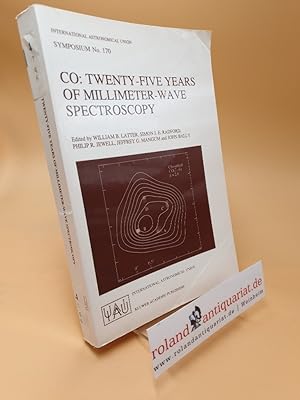
CO: Twenty-Five Years of Millimeter-Wave Spectroscopy ; Proceedings of the 170th Symposium of the International Astronomical Union, Held in Tucson, . Astronomical Union Symposia ; Band 170
Idioma: Inglés
Publicado por Kluwe Academix Publishers, 1997
ISBN 10: 0792342844 ISBN 13: 9780792342847
Librería: Roland Antiquariat UG haftungsbeschränkt, Weinheim, Alemania
Calificación del vendedor: 5 de 5 estrellas
EUR 99,60
Envío por EUR 14,95
Se envía de Alemania a Estados Unidos de AmericaCantidad disponible: 1 disponibles
Añadir al carritoSoftcover. 511 p. ATTENTION EDITION 1997!!! Good condition. Reading pages are clean and without markings. Slight signs of storage and use. Spine slightly light-margined. Binding slightly creased. Spine edge slightly bumped. Book corners slightly bumped. Book edges slightly stained. Otherwise a decent copy. 9780792342847 Sprache: Englisch Gewicht in Gramm: 748.
-
CO: Twenty-Five Years of Millimeter-Wave Spectroscopy
Librería: Ria Christie Collections, Uxbridge, Reino Unido
Calificación del vendedor: 5 de 5 estrellas
EUR 161,76
Envío por EUR 13,75
Se envía de Reino Unido a Estados Unidos de AmericaCantidad disponible: Más de 20 disponibles
Añadir al carritoCondición: New. In.
-

CO: Twenty-Five Years of Millimeter-Wave Spectroscopy : Proceedings of the 170th Symposium of the International Astronomical Union, Held in Tucson, Arizona, May 29-June 5, 1995
Librería: AHA-BUCH GmbH, Einbeck, Alemania
Calificación del vendedor: 5 de 5 estrellas
EUR 170,64
Envío por EUR 66,59
Se envía de Alemania a Estados Unidos de AmericaCantidad disponible: 1 disponibles
Añadir al carritoTaschenbuch. Condición: Neu. Druck auf Anfrage Neuware - Printed after ordering - Interstellar carbon monoxide (CO) was first detected in 1970 with the 36 foot diameter telescope of the National Radio Astronomy Observatory! on Kitt Peak in Southern Arizona. R. W. Wilson, K. B. Jefferts, and A. A. Penzias of Bell Labs reported, 'We have found intense 2.6 mm line radiation 2 from nine Galactic sources which we attribute to carbon monoxide.' Soon afterward, several other basic molecules were also observed in space. IAU Symposium 170, CO: Twenty Five Years of Millimeter Wave Spectroscopy, was organized to commemorate those discoveries. The Symposium reviewed the accomplishments of a quarter century of research on interstellar molec ular gas, surveyed the current state of millimeter-wave spectroscopy, and gave a glimpse of what the next 25 years might hold. Studies of interstellar CO have revolutionized our understanding of the phases and dynamics of the interstellar medium, the initial and final stages of stellar evolution, the chemistry of dense and diffuse interstellar matter and of the solar system, the structure of the Milky Way galaxy, and the content and structure of other galaxies, some very distant. Spectroscopic studies of CO and other molecules are primary tools for investigating all these topics, which are among the most fundamental and active research areas in astrophysics. New developments in instrumentation, including sev eral powerful new telescopes, continue to keep millimeter and submillimeter wavelength radio astronomy at the forefront of research.
-
CO: Twenty-Five Years of Millimeter-Wave Spectroscopy (International Astronomical Union Symposia)
Librería: Ria Christie Collections, Uxbridge, Reino Unido
Calificación del vendedor: 5 de 5 estrellas
EUR 245,86
Envío por EUR 13,75
Se envía de Reino Unido a Estados Unidos de AmericaCantidad disponible: Más de 20 disponibles
Añadir al carritoCondición: New. In.
-
CO
Librería: Books Puddle, New York, NY, Estados Unidos de America
Calificación del vendedor: 4 de 5 estrellas

EUR 281,35
Envío por EUR 3,39
Se envía dentro de Estados Unidos de AmericaCantidad disponible: 1 disponibles
Añadir al carritoCondición: New. pp. 532.
-
EUR 299,60
Envío por EUR 7,46
Se envía de Reino Unido a Estados Unidos de AmericaCantidad disponible: 1 disponibles
Añadir al carritoCondición: New. pp. 532 49:B&W 6.14 x 9.21 in or 234 x 156 mm (Royal 8vo) Perfect Bound on White w/Gloss Lam.
-

Co : Twenty-Five Years of Millimeter-Wave Spectroscopy
Librería: AHA-BUCH GmbH, Einbeck, Alemania
Calificación del vendedor: 5 de 5 estrellas
EUR 245,70
Envío por EUR 64,79
Se envía de Alemania a Estados Unidos de AmericaCantidad disponible: 2 disponibles
Añadir al carritoBuch. Condición: Neu. Druck auf Anfrage Neuware - Printed after ordering - Interstellar carbon monoxide (CO) was first detected in 1970 by R.W. Wilson, K.B. Jefferts, and A.A. Penzias through observations of its lowest rotational transition at 2.6 mm wavelength. This discovery opened the door to a profound new understanding of several diverse yet related fields, including the phases of the interstellar medium, the initial and final phases of stellar evolution, the chemistry of dense and diffuse interstellar matter and of the solar system, the structure of the Milky Way galaxy, and the content and structure of other galaxies. These are among the most fundamental research areas in astrophysics, and spectroscopic information about CO and other molecules serves as a primary tool of investigation. Continuing developments in instrumentation will further increase the power and utility of millimeter and submillimeter-wavelength molecular line spectroscopy. The twenty-fifth anniversary of the detection of CO was an opportunity for researchers from all branches of millimeter-wave astronomy to gather and review progress and future directions. These Proceedings discuss the state of the field and consider important unanswered questions.
-

CO: Twenty-Five Years of Millimeter-Wave Spectroscopy
Librería: moluna, Greven, Alemania
Calificación del vendedor: 4 de 5 estrellas
EUR 257,48
Envío por EUR 48,99
Se envía de Alemania a Estados Unidos de AmericaCantidad disponible: Más de 20 disponibles
Añadir al carritoCondición: New. Interstellar carbon monoxide (CO) was first detected in 1970 by R.W. Wilson, K.B. Jefferts, and A.A. Penzias through observations of its lowest rotational transition at 2.6 mm wavelength. This discovery opened the door to a profound new understanding of sev.
-
Co: Twenty-Five Years of Millimeter-Wave Spectroscopy : Proceedings of the 170th Symposium of the International Astronomical Unios, Held in Tucson, arizon
Librería: Revaluation Books, Exeter, Reino Unido
Calificación del vendedor: 5 de 5 estrellas
EUR 339,89
Envío por EUR 17,22
Se envía de Reino Unido a Estados Unidos de AmericaCantidad disponible: 2 disponibles
Añadir al carritoHardcover. Condición: Brand New. 532 pages. 9.75x6.75x1.25 inches. In Stock.
-
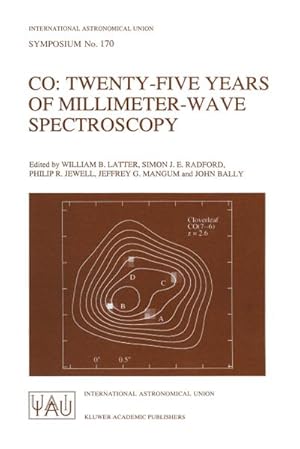
CO: Twenty-Five Years of Millimeter-Wave Spectroscopy
Idioma: Inglés
Publicado por Springer, Springer Dez 1996, 1996
ISBN 10: 0792342844 ISBN 13: 9780792342847
Librería: BuchWeltWeit Ludwig Meier e.K., Bergisch Gladbach, Alemania
Calificación del vendedor: 5 de 5 estrellas
EUR 160,49
Envío por EUR 23,00
Se envía de Alemania a Estados Unidos de AmericaCantidad disponible: 2 disponibles
Añadir al carritoTaschenbuch. Condición: Neu. This item is printed on demand - it takes 3-4 days longer - Neuware -Interstellar carbon monoxide (CO) was first detected in 1970 with the 36 foot diameter telescope of the National Radio Astronomy Observatory! on Kitt Peak in Southern Arizona. R. W. Wilson, K. B. Jefferts, and A. A. Penzias of Bell Labs reported, 'We have found intense 2.6 mm line radiation 2 from nine Galactic sources which we attribute to carbon monoxide.' Soon afterward, several other basic molecules were also observed in space. IAU Symposium 170, CO: Twenty Five Years of Millimeter Wave Spectroscopy, was organized to commemorate those discoveries. The Symposium reviewed the accomplishments of a quarter century of research on interstellar molec ular gas, surveyed the current state of millimeter-wave spectroscopy, and gave a glimpse of what the next 25 years might hold. Studies of interstellar CO have revolutionized our understanding of the phases and dynamics of the interstellar medium, the initial and final stages of stellar evolution, the chemistry of dense and diffuse interstellar matter and of the solar system, the structure of the Milky Way galaxy, and the content and structure of other galaxies, some very distant. Spectroscopic studies of CO and other molecules are primary tools for investigating all these topics, which are among the most fundamental and active research areas in astrophysics. New developments in instrumentation, including sev eral powerful new telescopes, continue to keep millimeter and submillimeter wavelength radio astronomy at the forefront of research. 532 pp. Englisch.
-

CO: Twenty-Five Years of Millimeter-Wave Spectroscopy
Librería: moluna, Greven, Alemania
Calificación del vendedor: 4 de 5 estrellas
EUR 136,16
Envío por EUR 48,99
Se envía de Alemania a Estados Unidos de AmericaCantidad disponible: Más de 20 disponibles
Añadir al carritoCondición: New. Dieser Artikel ist ein Print on Demand Artikel und wird nach Ihrer Bestellung fuer Sie gedruckt. Proceedings of the 170th Symposium of the International Astronomical Union, held in Tucson, Arizona, May 29-June 5, 1995 Interstellar carbon monoxide (CO) was first detected in 1970 with the 36 foot diameter telescope of the National Radio Astrono.
-
CO: Twenty-Five Years of Millimeter-Wave Spectroscopy | Proceedings of the 170th Symposium of the International Astronomical Union, Held in Tucson, Arizona, May 29-June 5, 1995
Librería: preigu, Osnabrück, Alemania
Calificación del vendedor: 5 de 5 estrellas
EUR 141,20
Envío por EUR 70,00
Se envía de Alemania a Estados Unidos de AmericaCantidad disponible: 5 disponibles
Añadir al carritoTaschenbuch. Condición: Neu. CO: Twenty-Five Years of Millimeter-Wave Spectroscopy | Proceedings of the 170th Symposium of the International Astronomical Union, Held in Tucson, Arizona, May 29-June 5, 1995 | William B. Latter (u. a.) | Taschenbuch | xvii | Englisch | 1996 | Springer | EAN 9780792342847 | Verantwortliche Person für die EU: Springer Verlag GmbH, Tiergartenstr. 17, 69121 Heidelberg, juergen[dot]hartmann[at]springer[dot]com | Anbieter: preigu Print on Demand.
-

Co: Twenty-Five Years of Millimeter-Wave Spectroscopy
Idioma: Inglés
Publicado por Springer Netherlands, Springer Netherlands Dez 1996, 1996
ISBN 10: 0792342844 ISBN 13: 9780792342847
Librería: buchversandmimpf2000, Emtmannsberg, BAYE, Alemania
Calificación del vendedor: 5 de 5 estrellas
EUR 160,49
Envío por EUR 60,00
Se envía de Alemania a Estados Unidos de AmericaCantidad disponible: 1 disponibles
Añadir al carritoTaschenbuch. Condición: Neu. This item is printed on demand - Print on Demand Titel. Neuware -Interstellar carbon monoxide (CO) was first detected in 1970 with the 36 foot diameter telescope of the National Radio Astronomy Observatory! on Kitt Peak in Southern Arizona. R. W. Wilson, K. B. Jefferts, and A. A. Penzias of Bell Labs reported, 'We have found intense 2.6 mm line radiation 2 from nine Galactic sources which we attribute to carbon monoxide.' Soon afterward, several other basic molecules were also observed in space. IAU Symposium 170, CO: Twenty Five Years of Millimeter Wave Spectroscopy, was organized to commemorate those discoveries. The Symposium reviewed the accomplishments of a quarter century of research on interstellar molec ular gas, surveyed the current state of millimeter-wave spectroscopy, and gave a glimpse of what the next 25 years might hold. Studies of interstellar CO have revolutionized our understanding of the phases and dynamics of the interstellar medium, the initial and final stages of stellar evolution, the chemistry of dense and diffuse interstellar matter and of the solar system, the structure of the Milky Way galaxy, and the content and structure of other galaxies, some very distant. Spectroscopic studies of CO and other molecules are primary tools for investigating all these topics, which are among the most fundamental and active research areas in astrophysics. New developments in instrumentation, including sev eral powerful new telescopes, continue to keep millimeter and submillimeter wavelength radio astronomy at the forefront of research.Springer Verlag GmbH, Tiergartenstr. 17, 69121 Heidelberg 532 pp. Englisch.
-
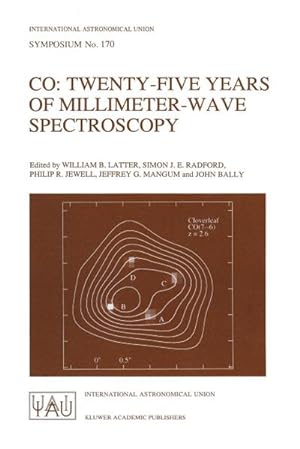
Co: Twenty-Five Years of Millimeter-Wave Spectroscopy
Idioma: Inglés
Publicado por SPRINGER NATURE Dez 1996, 1996
ISBN 10: 0792342836 ISBN 13: 9780792342830
Librería: BuchWeltWeit Ludwig Meier e.K., Bergisch Gladbach, Alemania
Calificación del vendedor: 5 de 5 estrellas
EUR 234,33
Envío por EUR 23,00
Se envía de Alemania a Estados Unidos de AmericaCantidad disponible: 2 disponibles
Añadir al carritoBuch. Condición: Neu. This item is printed on demand - it takes 3-4 days longer - Neuware -Interstellar carbon monoxide (CO) was first detected in 1970 by R.W. Wilson, K.B. Jefferts, and A.A. Penzias through observations of its lowest rotational transition at 2.6 mm wavelength. This discovery opened the door to a profound new understanding of several diverse yet related fields, including the phases of the interstellar medium, the initial and final phases of stellar evolution, the chemistry of dense and diffuse interstellar matter and of the solar system, the structure of the Milky Way galaxy, and the content and structure of other galaxies. These are among the most fundamental research areas in astrophysics, and spectroscopic information about CO and other molecules serves as a primary tool of investigation. Continuing developments in instrumentation will further increase the power and utility of millimeter and submillimeter-wavelength molecular line spectroscopy. The twenty-fifth anniversary of the detection of CO was an opportunity for researchers from all branches of millimeter-wave astronomy to gather and review progress and future directions. These Proceedings discuss the state of the field and consider important unanswered questions. 532 pp. Englisch.


