

Importe total (1 artículo artículos):
Destino del pedido:

iosif brodsky (20 resultados)
Ir a los resultados principales
Filtros de búsqueda
Tipo de artículo
- Todos los tipos de productos
- Libros (20)
- Revistas y publicaciones (No hay ningún otro resultado que coincida con este filtro.)
- Cómics (No hay ningún otro resultado que coincida con este filtro.)
- Partituras (No hay ningún otro resultado que coincida con este filtro.)
- Arte, grabados y pósters (No hay ningún otro resultado que coincida con este filtro.)
- Fotografías (No hay ningún otro resultado que coincida con este filtro.)
- Mapas (No hay ningún otro resultado que coincida con este filtro.)
- Manuscritos y coleccionismo de papel (No hay ningún otro resultado que coincida con este filtro.)
Condición Más información
- Nuevo (4)
- Como nuevo, Excelente o Muy bueno (5)
- Bueno o Aceptable (7)
- Regular o Pobre (No hay ningún otro resultado que coincida con este filtro.)
- Tal como se indica (4)
Encuadernación
Más atributos
Idioma (7)
Gastos de envío gratis
- Envío gratis a Estados Unidos de America (No hay ningún otro resultado que coincida con este filtro.)
Ubicación del vendedor
Valoración de los vendedores
-
Sochineniya Iosifa Brodskogo VI
Librería: Bookbot, Prague, Republica Checa
Calificación del vendedor: 5 de 5 estrellas

EUR 3,80
Envío por EUR 20,99
Se envía de Republica Checa a Estados Unidos de AmericaCantidad disponible: 1 disponibles
Añadir al carritoHardcover. Condición: Fine. Leichte Risse. Shestoi tom vpervye polnostyu vosproizvodit na russkom yazyke knigu esse I.Brodskogo "On Grief and Reason" (N.Y, 1995), sostavlennuyu samim avtorom. Vse esse -- krome dvuh -- v originale napisany po-angliiski.Posle smerti poeta pravo na izdanie predostavleno "Fondom Nasledstvennogo Imushchestva Iosifa Brodskogo".
-

To Urania: Selected Poems, 1965-85 (Penguin International Poets)
Idioma: Inglés
Publicado por Penguin Books Ltd, London, 1988
ISBN 10: 014058580X ISBN 13: 9780140585803
Librería: Caffrey Books, Oundle, Reino Unido
Calificación del vendedor: 4 de 5 estrellas

EUR 5,92
Envío por EUR 28,75
Se envía de Reino Unido a Estados Unidos de AmericaCantidad disponible: 1 disponibles
Añadir al carritoSoft cover. Condición: Very Good. Tanning to edges - commentary on the quality of paper Penguin chose for the book.
-
Fondamenta Degli Incurabili (Italian Edition)
Librería: Approximations, Ottawa, ON, Canada
Calificación del vendedor: 5 de 5 estrellas
EUR 8,68
Envío por EUR 11,80
Se envía de Canada a Estados Unidos de AmericaCantidad disponible: 1 disponibles
Añadir al carritoSoft cover. Condición: Very Good. Small trade paperback (12mo.) with French flaps. Reprint, 2006. Few light signs of prior handling. Translated by Gilberto Forti. 108pp.
-

La laguna di Venezia
Librería: libreriauniversitaria.it, Occhiobello, RO, Italia
Calificación del vendedor: 4 de 5 estrellas
EUR 11,87
Envío por EUR 17,95
Se envía de Italia a Estados Unidos de AmericaCantidad disponible: 2 disponibles
Añadir al carritoCondición: NEW.
-

Joseph Brodsky | Selected Poems (Penguin Modern European Poets Series)
Publicado por Published by Penguin Books Ltd., Harmondsworth, Middlesex First Penguin Edition . 1973., 1973
Librería: Little Stour Books PBFA Member, Canterbury, Reino Unido
Miembro de asociación: PBFA
Calificación del vendedor: 5 de 5 estrellas
EUR 7,11
Envío por EUR 28,75
Se envía de Reino Unido a Estados Unidos de AmericaCantidad disponible: 1 disponibles
Añadir al carritoMass market paperback in publisher's original colour illustrated card wrap covers (soft back). 8vo. 8'' x 5''. Contains 168 pp. Tanning to the page margins and in Good condition, no dust wrapper as issued. Member of the P.B.F.A. RUSSIAN [Literature].
-

EUR 22,38
Envío por EUR 14,95
Se envía de Holanda a Estados Unidos de AmericaCantidad disponible: 1 disponibles
Añadir al carritoCondición: Very good.
-

La ballata del piccolo rimorchiatore
Librería: libreriauniversitaria.it, Occhiobello, RO, Italia
Calificación del vendedor: 4 de 5 estrellas
EUR 17,10
Envío por EUR 17,95
Se envía de Italia a Estados Unidos de AmericaCantidad disponible: 1 disponibles
Añadir al carritoCondición: NEW. Igor' Olejnikov Ilustrador.
-

Revista de Occidente, Año 2012, nº 374_375, El secreto:: Sentidos y estrategias del secreto: presentación; "Que no se a de descubrir el secreto"; Cuadrado de veridicción; Sentado está el Secreto; Lógica del secreto; Los regímenes semióticos del secreto; Tipología del secreto; El mundo descifrado; De la simulación y la disimulación; El secreto y el desafío; Ya el secreto salió a la luz; Secreto y poder; La obsesión de Mazzarino; La sociedad secreta; Tiempos de conspiradores; Papeles (falsos) de la Garduña; Las cinco clases de espías; Todos somos agentes dobles; El sello; La desinformación de los servicios secretos; Voy a callar su nombre; Domingo Malagón: artista falsificador; Cómo hacer que cualquier cosa signifique cualquier cosa; Reflexiones sobre Wikileaks; WikiLeaks: opacidad y transpa
Publicado por Revista de Occidente., 2012
Librería: Alcaná Libros, Madrid, M, España
Calificación del vendedor: 5 de 5 estrellas
EUR 3,90
Envío por EUR 40,00
Se envía de España a Estados Unidos de AmericaCantidad disponible: 1 disponibles
Añadir al carritotapa blanda. Condición: Bien. Civilización, progreso y cultura.(008) Revista de Occidente. Madrid. 2012. 20 cm. Encuadernación en tapa blanda de editorial ilustrada. (=3580205=) HH20.
-
EUR 31,95
Envío por EUR 14,95
Se envía de Holanda a Estados Unidos de AmericaCantidad disponible: 1 disponibles
Añadir al carritoCondición: Very good.
-

Maloe sobranie sochinenij. Stihotvorenija. Pjesa. Esse
Librería: medimops, Berlin, Alemania
Calificación del vendedor: 5 de 5 estrellas
EUR 26,35
Envío por EUR 15,00
Se envía de Alemania a Estados Unidos de AmericaCantidad disponible: 1 disponibles
Añadir al carritoCondición: very good. Gut/Very good: Buch bzw. Schutzumschlag mit wenigen Gebrauchsspuren an Einband, Schutzumschlag oder Seiten. / Describes a book or dust jacket that does show some signs of wear on either the binding, dust jacket or pages.
-
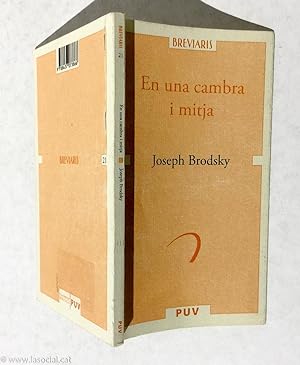
En una cambra i mitja
Idioma: Catalán
Publicado por Publicacions de la Universitat de València, 2013
ISBN 10: 8437073863 ISBN 13: 9788437073866
Librería: La Social. Galería y Libros, Barcelona, B, España
Calificación del vendedor: 5 de 5 estrellas
EUR 18,99
Envío por EUR 25,50
Se envía de España a Estados Unidos de AmericaCantidad disponible: 1 disponibles
Añadir al carritoTapa Blanda. Condición: Excelente. Colección "Brevaris" núm. 21. EXCELENTE ejemplar . 105pp + catálogo.
-
Poltory komnaty
Librería: Bookbot, Prague, Republica Checa
Calificación del vendedor: 5 de 5 estrellas
EUR 26,45
Envío por EUR 20,99
Se envía de Republica Checa a Estados Unidos de AmericaCantidad disponible: 1 disponibles
Añadir al carritoHardcover. Condición: Fine. Leichte Risse; Gebogener Buchrucken. "Poltory komnaty" - odno iz samyh izvestnyh esse I.Brodskogo v novom blestyashchem perevode s angl. M.Nemcova. Avtor vspominaet v nem o roditelyah, o svoem detstve i yunosti, o dome, gde on prozhil do nachala 1970-h godov i otkuda vynuzhden byl uehat v emigraciyu. Fotografii znamenitogo leningradskogo fotografa Borisa Smelova.
-

POEMAS DE NAVIDAD
Librería: Librerias Prometeo y Proteo, Malaga, MA, España
Calificación del vendedor: 2 de 5 estrellas

EUR 12,00
Envío por EUR 70,00
Se envía de España a Estados Unidos de AmericaCantidad disponible: 1 disponibles
Añadir al carritoRústica. Condición: New. Estado de la sobrecubierta: Nuevo. 1. LIBRO.
-

Maloe sobranie sochinenij. Stihotvorenija. Pjesa. Esse
Librería: moluna, Greven, Alemania
Calificación del vendedor: 4 de 5 estrellas
EUR 27,35
Envío por EUR 48,99
Se envía de Alemania a Estados Unidos de AmericaCantidad disponible: 1 disponibles
Añadir al carritoCondición: New. KlappentextrnrnJoseph Brodsky (geboren 24. Mai 1940 in Leningrad gestorben 28. Januar 1996 in New York) war ein russisch-US-amerikanischer Dichter und Nobelpreistraeger fuer Literatur. Brodsky ist in Leningrad als Sohn juedischer Eltern geboren un.
-

Stikhotvoreniya.
Publicado por Talinn, Eesti Raamat., 1991
Librería: Antiquariat J.J. Heckenhauer e.K., Tuebingen, Alemania
Miembro de asociación: ILAB VDA
Calificación del vendedor: 3 de 5 estrellas

Original o primera edición
EUR 150,00
Envío por EUR 39,00
Se envía de Alemania a Estados Unidos de AmericaCantidad disponible: 1 disponibles
Añadir al carrito8°. 255 pages. Original brochure. Good condition. Rare exile publication for the Russian market. Brodsky was a Russian and American poet and essayist. Born in Leningrad, he ran afoul of Soviet authorities and emigrated to the United States. Sprache: russisch.
-
A Stop in a Desert
Publicado por [Ardis, Ann Arbor,, 1972
Librería: PY Rare Books, London, Reino Unido
Miembro de asociación: ABA ILAB
Calificación del vendedor: 4 de 5 estrellas
Ejemplar firmado
EUR 1.125,24
Envío por EUR 23,00
Se envía de Reino Unido a Estados Unidos de AmericaCantidad disponible: 1 disponibles
Añadir al carritoPoetry on the wall - signed by the poet --- A scarce poetical poster, signed by the future Nobel Prize laureate and "the most popular Russian poet of the second half of the 20th century" (Shubinskii, our translation here and ). A very early US production of the poet and apparently Brodsky's first separate work to be printed by "the most important and legendary foreign publisher of Russian literature, the pinnacle of tamizdat history" (Oborin). Written in early 1966, the poem reflects on the destruction of a Greek church in Leningrad to make way for a concert hall marking the 50th anniversary of the October Revolution. Just a few months earlier, Joseph Brodsky (194096) had returned from exile in a labour camp, where he had been sent for "social parasitism." In 1972, he was forced out of his homeland and settled in the US, where, thanks to his close friends Carl and Ellendea Proffer, he became Poet in Residence at the University of Michigan. In 1971, the Proffers founded a small publishing house named "Ardis" in the basement of their Ann Arbor house, publishing banned Russian literature and, in doing so, "completely changed the map of Russian literature" (Oborin). Thanks to Ardis, works excluded from Soviet publishing became accessible to readers in both the West and the USSR. From 1977 onwards, Ardis published the majority of Brodsky's Russian poetry. After Carl Proffer's death in 1984, Brodsky remarked: "What Proffer did for Russian literature is comparable to Gutenberg's invention, for he brought back the printing press. By publishing in Russian and English works that were not destined to appear in print, he saved many Russian writers and poets from oblivion, distortion, neurosis, and despair. Moreover, he has changed the very climate of our literature" (quoted by Voronina). A very early professional collaboration between Brodsky and Ardis, this broadside-poster was apparently published in 1972, as catalogued by Harvard and other libraries. It features a rare translation by Jamie Fuller (b. 1945), previously printed in Ardis's Russian Literature Triquarterly, (#1, Fall 1971), alongside a handful of her other translations of Brodsky. This translation appears to have been published nowhere else. In his detailed biography of Brodsky, Lev Losev refers to a limited edition of 200 copies of Stop in the Desert in Fuller's translation, misdating it to 1973 and mistakenly describing it as a poetry collection; but we have found no trace of such a collection elsewhere. This broadside is indeed limited to 200 copies, most of them hand-numbered and signed by Brodsky this one being no. 200. The broadside was likely produced for Brodsky's public poetry readings both to promote his work and to help raise funds during his first year in the United States. His first public appearance in America took place on 12 September 1972, at Rackham Hall Auditorium, University of Michigan. Later that autumn, he gave readings in New York, at the Donnell Library and the New School. While copies of the broadside are held in several American university collections, very few have appeared on the market in recent decades: we are aware of only two other copies. From the publication of Selected Poems (Penguin Books, London, and Harper & Row, New York, 1973) onwards, English translations of Brodsky's poetry came to be dominated by George Kline, who played an essential role in establishing Brodsky's reputation in the English-speaking world. Kline's translation "Halt in the Desert" appeared in Selected Poems (1973), and earlier in The Living Mirror: Five Young Poets from Leningrad (Victor Gollancz Ltd., London, 1972). Another translationlikely also by Klinetitled "A Stopping Place in the Wasteland" was published in Unicorn Journal in 1968. Provenance: From the estate of Ellendea Proffer (Ellendea Proffer Teasley (b. 1944), co-founder of Ardis publishing house, writer, translator of Russian literature into English, and Brodsky's lifelong friend; by repute). Physical description:Broadside (63 x 37 cm) on this tan paper. Condition:Edges of the lower half minimally chipped, with a few minor holes and thinning parts, light staining along left edge, but still in lovely condition in spite of the fragile paper. Bibliography:Brodskii, Iosif. "Pamiati Karla Proffera". Per. Olga Voronina // Zvezda, n.4, 2005; Losev, Lev. Iosif Brodskii. Opyt literaturnoi biografii. ZhZL, Moskva, Molodaia gvardiia, 2006; Oborin, Lev. "Ardis byl obshchim delom", Polka academy, 2021; Shubinskii, Valerii. "Proshchaniie s normoi", Polka academy, 2020.
-
Stikhotvoreniia i poemy [Verses and Poems]
Publicado por Inter-Language Literary Associates, Washington, D.C.-New York,, 1965
Librería: PY Rare Books, London, Reino Unido
Miembro de asociación: ABA ILAB
Calificación del vendedor: 4 de 5 estrellas
Original o primera edición
EUR 888,35
Envío por EUR 23,00
Se envía de Reino Unido a Estados Unidos de AmericaCantidad disponible: 1 disponibles
Añadir al carritoA Nobel Prize's first book --- First edition of the first book of "the most popular Russian poet of the second half of the 20th century" (Shubinskii, our translation here and elsewhere). A landmark edition that brought him fame in the West. Unable to publish almost any of his works in the USSR, Joseph Brodsky (1940-96) was well known in samizdat circles as one of the most prominent poets of the time; his works were collected and reproduced by admirers of his poetry since 1962. When his notorious trial for "social parasitism" began in February 1964, the compilation of his typewritten works was sent to Moscow to Aleksandr Ginzburg, the creator of the samizdat magazine Syntaksis, and then by Ginzburg abroad to reach Boris Filippov, the emigré writer and director of the Inter-Language Literary Associates publishing house, and Gleb Struve, professor of Russian literature at the University of California at Berkeley, who in 1963 first published Akhmatova's Requiem. In March 1964, Brodsky was sentenced to five years of hard labour. His trial gained international attention and members of both the Russian and international intelligentsia, including Anna Akhmatova and Jean-Paul Sartre, appealed for his liberation. He returned to his native Leningrad in September 1965 to discover that this first collection of his poetry had been published in the US about half a year earlier. Brodsky was disappointed with the collection because its editors included his "juvenilia" works and overlooked many mistakes. It was however "the first book that, as Akhmatova put it, "made" Brodsky's biography, causing the greatest resonance in the literary circles of the Russian emigration. The history of this book, published without the author's knowledge and consent, shows how the tamizdat industry [.] worked in the first half of the 1960s" (Klots). The collection's preface by Struve (under the pseudonym Georgii Stukov) opens with an excerpt from the trial, "the first human rights document of Samizdat, a model for subsequent documentary materials on political processes" (Zubarev), recorded by Frida Vigdorova. The edition unites five poems and sixty verses from 1957-62 (including the 22 early poems that Brodsky did not publish in his later collections) and from 1964, including some written between different hearings in the trial ("S grustiu i nezhnostiu") and two written already in exile ("Kolesnik umer", "Zagadka angelu"). In 1972, Brodsky was forced to leave Russia and moved to the US; in 1987, he received the Nobel Prize for Literature and is now considered the most important Russian poet of the second half of the 20th century. Provenance: Physical description:Octavo (20 x 14 cm). 236 incl. title, [2] pp. t.o.c. Publisher's printed wrappers. Condition:Spine a bit sunned, spine and lower corner of lower wrapper minimally creased, light staining or soiling to wrappers; light marginal staining to the last several leaves, otherwise very fresh. Bibliography:Okhlopkov Debiuty 34; Losev, Lev, Iosif Brodskii. Opyt literaturnoi biografii. ZhZL, Moskva, Molodaia gvardiia, 2006; Shubinskii, Valerii, "Proshchaniie s normoi", Polka academy, 2020; Zubarev D. I., "Iosif Aleksandrovich Brodskii". Mezhdunarodnyi memorial; Klots, Iakov, "Kak izdavali pervuiu knigu Iosifa Brodskogo", Colta, 2015.
-
![Imagen del vendedor de Part of Speech [Poems 1972-1976] (Chast' rechi) Russian Language a la venta por Little Stour Books PBFA Member](https://pictures.abebooks.com/inventory/md/md32251917981.jpg)
Part of Speech [Poems 1972-1976] (Chast' rechi) Russian Language
Publicado por Published by Ardis | Heatherway, Ann Arbor, Michigan First Edition First Printing January 1977. 1977., 1977
Librería: Little Stour Books PBFA Member, Canterbury, Reino Unido
Miembro de asociación: PBFA
Calificación del vendedor: 5 de 5 estrellas
Original o primera edición
EUR 1.125,24
Envío por EUR 28,75
Se envía de Reino Unido a Estados Unidos de AmericaCantidad disponible: 1 disponibles
Añadir al carritoFirst edition in publisher's original grey and blue card wrap covers (soft back). 8vo. 8½'' x 5½''. Considered one of the greatest Russian poets of the twentieth century, expatriated due to political persecution, he was awarded the Nobel Prize for Literature in 1987 and in 1991 he was named poet laureate (United States Poet Laureate). He wrote mainly in Russian, except for the essays, which he wrote in English. Contains 113,-blank [i] pp Russian text. In very near Fine condition, no dust wrapper as issued. Member of the P.B.F.A. RUSSIAN [Language].
-
![Imagen del vendedor de The End of a Beautiful Era [Poems 1964-1971] (Konets prekrasnoy epokhi) Russian Language a la venta por Little Stour Books PBFA Member](https://pictures.abebooks.com/inventory/md/md32251926309.jpg)
The End of a Beautiful Era [Poems 1964-1971] (Konets prekrasnoy epokhi) Russian Language
Publicado por Published by Ardis | Heatherway, Ann Arbor, Michigan First Edition First Printing January 1977. 1977., 1977
Librería: Little Stour Books PBFA Member, Canterbury, Reino Unido
Miembro de asociación: PBFA
Calificación del vendedor: 5 de 5 estrellas
Original o primera edición
EUR 1.125,24
Envío por EUR 28,75
Se envía de Reino Unido a Estados Unidos de AmericaCantidad disponible: 1 disponibles
Añadir al carritoFirst edition in publisher's original grey and blue card wrap covers (soft back). 8vo. 8½'' x 5½''. Considered one of the greatest Russian poets of the twentieth century, expatriated due to political persecution, he was awarded the Nobel Prize for Literature in 1987 and in 1991 he was named poet laureate (United States Poet Laureate). He wrote mainly in Russian, except for the essays, which he wrote in English. Contains 114 + [i] pp Russian text. In very near Fine condition, no dust wrapper as issued. Related press cutting dated August 1978 loosely inserted. Member of the P.B.F.A. RUSSIAN [Language].
-
Konets prekrasnoi epokhi. Stikhotvoreniia 1964-1971 [with] Chast rechi. Stikhotvoreniia 1972-1976 [The End of a Beautiful Era. Poems 1964-1971 [with] Part of Speech. Poems 1972-1976].
Publicado por Ardis, Ann Arbor,, 1977
Librería: PY Rare Books, London, Reino Unido
Miembro de asociación: ABA ILAB
Calificación del vendedor: 4 de 5 estrellas
EUR 9.179,60
Envío por EUR 23,00
Se envía de Reino Unido a Estados Unidos de AmericaCantidad disponible: 1 disponibles
Añadir al carritoNobel-Prize winning poetry pre- and post-emigration - "avec best pozhelaniiami" --- Two first editions, both volumes inscribed by the future Nobel Prize winner to a Russian woman of letters living in Los Angeles and New York, and an important figure of the Russian community in the USA. This is Brodsky's first collaboration with Ardis, "the most important and legendary foreign publisher of Russian literature, the pinnacle of the history of tamizdat" (Oborin, our translation here and elsewhere). By creating Ardis, the American Slavists Carl and Ellendea Proffer "completely changed the map of Russian literature" (Oborin): thanks to them, works that had no place in Soviet publishing houses became available to readers in the West and the USSR. During one of their trips to the Soviet Union in 1969, the Proffers met Nadezhda Mandelshtam who introduced them to Moscow literary circles and to Joseph Brodsky (1940-96), who was to become the major Russian poet of post-war 20th century and winner of the Nobel Prize for Literature in 1987. These two contacts led the Proffers to the Soviet literary underground and enabled them to collect unpublished works by contemporary authors and rare editions of Russian literature from the early 20th century. Two years later, the couple founded a small publishing house, "Ardis", naming it after the estate from Vladimir Nabokov's novel Ada. The office of this private enterprise was located in the basement of the Proffers' house in Ann Arbor, Michigan. "In the best times it had three or four full-time employees, but often it would be the publishers Carl and Ellendea Proffer themselves who were typing, proof-reading (mostly at night), packing and mailing books. This publishing house acquired almost a mythical status as a refuge for uncensored literature among the Russian intelligentsia" (Lev Losev). Ardis published works and translations of the main Russian authors of the 20th century, including Osip Mandelshtam, Mikhail Bulgakov, Anna Akhmatova, Vladimir Nabokov, Velimir Khlebnikov, Andrei Platonov, Sasha Sokolov, Vasilii Aksenov, Sergei Dovlatov among many others. Brodsky became close friends with the Proffers and when he was forced to leave his homeland in 1972, they helped him emigrate to America and secured a place for him at the University of Michigan. Since 1977, the vast majority of Brodsky's Russian poetry had been published by Ardis. After Karl Proffer died of cancer in 1984, Brodsky stressed in his memorial: "What Proffer did for Russian literature is comparable to Gutenberg's invention, for he brought back the printing press. By publishing in Russian and English works that were not destined to appear in print, he saved many Russian writers and poets from oblivion, distortion, neurosis, and despair. Moreover, he has changed the very climate of our literature. Now the writer whose work is rejected or banned is personally freer, because he knows that he can, after all, send his work to Ardis." When preparing his first post-emigration collection of poetry in the US, Brodsky argued with Karl Proffer about the composition of the book: Brodsky wanted an edition of only new (post-1971) poems, while "Proffer did not want to leave out the other high quality poems that had been written since Brodsky's earlier collection A Stop in a Desert [Ostanovka v pustyne] (1970)". One of the editors of the present edition, Lev (Aleksei) Losev (1937-2009), also a Russian poet, literary critic, essayist and the author of one of the main biographies of Brodsky, remembers that as a result of this argument, Ardis decided to publish two collections of poetry simultaneously: in the first, The End of a Beautiful Era Brodsky's poems written before leaving Russia; in the second, Part of Speech [Chast rechi] poems written in the West. Another editor of both works was the writer Vladimir Maramzin (1934-2021). In 1974, he was arrested for compiling a typewritten collection of Brodsky's works in 5 volumes for samizdat; since 1975 he lived in France. Brodsky himself chose the colour and font for both editions; at his request, Ardis placed on the front covers images of winged lions: from the Bankovskii Bridge in Leningrad for The End of a Beautiful Era and the Venetian lion of St Mark for the Part of Speech. The first collection includes Brodsky's famous "Letter to general Z" ["Pismo generalu Z"] (shockingly relevant today) in which he expressed his reaction to the Soviet invasion of Czechoslovakia, the eponymous poem "The End of a Beautiful Era" and the "Speech over Spilled Milk" ["Rech o prolitom moloke"]. The Part of Speech comprises Brodsky's poems from 1972-76 with four major cycles ("Letters to a Roman Friend" ["Pisma rimskomu drugu"], "Twenty Sonnets to Mary Stuart" ["Dvadtsat sonetov k Marii Stuart"], "Mexican Divertissement" ["Meksikanskii divertisment"] and "Part of Speech"). According to Losev, the publication of Part of Speech was particularly important to Brodsky for his "fear of loosing his creative potency outside his mother tongue was not borne out He was proud of the title of the book. The idea of a person's creation, his "part of speech", being greater than man as a biological individual or social unit, was very dear to Brodsky. He gave the same title to his first representative collection of selected poems published in his homeland in 1990." In his review of both works, the literary scholar Henry Gifford wrote: "Our moment is ironically characterised by the fact that perhaps the best poetry currently created in America is written by this Russian" (quote from Losev). Provenance: Iraida Vandelos-Legkaia (1932-2020; manuscript dedication from the author on the upper flyleaves; a Latvian-born Russian poetess and translator of the second wave of emigration, journalist and radio presenter at the "Voice of America" (1963 1987) in Los Angeles and from the 1970s in New York). Physical description:Two volumes 8vo (21.5 x 13.8 cm). End of a Beautiful Era: Flyleaf with publisher's.


![Imagen del vendedor de Stikhotvoreniia i poemy [Verses and Poems] a la venta por PY Rare Books](https://pictures.abebooks.com/inventory/md/md32062775850.jpg)
![Imagen del vendedor de Konets prekrasnoi epokhi. Stikhotvoreniia 1964-1971 [with] Chast rechi. Stikhotvoreniia 1972-1976 [The End of a Beautiful Era. Poems 1964-1971 [with] Part of Speech. Poems 1972-1976]. a la venta por PY Rare Books](https://pictures.abebooks.com/inventory/md/md32145450685.jpg)