

Importe total (1 artículo artículos):
Destino del pedido:

harry whitver (1 resultados)
Ir a los resultados principales
Filtros de búsqueda
Tipo de artículo
- Todos los tipos de productos
- Libros (1)
- Revistas y publicaciones (No hay ningún otro resultado que coincida con este filtro.)
- Cómics (No hay ningún otro resultado que coincida con este filtro.)
- Partituras (No hay ningún otro resultado que coincida con este filtro.)
- Arte, grabados y pósters (No hay ningún otro resultado que coincida con este filtro.)
- Fotografías (No hay ningún otro resultado que coincida con este filtro.)
- Mapas (No hay ningún otro resultado que coincida con este filtro.)
- Manuscritos y coleccionismo de papel (No hay ningún otro resultado que coincida con este filtro.)
Condición Más información
- Nuevo (No hay ningún otro resultado que coincida con este filtro.)
- Como nuevo, Excelente o Muy bueno (No hay ningún otro resultado que coincida con este filtro.)
- Bueno o Aceptable (1)
- Regular o Pobre (No hay ningún otro resultado que coincida con este filtro.)
- Tal como se indica (No hay ningún otro resultado que coincida con este filtro.)
Encuadernación
- Todas
- Tapa dura (No hay ningún otro resultado que coincida con este filtro.)
- Tapa blanda (1)
Más atributos
- Primera edición (1)
- Firmado (No hay ningún otro resultado que coincida con este filtro.)
- Sobrecubierta (1)
- Con imágenes (No hay ningún otro resultado que coincida con este filtro.)
- No impresión bajo demanda (1)
Idioma (1)
Precio
- Cualquier precio
- Menos de EUR 20 (No hay ningún otro resultado que coincida con este filtro.)
- EUR 20 a EUR 45 (No hay ningún otro resultado que coincida con este filtro.)
- Más de EUR 45
Gastos de envío gratis
- Envío gratis a Estados Unidos de America (No hay ningún otro resultado que coincida con este filtro.)
Ubicación del vendedor
Valoración de los vendedores
-
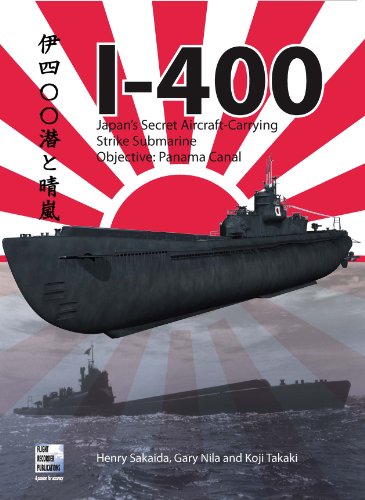
I-400; Japan's Secret aircraft-carrying Strike Submarine Objective: Panama Canal
Idioma: Inglés
Publicado por Crecy Publishing Limited, Manchester, 2010
ISBN 10: 0955426812 ISBN 13: 9780955426810
Librería: Ground Zero Books, Ltd., Silver Spring, MD, Estados Unidos de America
Calificación del vendedor: 5 de 5 estrellas

Original o primera edición
EUR 203,05
Envío por EUR 4,38
Se envía dentro de Estados Unidos de AmericaCantidad disponible: 1 disponibles
Añadir al carritoTrade paperback. Condición: Very good. Estado de la sobrecubierta: No dust jacket issued. Kyodhi Harada, Harry Whitver, and Tim Brown Ilustrador. Format is approximately 7.75 inches and 10.5 inches. 112 pages. Illustrations (some with color). Bibliography. Index. Foreword by Kazuo Takahashi. Foreword by Joseph M. McDowell. The I-400 class was the brainchild of Admiral Isoroku Yamamoto, Commander-in- Chief of the Japanese Combined Fleet. Shortly after the attack on Pearl Harbor, he conceived the idea of taking the war to the United States mainland by making aerial attacks against cities along the U.S. western and eastern seaboards using submarine-launched naval aircraft. He commissioned Captain Kameto Kuroshima to make a feasibility study. Construction of I-400 commenced at Kure Dock Yards on 18 January 1943. Following an inspection of Rabaul in August 1943, Captain Chikao Yamamoto and Commander Yasuo Fujimori conceived the idea of using the sen toku (secret submarine attack) to destroy the locks of the Panama Canal in an attempt to cut American supply lines to the Pacific Ocean and hamper the transfer of U.S. ships. Intelligence gathering on the proposed target began later that year. The Japanese conceived of an attack on the United States through the use of biological weapons specifically directed at the civilian population in San Diego, California. Dubbed "Operation Cherry Blossoms at Night", the plan was to launch aircraft from five I-400 submarines at night, who would then drop "infected flea" bombs on the intended target, in the hope that the resulting infection would spread to the entire Western seaboard and kill tens of thousands of people. Japan surrendered before the operation was carried out. The I-400 submarine was one of the most monstrous creations to emerge from World War II and, in its time, it was the largest submarine ever built. At more than 400 feet long, weighing 5,223 tons submerged, carrying a crew of nearly 200 and possessing a range of over 30,000 nautical miles, the I-400 featured state of the art Japanese radar and 'stealth' technology and carried three Aichi M6A Seiran attack floatplanes in a water-tight tube-like hangar built onto the deck forward of and under its massive conning tower. In mid-1944 this secret weapon was tasked with attacking American cities and destroying the Panama Canal. The extraordinary story of this submarine is told using first-hand accounts from three of the original air crew assigned to fly the Seirans and former officers and crew of the I-400 as well as American naval personnel who crewed the vessel on its dramatic final voyage. Hundreds of remarkable photographs show external and internal views of the I-400. The I-400-class submarine Imperial Japanese Navy (IJN) submarines were the largest submarines of World War II and remained the largest ever built until the construction of nuclear ballistic missile submarines in the 1960s. The IJN called this type of submarine Sentoku type submarine. The type name was shortened to Toku-gata Sensuikan. They were submarine aircraft carriers able to carry three Aichi M6A Seiran aircraft underwater to their destinations. They were designed to surface, launch their planes, then quickly dive again before they were discovered. They also carried torpedoes for close-range combat. The I-400 class was designed with the range to travel anywhere in the world and return. A fleet of 18 boats was planned in 1942, and work started on the first in January 1943 at the Kure, Hiroshima arsenal. Within a year the plan was scaled back to five, of which only three (I-400 at Kure, and I-401 and I-402 at Sasebo) were completed. First Edition this publisher [stated]. Presumed first printing.
