

Importe total (1 artículo artículos):
Destino del pedido:

get stankiewicz eugeniusz (4 resultados)
Ir a los resultados principales
Filtros de búsqueda
Tipo de artículo
- Todos los tipos de productos
- Libros (3)
- Revistas y publicaciones (No hay ningún otro resultado que coincida con este filtro.)
- Cómics (No hay ningún otro resultado que coincida con este filtro.)
- Partituras (No hay ningún otro resultado que coincida con este filtro.)
- Arte, grabados y pósters (1)
- Fotografías (No hay ningún otro resultado que coincida con este filtro.)
- Mapas (No hay ningún otro resultado que coincida con este filtro.)
- Manuscritos y coleccionismo de papel (No hay ningún otro resultado que coincida con este filtro.)
Condición Más información
- Nuevo (No hay ningún otro resultado que coincida con este filtro.)
- Como nuevo, Excelente o Muy bueno (No hay ningún otro resultado que coincida con este filtro.)
- Bueno o Aceptable (2)
- Regular o Pobre (No hay ningún otro resultado que coincida con este filtro.)
- Tal como se indica (2)
Encuadernación
- Todas
- Tapa dura (No hay ningún otro resultado que coincida con este filtro.)
- Tapa blanda (No hay ningún otro resultado que coincida con este filtro.)
Más atributos
- Primera edición (No hay ningún otro resultado que coincida con este filtro.)
- Firmado (No hay ningún otro resultado que coincida con este filtro.)
- Sobrecubierta (No hay ningún otro resultado que coincida con este filtro.)
- Con imágenes (4)
- No impresión bajo demanda (4)
Idioma (2)
Precio
- Cualquier precio
- Menos de EUR 20 (No hay ningún otro resultado que coincida con este filtro.)
- EUR 20 a EUR 40 (No hay ningún otro resultado que coincida con este filtro.)
- Más de EUR 40
Gastos de envío gratis
- Envío gratis a Estados Unidos de America (No hay ningún otro resultado que coincida con este filtro.)
Ubicación del vendedor
Valoración de los vendedores
-
![Imagen del vendedor de Przeciw zlu, przeciw przemocy. / Przeciw z?u, przeciw przemocy. Wystawa dedykowana pamieci Ks. Jerzego Popieluszki. [Against evil, against violence. An Exhibition to Commemorate the Memory of Fr. Jerzy Popieluszko.] a la venta por Földvári Books](https://pictures.abebooks.com/inventory/md/md22504235520.jpg)
Przeciw zlu, przeciw przemocy. / Przeciw z?u, przeciw przemocy. Wystawa dedykowana pamieci Ks. Jerzego Popieluszki. [Against evil, against violence. An Exhibition to Commemorate the Memory of Fr. Jerzy Popieluszko.]
Publicado por [Poland], 1985
Librería: Földvári Books, Budapest, Hungria
Miembro de asociación: ILAB MAE
Calificación del vendedor: 4 de 5 estrellas

EUR 5.500,00
Envío por EUR 19,50
Se envía de Hungria a Estados Unidos de AmericaCantidad disponible: 1 disponibles
Añadir al carritoOriginal collage. Printed and mounted on newspaper. ca. 425 × 300 mm. Get-Stankiewicz collage, with the title of the 1985 collective exhibition dedicated to the memory of Jerzy Popieluszko, the priest murdered by the Polish secret police. Printed on the first page of "Trybuna Ludu" the communist daily newspaper of Poland. Eugeniusz Get-Stankiewicz (b. 1942) is a Polish graphic artist and sculptor. During the 1980s he was associated with the Solidarno?ci (Solidarity) and created poster- and other designs for the movement. The Roman Catholic priest Jerzy Popieluszko (19471984) was also linked to the oppositional Solidarity and in his sermons, he agitated against the Communist politics and motivated the people to protest. The security service of the communist state tried to silence him in many ways unsuccessfully, and eventually, they set up a car accident to kill him. Get-Stankiewicz created this piece, to commemorate the memory of Popie?uszko, the red figure carrying the cross in the white background, emerging from the red soil or banner, the two colors and the composition is an allusion to the Polish flag. . The paper yellowed due to aging. Chipped, probably while cut by the artist. The mounted print is in fine condition. Overall in very good condition. Original collage. Printed and mounted on newspaper.
-
1987 Theatre Polish Poster - 13th Puppet Theatre Festival (Get-Stankiewicz)
Año de publicación: 1987
Librería: L'Affichiste Vintage Posters, Montreal, QC, Canada
Calificación del vendedor: 5 de 5 estrellas

EUR 144,23
Envío por EUR 42,43
Se envía de Canada a Estados Unidos de AmericaCantidad disponible: 1 disponibles
Añadir al carritoNo Binding. Condición: Good. About The Poster: Polish posters have come to stand apart from the advertising design conventions fostered in Europe during the 20th century. It was during the communist regime, a time when culture was closely monitored by the state, that Polish artists found liberation in poster art. Ironically, this foremost public artform became ground for individual expression. During that period, the cultural institutions (of theatre and cinema especially) flourished as they were funded by government agencies. Artists freshly out of the fine arts academy flocked towards poster production as the demand for this art was rapidly growing. The result became some of the most unique and expressive posters the world has ever seen - and artworks in themselves./ About the artist: Get-Stankiewicz is mainly known for his self-portrait pastiche works. He uses the motif of his own face or silhouette and talks about the 'narrative about his own head'. That 'head' resembles studies of the old physiognomists and may play all kinds of roles. It appears on variety of posters and it has been noted that: "Eugeniusz Get-Stankiewicz is not only a prominent artist, but also a person, who, as long as I can remember, was a legend on the town. This legend reaches back to the golden sixties and student's counterculture. A lot could be said about this, but first and foremost the source of that legend ought to be stressed. It was in fact Get's certain way of being, which I would describe as Socratesian and Rabelaisian. We can find that feature in a lot of his works, which are surprising in their independent way of seeing and intellectual reflection. This independence can be seen as one of the most typical traits of his personality and art."/ The poster is in overall good condition and ready to frame! This poster measures 25.5 x 38 inches.
-
1987 Theatre Polish poster - Dom Bernardy Alba (The House of Bernarda Alba, Play by Federico García Lorca) - Get-Stankiewicz
Año de publicación: 1987
Librería: L'Affichiste Vintage Posters, Montreal, QC, Canada
Calificación del vendedor: 5 de 5 estrellas
EUR 144,23
Envío por EUR 42,43
Se envía de Canada a Estados Unidos de AmericaCantidad disponible: 1 disponibles
Añadir al carritoNo Binding. Condición: Good. About The Poster: Polish posters have come to stand apart from the advertising design conventions fostered in Europe during the 20th century. It was during the communist regime, a time when culture was closely monitored by the state, that Polish artists found liberation in poster art. Ironically, this foremost public artform became ground for individual expression. During that period, the cultural institutions (of theatre and cinema especially) flourished as they were funded by government agencies. Artists freshly out of the fine arts academy flocked towards poster production as the demand for this art was rapidly growing. The result became some of the most unique and expressive posters the world has ever seen - and artworks in themselves./ About the artist: Get Stankiewicz is mainly known for his self-portrait pastiche works. He uses the motif of his own face or silhouette and talks about the 'narrative about his own head'. That 'head' resembles studies of the old physiognomists and may play all kinds of roles. It appears on variety of posters and it has been noted that: "Eugeniusz Get-Stankiewicz is not only a prominent artist, but also a person, who, as long as I can remember, was a legend on the town. This legend reaches back to the golden sixties and student's counterculture. A lot could be said about this, but first and foremost the source of that legend ought to be stressed. It was in fact Get's certain way of being, which I would describe as Socratesian and Rabelaisian. We can find that feature in a lot of his works, which are surprising in their independent way of seeing and intellectual reflection. This independence can be seen as one of the most typical traits of his personality and art."/ About the Play: Upon her second husband's death, domineering matriarch Bernarda Alba imposes an eight-year mourning period on her household in accordance with her family tradition. Bernarda has five daughters, aged between 20 and 39, whom she has rigidly controlled and prohibited from any form of relationship. The mourning period further isolates them and tension mounts within the household./ The poster is in good condition and ready to frame. This poster measures 26.5 x 38.5 inches.
-
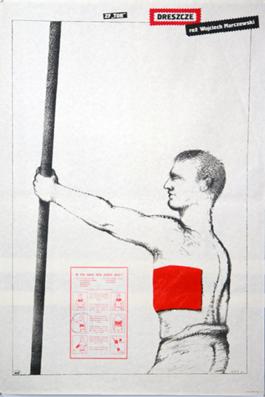
Plakat - Dreszcze rez Wojciech Marczewski. Offset.
Idioma: Alemán
Año de publicación: 1981
Librería: antiquariat peter petrej - Bibliopolium AG, Zürich, ZH, Suiza
Miembro de asociación: ILAB VEBUKU
Calificación del vendedor: 5 de 5 estrellas
Arte / Grabado / Póster
EUR 199,63
Envío por EUR 72,50
Se envía de Suiza a Estados Unidos de AmericaCantidad disponible: 1 disponibles
Añadir al carrito97 x 66 cm, Zustand A Text polnisch. Filmplakat für den Film «Schande, des polnischen Regisseurs Wojciech Marczewski. 1200 gr. Schlagworte: Plakate - Film.


