
Importe total (1 artículo artículos):
Destino del pedido:

germer lester (6 resultados)
Ir a los resultados principales
Filtros de búsqueda
Tipo de artículo
- Todos los tipos de productos
- Libros (6)
- Revistas y publicaciones (No hay ningún otro resultado que coincida con este filtro.)
- Cómics (No hay ningún otro resultado que coincida con este filtro.)
- Partituras (No hay ningún otro resultado que coincida con este filtro.)
- Arte, grabados y pósters (No hay ningún otro resultado que coincida con este filtro.)
- Fotografías (No hay ningún otro resultado que coincida con este filtro.)
- Mapas (No hay ningún otro resultado que coincida con este filtro.)
- Manuscritos y coleccionismo de papel (No hay ningún otro resultado que coincida con este filtro.)
Condición Más información
- Nuevo (1)
- Como nuevo, Excelente o Muy bueno (No hay ningún otro resultado que coincida con este filtro.)
- Bueno o Aceptable (2)
- Regular o Pobre (No hay ningún otro resultado que coincida con este filtro.)
- Tal como se indica (3)
Encuadernación
Más atributos
- Primera edición (5)
- Firmado (No hay ningún otro resultado que coincida con este filtro.)
- Sobrecubierta (No hay ningún otro resultado que coincida con este filtro.)
- Con imágenes (4)
- No impresión bajo demanda (5)
Idioma (2)
Precio
- Cualquier precio
- Menos de EUR 20 (No hay ningún otro resultado que coincida con este filtro.)
- EUR 20 a EUR 40
- Más de EUR 40
Gastos de envío gratis
Ubicación del vendedor
Valoración de los vendedores
-

Recent Advances In Surface Chemistry And Chemical Physics (Including Harold Urey "The Separation Of Isotopes")
Idioma: Inglés
Publicado por The Science Press, Mancaster, 1939
Librería: Arroyo Seco Books, Pasadena, Member IOBA, Pasadena, CA, Estados Unidos de America
Miembro de asociación: IOBA
Calificación del vendedor: 5 de 5 estrellas

Original o primera edición
EUR 239,62
Envío por EUR 6,77
Se envía dentro de Estados Unidos de AmericaCantidad disponible: 1 disponibles
Añadir al carritoHardcover. Condición: Very Good +. 1st Edition. 133 Pp. Blue Grey Cloth, Gilt. Very Good +, Lightly Used, No Fraying, Hinges Tight, No Marks.
-
![Imagen del vendedor de A new low energy electron diffraction technique having possible application to catalysis 1961 [LeatherBound] a la venta por S N Books World](https://pictures.abebooks.com/inventory/md/md30863563928.jpg)
A new low energy electron diffraction technique having possible application to catalysis 1961 [LeatherBound]
Idioma: Inglés
Año de publicación: 2025
Librería: S N Books World, Delhi, India
Calificación del vendedor: 5 de 5 estrellas
EUR 20,90
Gastos de envío gratis
Se envía de India a Estados Unidos de AmericaCantidad disponible: 18 disponibles
Añadir al carritoLeatherbound. Condición: NEW. BOOKS ARE EXEMPT FROM IMPORT DUTIES AND TARIFFS; NO EXTRA CHARGES APPLY. Leather Binding on Spine and Corners with Golden leaf printing on spine. Bound in genuine leather with Satin ribbon page markers and Spine with raised gilt bands. A perfect gift for your loved ones. Reprinted from 1961 edition. NO changes have been made to the original text. This is NOT a retyped or an ocr'd reprint. Illustrations, Index, if any, are included in black and white. Each page is checked manually before printing. As this print on demand book is reprinted from a very old book, there could be some missing or flawed pages, but we always try to make the book as complete as possible. Fold-outs, if any, are not part of the book. If the original book was published in multiple volumes then this reprint is of only one volume, not the whole set and contains approximately 40 pages. IF YOU WISH TO ORDER PARTICULAR VOLUME OR ALL THE VOLUMES YOU CAN CONTACT US. Resized as per current standards. Sewing binding for longer life, where the book block is actually sewn (smythe sewn/section sewn) with thread before binding which results in a more durable type of binding. Language: English.
-
Diffraction of Electrons by a Crystal of Nickel
Publicado por The American Physical Society, Minneapolis, 1927
Librería: Manhattan Rare Book Company, ABAA, ILAB, New York, NY, Estados Unidos de America
Miembro de asociación: ABAA ILAB
Calificación del vendedor: 5 de 5 estrellas
Original o primera edición
EUR 2.004,08
Envío por EUR 5,08
Se envía dentro de Estados Unidos de AmericaCantidad disponible: 1 disponibles
Añadir al carritoOriginal wrappers. Condición: Very Good. First edition. FIRST EDITION IN ORIGINAL WRAPPERS of Davisson and Germer's confirmation of de Broglie's hypothesis that matter has wave-like properties. "A 1927 paper in the Physical Review demonstrated that particles of matter can act like waves, just as light waves sometimes behave like particles. Clinton Davisson and Lester Germer of the Bell Telephone Laboratories, then in New York, found that electrons scatter from a crystal in the same way that x rays do. The work began as a result of a laboratory accident and ultimately earned Davisson a Nobel Prize. "In 1924, Louis de Broglie. proposed that matter, like light, has a dual nature. The next year, graduate student Walter Elsasser of the University of Göttingen in Germany proposed a way to test it: If electrons do have a wave nature, they should, like light, exhibit wave phenomena such as diffraction. In one form of diffraction, a light beam passing through a regular series of holes or slits, called a grating, exhibits "dark spots" in directions where the wave troughs coming from some holes cancel the peaks coming from others. "Bright spots" appear in directions where the peaks reinforce one another. A beam of tiny marbles, as electrons were conceived of until this point, could never show such cancellation and enhancement. "By chance, Davisson and his junior partner Germer were well-positioned to quickly follow Elsasser's suggestion. They had been attempting to probe the structure of the atom by firing low-speed electrons at nickel and measuring the scatter. Their experiments weren't turning up anything of interest, and in 1925 they were saved from frustration and ultimately obscurity by an accident. Their equipment broke, and extreme heating recrystallized their nickel target into a few large crystals, where previously there had been many smaller ones. Their data, showing the amount of scattered electrons at each detector position, began exhibiting some intriguing peaks. "It was only later, when Davisson discussed his results with physicists during his 1926 summer vacation in England, that he learned of de Broglie's theory and realized that his data likely contained the world's first glimpse of electron diffraction. The atoms in the recrystallized nickel had acted as a grating. Following this realization, Davisson and Germer began a deliberate search for diffraction patterns, especially the peaks in their data plots that would indicate extra electrons scattering in specific directions. After some disappointing initial results, they found a single peak that agreed both with de Broglie's theory and with separate experiments using x rays in place of electrons. Eventually they found 30 peaks, 29 of which could be explained by diffraction. One was left unexplained, and they failed to find eight additional peaks that they had expected to appear. "The team published a short paper in Nature in early 1927 and then a more complete article later that year in the Physical Review. George Paget Thomson of the University of Aberdeen in Scotland published his own experimental proof of electron diffraction just a month later and shared the 1937 Nobel Prize in physics with Davisson" (Chelsea Wald, American Physical Society). Particle Physics: One Hundred Years of Discoveries: "Discovery of the diffraction of electrons by crystals. Confirmation of the wave properties of moving electrons. Nobel Prize to C.J. Davisson awarded in 1937 and to co-winner G.P. Thomson 'for their experimental discovery of the diffraction of electrons by crystals.'" IN: The Physical Review, Vol 30, No. 6, December 1927, pp. 705-740. Minneapolis, MN: The American Physical Society, 1927. Octavo, original wrappers; custom box. Some fading to spine and wrapper edges; otherwise fine. RARE in wrappers.
-
The Scattering of Electrons by a Single Crystal of Nickel. - [ELECTRON DIFFRACTION - NOBEL PRIZE IN PHYSICS 1937.]
Librería: Herman H. J. Lynge & Søn ILAB-ABF, Copenhagen, Dinamarca
Miembro de asociación: ABF ILAB
Calificación del vendedor: 4 de 5 estrellas

Original o primera edición
EUR 440,99
Envío por EUR 42,00
Se envía de Dinamarca a Estados Unidos de AmericaCantidad disponible: 1 disponibles
Añadir al carritoLondon, Macmillian and Co, 1927. Royal8vo. Bound in contemporary half cloth with whilte title paper-label to spine. In "Nature", vol. 119, 1927, entire volume offered. Stamp to front free end-paper and title-pages of each issue.Light wear to extremieies, otherwise fine. Pp. 558-560. [Entire volume: LIX, (1), 948, 100]. First edition of this seminal and highly influential paper on electron diffraction. Today the paper is regarded as one of the most important in the entire journal of Nature, and it led directly to Davisson receiving the Nobel Prize in physics in 1937. It advanced understanding of physics at the quantum level and led to inventions such as the electron microscope. Davisson and Germer's confirmation of the de Broglie hypothesis if today known as the Davisson-Germer experiment."Davisson's investigations on the scattering of electrons entered a new phase when, in April 1925, his taget was heavily oxidized by an accidental explosion of a liquid-air bottle. He cleaned the target by prolonged heating and then found the distribution-inangle of the secondary electrons completely changed, new showing a strong dependence on crystal direction. Prior to the accident the target had consisted of many tiny crystals, but heating converted it to several large crystals. Davisson and L. H. Germer, who had replaced Kunsman before the accident, at once began bombarding targets of single crystals. [.] When Davisson returned from England, he and Germer began a systematic research for some sort of interference phenomenon, and in January 1927 they observed electron beams resulting from diffraction by a single crystal of nickle. The results were in good agreement with de Broglie's prediction. For his confirmation of electron waves Davisson shared the Nobel Prize in physics in 1937 with G. P. Thomson." (DSB, III, 597b-598a).
-

The Scattering of Electrons by a Single Crystal of Nickel. - [ELECTRON DIFFRACTION - NOBEL PRIZE IN PHYSICS 1937.]
Librería: Herman H. J. Lynge & Søn ILAB-ABF, Copenhagen, Dinamarca
Miembro de asociación: ABF ILAB
Calificación del vendedor: 4 de 5 estrellas
Original o primera edición
EUR 482,33
Envío por EUR 42,00
Se envía de Dinamarca a Estados Unidos de AmericaCantidad disponible: 1 disponibles
Añadir al carritoLondon, Macmillian and Co, 1927. Royal8vo. Bound in a nice black full cloth with title, year and exlibris (Grosvenor Library) in gilt on spine. The entire volume 119, 1927, of "Nature" offered. Pasted library stamp to pasted down free front end-paper. Binding tight, clean and externally as well as internally. Pp. 558-560. [Entire volume: LIX, (1), 948, 100]. First edition of this seminal and highly influential paper on electron diffraction. Today the paper is regarded as one of the most important in the entire journal of Nature, and it led directly to Davisson receiving the Nobel Prize in physics in 1937. It advanced understanding of physics at the quantum level and led to inventions such as the electron microscope. Davisson and Germer's confirmation of the de Broglie hypothesis if today known as the Davisson-Germer experiment."Davisson's investigations on the scattering of electrons entered a new phase when, in April 1925, his taget was heavily oxidized by an accidental explosion of a liquid-air bottle. He cleaned the target by prolonged heating and then found the distribution-inangle of the secondary electrons completely changed, new showing a strong dependence on crystal direction. Prior to the accident the target had consisted of many tiny crystals, but heating converted it to several large crystals. Davisson and L. H. Germer, who had replaced Kunsman before the accident, at once began bombarding targets of single crystals. [.] When Davisson returned from England, he and Germer began a systematic research for some sort of interference phenomenon, and in January 1927 they observed electron beams resulting from diffraction by a single crystal of nickle. The results were in good agreement with de Broglie's prediction. For his confirmation of electron waves Davisson shared the Nobel Prize in physics in 1937 with G. P. Thomson." (DSB, III, 597b-598a).
-
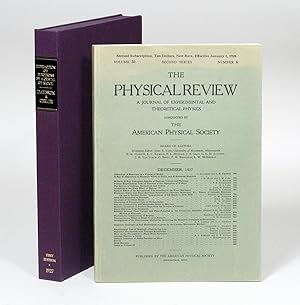
Diffraction of Electrons by a Crystal of Nickel.
Librería: Herman H. J. Lynge & Søn ILAB-ABF, Copenhagen, Dinamarca
Miembro de asociación: ABF ILAB
Calificación del vendedor: 4 de 5 estrellas
Original o primera edición
EUR 275,62
Envío por EUR 42,00
Se envía de Dinamarca a Estados Unidos de AmericaCantidad disponible: 1 disponibles
Añadir al carritoMinneapolis, The Collegiate Press, 1927. 4to. As extracted from "The Physical Review, Volume 30, Second Series, July-December, 1927". Title-page detached, with vague library stamp to top right corner. A fine and clean copy. (2), 704-740 pp. First printing of Davisson and Germer's paper in which they present some additional discoveries not published in their groundbreaking paper "The Scattering of Electrons by a Single Crystal of Nickel" published the same year. This led directly to Davisson receiving the Nobel Prize in physics in 1937. It advanced understanding of physics at the quantum level and led to inventions such as the electron microscope."Davisson and Germer submitted their results to Nature in early March and their paper was published on 16 April. It contains a detailed comparison between their replcted beams and those that would be produced by illuminationg the crystal with X-rays. There were thirteen reflected beams in all, of which ten corresponded to those seen in X-ray diffraction". (Gerwin, A Century of Nature, 28 p.) They could not account for the last three wave and this was not published in their first paper. "The remaining three peaks for which Davisson and Germer could not find any correspondence with X-ray data were later identified as being due to diffraction from atoms absorb ed on the surfaces of the target crystal." (Ibid.). This information was published in the present paper. "Davisson's investigations on the scattering of electrons entered a new phase when, in April 1925, his taget was heavily oxidized by an accidental explosion of a liquid-air bottle. He cleaned the target by prolonged heating and then found the distribution-inangle of the secondary electrons completely changed, new showing a strong dependence on crystal direction. Prior to the accident the target had consisted of many tiny crystals, but heating converted it to several large crystals. Davisson and L. H. Germer, who had replaced Kunsman before the accident, at once began bombarding targets of single crystals. [.] When Davisson returned from England, he and Germer began a systematic research for some sort of interference phenomenon, and in January 1927 they observed electron beams resulting from diffraction by a single crystal of nickle. The results were in good agreement with de Broglie's prediction. For his confirmation of electron waves Davisson shared the Nobel Prize in physics in 1937 with G. P. Thomson." (DSB, III, 597b-598a).Davisson and Germer's confirmation of the de Broglie hypothesis if today known as the Davisson-Germer experiment.

![Imagen del vendedor de The Scattering of Electrons by a Single Crystal of Nickel. - [ELECTRON DIFFRACTION - NOBEL PRIZE IN PHYSICS 1937.] a la venta por Herman H. J. Lynge & Søn ILAB-ABF](https://pictures.abebooks.com/inventory/md/md30918200232.jpg)

