

Importe total (1 artículo artículos):
Destino del pedido:

falloppio fallopius gabriele (6 resultados)
Ir a los resultados principales
Filtros de búsqueda
Tipo de artículo
- Todos los tipos de productos
- Libros (6)
- Revistas y publicaciones (No hay ningún otro resultado que coincida con este filtro.)
- Cómics (No hay ningún otro resultado que coincida con este filtro.)
- Partituras (No hay ningún otro resultado que coincida con este filtro.)
- Arte, grabados y pósters (No hay ningún otro resultado que coincida con este filtro.)
- Fotografías (No hay ningún otro resultado que coincida con este filtro.)
- Mapas (No hay ningún otro resultado que coincida con este filtro.)
- Manuscritos y coleccionismo de papel (No hay ningún otro resultado que coincida con este filtro.)
Condición Más información
- Nuevo (No hay ningún otro resultado que coincida con este filtro.)
- Como nuevo, Excelente o Muy bueno (1)
- Bueno o Aceptable (4)
- Regular o Pobre (No hay ningún otro resultado que coincida con este filtro.)
- Tal como se indica (1)
Encuadernación
Más atributos
- Primera edición (5)
- Firmado (No hay ningún otro resultado que coincida con este filtro.)
- Sobrecubierta (No hay ningún otro resultado que coincida con este filtro.)
- Con imágenes (6)
- No impresión bajo demanda (6)
Idioma (1)
Precio
- Cualquier precio
- Menos de EUR 20 (No hay ningún otro resultado que coincida con este filtro.)
- EUR 20 a EUR 45 (No hay ningún otro resultado que coincida con este filtro.)
- Más de EUR 45
Gastos de envío gratis
- Envío gratis a Estados Unidos de America (No hay ningún otro resultado que coincida con este filtro.)
Ubicación del vendedor
Valoración de los vendedores
-
In Hippocratis librum de vulneribus capitis.
Idioma: Latín
Publicado por Luca Bertello, Venice, 1566
Librería: Milestones of Science Books, Ritterhude, Alemania
Miembro de asociación: ILAB VDA
Calificación del vendedor: 5 de 5 estrellas

Original o primera edición
EUR 4.500,00
Envío por EUR 45,00
Se envía de Alemania a Estados Unidos de AmericaCantidad disponible: 1 disponibles
Añadir al carritoHardcover. Condición: Very Good. 1st Edition. 4to (207 x 155 mm). 59, [1] leaves. Woodcut initials. Signatures: A-P4. Including final blank P4. Bound in 20th-century carta rustica. Text crisp and clean throughout, gutter of first and last gatherings reinforced with paper, a few blank corners clipped, few pages with light (finger-) soiling. Provenance: Il Polifilo (small sticker to front pastedown); a few contemporary marginal comments and marks. Very good copy. ---- FIRST EDITION, AND EXCEPTIONALLY RARE, of Falloppio's treatise on head wounds. This work, which like most of his writings was printed posthumously, is a transcript of lectures given by Falloppio in Padua, where he held the chair of anatomy. It was edited for publication by Giovanni Bonacci. It takes the form of an exposition and commentary on relevant passages from Hippocrates dealing with cranial anatomy and various diseases and their cures. Falloppio was the first to describe many physical characteristics of the brain and made an important contribution to cranial surgery with his work, although he himself was not a trained surgeon. The publication is dedicated to the great Venetian printer Vincenzo Valgrisi. This work is rare and absent from many standard medical bibliographies. RBH only records one other copy at auction (Jeschke can Vliet, Berlin 2011, lot no. 47). Bibliography: Adams F-142.; Bruni Celli 1334 (with incorrect citation of the printer and erroneous collation); not in Norman, Waller, or Wellcome. - Visit our website to see more images!
-
Tractatus de compositione medicamentorum dilucidissimus; nunc primum ad candidatorum medicinae utilitatem summa opera, ac cura castigatus, & in lucem editus [.].
Idioma: Latín
Publicado por Venedig, (Officina Gratiosi Perchacini für) Paolo u. Antonio Meietti, 1570., 1570
Librería: Versandantiquariat Wolfgang Friebes, Graz, Austria
Miembro de asociación: ILAB VDAO
Calificación del vendedor: 5 de 5 estrellas
Original o primera edición
EUR 800,00
Envío por EUR 72,50
Se envía de Austria a Estados Unidos de AmericaCantidad disponible: 1 disponibles
Añadir al carritoCondición: 0. Erstausgabe. - This scarce and infrequently seen book contains two works by Fallopius. The first deals with the theoretical and practical aspects of formulating various therapeutic remedies [.]. The second work is Fallopius tract on cautery in which he discusses its uses and concentrates on the various salves and caustics that may be employed with the procedure (Eimas 339). - Der italienische Anatom und Chirurg Gabriele Falloppio (1523 -1562) gilt als Mitbegründer der modernen Anatomie und war einer der wichtigsten Ärzte des 16. Jahrhunderts. Falloppio empfahl mit Medikamenten und anorganischen Salzen getränkte Leinensäckchen gegen die sich ausbreitende Syphilis, weshalb er auch als Erfinder des Kondoms gehalten wird. - Titel m. altem Besitzvermerk u. etw. fingerfleckig. Durchg. etw. wasserrandig (dadurch der Farbschnitt tlw. leicht verlaufen). Min. gebräunt. - EDIT16, CNCE 18544; BM STC, Italian Books 243; Durling, 1453; Wellcome, I, 2159; nicht bei Adams. la Gewicht in Gramm: 500 4°. Mit Holzschn.-Titelvignette, Holzschn.-Druckermarke am Ende, zahlr. Holzschn.-Initialen u. einigen Holzschn.-Vignetten. 4 nn., 67 (recte 72) num., 12 nn. Bll., Mod. Ppbd.
-
Libelli duo, alter de ulceribus, alter de tumoribus praeter naturam, nunc recens in lucem editi.
Idioma: Latín
Publicado por Donato Bertelli, Venice, 1563
Librería: Milestones of Science Books, Ritterhude, Alemania
Miembro de asociación: ILAB VDA
Calificación del vendedor: 5 de 5 estrellas
Original o primera edición
EUR 4.500,00
Envío por EUR 45,00
Se envía de Alemania a Estados Unidos de AmericaCantidad disponible: 1 disponibles
Añadir al carritoHardcover. Condición: Very Good. 1st Edition. 4to (222 x 154 mm). [3], 101, [1] leaves. Signatures: A3, A* (A-Z)4 Aa4 Bb6, with both, the cancel and cancelland leaf present. Title page with woodcut vignette, woodcut intials in text, errata on final leaf recto. 19th-century drab boards, spine with gilt-lettered paper label (rebacked with most of original spine preserved, corners scuffed, extremities rubbed, boards stained). Leaves untrimmed. Text only very little browned, faint minor spotting and soiling of outer margins, leaf E2 loose, two leaves with old paper repair to top blank margin. Provenance: Henri Aniere, Paris (sticker to front pastedown). A fine, crisp and wide-margined copy. ---- Eimas, Heirs of Hippocrates 333, Cushing F25; NLM/Durling 1438; Waller 2934; Wellcome I, 2156 (2nd edition only). EXCEPTIONALLY RARE FIRST EDITION. "Fallopius was a clinician as well as an anatomist, and this treatise on diseases of the skin (ulcers and tumors) is one of the most complete of its kind up to the time of its publication. An interesting bibliographical point in this copy is the canceling of leaf 1 with a substitute leaf, but the cancelland was not removed, thus leaving both the original leaf and its substitute in place." (Heirs of Hippocrates). This first edition is rare. Only one copy has appeared at auction in the past 80 years (the Virchow copy, Christie's 2016). - Visit our website for additional images and information.
-
Opuscula tria. I. Tractatus de vulneribus. II. Expositio in lib. Hipp. de vulneribus capitis. III. Tractatus de vulneribus oculorum, aliarumque partium corporis. . .
Idioma: Latín
Publicado por Paul Meietus, Venice, 1569
Librería: Milestones of Science Books, Ritterhude, Alemania
Miembro de asociación: ILAB VDA
Calificación del vendedor: 5 de 5 estrellas
Original o primera edición
EUR 3.000,00
Envío por EUR 45,00
Se envía de Alemania a Estados Unidos de AmericaCantidad disponible: 1 disponibles
Añadir al carritoSoft cover. Condición: Very Good. 1st Edition. 3 parts in 1 volume. 4to (208 x 149 mm). [8], 223, [25] pp. Signatures: *4 A8 B-V4 X6 Y-Cc4 Dd2 a-c4. Separate title-page with woodcut device to each part, woodcut head-pieces and initials, including the blank leaf L4. Internally little browned, occasional minor foxing, some worming and light dampstaining to top margin of second part, one wormtrack to final leaves of index affecting a few letters, leaf Q4 torn in lower blank margin. Contemporary limp vellum, spine lettered in script (little staining and soiling, spine darkened). Provenance: Joannis Antony Farrelly(?) (signature to lower margin of title-page, dated 1744). A fine, wide-margined copy. ---- NLM/Durling 1429; Adams F136; Castiglioni 372; not in Wellcome, Waller or Bird. FIRST EDITION. Rare work of the famous surgeon and anatomist Gabriele Falloppio dealing with different types of injuries, their care and healing. - Visit our website to see more images!
-
De morbo gallico liber absolutissimus. . .Additus etiam est in calce De morbo Gallico tractatus, Antonii Fracanciani Bononiae.
Idioma: Latín
Publicado por L. Bertelli, Padova, 1564
Librería: Milestones of Science Books, Ritterhude, Alemania
Miembro de asociación: ILAB VDA
Calificación del vendedor: 5 de 5 estrellas
Original o primera edición
EUR 4.800,00
Envío por EUR 45,00
Se envía de Alemania a Estados Unidos de AmericaCantidad disponible: 1 disponibles
Añadir al carritoHardcover. Condición: Near Fine. 1st Edition. 2 parts in one volume. Padua: L. Bertelli, 1564 [part 2: C. Gryphius, 1563 (colophon 1564)]. 4to (220x170 mm). [4], 64, 16, [2] ff. Contemporary limp vellum, spine titled in manuscript (covers browned and little soiled), title page with old ex-libris stamp, text leaves expertly cleaned. A fine, crisp copy of this important work on syphilis.---- Eimas, Heirs of Hippocrates 334; Garrison-Morton 2370. Wellcome 2152; Waller 2928. RARE FIRST EDITION. In this classic work on "the French disease," Fallopius wrote more knowingly of the Europe-wide scourge of syphilis than previous authors on the subject and was one of the first to oppose the use of mercury in its treatment. Antonio Fracanzano (d. 1567), a teacher of Fallopius at Padua and later his colleague there, contributed a short tract to this work on syphilis published in the year after Fallopius' death. (Heirs of Hippocrates, p.123). "He distinguished between syphilitic and non-syphilitic condylomata" (Garrison-Morton). Exceedingly rare, only two copies have been auctioned in the past 25 years. - Visit our website for additional images.
-
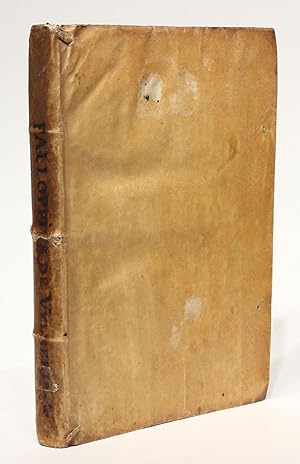
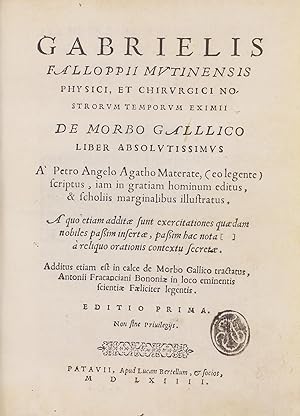
De morbo gallico liber absolutissimus / A Petro Angelo Agatho Materate [i.e. Giovanni Bonacci] (eo legente) scriptus, jam in gratiam hominum editus, et scholiis marginalibus illustratus. A quo etiam additae sunt exercitationes quaedam . a reliquo orationis contextu secretae. Additus etiam est in calce de morbo gallico Tractatus Antonii Fracanciani.
Idioma: Latín
Publicado por Ex officina Francisci Laurentini de Turino, Venetiis, 1565
Librería: Sequitur Books, Boonsboro, MD, Estados Unidos de America
Miembro de asociación: IOBA
Calificación del vendedor: 5 de 5 estrellas
EUR 2.267,89
Envío por EUR 4,38
Se envía dentro de Estados Unidos de AmericaCantidad disponible: 1 disponibles
Añadir al carritoVellum. Condición: Good. 2. [Early Treatise on Syphilis] 8vo. 2 parts in one volume. Bound in contemporary limp vellum. Soiling to cover. Woodcut printer's device on each title, woodcut initials. A few scattered early notations. [9], 98 pages [1]; [4], 24, [1]. Part [2] has special title page: Antonii Fracanciani . De morbo gallico fragmenta quaedam elegantissima ex lectionibus anni 1563 Bononiae. 2nd edition, first published in 1564. Falloppio asserted that syphilis was brought to Europe from America. He was one of the first to oppose the use of mercury in its treatment. He is remembered for his discovery of the fallopian tube. Refs: Durling 1434; Wellcome I 2153.


![Imagen del vendedor de Tractatus de compositione medicamentorum dilucidissimus; nunc primum ad candidatorum medicinae utilitatem summa opera, ac cura castigatus, & in lucem editus [.]. a la venta por Versandantiquariat Wolfgang Friebes](https://pictures.abebooks.com/inventory/md/md30678971752.jpg)

![Imagen del vendedor de De morbo gallico liber absolutissimus / A Petro Angelo Agatho Materate [i.e. Giovanni Bonacci] (eo legente) scriptus, jam in gratiam hominum editus, et scholiis marginalibus illustratus. A quo etiam additae sunt exercitationes quaedam . a reliquo orationis contextu secretae. Additus etiam est in calce de morbo gallico Tractatus Antonii Fracanciani. a la venta por Sequitur Books](https://pictures.abebooks.com/inventory/md/md32351746376.jpg)