

Importe total (1 artículo artículos):
Destino del pedido:

efros vladimir (3 resultados)
Ir a los resultados principales
Filtros de búsqueda
Tipo de artículo
- Todos los tipos de productos
- Libros (3)
- Revistas y publicaciones (No hay ningún otro resultado que coincida con este filtro.)
- Cómics (No hay ningún otro resultado que coincida con este filtro.)
- Partituras (No hay ningún otro resultado que coincida con este filtro.)
- Arte, grabados y pósters (No hay ningún otro resultado que coincida con este filtro.)
- Fotografías (No hay ningún otro resultado que coincida con este filtro.)
- Mapas (No hay ningún otro resultado que coincida con este filtro.)
- Manuscritos y coleccionismo de papel (No hay ningún otro resultado que coincida con este filtro.)
Condición Más información
- Nuevo (No hay ningún otro resultado que coincida con este filtro.)
- Como nuevo, Excelente o Muy bueno (No hay ningún otro resultado que coincida con este filtro.)
- Bueno o Aceptable (3)
- Regular o Pobre (No hay ningún otro resultado que coincida con este filtro.)
- Tal como se indica (No hay ningún otro resultado que coincida con este filtro.)
Encuadernación
- Todas
- Tapa dura (No hay ningún otro resultado que coincida con este filtro.)
- Tapa blanda (2)
Más atributos
- Primera edición (1)
- Firmado (No hay ningún otro resultado que coincida con este filtro.)
- Sobrecubierta (No hay ningún otro resultado que coincida con este filtro.)
- Con imágenes (3)
- No impresión bajo demanda (3)
Idioma (1)
Gastos de envío gratis
- Envío gratis a Estados Unidos de America (No hay ningún otro resultado que coincida con este filtro.)
Ubicación del vendedor
Valoración de los vendedores
-

The Sovietumion. Facts - Problems - Appraisals. Soviet Pipelines. First Issue.
Publicado por ohne Verlagsangabe, 1984
Librería: biblion2, Obersulm, Alemania
Calificación del vendedor: 5 de 5 estrellas

EUR 18,00
Envío por EUR 22,00
Se envía de Alemania a Estados Unidos de AmericaCantidad disponible: 1 disponibles
Añadir al carritoCondición: Good. Taschenbuch. Zustandsangabe altersgemäß. Sofortversand aus Deutschland. Artikel wiegt maximal 500g. 120 Seiten. In englischer Sprache. Einband mit leichten Gebrauchsspuren sowie leicht verfärbt.
-
[Cold War Era Soviet Publicity Booklets]: Flying the Soviet Flag; How I "Discovered" Religion in Russia; Do Russian People Stand for War?; The Great Victory: A Brief Account of the Great Patriotic War of the Soviet People (1941-4945); Revolution in Women's Life; The Soviet People: Portrait Sketches About the Origins, Ways, Customs and Traditions of Peoples; The Soviet Union: Facts, Problems, Appraisals, First and Second Issues; The Roots of European Security: 40 Years After the Yalta and Potsdam Conferences (1945); CMEA: The Strength of Friendship and Cooperation, Documents and Materials of the Top-Level Economic Conference of the CMEA Member States, Moscow, June 12-14, 1984 [Ten Booklets]
Publicado por Novosti Press Agency Publishing House, Moscow, 1985
Librería: Underground Books, ABAA, Carrollton, GA, Estados Unidos de America
Miembro de asociación: ABAA ILAB IOBA
Calificación del vendedor: 5 de 5 estrellas
EUR 112,59
Envío por EUR 4,81
Se envía dentro de Estados Unidos de AmericaCantidad disponible: 1 disponibles
Añadir al carritoPaperback. Condición: Good +. Paperback. Within this collection of publications by the Novosti Press Agency, the USSR's state public information service from 1961 to 1990, you'll find Soviet cruises, an Italian journalist's praises of the Russian Orthodox Church and religious freedom in the U.S.S.R., an Australian peace activist's confirmation of the peace-loving nature of the Russian people, the story of the Soviet defeat of the Nazi forces on the Soviet-German front, a journey through the stages of the Socialist Revolution through the work of women, a survey of the many cultures within the USSR, factbooks for 1984 covering "rapid advances in robot technology" and the progress of Soviet pipelines, speeches and documents of Comecon, and more. These ten booklets are fascinating artifacts of the Soviet Union and its publications intended for international consumption. Founded in Moscow in 1961 by the USSR Journalists' Union, the USSR Writers' Union, the Union of Soviet Societies for Friendship and Cultural Relations With Foreign Countries, and the Znanie (Knowledge) society as a Soviet public information service, the Novosti Press Agency aimed "to aid the development and strengthening of mutual understanding, confidence, and friendship among peoples," according to The Great Soviet Encyclopedia (1979). The Novosti Press Agency succeeded Sovinformburo, and in turn was succeeded by the Information Agency Novosti and then the Russian Information Agency Novosti, now Rossiya Segodnya. Moderate wear to staplebound and perfect bound wraps, with creasing to corners, light dust soiling, and scattered rubbing. Tear to spine of The Roots of European Security. Small spots of dampstaining to rear wraps of CMEA and Roots of European Security. All bindings firm and sound. Pages are clean and unmarked. OCLC shows 2 holdings for Flying the Soviet Flag, 16 for How I "Discovered" Religion in Russia, and 9 for CMEA: The Strength of Friendship and Cooperation.
-
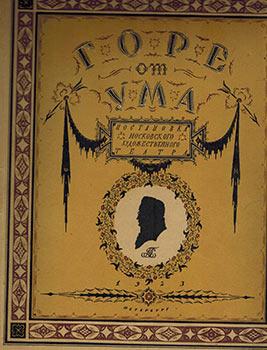
Gore ot uma A. S. Griboedova v postanovke Moskovskogo Chudozestvennogo TeatraTrop d' Esprit porte Malheur. (Woe to Wit)
Publicado por Moscow-Peterburg: : Gosudarstvennoe Izdatelstvo, 1923
Librería: Wittenborn Art Books, San Francisco, CA, Estados Unidos de America
Calificación del vendedor: 5 de 5 estrellas
Original o primera edición
EUR 270,22
Envío por EUR 8,75
Se envía dentro de Estados Unidos de AmericaCantidad disponible: 1 disponibles
Añadir al carritoCondición: Good. 24 x 31 cm. Original wraps. 267pp. The Verskomödie Gore ot uma criticizes Russian society. A senior official described it as a "satirical pamphlet against Moscow" . The actual story of the play is rather thin, and the portrayal of social types is all the more accurate. The main characters are Famusow , a lover of traditional mismanagement and Reform hater, his secretary Molchalin , a premier toady, Reptilow , a young nobleman, liberal and crazy about English life, and Tschatski over, an ironic satirist, who has just returned from Western Europe and Weakens the weaknesses of others. He is the hero of the play. His words reflected the views of young intellectuals of Russia, in the Decembrist revolt led by 1825thAlthough the play in the classic French comedy Molière rooted, the types are at Griboyedov individual and the interactions between the individual and society are a sparkling dialectical give and take. Mikhail Bulgakov was later the main venues of his satirical novel The Master and Margarita named after Griboyedov.Griboyedov wrote the piece in Georgia and Russia in the summer of 1823, then took it to Saint Petersburg. There it was from the censors rejected. It was never printed during his lifetime. There were, however, many copies, which circulated privately. The first edition was published in 1833, four years after his death. He saw it only once on stage, in December 1827 performed.

![Imagen del vendedor de [Cold War Era Soviet Publicity Booklets]: Flying the Soviet Flag; How I "Discovered" Religion in Russia; Do Russian People Stand for War?; The Great Victory: A Brief Account of the Great Patriotic War of the Soviet People (1941-4945); Revolution in Women's Life; The Soviet People: Portrait Sketches About the Origins, Ways, Customs and Traditions of Peoples; The Soviet Union: Facts, Problems, Appraisals, First and Second Issues; The Roots of European Security: 40 Years After the Yalta and Potsdam Conferences (1945); CMEA: The Strength of Friendship and Cooperation, Documents and Materials of the Top-Level Economic Conference of the CMEA Member States, Moscow, June 12-14, 1984 [Ten Booklets] a la venta por Underground Books, ABAA](https://pictures.abebooks.com/inventory/md/md22888722985.jpg)