Importe total (1 artículo artículos):
Destino del pedido:

computer music (7 resultados)
Ir a los resultados principales
Filtros de búsqueda
Tipo de artículo
- Todos los tipos de productos
- Libros (7)
- Revistas y publicaciones (No hay ningún otro resultado que coincida con este filtro.)
- Cómics (No hay ningún otro resultado que coincida con este filtro.)
- Partituras (No hay ningún otro resultado que coincida con este filtro.)
- Arte, grabados y pósters (No hay ningún otro resultado que coincida con este filtro.)
- Fotografías (No hay ningún otro resultado que coincida con este filtro.)
- Mapas (No hay ningún otro resultado que coincida con este filtro.)
- Manuscritos y coleccionismo de papel (No hay ningún otro resultado que coincida con este filtro.)
Condición Más información
- Nuevo (4)
- Como nuevo, Excelente o Muy bueno (1)
- Bueno o Aceptable (No hay ningún otro resultado que coincida con este filtro.)
- Regular o Pobre (No hay ningún otro resultado que coincida con este filtro.)
- Tal como se indica (2)
Encuadernación
Más atributos
- Primera edición (No hay ningún otro resultado que coincida con este filtro.)
- Firmado (No hay ningún otro resultado que coincida con este filtro.)
- Sobrecubierta (No hay ningún otro resultado que coincida con este filtro.)
- Con imágenes (3)
- No impresión bajo demanda (6)
Idioma (2)
Precio
- Cualquier precio
- Menos de EUR 20 (No hay ningún otro resultado que coincida con este filtro.)
- EUR 20 a EUR 40
- Más de EUR 40
Gastos de envío gratis
- Envío gratis a Estados Unidos de America (No hay ningún otro resultado que coincida con este filtro.)
Ubicación del vendedor
Valoración de los vendedores
-

Electronic and Computer Music Manning, Peter
Idioma: Inglés
Publicado por Oxford University Press, 2004
ISBN 10: 0195170857 ISBN 13: 9780195170856
Librería: Aragon Books Canada, OTTAWA, ON, Canada
Calificación del vendedor: 3 de 5 estrellas

EUR 47,77
Envío por EUR 19,39
Se envía de Canada a Estados Unidos de AmericaCantidad disponible: 1 disponibles
Añadir al carritoCondición: New.
-

Proceedings of the 14th International Computer Music Conference Cologne, September 20 - 25, 1988.
Publicado por Köln., 1988
Librería: Musik-Antiquariat Heiner Rekeszus, Wiesbaden, WI, Alemania
Calificación del vendedor: 4 de 5 estrellas

EUR 38,00
Envío por EUR 18,00
Se envía de Alemania a Estados Unidos de AmericaCantidad disponible: 1 disponibles
Añadir al carritoVI, 438 S. m. Notenbsp. u. Graphiken, 1 Bl. Orig.-Broschur.
-
Foundations of Computer Music.
Publicado por Cambridge, Massachusetts, 1985
Librería: Musik-Antiquariat Heiner Rekeszus, Wiesbaden, WI, Alemania
Calificación del vendedor: 4 de 5 estrellas
EUR 38,00
Envío por EUR 18,00
Se envía de Alemania a Estados Unidos de AmericaCantidad disponible: 1 disponibles
Añadir al carritoXX, 712 S. m. zahlr. graphischen Bsp. OLn.
-
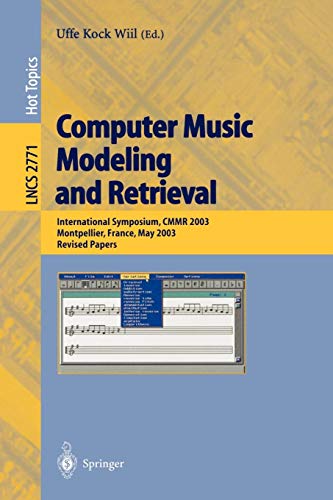
Computer Music Modeling and Retrieval: International Symposium, Cmmr 2003, Montpellier, France, May 26-27, 2003 : Revised Papers
Idioma: Inglés
Publicado por Springer-Verlag New York Inc, 2004
ISBN 10: 3540209220 ISBN 13: 9783540209225
Librería: Revaluation Books, Exeter, Reino Unido
Calificación del vendedor: 5 de 5 estrellas

EUR 150,84
Envío por EUR 11,52
Se envía de Reino Unido a Estados Unidos de AmericaCantidad disponible: 2 disponibles
Añadir al carritoPaperback. Condición: Brand New. 1st edition. 247 pages. German language. 9.25x6.25x0.75 inches. In Stock.
-
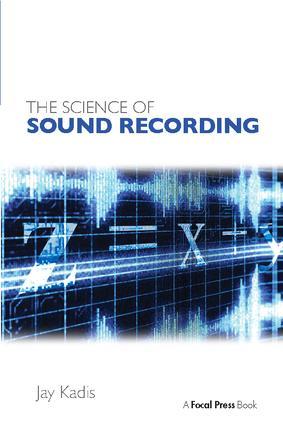
The Science of Sound Recording
Librería: moluna, Greven, Alemania
Calificación del vendedor: 4 de 5 estrellas
EUR 234,16
Envío por EUR 48,99
Se envía de Alemania a Estados Unidos de AmericaCantidad disponible: Más de 20 disponibles
Añadir al carritoGebunden. Condición: New. As a Lecturer and Audio Engineer for the Center for Computer Research in Music and Acoustics, Stanford University, Jay Kadis has written and performed with several bands, including Urban Renewal and Offbeats. He has built home studios, recorded and produce.
-
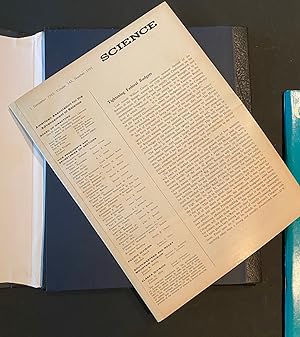
Two items. (1) "The Digital Computer as a Musical Instrument" and (2) C. Roads, "Interview with Max Mathews" in "Science" and "Computer Music Journal". ** A Visionary Work**
Publicado por Science AND Computer Music Journal. **Visionary Piece of Writing 'There are no theoretical limits' to the Computer in Music**, 1963
Librería: JF Ptak Science Books, Hendersonville, NC, Estados Unidos de America
Calificación del vendedor: 5 de 5 estrellas
EUR 2.171,24
Envío por EUR 5,06
Se envía dentro de Estados Unidos de AmericaCantidad disponible: 1 disponibles
Añadir al carritoSoft cover. Condición: Fine. MATHEWS, Max V. Two items. (1) "The Digital Computer as a Musical Instrument" in Science, vol 142 no. 3592, 1 November 1963 in the issue of pp of (ii), 545-624 with the Mathews on pp 553-557. This is the full issue extracted from a larger bound volume with the spine finely restored professionally with a slick paper backing. VG/Fine copy. [++] With: (2) C. Roads, "Interview with Max Mathews", in Computer Music Journal, vol 4 no. 4, Winter 1980, published by the MIT press. 95p, with the Mathews interview on pp 15-22. Original wrappers. Slick paper. FINE copy. This issue comes with a **flexidisk** recording laid in: Paul Lansky, "Two Fantasies on a Poem by Thomas Campion" (1980) on side one. Side two: "Examples of digital sound synthesis techniques by James Dashow", and with "Opening section of Prisms by Stanley Haynes". 7"x 7". Black acetate (?) Very Fine. [++] Both are laid into a new and very fine four-fold case with leather joints. Lovely. [++] "The rapid evolution of [Mathews] work inspired [him] to publish a visionary 1963 Science Magazine piece [offered here] confidently predicting the computer would soon emerge as the ultimate musical instrument. 'There are no theoretical limits', he wrote, 'to the performance of the computer as a source of musical sounds." And: "Two further major 1950s developments were the origins of digital sound synthesis by computer, and of algorithmic composition programs beyond rote playback. Max Mathews at Bell Laboratories developed the influential MUSIC I program and its descendants, further popularising computer music through a 1963 article in Science [the paper offered here]. --Bogdanov, Vladimir, "All Music Guide to Electronica: The Definitive Guide to Electronic Music", 1980, Backbeat Books. p. 321 [++] "Max Vernon Mathews (1926-2011) was a pioneer of computer music, He studied electrical engineering at the California Institute of Technology and the Massachusetts Institute of Technology, receiving a Sc.D. in 1954. Working at Bell Labs, Mathews wrote MUSIC, the first widely used program for sound generation, in 1957. For the rest of the century, he continued as a leader in digital audio research, synthesis, and human-computer interaction as it pertains to music performance. In 1968, Mathews and L. Rosler developed Graphic 1, an interactive graphical sound system on which one could draw figures using a light-pen that would be converted into sound, simplifying the process of composing computer generated music. Also in 1970, Mathews and F. R. Moore developed the GROOVE (Generated Real-time Output Operations on Voltage-controlled Equipment) system, a first fully developed music synthesis system for interactive composition and realtime performance."--Wikipedia n Max Mathews. [++] "[Mathews] published another detailed paper, "The Digital Computer as a Musical Instrument" in Science, November 1, 1963. These papers created a widespread interest in the generation of waveforms by digital computers, for musical or research purposes." John R. Pierce quoted in "Technology, Musical Perception, and the Composer", Technology and Perception, by J. Timothy Kolosick.
-
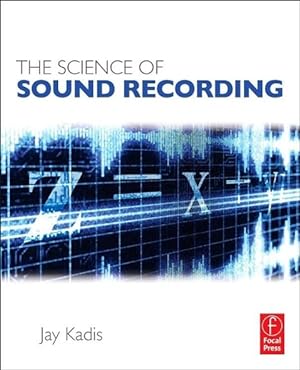
Kadis, J: The Science of Sound Recording
Librería: moluna, Greven, Alemania
Calificación del vendedor: 4 de 5 estrellas
EUR 56,83
Envío por EUR 48,99
Se envía de Alemania a Estados Unidos de AmericaCantidad disponible: Más de 20 disponibles
Añadir al carritoCondición: New. Dieser Artikel ist ein Print on Demand Artikel und wird nach Ihrer Bestellung fuer Sie gedruckt. As a Lecturer and Audio Engineer for the Center for Computer Research in Music and Acoustics, Stanford University, Jay Kadis has written and performed with several bands, including Urban Renewal and Offbeats. He has built home studios, recorded and produce.