

Importe total (1 artículo artículos):
Destino del pedido:

a thurber beverly (11 resultados)
Ir a los resultados principales
Filtros de búsqueda
Tipo de artículo
- Todos los tipos de productos
- Libros (11)
- Revistas y publicaciones (No hay ningún otro resultado que coincida con este filtro.)
- Cómics (No hay ningún otro resultado que coincida con este filtro.)
- Partituras (No hay ningún otro resultado que coincida con este filtro.)
- Arte, grabados y pósters (No hay ningún otro resultado que coincida con este filtro.)
- Fotografías (No hay ningún otro resultado que coincida con este filtro.)
- Mapas (No hay ningún otro resultado que coincida con este filtro.)
- Manuscritos y coleccionismo de papel (No hay ningún otro resultado que coincida con este filtro.)
Condición Más información
- Nuevo (9)
- Como nuevo, Excelente o Muy bueno (1)
- Bueno o Aceptable (1)
- Regular o Pobre (No hay ningún otro resultado que coincida con este filtro.)
- Tal como se indica (No hay ningún otro resultado que coincida con este filtro.)
Encuadernación
Más atributos
- Primera edición (No hay ningún otro resultado que coincida con este filtro.)
- Firmado (No hay ningún otro resultado que coincida con este filtro.)
- Sobrecubierta (No hay ningún otro resultado que coincida con este filtro.)
- Con imágenes (9)
- No impresión bajo demanda (2)
Idioma (2)
Precio
- Cualquier precio
- Menos de EUR 20 (No hay ningún otro resultado que coincida con este filtro.)
- EUR 20 a EUR 45 (No hay ningún otro resultado que coincida con este filtro.)
- Más de EUR 45
Gastos de envío gratis
- Envío gratis a Estados Unidos de America (No hay ningún otro resultado que coincida con este filtro.)
Ubicación del vendedor
Valoración de los vendedores
-

Bones at a crossroads: Integrating Worked Bone Research with Archaeometry and Social Zooarchaeology
Librería: Books From California, Simi Valley, CA, Estados Unidos de America
Calificación del vendedor: 4 de 5 estrellas

EUR 87,21
Envío por EUR 4,31
Se envía dentro de Estados Unidos de AmericaCantidad disponible: 1 disponibles
Añadir al carritohardcover. Condición: Very Good. Cover and edges may have some wear.
-

EUR 57,27
Envío por EUR 53,50
Se envía de Suiza a Estados Unidos de AmericaCantidad disponible: 1 disponibles
Añadir al carritoCondición: Used: Like New. LIVRE A L?ETAT DE NEUF. EXPEDIE SOUS 3 JOURS OUVRES. NUMERO DE SUIVI COMMUNIQUE AVANT ENVOI, EMBALLAGE RENFORCE. EAN:9782384281114.
-

Bones at a crossroads
Idioma: Inglés
Publicado por Sidestone Press Academics, 2021
ISBN 10: 9464270063 ISBN 13: 9789464270068
Librería: moluna, Greven, Alemania
Calificación del vendedor: 5 de 5 estrellas

EUR 45,51
Envío por EUR 48,99
Se envía de Alemania a Estados Unidos de AmericaCantidad disponible: Más de 20 disponibles
Añadir al carritoCondición: New. Dieser Artikel ist ein Print on Demand Artikel und wird nach Ihrer Bestellung fuer Sie gedruckt. Bone tool studies are at a crossroads. A current path is to go beyond the concatenation of methods or concepts borrowed from other disciplines and aim instead at a truly integrated approach that is more in line with the objectives of interdisciplinary and t.
-

Bones at a crossroads
Idioma: Inglés
Publicado por Sidestone Press Academics Sep 2021, 2021
ISBN 10: 9464270063 ISBN 13: 9789464270068
Librería: buchversandmimpf2000, Emtmannsberg, BAYE, Alemania
Calificación del vendedor: 5 de 5 estrellas
EUR 55,00
Envío por EUR 60,00
Se envía de Alemania a Estados Unidos de AmericaCantidad disponible: 1 disponibles
Añadir al carritoTaschenbuch. Condición: Neu. This item is printed on demand - Print on Demand Titel. Neuware -Bone tool studies are at a crossroads. A current path is to go beyond the concatenation of methods or concepts borrowed from other disciplines and aim instead at a truly integrated approach that is more in line with the objectives of interdisciplinary and transdisciplinary research. The papers in this volume follow this direction by adopting various forms of dialogue and integration between old and new methods and approaches, including technological analysis, usewear analysis, typology, zooarchaeology, stable isotope analysis, experimental archaeology or spatial analysis. They represent a mixture of methodological issues, case studies, and discussions of larger cultural and historical phenomena that span thousands of years and many parts of the World, from South Asia to the Near East and Europe, and from North to South America. The synergies deriving from these multi-perspective approaches lead to the repeated identification of diverse social aspects of past societies, including the identification of general social contexts of bone tool production and use, transmission of knowledge, the symbolic dimensions of artifacts, and intergroup relations as well as warfare and state formation processes. All these papers grew out of communications presented at the 13th meeting of the Worked Bone Research Group (WBRG) on October 7th¿13th, 2019, at the Département d¿anthropologie, Université de Montréal, Canada. The WBRG is an official working group of the International Council for Archaeozoology (ICAZ) dealing with the study of worked faunal remains from archaeological sites. Contents Osseous arrowheads in the Iron Age of the Upper Ganga Plains Vinayak Uncovering some aspects of the worked bone assemblages from Periods I-III (Neolithic to Pre-Northern Black Polished Ware with Iron Cultures) of Agiabir, India Ravi Shankar, Pramod P. Joglekar, Sharada Channarayapatna, and Ashok Kumar Singh Magnifying the differences: Investigating variability in Dorset Paleo-Inuit organic material culture using microscopic analysis Matilda I. Siebrecht, Sean P. A. Desjardins, Sarah M. Hazell, Susan Lofthouse, Elsa Cencig, Katie Kotar, Peter D. Jordan, and Annelou van Gijn Antler as raw material among hunter-gatherer groups from the Pampean Region (Argentina) Natacha Buc, Alejandro A. Acosta, and Lucía T. Rombolá Osseous artifacts from the Maros-culture necropolis at Ostoji¿evo (northern Serbia) Selena Vitezovi¿ An antler workshop in a Germanic settlement in Nitra, Slovakia Gertrúda B¿ezinová and Erik Hrn¿iarik The worked bone and tooth assemblage from Piaçaguera: Insights and challenges Daniela Klokler Traceological evaluation of bone instruments as an indirect indicator: Rebuilding textile technology during the Ceramic period on Mocha Island (Chile) Helga Inostroza Rojas A microscopic view of Maya needle and perforator production at Ucanal, Guatemala Carolyn Freiwald, Christina Halperin, Camille Dubois-Francoeur, Caroline Schlinsog, and Kimberly A. Bauer Warm it up! Using experimental archaeology to test shark teeth extraction hypotheses Simon-Pierre Gilson and Andrea Lessa Crafting white-tailed deer (Odocoileus virginianus) bone and antler at Cerro Juan Díaz (LS-3), Greater Coclé Culture Area, Panama María Fernanda Martínez-Polanco, Luis Alberto Sánchez-Herrera, Máximo Jiménez-Acosta, and Richard G. Cooke Preliminary spatial analysis of the morphologically identifiable bone tools from an Early Bronze Age III domestic building in a residential neighborhood house at Tell e¿-¿âfi/Gath (Stratum E5c) Sarah J. Richardson, Haskel J. Greenfield, Tina L. Greenfield, and Aren M. Maeir A Woodland-period bone tool industry on the northern Gulf of Mexico coastal plain Gregory A. Waselkov, Sarah E. Price, Alexandra Stenson, Carla S. Hadden, and Long Dinh The many dimensions of a bone Marie-Ève Boisvert, Claire St-Germain, and Christian Gates St-PierreBooks on Demand GmbH, Überseering 33, 22297 Hamburg 318.
-

Bones at a crossroads
Idioma: Inglés
Publicado por Sidestone Press Academics, 2021
ISBN 10: 9464270063 ISBN 13: 9789464270068
Librería: preigu, Osnabrück, Alemania
Calificación del vendedor: 5 de 5 estrellas
EUR 47,25
Envío por EUR 70,00
Se envía de Alemania a Estados Unidos de AmericaCantidad disponible: 5 disponibles
Añadir al carritoTaschenbuch. Condición: Neu. Bones at a crossroads | Markus Wild (u. a.) | Taschenbuch | Englisch | 2021 | Sidestone Press Academics | EAN 9789464270068 | Verantwortliche Person für die EU: preigu GmbH & Co. KG, Lengericher Landstr. 19, 49078 Osnabrück, mail[at]preigu[dot]de | Anbieter: preigu Print on Demand.
-
Bones at a crossroads
Idioma: Inglés
Publicado por Sidestone Press Academics, 2021
ISBN 10: 9464270063 ISBN 13: 9789464270068
Librería: AHA-BUCH GmbH, Einbeck, Alemania
Calificación del vendedor: 5 de 5 estrellas
EUR 56,43
Envío por EUR 64,60
Se envía de Alemania a Estados Unidos de AmericaCantidad disponible: 1 disponibles
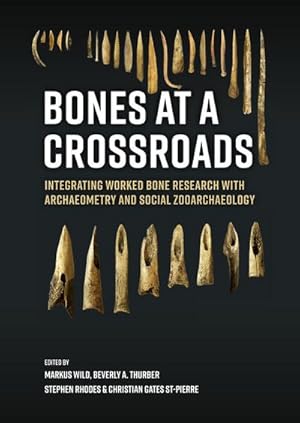
Añadir al carritoTaschenbuch. Condición: Neu. nach der Bestellung gedruckt Neuware - Printed after ordering - Bone tool studies are at a crossroads. A current path is to go beyond the concatenation of methods or concepts borrowed from other disciplines and aim instead at a truly integrated approach that is more in line with the objectives of interdisciplinary and transdisciplinary research.The papers in this volume follow this direction by adopting various forms of dialogue and integration between old and new methods and approaches, including technological analysis, usewear analysis, typology, zooarchaeology, stable isotope analysis, experimental archaeology or spatial analysis. They represent a mixture of methodological issues, case studies, and discussions of larger cultural and historical phenomena that span thousands of years and many parts of the World, from South Asia to the Near East and Europe, and from North to South America. The synergies deriving from these multi-perspective approaches lead to the repeated identification of diverse social aspects of past societies, including the identification of general social contexts of bone tool production and use, transmission of knowledge, the symbolic dimensions of artifacts, and intergroup relations as well as warfare and state formation processes.All these papers grew out of communications presented at the 13th meeting of the Worked Bone Research Group (WBRG) on October 7th-13th, 2019, at the Département d'anthropologie, Université de Montréal, Canada. The WBRG is an official working group of the International Council for Archaeozoology (ICAZ) dealing with the study of worked faunal remains from archaeological sites.ContentsOsseous arrowheads in the Iron Age of the Upper Ganga PlainsVinayakUncovering some aspects of the worked bone assemblages from Periods I-III (Neolithic to Pre-Northern Black Polished Ware with Iron Cultures) of Agiabir, IndiaRavi Shankar, Pramod P. Joglekar, Sharada Channarayapatna, and Ashok Kumar SinghMagnifying the differences: Investigating variability in Dorset Paleo-Inuit organic material culture using microscopic analysisMatilda I. Siebrecht, Sean P. A. Desjardins, Sarah M. Hazell, Susan Lofthouse, Elsa Cencig, Katie Kotar, Peter D. Jordan, and Annelou van GijnAntler as raw material among hunter-gatherer groups from the Pampean Region (Argentina)Natacha Buc, Alejandro A. Acosta, and Lucía T. RomboláOsseous artifacts from the Maros-culture necropolis at Ostojicevo (northern Serbia)Selena VitezovicAn antler workshop in a Germanic settlement in Nitra, SlovakiaGertrúda Brezinová and Erik HrnciarikThe worked bone and tooth assemblage from Piaçaguera: Insights and challengesDaniela KloklerTraceological evaluation of bone instruments as an indirect indicator: Rebuilding textile technology during the Ceramic period on Mocha Island (Chile)Helga Inostroza RojasA microscopic view of Maya needle and perforator production at Ucanal, GuatemalaCarolyn Freiwald, Christina Halperin, Camille Dubois-Francoeur, Caroline Schlinsog, and Kimberly A. BauerWarm it up! Using experimental archaeology to test shark teeth extraction hypothesesSimon-Pierre Gilson and Andrea LessaCrafting white-tailed deer (Odocoileus virginianus) bone and antler at Cerro Juan Díaz (LS-3), Greater Coclé Culture Area, PanamaMaría Fernanda Martínez-Polanco, Luis Alberto Sánchez-Herrera, Máximo Jiménez-Acosta, and Richard G. CookePreliminary spatial analysis of the morphologically identifiable bone tools from an Early Bronze Age III domestic building in a residential neighborhood house at Tell es-Sâfi/Gath (Stratum E5c)Sarah J. Richardson, Haskel J. Greenfield, Tina L. Greenfield, and Aren M. MaeirA Woodland-period bone tool industry on the northern Gulf of Mexico coastal plainGregory A. Waselkov, Sarah E. Price, Alexandra Stenson, Carla S. Hadden, and Long DinhThe many dimensions of a boneMarie-Ève Boisvert, Claire St-Germain, and Christian Gates St-Pierre.
-

Bones at a crossroads
Idioma: Inglés
Publicado por Sidestone Press Academics, 2021
ISBN 10: 9464270071 ISBN 13: 9789464270075
Librería: moluna, Greven, Alemania
Calificación del vendedor: 5 de 5 estrellas
EUR 112,64
Envío por EUR 48,99
Se envía de Alemania a Estados Unidos de AmericaCantidad disponible: Más de 20 disponibles
Añadir al carritoCondición: New. Dieser Artikel ist ein Print on Demand Artikel und wird nach Ihrer Bestellung fuer Sie gedruckt. Bone tool studies are at a crossroads. A current path is to go beyond the concatenation of methods or concepts borrowed from other disciplines and aim instead at a truly integrated approach that is more in line with the objectives of interdisciplinary and t.
-

Bones at a crossroads
Idioma: Inglés
Publicado por Sidestone Press Academics Sep 2021, 2021
ISBN 10: 9464270071 ISBN 13: 9789464270075
Librería: BuchWeltWeit Ludwig Meier e.K., Bergisch Gladbach, Alemania
Calificación del vendedor: 5 de 5 estrellas
EUR 145,00
Envío por EUR 23,00
Se envía de Alemania a Estados Unidos de AmericaCantidad disponible: 2 disponibles
Añadir al carritoBuch. Condición: Neu. This item is printed on demand - it takes 3-4 days longer - Neuware -Bone tool studies are at a crossroads. A current path is to go beyond the concatenation of methods or concepts borrowed from other disciplines and aim instead at a truly integrated approach that is more in line with the objectives of interdisciplinary and transdisciplinary research.The papers in this volume follow this direction by adopting various forms of dialogue and integration between old and new methods and approaches, including technological analysis, usewear analysis, typology, zooarchaeology, stable isotope analysis, experimental archaeology or spatial analysis. They represent a mixture of methodological issues, case studies, and discussions of larger cultural and historical phenomena that span thousands of years and many parts of the World, from South Asia to the Near East and Europe, and from North to South America. The synergies deriving from these multi-perspective approaches lead to the repeated identification of diverse social aspects of past societies, including the identification of general social contexts of bone tool production and use, transmission of knowledge, the symbolic dimensions of artifacts, and intergroup relations as well as warfare and state formation processes.All these papers grew out of communications presented at the 13th meeting of the Worked Bone Research Group (WBRG) on October 7th-13th, 2019, at the Département d'anthropologie, Université de Montréal, Canada. The WBRG is an official working group of the International Council for Archaeozoology (ICAZ) dealing with the study of worked faunal remains from archaeological sites.ContentsOsseous arrowheads in the Iron Age of the Upper Ganga PlainsVinayakUncovering some aspects of the worked bone assemblages from Periods I-III (Neolithic to Pre-Northern Black Polished Ware with Iron Cultures) of Agiabir, IndiaRavi Shankar, Pramod P. Joglekar, Sharada Channarayapatna, and Ashok Kumar SinghMagnifying the differences: Investigating variability in Dorset Paleo-Inuit organic material culture using microscopic analysisMatilda I. Siebrecht, Sean P. A. Desjardins, Sarah M. Hazell, Susan Lofthouse, Elsa Cencig, Katie Kotar, Peter D. Jordan, and Annelou van GijnAntler as raw material among hunter-gatherer groups from the Pampean Region (Argentina)Natacha Buc, Alejandro A. Acosta, and Lucía T. RomboláOsseous artifacts from the Maros-culture necropolis at Ostojicevo (northern Serbia)Selena VitezovicAn antler workshop in a Germanic settlement in Nitra, SlovakiaGertrúda Brezinová and Erik HrnciarikThe worked bone and tooth assemblage from Piaçaguera: Insights and challengesDaniela KloklerTraceological evaluation of bone instruments as an indirect indicator: Rebuilding textile technology during the Ceramic period on Mocha Island (Chile)Helga Inostroza RojasA microscopic view of Maya needle and perforator production at Ucanal, GuatemalaCarolyn Freiwald, Christina Halperin, Camille Dubois-Francoeur, Caroline Schlinsog, and Kimberly A. BauerWarm it up! Using experimental archaeology to test shark teeth extraction hypothesesSimon-Pierre Gilson and Andrea LessaCrafting white-tailed deer (Odocoileus virginianus) bone and antler at Cerro Juan Díaz (LS-3), Greater Coclé Culture Area, PanamaMaría Fernanda Martínez-Polanco, Luis Alberto Sánchez-Herrera, Máximo Jiménez-Acosta, and Richard G. CookePreliminary spatial analysis of the morphologically identifiable bone tools from an Early Bronze Age III domestic building in a residential neighborhood house at Tell es-Sâfi/Gath (Stratum E5c)Sarah J. Richardson, Haskel J. Greenfield, Tina L. Greenfield, and Aren M. MaeirA Woodland-period bone tool industry on the northern Gulf of Mexico coastal plainGregory A. Waselkov, Sarah E. Price, Alexandra Stenson, Carla S. Hadden, and Long DinhThe many dimensions of a boneMarie-Ève Boisvert, Claire St-Germain, and Christian Gates St-Pierre 318 pp. Englisch.
-

Bones at a crossroads
Idioma: Inglés
Publicado por Sidestone Press Academics, 2021
ISBN 10: 9464270071 ISBN 13: 9789464270075
Librería: preigu, Osnabrück, Alemania
Calificación del vendedor: 5 de 5 estrellas
EUR 116,80
Envío por EUR 70,00
Se envía de Alemania a Estados Unidos de AmericaCantidad disponible: 5 disponibles
Añadir al carritoBuch. Condición: Neu. Bones at a crossroads | Markus Wild (u. a.) | Buch | Englisch | 2021 | Sidestone Press Academics | EAN 9789464270075 | Verantwortliche Person für die EU: preigu GmbH & Co. KG, Lengericher Landstr. 19, 49078 Osnabrück, mail[at]preigu[dot]de | Anbieter: preigu Print on Demand.
-

Bones at a crossroads
Idioma: Inglés
Publicado por Sidestone Press Academics Sep 2021, 2021
ISBN 10: 9464270071 ISBN 13: 9789464270075
Librería: buchversandmimpf2000, Emtmannsberg, BAYE, Alemania
Calificación del vendedor: 5 de 5 estrellas
EUR 145,00
Envío por EUR 60,00
Se envía de Alemania a Estados Unidos de AmericaCantidad disponible: 1 disponibles
Añadir al carritoBuch. Condición: Neu. This item is printed on demand - Print on Demand Titel. Neuware -Bone tool studies are at a crossroads. A current path is to go beyond the concatenation of methods or concepts borrowed from other disciplines and aim instead at a truly integrated approach that is more in line with the objectives of interdisciplinary and transdisciplinary research.The papers in this volume follow this direction by adopting various forms of dialogue and integration between old and new methods and approaches, including technological analysis, usewear analysis, typology, zooarchaeology, stable isotope analysis, experimental archaeology or spatial analysis. They represent a mixture of methodological issues, case studies, and discussions of larger cultural and historical phenomena that span thousands of years and many parts of the World, from South Asia to the Near East and Europe, and from North to South America. The synergies deriving from these multi-perspective approaches lead to the repeated identification of diverse social aspects of past societies, including the identification of general social contexts of bone tool production and use, transmission of knowledge, the symbolic dimensions of artifacts, and intergroup relations as well as warfare and state formation processes.All these papers grew out of communications presented at the 13th meeting of the Worked Bone Research Group (WBRG) on October 7th¿13th, 2019, at the Département d¿anthropologie, Université de Montréal, Canada. The WBRG is an official working group of the International Council for Archaeozoology (ICAZ) dealing with the study of worked faunal remains from archaeological sites.ContentsOsseous arrowheads in the Iron Age of the Upper Ganga PlainsVinayakUncovering some aspects of the worked bone assemblages from Periods I-III (Neolithic to Pre-Northern Black Polished Ware with Iron Cultures) of Agiabir, IndiaRavi Shankar, Pramod P. Joglekar, Sharada Channarayapatna, and Ashok Kumar SinghMagnifying the differences: Investigating variability in Dorset Paleo-Inuit organic material culture using microscopic analysisMatilda I. Siebrecht, Sean P. A. Desjardins, Sarah M. Hazell, Susan Lofthouse, Elsa Cencig, Katie Kotar, Peter D. Jordan, and Annelou van GijnAntler as raw material among hunter-gatherer groups from the Pampean Region (Argentina)Natacha Buc, Alejandro A. Acosta, and Lucía T. RomboláOsseous artifacts from the Maros-culture necropolis at Ostoji¿evo (northern Serbia)Selena Vitezovi¿An antler workshop in a Germanic settlement in Nitra, SlovakiaGertrúda B¿ezinová and Erik Hrn¿iarikThe worked bone and tooth assemblage from Piaçaguera: Insights and challengesDaniela KloklerTraceological evaluation of bone instruments as an indirect indicator: Rebuilding textile technology during the Ceramic period on Mocha Island (Chile)Helga Inostroza RojasA microscopic view of Maya needle and perforator production at Ucanal, GuatemalaCarolyn Freiwald, Christina Halperin, Camille Dubois-Francoeur, Caroline Schlinsog, and Kimberly A. BauerWarm it up! Using experimental archaeology to test shark teeth extraction hypothesesSimon-Pierre Gilson and Andrea LessaCrafting white-tailed deer (Odocoileus virginianus) bone and antler at Cerro Juan Díaz (LS-3), Greater Coclé Culture Area, PanamaMaría Fernanda Martínez-Polanco, Luis Alberto Sánchez-Herrera, Máximo Jiménez-Acosta, and Richard G. CookePreliminary spatial analysis of the morphologically identifiable bone tools from an Early Bronze Age III domestic building in a residential neighborhood house at Tell e¿-¿âfi/Gath (Stratum E5c)Sarah J. Richardson, Haskel J. Greenfield, Tina L. Greenfield, and Aren M. MaeirA Woodland-period bone tool industry on the northern Gulf of Mexico coastal plainGregory A. Waselkov, Sarah E. Price, Alexandra Stenson, Carla S. Hadden, and Long DinhThe many dimensions of a boneMarie-Ève Boisvert, Claire St-Germain, and Christian Gates St-PierreBooks on Demand GmbH, Überseering 33, 22297 Hamburg 318 pp. Englisch.
-

Bones at a crossroads
Idioma: Inglés
Publicado por Sidestone Press Academics, 2021
ISBN 10: 9464270071 ISBN 13: 9789464270075
Librería: AHA-BUCH GmbH, Einbeck, Alemania
Calificación del vendedor: 5 de 5 estrellas
EUR 146,74
Envío por EUR 65,62
Se envía de Alemania a Estados Unidos de AmericaCantidad disponible: 1 disponibles
Añadir al carritoBuch. Condición: Neu. nach der Bestellung gedruckt Neuware - Printed after ordering - Bone tool studies are at a crossroads. A current path is to go beyond the concatenation of methods or concepts borrowed from other disciplines and aim instead at a truly integrated approach that is more in line with the objectives of interdisciplinary and transdisciplinary research.The papers in this volume follow this direction by adopting various forms of dialogue and integration between old and new methods and approaches, including technological analysis, usewear analysis, typology, zooarchaeology, stable isotope analysis, experimental archaeology or spatial analysis. They represent a mixture of methodological issues, case studies, and discussions of larger cultural and historical phenomena that span thousands of years and many parts of the World, from South Asia to the Near East and Europe, and from North to South America. The synergies deriving from these multi-perspective approaches lead to the repeated identification of diverse social aspects of past societies, including the identification of general social contexts of bone tool production and use, transmission of knowledge, the symbolic dimensions of artifacts, and intergroup relations as well as warfare and state formation processes.All these papers grew out of communications presented at the 13th meeting of the Worked Bone Research Group (WBRG) on October 7th-13th, 2019, at the Département d'anthropologie, Université de Montréal, Canada. The WBRG is an official working group of the International Council for Archaeozoology (ICAZ) dealing with the study of worked faunal remains from archaeological sites.ContentsOsseous arrowheads in the Iron Age of the Upper Ganga PlainsVinayakUncovering some aspects of the worked bone assemblages from Periods I-III (Neolithic to Pre-Northern Black Polished Ware with Iron Cultures) of Agiabir, IndiaRavi Shankar, Pramod P. Joglekar, Sharada Channarayapatna, and Ashok Kumar SinghMagnifying the differences: Investigating variability in Dorset Paleo-Inuit organic material culture using microscopic analysisMatilda I. Siebrecht, Sean P. A. Desjardins, Sarah M. Hazell, Susan Lofthouse, Elsa Cencig, Katie Kotar, Peter D. Jordan, and Annelou van GijnAntler as raw material among hunter-gatherer groups from the Pampean Region (Argentina)Natacha Buc, Alejandro A. Acosta, and Lucía T. RomboláOsseous artifacts from the Maros-culture necropolis at Ostojicevo (northern Serbia)Selena VitezovicAn antler workshop in a Germanic settlement in Nitra, SlovakiaGertrúda Brezinová and Erik HrnciarikThe worked bone and tooth assemblage from Piaçaguera: Insights and challengesDaniela KloklerTraceological evaluation of bone instruments as an indirect indicator: Rebuilding textile technology during the Ceramic period on Mocha Island (Chile)Helga Inostroza RojasA microscopic view of Maya needle and perforator production at Ucanal, GuatemalaCarolyn Freiwald, Christina Halperin, Camille Dubois-Francoeur, Caroline Schlinsog, and Kimberly A. BauerWarm it up! Using experimental archaeology to test shark teeth extraction hypothesesSimon-Pierre Gilson and Andrea LessaCrafting white-tailed deer (Odocoileus virginianus) bone and antler at Cerro Juan Díaz (LS-3), Greater Coclé Culture Area, PanamaMaría Fernanda Martínez-Polanco, Luis Alberto Sánchez-Herrera, Máximo Jiménez-Acosta, and Richard G. CookePreliminary spatial analysis of the morphologically identifiable bone tools from an Early Bronze Age III domestic building in a residential neighborhood house at Tell es-Sâfi/Gath (Stratum E5c)Sarah J. Richardson, Haskel J. Greenfield, Tina L. Greenfield, and Aren M. MaeirA Woodland-period bone tool industry on the northern Gulf of Mexico coastal plainGregory A. Waselkov, Sarah E. Price, Alexandra Stenson, Carla S. Hadden, and Long DinhThe many dimensions of a boneMarie-Ève Boisvert, Claire St-Germain, and Christian Gates St-Pierre.


