
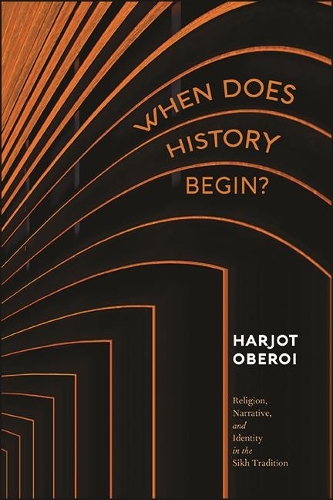

When Does History Begin?
Harjot Oberoi
ISBN 10: 1438487355 ISBN 13: 9781438487359
Editorial: State University of New York Press, US, 2022
Nuevos
Hardback
Librería:
Rarewaves.com UK, London, Reino Unido
Calificación del vendedor: 5 de 5 estrellas

Vendedor de AbeBooks desde 11 de junio de 2025
Este artículo en concreto ya no está disponible.
Descripción
Descripción:
Documents how the premodern techniques of narrating the past in South Asia were deeply transformed by colonial modernity, resulting in newer forms of truth-telling within the Sikh community.Focusing on important issues in Sikh religious identity and memory, Harjot Oberoi shows how premodern techniques of narrating the past and truth-telling in South Asia were deeply transformed by colonialism. Indian historiographical praxis has long been problematic. Al-Biruni, the eleventh-century polymath, was puzzled by how people in the subcontinent treated the protocols of history; it escaped his learning that Indian narrative constructions of the past were embedded in an intricate canon of poetical traditions and represented a radical departure from historical narratives in the Islamic, Sinic, and Greco-Roman worlds. Where others tended to search for "facts," people in South Asia looked for "affect." This alternative model for comprehending and evaluating the past-through aesthetics and gradients of taste-generated a crucially different variety of historical consciousness. Oberoi's examination of the Sikh tradition demonstrates what modern critical narrative achieves when it moves away from classical models, traversing significant moments in colonialism, coercion and protest in the Raj, the production of knowledge, the rise of secular nationalism, and modern notions of the self within and outside India. N° de ref. del artículo LU-9781438487359
Sinopsis:
Documents how the premodern techniques of narrating the past in South Asia were deeply transformed by colonial modernity, resulting in newer forms of truth-telling within the Sikh community.
Focusing on important issues in Sikh religious identity and memory, Harjot Oberoi shows how premodern techniques of narrating the past and truth-telling in South Asia were deeply transformed by colonialism. Indian historiographical praxis has long been problematic. Al-Biruni, the eleventh-century polymath, was puzzled by how people in the subcontinent treated the protocols of history; it escaped his learning that Indian narrative constructions of the past were embedded in an intricate canon of poetical traditions and represented a radical departure from historical narratives in the Islamic, Sinic, and Greco-Roman worlds. Where others tended to search for "facts," people in South Asia looked for "affect." This alternative model for comprehending and evaluating the past-through aesthetics and gradients of taste-generated a crucially different variety of historical consciousness. Oberoi’s examination of the Sikh tradition demonstrates what modern critical narrative achieves when it moves away from classical models, traversing significant moments in colonialism, coercion and protest in the Raj, the production of knowledge, the rise of secular nationalism, and modern notions of the self within and outside India.
Acerca del autor: Harjot Oberoi is Professor of South Asian History at the University of British Columbia, Canada. He is the author of The Construction of Religious Boundaries: Culture, Identity, and Diversity in the Sikh Tradition.
"Sobre este título" puede pertenecer a otra edición de este libro.
Detalles bibliográficos
Título: When Does History Begin?
Editorial: State University of New York Press, US
Año de publicación: 2022
Encuadernación: Hardback
Condición: New