
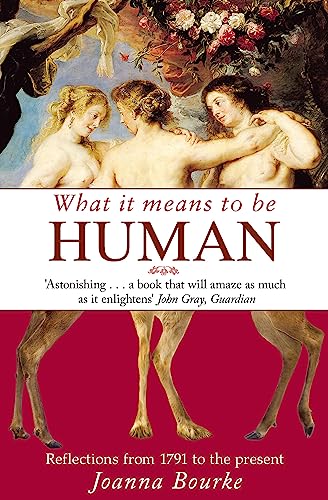
What It Means To Be Human: Reflections from 1791 to the present
Bourke, Professor Joanna
ISBN 10: 1844086453 ISBN 13: 9781844086450
Editorial: Virago, 2013
Usado
Paperback
Librería:
WorldofBooks, Goring-By-Sea, WS, Reino Unido
Calificación del vendedor: 5 de 5 estrellas

Vendedor de AbeBooks desde 16 de marzo de 2007
Este artículo en concreto ya no está disponible.
Descripción
Descripción:
The book has been read but remains in clean condition. All pages are intact and the cover is intact. Some minor wear to the spine. N° de ref. del artículo GOR006319480
Sinopsis:
In 1872, a woman known only as 'An Ernest Englishwoman' published an open letter entitled 'Are women animals?', in which she protested the fact that women were not treated as fully human. In reality, their status was worse than that of animals: regulations prohibiting cruelty against dogs, horses and cattle were significantly more punitive than laws against cruelty to women.
What does it mean to be 'human' rather than 'animal'? If the Ernest Englishwoman had turned her gaze to the previous century, her critique could equally have applied to slaves. In her time and beyond, the debate around human status involved questions of language, facial physiology, and vegetarianism. If she had been capable of looking 100 years into the future, she might have wondered about chimeras, created by transplanting animal fluids and organs into human bodies, or the ethics of stem cell research.
In this meticulously researched, wide-ranging and illuminating book, Joanna Bourke explores the legacy of more than two centuries, and looks forward to what the future might hold for humans and animals.
Acerca del autor: Joanna Bourke is a professor of history at Birkbeck College in London. Her book An Intimate History of Killing received critical acclaim, winning the Wolfson History Prize.
"Sobre este título" puede pertenecer a otra edición de este libro.
Detalles bibliográficos
Título: What It Means To Be Human: Reflections from ...
Editorial: Virago
Año de publicación: 2013
Encuadernación: Paperback
Condición: Good