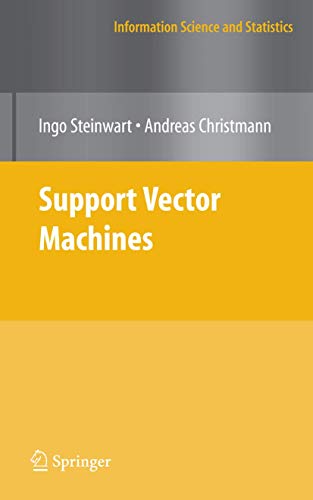
Support Vector Machines (Information Science and Statistics)
Steinwart, Ingo; Christmann, Andreas
ISBN 10: 0387772413 ISBN 13: 9780387772417
Editorial: Springer, 2008
Nuevos
Encuadernación de tapa dura
Librería:
Lucky's Textbooks, Dallas, TX, Estados Unidos de America
Calificación del vendedor: 5 de 5 estrellas

Vendedor de AbeBooks desde 22 de julio de 2022
Este artículo en concreto ya no está disponible.
Descripción
Descripción:
N° de ref. del artículo ABLIING23Feb2215580173147
Sinopsis:
Every mathematical discipline goes through three periods of development: the naive, the formal, and the critical. David Hilbert The goal of this book is to explain the principles that made support vector machines (SVMs) a successful modeling and prediction tool for a variety of applications. We try to achieve this by presenting the basic ideas of SVMs together with the latest developments and current research questions in a uni?ed style. In a nutshell, we identify at least three reasons for the success of SVMs: their ability to learn well with only a very small number of free parameters, their robustness against several types of model violations and outliers, and last but not least their computational e?ciency compared with several other methods. Although there are several roots and precursors of SVMs, these methods gained particular momentum during the last 15 years since Vapnik (1995, 1998) published his well-known textbooks on statistical learning theory with aspecialemphasisonsupportvectormachines. Sincethen,the?eldofmachine learninghaswitnessedintenseactivityinthestudyofSVMs,whichhasspread moreandmoretootherdisciplinessuchasstatisticsandmathematics. Thusit seems fair to say that several communities are currently working on support vector machines and on related kernel-based methods. Although there are many interactions between these communities, we think that there is still roomforadditionalfruitfulinteractionandwouldbegladifthistextbookwere found helpful in stimulating further research. Many of the results presented in this book have previously been scattered in the journal literature or are still under review. As a consequence, these results have been accessible only to a relativelysmallnumberofspecialists,sometimesprobablyonlytopeoplefrom one community but not the others.
Acerca del autor:
Ingo Steinwart is a researcher in the machine learning group at the Los Alamos National Laboratory. He works on support vector machines and related methods.
Andreas Christmann is Professor of Stochastics in the Department of Mathematics at the University of Bayreuth. He works in particular on support vector machines and robust statistics.
"Sobre este título" puede pertenecer a otra edición de este libro.
Detalles bibliográficos
Título: Support Vector Machines (Information Science...
Editorial: Springer
Año de publicación: 2008
Encuadernación: Encuadernación de tapa dura
Condición: New
Los mejores resultados en AbeBooks

Imagen del vendedor
Support Vector Machines
Impresión bajo demandaLibrería: moluna, Greven, Alemania
Calificación del vendedor: 4 de 5 estrellas

Condición: New. Dieser Artikel ist ein Print on Demand Artikel und wird nach Ihrer Bestellung fuer Sie gedruckt. Explains the principles that make support vector machines a successful modelling and prediction tool for a variety of applicationsRigorous treatment of state-of-the-art results on support vector machinesSuitable for both graduate students a. Nº de ref. del artículo: 5911114
Comprar nuevo
EUR 201,17
EUR 48,99 shipping
Se envía de Alemania a Estados Unidos de America
Se envía de Alemania a Estados Unidos de America
Cantidad disponible: Más de 20 disponibles
Support Vector Machines
Impresión bajo demandaLibrería: preigu, Osnabrück, Alemania
Calificación del vendedor: 5 de 5 estrellas
Buch. Condición: Neu. Support Vector Machines | Andreas Christmann (u. a.) | Buch | xvi | Englisch | 2008 | Springer | EAN 9780387772417 | Verantwortliche Person für die EU: Springer Verlag GmbH, Tiergartenstr. 17, 69121 Heidelberg, juergen[dot]hartmann[at]springer[dot]com | Anbieter: preigu Print on Demand. Nº de ref. del artículo: 101847892
Comprar nuevo
EUR 208,65
EUR 70,00 shipping
Se envía de Alemania a Estados Unidos de America
Se envía de Alemania a Estados Unidos de America
Cantidad disponible: 5 disponibles
Imagen del vendedor
Support Vector Machines
Publicado por
Springer New York, Springer New York Aug 2008, 2008
ISBN 10: 0387772413
ISBN 13: 9780387772417
Nuevo
Buch
Librería: buchversandmimpf2000, Emtmannsberg, BAYE, Alemania
Calificación del vendedor: 5 de 5 estrellas
Buch. Condición: Neu. Neuware -Every mathematical discipline goes through three periods of development: the naive, the formal, and the critical. David Hilbert The goal of this book is to explain the principles that made support vector machines (SVMs) a successful modeling and prediction tool for a variety of applications. We try to achieve this by presenting the basic ideas of SVMs together with the latest developments and current research questions in a uni ed style. In a nutshell, we identify at least three reasons for the success of SVMs: their ability to learn well with only a very small number of free parameters, their robustness against several types of model violations and outliers, and last but not least their computational e ciency compared with several other methods. Although there are several roots and precursors of SVMs, these methods gained particular momentum during the last 15 years since Vapnik (1995, 1998) published his well-known textbooks on statistical learning theory with aspecialemphasisonsupportvectormachines. Sincethen,the eldofmachine learninghaswitnessedintenseactivityinthestudyofSVMs,whichhasspread moreandmoretootherdisciplinessuchasstatisticsandmathematics. Thusit seems fair to say that several communities are currently working on support vector machines and on related kernel-based methods. Although there are many interactions between these communities, we think that there is still roomforadditionalfruitfulinteractionandwouldbegladifthistextbookwere found helpful in stimulating further research. Many of the results presented in this book have previously been scattered in the journal literature or are still under review. As a consequence, these results have been accessible only to a relativelysmallnumberofspecialists,sometimesprobablyonlytopeoplefrom one community but not the others.Springer Verlag GmbH, Tiergartenstr. 17, 69121 Heidelberg 620 pp. Englisch. Nº de ref. del artículo: 9780387772417
Comprar nuevo
EUR 246,09
EUR 60,00 shipping
Se envía de Alemania a Estados Unidos de America
Se envía de Alemania a Estados Unidos de America
Cantidad disponible: 2 disponibles
Imagen del vendedor
Support Vector Machines
Publicado por
Springer New York Aug 2008, 2008
ISBN 10: 0387772413
ISBN 13: 9780387772417
Nuevo
Buch
Librería: BuchWeltWeit Ludwig Meier e.K., Bergisch Gladbach, Alemania
Calificación del vendedor: 5 de 5 estrellas
Buch. Condición: Neu. This item is printed on demand - it takes 3-4 days longer - Neuware -Every mathematical discipline goes through three periods of development: the naive, the formal, and the critical. David Hilbert The goal of this book is to explain the principles that made support vector machines (SVMs) a successful modeling and prediction tool for a variety of applications. We try to achieve this by presenting the basic ideas of SVMs together with the latest developments and current research questions in a uni ed style. In a nutshell, we identify at least three reasons for the success of SVMs: their ability to learn well with only a very small number of free parameters, their robustness against several types of model violations and outliers, and last but not least their computational e ciency compared with several other methods. Although there are several roots and precursors of SVMs, these methods gained particular momentum during the last 15 years since Vapnik (1995, 1998) published his well-known textbooks on statistical learning theory with aspecialemphasisonsupportvectormachines. Sincethen,the eldofmachine learninghaswitnessedintenseactivityinthestudyofSVMs,whichhasspread moreandmoretootherdisciplinessuchasstatisticsandmathematics. Thusit seems fair to say that several communities are currently working on support vector machines and on related kernel-based methods. Although there are many interactions between these communities, we think that there is still roomforadditionalfruitfulinteractionandwouldbegladifthistextbookwere found helpful in stimulating further research. Many of the results presented in this book have previously been scattered in the journal literature or are still under review. As a consequence, these results have been accessible only to a relativelysmallnumberofspecialists,sometimesprobablyonlytopeoplefrom one community but not the others. 620 pp. Englisch. Nº de ref. del artículo: 9780387772417
Comprar nuevo
EUR 246,09
EUR 23,00 shipping
Se envía de Alemania a Estados Unidos de America
Se envía de Alemania a Estados Unidos de America
Cantidad disponible: 2 disponibles
Imagen del vendedor
Support Vector Machines
Publicado por
Springer New York, Springer New York, 2008
ISBN 10: 0387772413
ISBN 13: 9780387772417
Nuevo
Tapa dura
Librería: AHA-BUCH GmbH, Einbeck, Alemania
Calificación del vendedor: 5 de 5 estrellas
Buch. Condición: Neu. Druck auf Anfrage Neuware - Printed after ordering - Every mathematical discipline goes through three periods of development: the naive, the formal, and the critical. David Hilbert The goal of this book is to explain the principles that made support vector machines (SVMs) a successful modeling and prediction tool for a variety of applications. We try to achieve this by presenting the basic ideas of SVMs together with the latest developments and current research questions in a uni ed style. In a nutshell, we identify at least three reasons for the success of SVMs: their ability to learn well with only a very small number of free parameters, their robustness against several types of model violations and outliers, and last but not least their computational e ciency compared with several other methods. Although there are several roots and precursors of SVMs, these methods gained particular momentum during the last 15 years since Vapnik (1995, 1998) published his well-known textbooks on statistical learning theory with aspecialemphasisonsupportvectormachines. Sincethen,the eldofmachine learninghaswitnessedintenseactivityinthestudyofSVMs,whichhasspread moreandmoretootherdisciplinessuchasstatisticsandmathematics. Thusit seems fair to say that several communities are currently working on support vector machines and on related kernel-based methods. Although there are many interactions between these communities, we think that there is still roomforadditionalfruitfulinteractionandwouldbegladifthistextbookwere found helpful in stimulating further research. Many of the results presented in this book have previously been scattered in the journal literature or are still under review. As a consequence, these results have been accessible only to a relativelysmallnumberofspecialists,sometimesprobablyonlytopeoplefrom one community but not the others. Nº de ref. del artículo: 9780387772417
Comprar nuevo
EUR 251,15
EUR 65,43 shipping
Se envía de Alemania a Estados Unidos de America
Se envía de Alemania a Estados Unidos de America
Cantidad disponible: 1 disponibles
Imagen de archivo
Support Vector Machines
Impresión bajo demandaLibrería: Majestic Books, Hounslow, Reino Unido
Calificación del vendedor: 4 de 5 estrellas
Condición: New. Print on Demand pp. 620. Nº de ref. del artículo: 7453376
Comprar nuevo
EUR 329,33
EUR 7,45 shipping
Se envía de Reino Unido a Estados Unidos de America
Se envía de Reino Unido a Estados Unidos de America
Cantidad disponible: 4 disponibles