People of knowledge shouldn't be the decision-makers on the body. The Mayor of La Crosse, Mark Johnsrud, in a public meeting at which the city and county were discussing how an Emergency Medical Service Commission was to be staffed, made the above statement. In doing so he got the biggest laugh of the night but didn't seem to recognize the incredulity what he had just said. The incidents leading up to the approval of the petition to stop the city were in some cases humorous while in other situations were frustrating with time lost and a waste of taxpayer dollars. As you can see by the letters from other communities, such thinking is not limited to a single area, but it is common for the elected to think they can do something better or in the worst case, more profitably for their electorate than private industry. The national debate over nationalizing health care is another example where government should have very limited involvement. Members of our local Citizens for Responsible Government led the activities and we all learned much about democracy in action. I can't emphasize enough the dedication of the men and women who spent many hours and much shoe leather gathering those needed signatures for the petition. In all there were 76 circulators who talked to their friends, neighbors, and anyone who would stop long enough to listen so they could explain the need to, "Stop City Hall".
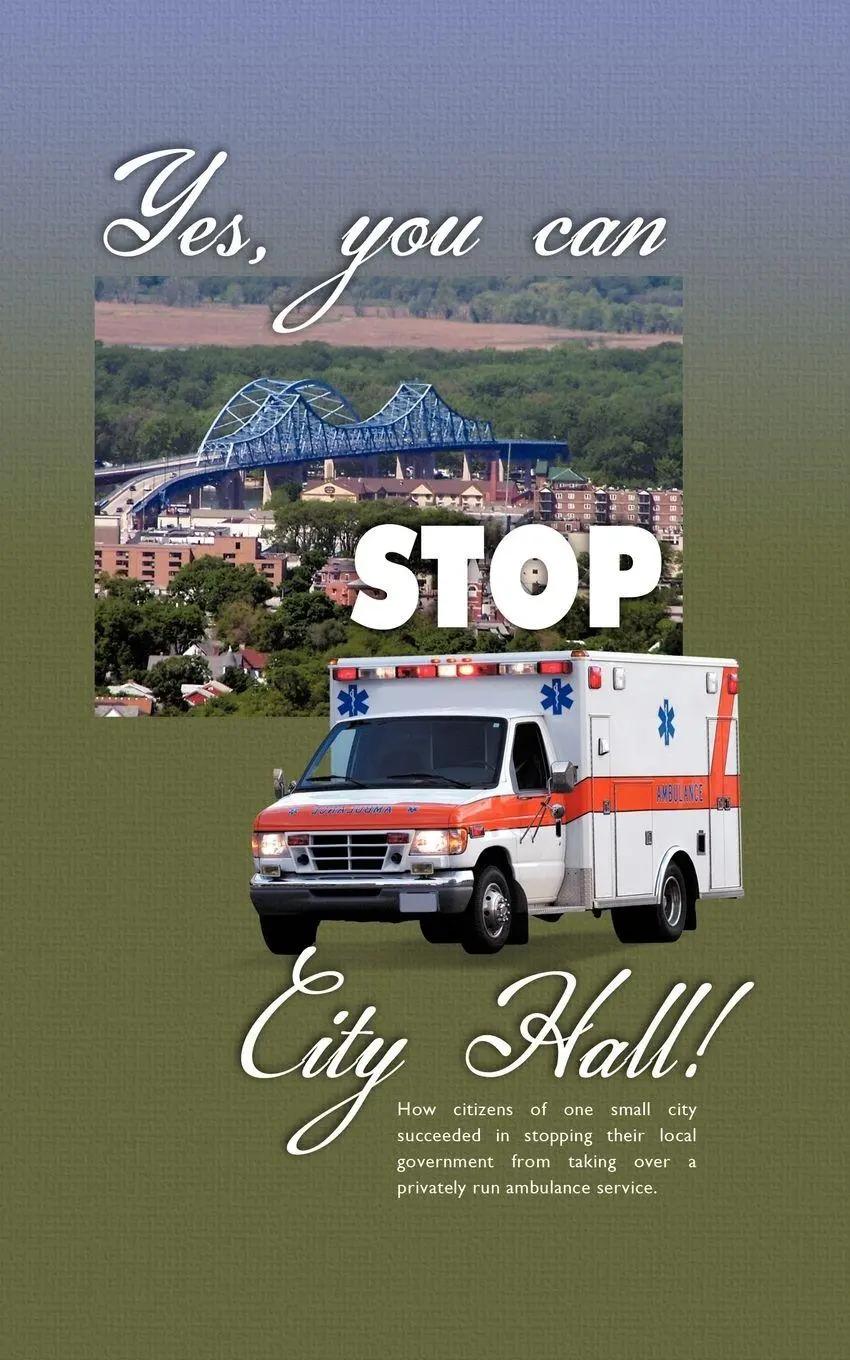
YES, YOU CAN STOP CITY HALL!
A History of Ambulance Service in La Crosse, Wisconsin and the Coulee RegionBy David DrewesAuthorHouse
Copyright © 2009 David Drewes
All right reserved.ISBN: 978-1-4490-5648-3Contents
Chapter 1 The Black Moria and Horizontal Taxis............................7Chapter 2 The Government Monster Begins to Stir...........................21Chapter 3 The Citizens Yell, NO!..........................................30Chapter 4 Oh What a Tangled Web We Weave..................................41Chapter 5 Victory in Spite of City Attorney's Opinion.....................56Chapter 6 What Can You Do?................................................68
Chapter One
The Black Moria and Horizontal Taxis
The history of ambulance service in the county of, and area surrounding La Crosse, is in some ways quite typical and in other ways quite different from those of other smaller market areas. A search for a written history provided some interesting facts, but did not include the developments in 2008 and 2009, so a record of the history including more recent events seemed essential.
The Coulee Region is the name that has been adopted for this beautiful western Wisconsin area. It is descriptive as the area is full of valleys, or coulees as they are known here, cut from the plains surrounding the Mississippi River valley. The remaining bluffs along the Mississippi are as picturesque as any in the country. There are some higher hills that rise above the plain, as this area is a non-glaciated area.
When reference is made to the Coulee Region it refers to extreme southeast Minnesota, and areas north of La Crosse, south along the river, with those areas extending east and west of the Mississippi about 50 miles.
Mr. Ken Jenkerson wrote a paper for the Police Department in May of 2001 that provided some early history of police ambulance services. He noted that until 1946 the city relied upon an aging 1937 Studebaker Ambulance. In 1946 the city purchased a paddy wagon that served a dual purpose as an improvised ambulance as well as police work. It was known as the "Black Maria" (pronounced Moriah). As can be seen it was all black.
In 1949 a Packard ambulance was purchased that acquired the name "Jet." The Packard was replaced by a Cadillac ambulance in 1962. During this period an ancient Pontiac ambulance was acquired as a backup. To keep the rear door closed they had to put a chain lock on it.
Pat "Doc" Ferguson was head instructor for training for the police force in 1966 as he had been a corpsman in the military. He also was a member of the ambulance crew. Sometimes the police used Harley Davidson motorcycles with a sidecar for transport of accident patients. Non-emergency service was provided in various ways. For a period up until 1960, Dahl Funeral Home provided transport for non-emergencies.
At one time there were five hospitals in La Crosse. (Lutheran, St. Francis, Grandview, St. Anne's, and La Crosse Hospital) The doctors, and possibly others, would transport patients to the hospital. When Grandview, St. Anne's, and La Crosse hospitals consolidated with St. Francis, this service was discontinued. At the same time emergency transportation was provided by the police and sheriff 's departments.
Later the vehicles consisted of hearse-style station wagons (also known as horizontal taxis), squad cars, and in some cases private vehicles. These carriers were usually without skilled medical personnel in attendance, and the time of transporting was often critical for survival. By 1968 the police unit had grown to 5 station wagons on the road 7 days a week. The charge per call was $15.00.
As the law-enforcement and fire department personnel people were only trained in basic survival techniques and were at the scene of an accident or fire to do their work of investigating, fighting fires, and or clearing the scene, proper medical attention was not always available.
Wisconsin recognized the need for higher standards for emergency medical services in smaller communities. The state evaluated local agencies to determine how to improve their operations, and based upon their findings, local law enforcement agencies were ordered to improve their operations.
A true pioneer brings professionalism to La Crosse ambulances
In February of 1968 two sheriff department employees, Herb Garbers and Carl Tabbert, started an ambulance service and called it Tri-State. When it was determined that there was a conflict with their duties as deputies, they sold Tri-State to Walter Gardner. Subsequently, in 1968, a former police officer, Walter "Wally" Gardner took the lead and established this privately run ambulance service for the Coulee Region. He saw the need for better and more professional care in emergency situations. At first, the operation was run from his garage with his wife Joan serving as the dispatcher. Her "office" was their back porch.
This then was the beginning of Tri-State Ambulance, and with it the beginning of modern ambulance service in the La Crosse area.
Wally was a pioneer who aggressively pursued changes for better medical care en route to medical facilities. To get more professional employees, he sponsored several students at the University of Wisconsin, La Crosse, in an, "Emergency Medical Technical Training" program. This innovation eventually led to putting the first paramedics in emergency vehicles in 1985. In recognition of his work, Wally was elected President of the Wisconsin Professional Ambulance Association in the mid 1980's.
A joint effort of St. Francis and Lutheran hospitals with Tri-State ambulance established the "Pre-hospital Advanced Care and Education" (PACE) program in 1983. The purpose was to provide standards and procedures for better patient ambulance care en route to a hospital.
In 1986 PACE contracted with an independent consultant, "The Fourth Party Inc." to provide guidance regarding ambulance/paramedic services. The evaluation authored by Jack Stout, ascertained the La Crosse market was not big enough to support competing ambulance services without a tax subsidy. In the mid 1960's alderman Pat Zielke (pictured at left) suggested a central emergency communications system, but the idea was not acceptable to the fire, police, or sheriff 's departments.
The Coulee Region needed a support system that could coordinate emergency calls from citizens outside the city of La Crosse including the remainder of the county, some Minnesota towns along the river, and other areas just outside the county. The complexity of who should respond, at what level, when, and where needed a plan with structure and coordination. In the early 70's it was recognized that an emergency communications system was essential.
An emergency 911 plan was first considered in 1978. Funding for this project required new radios for all emergency vehicles involved and a dispatch center. A historical event occurred in 1980 when for the first time there was a joint session of the La Crosse aldermen and the La Crosse County supervisors to resolve questions that crossed normal boundary lines.
911 Emergency System becomes a reality in La Crosse
At this time Pat Zielke was the mayor of La Crosse (75-97), and Charles Pierce was the county board chairman (78-85). All forms of funding and other details were eventually resolved, and in January of 1983, a 911 dispatch center became a reality.
In July of 1985 Steve and Cheryl Paar established MedStar Ambulance Service based in Onalaska. They provided only basic life support for patients, and this limitation caused questions as to whom the dispatcher should be sending on a call. It was difficult for the dispatcher to determine whether paramedic care or just basic care was needed. Both Tri-State and Med- Star questioned the call procedures which determined who was to get which call.
In one instance, the county was sued for not sending Tri-State when a person apparently needed more life support care than MedStar was able to provide. The individual died. The lawsuit was settled in November of 1989.
The La Crosse County supervisors recognized that competing ambulance services threatened the quality of emergency care, and that the conflicts needed resolution. With that in mind, the county law enforcement committee voted to establish an Emergency Medical Services (EMS) board in 1987. This board was to establish criteria for treatment of patients before their admission into a hospital. It would coordinate the 911 dispatch system, law enforcement agencies, and other involved government units.
PACE encouraged formation of the EMS board as the consultant hired by PACE had identified problems with the current ambulance system. Problems noted were poor administration and inadequate equipment. Also, part of the problem, according to the study, was that La Crosse had two competing ambulance companies.
The study, authored by Jack Stout of "The Fourth Party, Inc." recommended the county consider two options:
1. Providing a tax subsidy of $300,000 for non-emergency calls, and
2. having one ambulance service with a monopoly by written contract
Tri-State suffers a great loss
Wally Gardner, (pictured at right), died in September 1987 at age 48. He had continued working on improving emergency care and pushed for higher standards during his entire career. Former Fire Chief (72-75), Irwin Kahler, noted that he and Wally worked together as a team. When the first responders arrived at the scene before Tri-State, they would stabilize the patients and then turn them over to Tri-State. The actions and cooperation of the first responders continue to be positive today.
Because Mrs. Gardner was very familiar with Tri-State's operation, she continued as owner and operations manager for more than seven years after Wally's death. In 1987 Tri-State had six vehicles and 29 employees. The business was sold to Gundersen Lutheran Hospital in 1995.
The county continued to struggle with the decision of how to resolve the conflicts caused by competing ambulance services. One can appreciate the difficult decisions facing the county supervisors as the problems were serious and needed some governmental attention. At the same time, it was recognized monopolies can be problematic.
Whatever the action, it would have to be in the interest of high quality care while considering the best method of funding.
Rufus Schmaltz, Greenfield town chair, mentioned that government should stay out of the private business market. "We've got enough government regulation."
In November of 1987 Supervisor Mike Forer, (pictured above) chair of the county Emergency Photo courtesy of the La Crosse Tribune Medical Services Board, said, "By not doing anything, you are telling paramedics they are not wanted in La Crosse County."
People in the area wrote letters to the editor of the La Crosse Tribune asking the county board to make the "right" ambulance decision quickly. Two letters from January 1988 are summarized below:
Robert Kenneth wrote, "Public officials have scrambled to protect their political turf and thus the true issue of comprehensive effective paramedic care has been lost. The issue is quite simple. La Crosse County needs not only to continue providing a system of advanced life support, as it is authorized to do, but also to develop and engage a paramedic service. The resolution by Supervisor Mike Forer represents such a system and deserves attention."
Julie Schuppel, Franz Fisher, Concerned Citizens for La Crosse County, Paramedic Service Committee, wrote, "The primary issue is whether La Crosse County will retain paramedic service, not one ambulance service against another or monopoly versus free enterprise. Think about the ones you love and the care you want for them. Please support maintaining paramedic service in La Crosse County, your life may depend on it. Contact Mike Forer, chairman of the Emergency Medical Services board."
At this time there were four different companies offering ambulance services in La Crosse County. They were, Tri-State, MedStar of Holmen, Quad County Ambulance of Melrose, and Sparta Ambulance.
In January of 1988 the towns of Farmington, Burns and Bangor passed resolutions designating ambulance companies other than Tri-State to be their primary responder. As a result, Tri-State stated that they would no longer be able to provide paramedic staffed ambulances to Farmington, Burns, or Bangor unless specifically requested to do so. The county board passed a resolution in June of 1988 asking that all communities pick a primary and secondary ambulance service by July 15. It required the community have a written mutual aid agreement with a back-up ambulance service.
Another ambulance service, Prehospital Emergency Care Systems (PECS), explored the possibility of beginning area operations in April 1988, however, they discontinued those efforts in June of 1988.
At about this time the La Crosse County Emergency Medical Services Board agreed to work with the two hospitals to formalize an emergency medical care plan. The stated purpose of the plan was to solve the problem of competing ambulance businesses jeopardizing the future of paramedic level care in the area. The Emergency Medical Services Board was formed in 1987 to oversee ambulance services and avoid the need for a county financial subsidy.
Quad-County Ambulance announced plans to end its services in March of 1988. The company had begun operations in 1982 but was plagued by a lack of volunteers. Quad County covered the towns of Farmington, Franklin, Irving, Melrose, and North Bend. Sparta ambulance handled the eastern end of the county while Tri-State and MedStar battled over the central and western parts of the county.
Wisconsin Attorney General James Doyle charged MedStar Ambulance Service, Inc. with defrauding the state's medical assistance program in December of 1994. MedStar ceased operating in 1995.
Tri-State ownership changes
Numerous offers were made to purchase all or part of Tri-State over the years following Wally's death, but Joan wanted to continue the business her husband had started. The battles with competing, but less medically qualified ambulance businesses took their toll and made it difficult to keep Tri-State's operation viable. Finally, in December of 1994, Gundersen Lutheran Hospital announced it intended to purchase Tri-State. Franciscan Skemp hospital declined to be involved in the ownership.
Tri-State was sold as a subsidiary of Lutheran Hospital on March 14, 1995. At this time, some aspects of Tri-State's contract with the county had not been resolved, so the old contract was just extended to December of 1995.
At time of sale Tri-State had 12 ambulances and 70 employees.
There was concern that Tri-State, as a subsidiary of Lutheran Hospital, would not offer the chance for patients to choose which hospital they would be taken to for treatment. It was clarified with a medical control agreement between the two hospitals. This agreement allows full choice by the patient; however, if no hospital was requested, ambulance deliveries would be made to St Francis and/or Lutheran on alternate weeks.
Later studies showed this plan worked very well, and the number of deliveries of patients to each hospital was balanced and equitable.
Thus began a new chapter of ambulance service in La Crosse, La Crosse County, and surrounding communities.
Chapter Two
The government monster begins to stir
As ambulance service in the "Coulee Region" evolved over the years from 1968 to 1995, several things became evident. The people of the region recognized the need for high-level emergency medical care, and they wanted it available at their homes or scenes of accidents as quickly as possible. This required thoroughly trained paramedics with fully equipped ambulances on call 24/7.
It also became apparent that standards were necessary to meet the needs of the hospitals and the county residents. The county Emergency Medical Services Board (EMS) found that service was improving. Previous studies and experiences of other smaller markets showed that a community of this size could not support more than one ambulance company unless a tax subsidy was imposed. In addition, without a high number of calls to exercise the required paramedic skills, quality of care would also suffer.
In February of 1996 the Town of Farmington and Tri-State signed a three-year pact that required more of Tri-State than the county contract had. Tri-State was to station an ambulance in Mindoro with Mindoro providing the garage, and that the former Med-Star employees based in Mindoro would be given an opportunity to work for Tri-State. The town was to pay a $75 "no haul" fee when care was given but there was no actual transporting of a patient.
No other support by taxes or other means was to be provided.
Med-Star had received a subsidy of $3,000 annually.
The City of Onalaska had a contract with Tri- State to provide first responder services as well as paramedic care. The fire department was to provide back-up first responder care.
In April of 1998 Onalaska decided their fire department would provide the basic life support first responder service with Tri-State continuing the advanced paramedic ambulance service. Tri-State would no longer keep its ambulance at the National Guard Armory, as the site did not meet Wisconsin State standards for storage. Onalaska felt this new arrangement would better serve its community.
(Continues...)
Excerpted from YES, YOU CAN STOP CITY HALL!by David Drewes Copyright © 2009 by David Drewes. Excerpted by permission.
All rights reserved. No part of this excerpt may be reproduced or reprinted without permission in writing from the publisher.
Excerpts are provided by Dial-A-Book Inc. solely for the personal use of visitors to this web site.