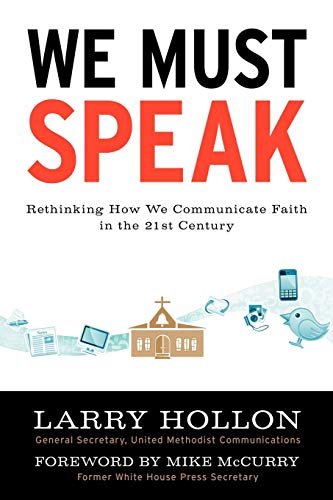
We Must Speak: Rethinking How We Communicate About Faith in the 21st Century "Pray that I may declare (the message) boldly, as I must speak" - Ephesians 6:20 In "We Must Speak" Larry Hollon addresses the communications crisis in mainline denominations and sounds a call to action for the church: Speak out in today's digital culture or risk irrelevance. Communications technology is connecting people in unprecedented ways, yet many mainline churches have been slow to adapt - and have continued to lose members and status. Other voices and messages are filling the void, offering superficial entertainment and consumerism as poor substitutes for the good news of the church. By embracing communications ministry, churches can transform their communities, change lives and be the presence of Christ for a hurting world. Hollon shares success stories, a theologically grounded vision, and specific steps for local congregations and denominations to tap the power of communications. "Larry Hollon sets out the case for why we need to maintain our voice . . . in a world crowded with competing messages and often destructive values" - Mike McCurry, former White House press secretary
WE MUST SPEAK
RETHINKING HOW WE COMMUNICATE ABOUT FAITH IN THE 21ST CENTURYBy LARRY HOLLON AuthorHouse
Copyright © 2012 Connexion Mission and Ministry
All right reserved.ISBN: 978-1-4772-3211-8Contents
ABOUT THE AUTHOR.......................................................ixFOREWORD...............................................................xiINTRODUCTION...........................................................xviiPart One Why We Speak..................................................11. OUR MISSING VOICE...................................................32. THE FOUNDATIONS OF CHRISTIAN COMMUNICATION..........................123. IS THE MESSAGE THAT THERE IS NO MESSAGE?............................174. DEEP SUPPORT........................................................235. SINGING GOD'S SONG..................................................336. LIVING FAITH, DOING THEOLOGY........................................397. ENGAGING THE CULTURE, HEALING THE WORLD.............................508. THE MESSAGE WE LIVE.................................................55Part Two A Second Chance...............................................639. STORY, CALLING, AND MINISTRY........................................6510. STRATEGIES FOR LIFE................................................7111. PROMISE AND POSSIBILITY............................................7512. WILL, FOCUS, AND PUBLIC POLICY.....................................8713. TRANSFORMATIVE COMMUNICATION.......................................9814. STORIES OF HOPE AND HEALING........................................10215. THE VALUE OF EVERY PERSON..........................................11016. THE USE OF OUR RESOURCES...........................................11417. WORD AND IMAGE.....................................................11818. THE CHALLENGE WE FACE, THE CONFIDENCE WE SHARE.....................122Appendices.............................................................1271. MULTIMEDIA LINKS....................................................1292. A BRIEF HISTORY OF GOD'S COMMUNICATION..............................1303. SIX REASONS TO LEAVE................................................1324. FEAR IS NOT THE ONLY FORCE..........................................1345. "IS VIRTUAL COMMUNITY INCARNATIONAL?"...............................1366. THE IMAGINE NO MALARIA PARTNERSHIP..................................1387. CÔTE D'IVOIRE: THE VOICE OF HOPE...............................1398. CHART: EXAMPLE OF STRATEGIC COMMUNICATIONS..........................1409. THE POWER OF IMAGES.................................................14110. GOD IN OUR MIDST...................................................144BIBLIOGRAPHY...........................................................147
Chapter One
OUR MISSING VOICE
In the most connected era in human history, as the tools of communication have become ubiquitous and instantaneous, one voice is missing. While people across the globe gain ever-greater access to instant messaging and to 24/7 news, information, and social connection through the Internet, the mainline denominations have unplugged themselves. A dozen years into the millennium, our global repository of Christian unity and experience, spiritual and moral guidance, and advocacy for the marginalized is for all practical purposes on the sideline. It appears we have all but abandoned our responsibility to bring the Good News to the people of the world.
The First Great Wave
The phenomenon began amid the first great wave of global connectedness. The 1960s brought the first communications satellites, allowing news and information to reach the farthest corners of the globe in real time. For good or ill, Western culture—its music, television, art, sports, and ideas—was transported around the world. Concurrently, images from the war in Southeast Asia reached our homes in time for the evening news, giving events half a world away the power to grip us with an immediacy we had never experienced before. Cultures and institutions were being radically and fundamentally changed in ways we could not begin to comprehend at the time. We are still sorting out the intellectual and emotional effects of that transformation and their meaning for and impact on the church.
Ironically, the '60s saw the flowering of the last great generation of communicators within the mainline denominations. Those years were a golden age of communication led by Dr. C. Everett Parker, director of the Office of Communication of the United Church of Christ from 1954 until 1983, and Dr. William F. Fore, United Methodist clergyperson and executive director from 1964 to 1989 of the Broadcasting and Film Commission of the National Council of Churches of Christ U.S.A.
Parker was named by Broadcasting magazine as one of the most influential men in the field. He was known both for his leadership and for his activism on behalf of social reform. Fore was equally influential as an interpreter of theology through popular media. He frequently contributed cover articles on faith and culture to popular magazines including TV Guide, one of the highest-circulation publications of the broadcast era. The magazine, and thus Fore and a contemporary Christian perspective, had a place in every living room.
Fore and Parker engaged the culture in other important and often profound ways, using media, government agencies, and the courts when the situation warranted. When, to take just one example, a TV station in Mississippi would not provide air time for African Americans, as their license required, Fore, Parker, and others viewed the situation as a justice issue, one for which the involvement of a religion communications agency was appropriate. With the support of their respective agencies, they sued the Federal Communications Commission, first for the right even to petition the agency as non-license-holders, and then to force revocation of the station's license. The Supreme Court, in an opinion written by later Chief Justice Warren Burger, did indeed direct the FCC to revoke the license, a move which, according to Fore, made every TV station realize "they had to begin to seriously meet the interests of their minority publics, or risk losing their license." The decision was in essence a media-focused Civil Rights victory.
That generation, unlike ours, was able to articulate a theology of communication that was about justice, fairness, and equity while carrying the message of the gospel to the world through media.
Disengaging
However, the mainline church as a whole then began to disengage from the media. The reasons were many, not the least of which was a misreading of the changes that were coming. Today, in hindsight, we discuss these changes as the end of the Enlightenment, the close of the modern era, and the transition to post-modernism. The privileged position the church held in the West was coming to an end as waves of secularization swept through society and the honoring of the individual was becoming paramount.
The shift happened within a marketplace of ideas freer than any other the world had seen, carried by the mass media, the most pervasive means of communication ever known, amid a rise of new technologies heralding mass production and consumption on a scale unprecedented in human history. As these new forms of human interaction reshaped the culture and its values, changing the ways we relate to one another as individuals and as communities, the mainline churches absented themselves. Amid a revolution in thought and conversation, they left their place in the discussion to others.
Denominations backed away from producing radio and television programming in a resolute way, a decision that may have been in part economic, a result of broadcasters working to free themselves of a commitment to public service time, which did not generate revenue. That time was available because of government recognition, from the inception of radio in 1927, that the public owned the broadcast spectrum. In exchange for access to the airwaves, broadcast media had been required to serve the public interest with public affairs programming produced on behalf of the entire community, to assure that groups that might not otherwise have a voice in the public conversation were not left out.
The mainline churches were also the victims of political attacks from well-funded right-wing foundations and advocacy groups. Their agenda was to de-fund those organizations and denominations that did not adhere to conservative political ideology.
In addition, denominational leaders might well have believed that person-to-person outreach would be sufficient or that the voices of their respective denominations had a strength, resonance, and momentum capable of sustaining them in this new world. And after centuries of comfort with and mastery of the tools of print culture, the church did not adapt as well to the visual imagery and the nonlinear and episodic aspects of broadcast media. Consequently, mainline churches failed to embrace the opportunities the technology brought.
Throughout the 1980s, the Federal Communications Commission reduced the responsibility of broadcasters to offer public service programming. Prior to this action, they were required to offer programs to serve the public interest, giving access to a wide range of voices that otherwise might go unheard. The FCC monitored this requirement and considered it when licenses came up for renewal. When it was relaxed, the change effectively closed the lid for good on free broadcast time for the church and many other groups. The time previously allocated to the public interest was now available to broadcasters to sell.
In the decades that followed, the advance of communication technology proceeded even faster. Old media—print and broadcast—began giving way to new. Cable television divided and subdivided audiences into smaller and smaller groups; network shows would never again achieve the kind of saturation they once had, and television news lost its domination. Video games announced the beginning of electronic entertainment, which would come to steal audience numbers from all other forms. The computer, once room-sized and available only to universities and corporations, was a decentralizing force as it made its way into the average person's home and office. Thus, advances in our ability to communicate actually fed fragmentation and isolation.
Over the next three decades, all those forms and functions would coalesce in handheld devices that now provide information, entertainment, and virtual community. The media with roots in another time—television and movies, radio and records, newspapers and magazines—not to mention games, shopping, and an overabundance of "apps" previously unheard of, are all available now in handheld devices. Our media-saturated culture sits squarely in our palms.
Communication technologies of today represent a breakthrough as world-changing as that of the printing press, the Industrial Revolution, or the assembly line. But whereas church leaders and thinkers of the past embraced the printing press (the mainline denominations are an outgrowth of it), today's mainline churches have failed to embrace a revolution that amounts to another sea change in human history. They set aside what had been considered a core function—communication—viewing it increasingly as a back-office support function and cutting staff and salaries. In the decades since, denominations have lost many of the skills to reflect theologically on how media content and tools affect us and how to use these media to interpret faith to people in the culture. Sadly, we've also lost much of the focus and fire that the last great generation of communicators bequeathed us.
Lost in the Noise
The '60s eliminated distance as a factor in the communication equation. The '90s pushed further, eliminating source dominance and consequently putting the ability to send and receive, opine and react, launch prose or video into the hands of everyone, not just corporations and institutions. The next great phase of communication, the one that moved connectedness from the dominion of the network and the conglomerate to that of the individual, had arrived, as miniaturization and other advances brought it into the homes and ultimately the palms of people everywhere.
As is often the case, that egalitarian development skewed the range of taste, quality, and sophistication toward the lowest common denominator. This factor was perhaps another reason for the church's lack of engagement. With the church entrenched in the old ways of doing things, the new may have seemed transitory and then perhaps trivial or faddish, offering simply entertainment or analgesia. Many in our leadership no doubt considered it lowbrow, beneath the theological discourse conducted in offices far removed from the college dorms, coffee shops, and suburban living rooms so transformed by technology. As the mainline overlooked the profound usefulness the new media would have for serious thought and scholarship, other, far different religious voices were actively engaging those media to advance their own political, moral, and ideological convictions.
While the church may view much of the content available on all these venues as idle or debasing, nevertheless they express values and promulgate worldviews. Those values and worldviews do not reflect our voice or offer any sort of unified and coherent message to a world John Wesley, the founder of the Methodist movement, regarded as his parish. Rather, the frame is secular and consumer-driven, often exaggerated for impact, in which partisan extremes and corporate advertising shape value and values. We are, for the first time since pre-Constantinian Europe, experiencing a world in which the Christian message is not an organized and coherent part of widespread public discourse. The gospel of Jesus is at best a fragmented sidebar in a media-saturated 21st-century culture.
By remaining silent, mainline traditions abrogate responsibility to influence the culture by not injecting moral and ethical values for the benefit of the common good. The results have been disastrous. Can it be merely accidental that the decline of the church over the past thirty years coincides with our disengagement from the culture and our withdrawal from mainstream media, the entity that does more than anything to shape attitudes, values, and culture?
The various denominational boards and agencies have played vital roles in communications at important points. However, what has been lacking is an integrated, consistent mainline identity in public discourse. Without it, the several voices are lost in the noise and less able to achieve the scale of influence they deserve.
Moreover, those engaged in specialized functions, such as education, advocacy, and mission, usually operate in a particular sphere and not in the wide landscape of the culture. They are specialists, and appropriately so. Each is an important witness and presence in their arenas of influence, but their respective mandates call for them to perform specific tasks. A key consideration for a holistic communication strategy is that it consistently presents the values and theology of the whole body and is effective across this vast media landscape, in addition to appealing to specific, targeted groups.
For example, the role of the advocacy offices of the denominations is to work closely with legislators, often outside the glare of media, to interject humane values into policy-making and legislative processes. This function is essential. However, the contention of this book is that the voice of the mainline denominations should be present in the wider culture, offering imaginative alternatives to the worst society has to offer and influencing values toward the common good. That role extends beyond attempting to shape public policy. Its function is not political and therefore is not encapsulated in ideology, right or left.
Set against the values of a consumer-oriented culture, the task is counter-cultural. It involves inviting people into a supportive community, offering an alternative understanding of life (one lived in relationship to a loving God), and affirming values that rest in the teachings of Jesus:
• That we are all created for meaning and purpose and deserve to live in conditions that allow us to flourish as God intends for us all;
• That each voice yearns to be heard and, in the economy of God's creation, each is heard;
• That none of us stands outside the embracing love of God;
• That we are each invited to enter into a relationship with God that offers us healing, forgiveness, and meaningful direction for our lives.
The specific roles of education, advocacy, and mission boards or agencies, for example, are vital. However, an integrated, consistent mainline identity in public discourse does not compete with or detract from their function. Rather, it extends and broadens their reach. The scope and scale of the mainline communions are key assets.
Combined, our voice can have greater influence in redirecting attention toward humane values than any one individual or agency can accomplish alone. This potential is why it's so important for mainline communions to find their voice once again. They are networks of influence with the capacity to effect healing, empowerment, reconciliation, and justice.
Reclaiming our voice is important not just for us, but also for the world, which needs to hear of these life-enhancing values. The church calls us to compassion and responsibility for one another; to reconciliation, not violence. The church calls us to listen and hear with an ear for justice, self-determination, and human flourishing. This much-needed voice contrasts with the harsh rhetoric and exclusive claims that mark public conversation today.
THE OPRAHFICATION OF THEOLOGY
United Methodist churches, to speak of one denomination, are located in almost every county in the United States, but we are in many ways invisible. Yet we live in a media-saturated society in which, if you're not visible, you simply don't exist. We have not wrestled with how to do theology in a media-driven culture, something we, as a body whose prime directive combines theology and communication, absolutely must do. In 2000, Tom Boomershine, soon to be head of the electronic division of The United Methodist Reporter, wrote that The United Methodist Church had never embraced electronic communications technologies and had in fact knowingly avoided ministry through electronic media. He called it "resistance to the electronic culture." He said mainline denominations had marginalized their communications staff in terms of structure, budget, and policy even as membership and participation declined.
This concern for visibility is not a superficial one. It is a concern for ministry. If we are not present in the media, extending an invitation to the community of faith and offering, in the case of my own denominational history, the Wesleyan values of personal piety and social justice, we are left out of the public dialogue. Consequently, we are not helping to shape a society that values openness, inclusiveness, and justice.
To be absent is to leave this theological task to other voices. Clearly, we have abdicated our responsibility to participate in the conversation where it is taking place. It is possible to sum up the effect succinctly: One of the most influential spiritual leaders in America in the past quarter-century has been Oprah Winfrey. With her daily program, she has done more to shape the spiritual conversation in this country than many denominations. She has certainly reached more people.
We are in an era when many teens and even children sleep with their phones so as not to miss a text message or a Twitter update, yet mainline churches offer few if any websites for children and families. Virtually no ongoing radio or television programs by mainline denominations deal with family life. The spiritual perspective, which the mainline church in the past had provided, is absent from the stories that shape our young people's worldviews.
(Continues...)
Excerpted from WE MUST SPEAKby LARRY HOLLON Copyright © 2012 by Connexion Mission and Ministry. Excerpted by permission of AuthorHouse. All rights reserved. No part of this excerpt may be reproduced or reprinted without permission in writing from the publisher.
Excerpts are provided by Dial-A-Book Inc. solely for the personal use of visitors to this web site.